


Washington runs on relationships, not white papers. Spend a week in DC and you’ll see it everywhere, brilliant policy proposals from think tanks gathering dust while deals get made over drinks and handshakes.
Nick Muzin figured this out faster than most. After trading his stethoscope for a law degree and then a political playbook, he discovered something that now seems obvious to him: who you know crushes what you know every time.
His unusual path through Republican campaigns and global consulting wasn’t planned, but it taught him that trust networks outperform policy expertise when it matters most.
“It’s all about relationships. It’s really about people knowing me, my reputation, and trusting me to help them navigate through their problems,” he explains about his approach to political influence.
Relationship Currency That Actually Works
You need connections that matter. Behind closed doors, successful political operators know effective governance depends more on trust networks than position papers.
Nick Muzin learned this lesson early, particularly during his work with Senator Tim Scott. Their connection transcended typical staff-politician dynamics, built on shared values despite different religious backgrounds.
“Tim and I always had a very deep bond based on our faith. I mean, he’s a very religious Christian, I’m an Orthodox Jew, but almost every day, we would talk about what I was learning… or something that relevant because he’s a person of faith,” Muzin recalls.
The strength of that relationship helped them tackle complex political challenges together. When Scott needed to avoid being categorized solely as “the Black Republican” in Congress, their trust-based partnership enabled strategic positioning that maintained his authenticity while broadening his appeal.
Personal connections create pathways for accomplishing objectives that policy expertise alone cannot achieve. Washington’s most effective operators build networks that span political divides, enabling solutions when formal channels stall.
Bipartisan Survival Through Power Shifts
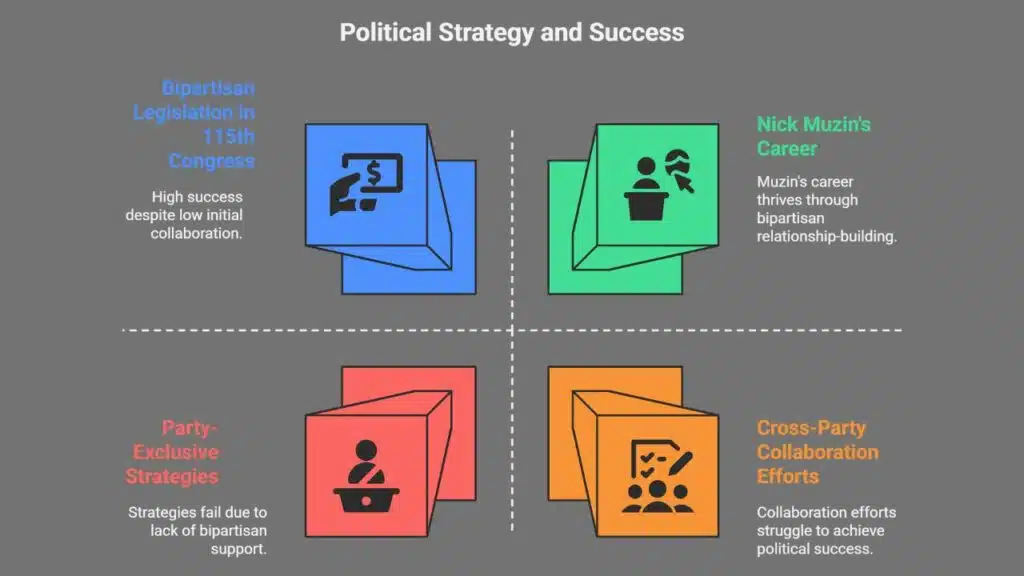
Washington’s pendulum swings between parties with clockwork regularity. Political professionals who tie themselves exclusively to one party’s fortunes risk career extinction with each electoral cycle.
Nick Muzin’s approach exemplifies how relationship-building across party lines ensures continued relevance regardless of who controls government. His career has thrived through both Republican and Democratic administrations by maintaining connections on both sides.
“Washington is constantly shifting, power swings between Republicans, Democrats, and even different factions within each party. Politicians rise and fall quickly, so staying relevant means maintaining balance and building relationships on both sides of the aisle,” he notes.
Even when one party dominates Washington, successful political outcomes typically require cross-party collaboration. Muzin observes that “Even now, when Republicans control the House, the Senate, and the White House, you still need on various issues to have Democrats involved and it always seesaws back and forth.”
Historical numbers confirm this reality. According to Quorum Analytics, 70% of bills signed into law in the 115th Congress (2017-2018) carried at least one Democrat and one Republican cosponsor, representing the highest percentage of bipartisan enacted legislation in 20 years.
Results Beat Rhetoric Every Time
Many political operations measure success through media mentions, position papers published, or meetings scheduled. Nick Muzin’s approach dismisses these superficial metrics in favor of tangible outcomes that clients can immediately recognize.
His firm’s unconventional month-to-month retainer model demonstrates supreme confidence in relationship-based results. While most firms lock clients into long-term contracts regardless of performance, Muzin’s structure demands continuous proof of value.
“We never ask for more than a one-month retainer. Every other firm wants six months or a year. But we go month-to-month because we want to be invested with our clients, and if they don’t see value after a month, we don’t want to take their money or waste their time,” he explains.
This arrangement creates powerful incentives for delivering meaningful results. Clients stay because their objectives are being met, not because they’re contractually obligated.
The high-stakes nature of his clientele further illustrates the premium placed on results over rhetoric: “They’ll call me and say, ‘If this bill doesn’t pass, my company goes bankrupt. We’re not just moving papers. We’re moving mountains.'”
Networks That Cross Traditional Boundaries
Most political strategies break people down into demographics or interest groups. Nick Muzin looks past that, he focuses on the connectors, the people who carry influence across different communities.
During his time directing coalitions for the House Republican Conference, he developed strategies for reaching diverse voter groups. “My job there was to represent the entire Republican House majority, and to help them create outreach to various constituents – women, minorities, young millennial voters – and create programs and dialogue between the House Republican arm and all these different groups to hopefully be able to change the electoral trends.”
Later, when advising international clients, he applied this network-based approach at the highest levels. “We identified 250 key people in Trump’s orbit. Our job was to get to them and shape the conversation.”
The approach proves that relationship mapping can accomplish what traditional lobbying often misses. Muzin identifies the real influencers around key decision-makers and builds genuine trust—opening doors that typical strategies can’t.





















