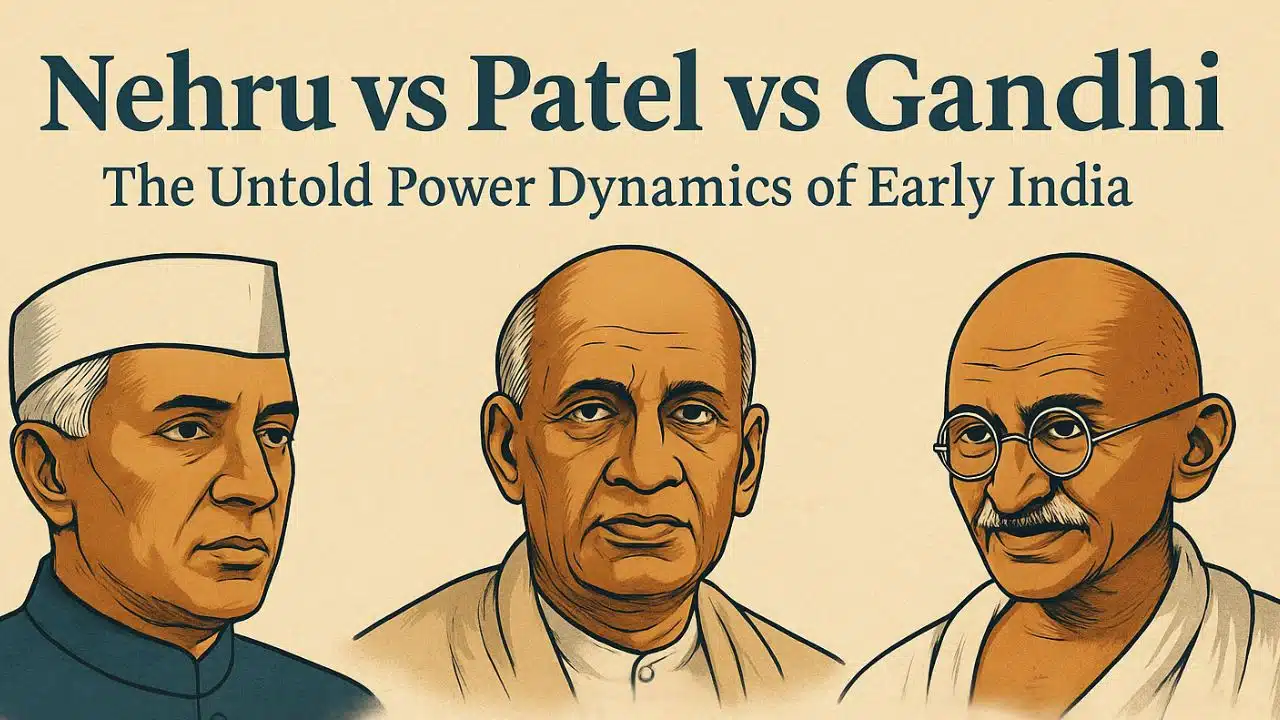
India’s path to independence is often remembered as a unified national struggle. Yet behind the collective image lay a complex triangular relationship between Jawaharlal Nehru, Vallabhbhai Patel, and Mahatma Gandhi—three towering personalities whose differing visions quietly shaped the birth of the Republic.
These leaders rarely clashed publicly, but privately they navigated profound ideological disagreements, contrasting temperaments, and divergent philosophies on governance, economics, and nation-building.
Understanding “Nehru vs. Patel vs. Gandhi” is not about choosing sides. It is about revealing the intellectual diversity, strategic debates, and power balancing that gave India a stable democratic foundation at a time when many newly decolonized nations descended into authoritarianism or civil war.
This long-form editorial examines these relationships in depth—how the three men differed, how they depended on each other, and how their complex interplay shaped the Indian state.
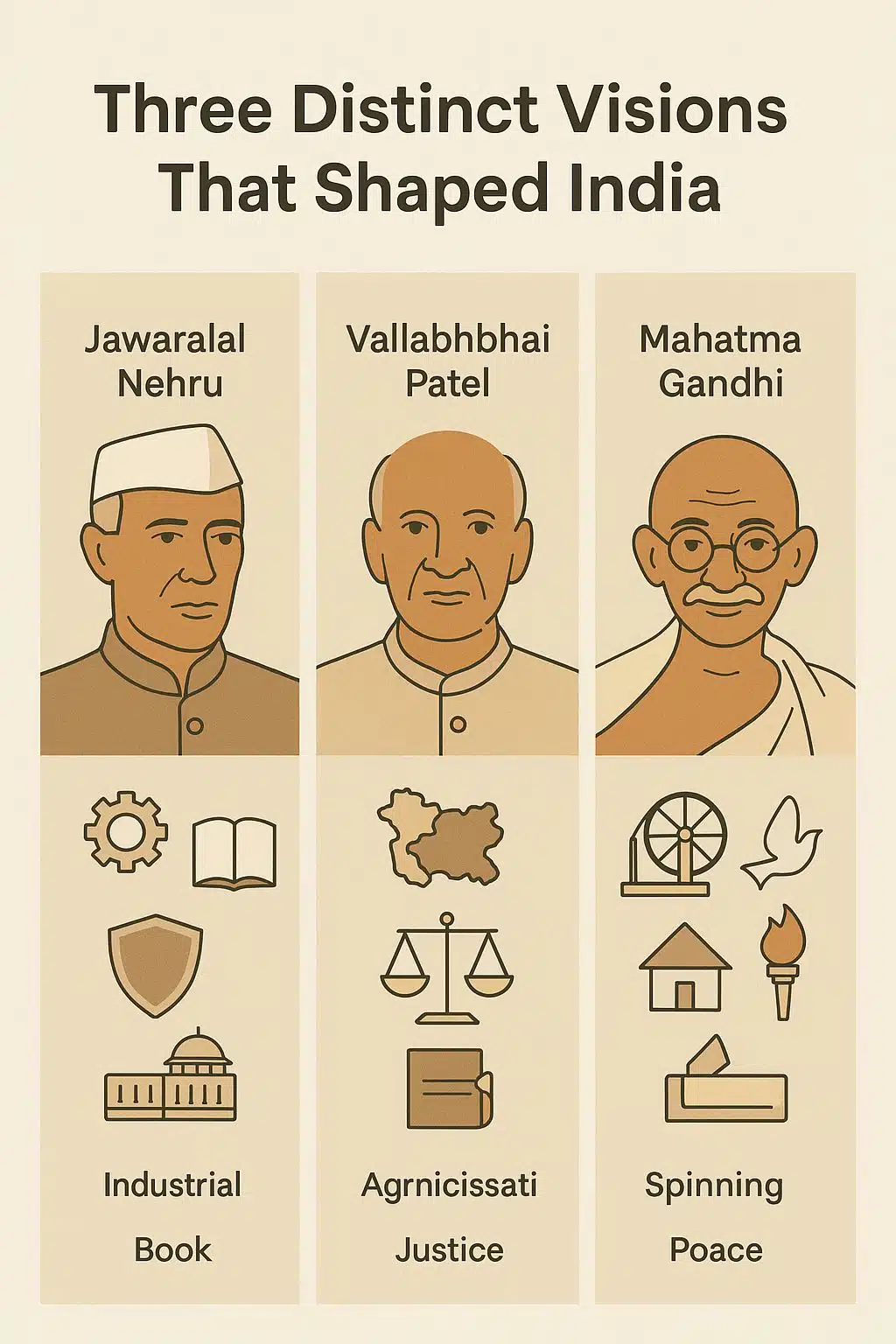
Three Distinct Minds: Ideological Maps of Nehru, Patel, and Gandhi
The political triangle of Nehru, Patel, and Gandhi was defined not by rivalry alone, but by ideological distance. Each brought a philosophical lens shaped by experience, education, and temperament.
Understanding these ideological maps is crucial, because the India we know today is the composite product of their visions—sometimes complementary, sometimes contradictory.
Jawaharlal Nehru: Architect of a Modern, Secular, Scientific India
Nehru’s ideology was a fusion of European intellectual traditions, anti-colonial nationalism, and socialist modernism. Fabian socialism shaped his thinking.
-
Fabian socialism, which influenced his support for centralized planning
-
Liberal internationalism, which shaped his diplomatic worldview
-
Scientific temper, which shaped educational and industrial policy
-
Secular nationalism, which promoted equality across religions
Nehru saw India not merely as a political entity but as a future-oriented civilizational project. His priorities were:
-
Industrialization through state-led investment
-
Building premier institutions (IITs, AIIMS, national laboratories)
-
Establishing a constitutional, secular democracy
-
Creating a foreign policy based on non-alignment
His ideology was long-term, visionary, and transformative—sometimes criticized as elitist, but undeniably foundational.
Vallabhbhai Patel: The Administrative Realist and Consolidator of the Nation-State
Patel’s worldview emerged from decades of municipal governance, grassroots mobilization, and crisis management. He was a practitioner, not a theorist. His ideology can be summarized as
-
Administrative pragmatism over idealism
-
Fiscal conservatism over socialist planning
-
Strong internal security over diplomatic experimentation.
-
Political centralization for national unity
-
Respect for cultural sensibilities without majoritarianism
Patel’s legacy includes the integration of over 562 princely states, the reorganization of civil services, and the restoration of law and order post-Partition.
His philosophy prioritized:
-
Stability over experimentation
-
Order over abstraction
-
Administrative clarity over intellectual debate
Patel was the “steel frame” builder who ensured India would not fragment during its most vulnerable moment.
Mahatma Gandhi: The Ethical Visionary and Spiritual Center of Indian Politics
Gandhi’s ideology operated beyond the realm of standard political thought. His worldview synthesized:
-
Non-violence (Ahimsa) as political strategy
-
Decentralized village republics (Gram Swaraj)
-
Spiritualized public life
-
Trusteeship economics, rejecting both capitalism and socialism
-
Civic ethics shaped by personal responsibility
He saw politics as an extension of moral duty, not a pursuit of power.
Gandhi envisioned an India built on:
-
Community participation
-
Ethical leadership
-
Simplicity, self-restraint, and local self-sufficiency
-
Harmony between tradition and modernity
While many aspects of his economic vision did not materialize, his moral influence shaped both Nehru and Patel, acting as the ethical anchor of the national movement.
Gandhi’s Influence: The Silent Arbiter of Congress Politics
In the Congress Party, Gandhi held no formal title, yet wielded ultimate influence. His moral legitimacy gave him an authority that neither Nehru nor Patel could challenge directly.
Gandhi’s role included:
-
Mediating conflicts
-
Selecting political heirs
-
Calming factional disputes
-
Guiding mass movements
-
Maintaining unity among ideologically diverse leaders
He appreciated Nehru’s modern, cosmopolitan outlook and felt India needed a leader who could engage with the world on equal terms. Simultaneously, Gandhi depended on Patel’s discipline, organizational command, and administrative effectiveness.
This dual trust meant Gandhi acted as the balancing force between two poles—using his moral authority to prevent ideological escalation and maintain collective purpose.
Nehru vs. Patel: The Real Power Axis in Early India
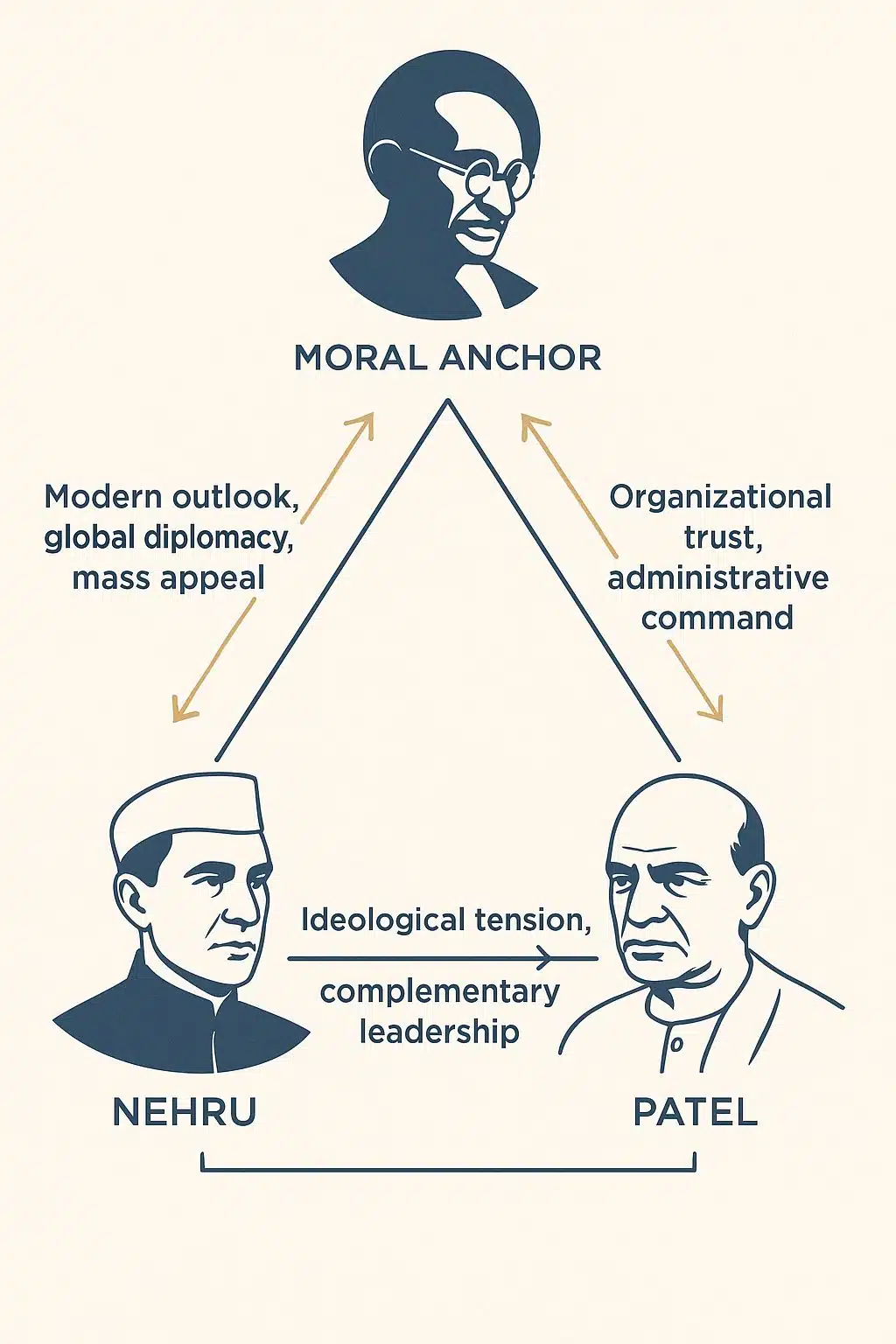
Contrary to popular belief, the crucial political tension of early India was not Gandhi vs anyone—it was Nehru vs Patel, two leaders who deeply respected each other yet differed profoundly.
Their differences covered four major domains: economics, governance, diplomacy, and temperament.
Economic Vision: Planned Development vs. Pragmatic Growth
Nehru’s View: Nehru believed that India’s backwardness required an assertive state that would:
-
Lead industrialization
-
Manage key industries
-
Guide economic planning
-
Invest in public sector infrastructure
He considered socialism essential to uproot poverty and inequality.
Patel’s View: Patel distrusted excessive state intervention. He favored:
-
Private enterprise
-
Fiscal restraint
-
Agricultural strengthening
-
Market-based resource allocation
He worried Nehru’s vision would create bureaucracy and hamper entrepreneurial dynamism. The Nehru–Patel divide shaped India’s mixed economy, which blended socialism and capitalism uneasily for decades.
Governance Philosophy: Idealism vs Administrative Realism
Patel’s approach to governance was honed through real crises:
-
Integrating princely states
-
Addressing communal tensions
-
Managing refugee resettlement
-
Rebuilding administrative stability
Nehru, meanwhile, focused on ideological nation-building:
-
Secular institutions
-
Civil liberties
-
Scientific education
-
Constitutional protections
Both approaches were necessary. Patel’s decisiveness created order; Nehru’s constitutionalism created democratic legitimacy.
Leadership Style: Intellectualism vs. Organizational Command
Nehru’s leadership style emphasized vision and persuasion.
Patel’s style emphasized negotiation, discipline, and organizational control.
Together, they created a dual structure:
-
Nehru → national vision, foreign policy, long-term planning
-
Patel → internal unity, administrative strength, political discipline
Their partnership—though tense—prevented India from descending into chaos.
The 1946 Congress Presidency: A Turning Point in Indian History
The internal Congress election of 1946 became the moment that decided India’s first prime minister. Most state committees supported Patel. But Gandhi insisted Nehru should lead.
Why Gandhi Chose Nehru
-
Nehru represented India’s future modern identity
-
His global stature was unmatched
-
He appealed to youth and progressive intellectuals
-
He symbolized ideological continuity for the movement
Patel stepped aside voluntarily, showcasing his profound loyalty to Gandhi and the organization. This decision defined the architecture of post-colonial India—shaping everything from economic direction to foreign policy.
Kashmir: The Sharpest Ideological Divide
Kashmir crystallized the differences between Nehru and Patel.
Nehru’s Perspective
-
Personal emotional link
-
Deep ideological commitment to secularism
-
Preference for international arbitration
-
Belief that democratic legitimacy would prevail
Nehru’s approach was rooted in moral principles and constitutional process.
Patel’s Perspective
-
Treat Kashmir as he treated Hyderabad and Junagadh
-
Avoid internationalizing territorial questions
-
Assert firm military and administrative control
Patel’s approach was grounded in strategic clarity and realist instinct. Their divergence shaped one of India’s most enduring geopolitical challenges.
The China Question: Idealism Meets Realpolitik
China was another area of sharp disagreement.
Patel’s Letters and Warnings
Patel’s 1950 letter to Nehru—prescient and forceful—outlined:
-
China’s long-term expansionist goals
-
The danger to Tibet
-
The need to strengthen defenses
-
Doubts about diplomatic assurances
Patel viewed China as a strategic competitor.
Nehru’s Belief in Asian Solidarity
Nehru envisioned a cooperative Asia led by:
-
Shared anti-colonial experiences
-
Panchsheel principles
-
Mutual respect
-
Peaceful coexistence
His foreign policy aimed to avoid Cold War militarization. The 1962 conflict eventually exposed the fragility of Nehru’s expectations.
After Gandhi: The Collapse of the Balancing Mechanism
Gandhi’s assassination disrupted the ideological triangle.
His moral presence had kept Nehru and Patel in balance. Without him:
-
Nehru became the uncontested leader
-
Patel’s health deteriorated
-
Institutional debate weakened
-
Foreign policy became more centralized
Patel’s death in December 1950 ended the era of shared leadership, leaving Nehru as the sole architect of independent India’s next decade.
How Their Contrasting Strengths Built India’s Foundation
India’s early decades reflect their combined imprint.
Nehru’s Lasting Contributions
-
Parliamentary democracy
-
Secular constitutionalism
-
IITs, AIIMS, scientific institutions
-
strengthened judiciary and Election Commission
-
Non-Alignment and diplomatic stature
Patel’s Enduring Legacy
-
Political unification of India
-
Reorganized civil services (IAS, IPS)
-
Strengthened internal security
-
Laid administrative foundations for economic stability
Gandhi’s Timeless Influence
-
Ethical politics as national ideal
-
Non-violent activism as global model
-
Community self-reliance
-
Emphasis on simplicity, morality, and compassion
Modern India is a product of their combined strengths—even where their visions conflicted.
Final Words
The story of Nehru vs. Patel vs. Gandhi is not a tale of rivalry but of creative tension—three contrasting visions merging into one nation-state. Their disagreements were not divisive; they were foundational debates that shaped the Republic’s identity.
-
Gandhi provided ethical grounding
-
Patel secured territorial and administrative unity
-
Nehru built constitutional and institutional architecture
India’s modern political and institutional framework stands on the interplay of their ideas.
Their power dynamics remain “untold” not because they were hidden, but because they were subtle, respectful, and deeply intertwined, reflecting a leadership culture anchored in purpose—not ego.
The Republic they built survives today because it was shaped not by one mind, but by three contrasting, complementary minds whose debates strengthened India’s democratic core.