I care about greener swaps, but I draw a very thick line at gambling with sun protection. Reusable bottles, low-waste cleaning, better packaging, cleaner ingredients, yes, absolutely. But when it comes to sunscreen, I am not interested in homemade recipes, coconut oil fantasies, or some “chemical-free” miracle cream made by people who think SPF is a personality trait. Natural Sunscreen can work, but only when it is a real, tested sunscreen with proper SPF, broad-spectrum protection, and the right active ingredients. A nice beige tube with a leaf on it is not enough.
The honest answer is this: natural sunscreen usually means mineral sunscreen made with zinc oxide, titanium dioxide, or both. Conventional sunscreen usually means chemical or hybrid sunscreen using filters such as avobenzone, octocrylene, octisalate, or similar ingredients. Both can protect your skin when they are properly formulated, labeled broad-spectrum, SPF 30 or higher, and reapplied correctly. The sunscreen that works best is not the one with the prettiest eco branding. It is the one you will apply enough of, use correctly, and actually keep using. The American Academy of Dermatology recommends broad-spectrum, water-resistant sunscreen with SPF 30 or higher, and says chemical, physical, and hybrid sunscreens can all protect effectively when they meet those standards.
Why The Natural Sunscreen Debate Gets So Confusing
The sunscreen conversation is messy because people use emotional words instead of precise ones. “Natural” sounds safe. “Chemical” sounds scary. “Mineral” sounds clean. “Conventional” sounds suspicious. Marketing teams love this confusion because confused shoppers buy whatever looks least terrifying.
The problem is that everything is chemical. Water is a chemical. Zinc oxide is a chemical. Titanium dioxide is a chemical. Your skin, your coffee, your lunch, and the air you breathe are all made of chemicals. The Skin Cancer Foundation makes this point clearly: even so-called physical sunscreens containing zinc and titanium are chemicals. So when a brand screams “chemical-free,” it is not educating you. It is hoping you skipped science class.
A better way to compare sunscreen is not “natural versus chemical.” It is:
| Question | Why It Matters |
|---|---|
| Is it broad-spectrum? | Protects against both UVA and UVB rays |
| Is it SPF 30 or higher? | Meets common dermatologist guidance for daily protection |
| Is it water-resistant if needed? | Matters for swimming, sweating, and outdoor activity |
| Will I apply enough? | Under-application weakens real-world protection |
| Will I reapply it? | Sunscreen wears off, sweats off, and rubs off |
| Does it suit my skin? | Irritation, acne, white cast, and texture affect daily use |
| Is the eco claim specific? | “Reef-safe” and “natural” can be vague marketing |
That is the real comparison. Not fear. Not purity. Not a bottle trying to look like it composts itself after sunset.
What Natural Sunscreen Usually Means
Natural sunscreen usually refers to mineral sunscreen. These products use zinc oxide, titanium dioxide, or both as active UV filters. The American Academy of Dermatology says if the active ingredient is titanium dioxide, zinc oxide, or both, the product is a physical sunscreen.
Mineral sunscreens sit on the skin and help protect by reflecting, scattering, and absorbing UV rays. Older mineral formulas often felt thick, chalky, and ghostly. Modern formulas are much better, especially tinted and micronized versions, although white cast can still be a real issue, especially on deeper skin tones.
The big advantage is skin tolerance. Mineral sunscreens are often recommended for sensitive skin, children, and people who react easily to certain chemical filters. The AAD notes that sunscreens using zinc oxide or titanium dioxide may cause less irritation for infants and toddlers over 6 months.
Here is the practical version:
| Natural Or Mineral Sunscreen | What It Usually Offers | What To Watch |
|---|---|---|
| Zinc oxide | Strong broad-spectrum coverage, including UVA protection | Can feel thick or leave a white cast |
| Titanium dioxide | Good UVB and some UVA protection | Often works best when combined with zinc oxide |
| Tinted mineral sunscreen | Better cosmetic finish and visible-light coverage | Shade range can be limited |
| Non-nano mineral sunscreen | Often preferred by eco-conscious buyers | Can be thicker and harder to blend |
| Mineral sticks | Good for face, ears, nose, and touch-ups | Easy to under-apply |
So yes, natural sunscreen can work. But “natural” alone does not prove anything. The active ingredients, SPF rating, broad-spectrum claim, water resistance, and real-world use matter more.
What Conventional Sunscreen Usually Means
Conventional sunscreen usually means chemical sunscreen, although many modern products are hybrids that combine chemical and mineral filters. Chemical sunscreens use organic UV filters that absorb UV radiation and convert it into less harmful energy. The American Cancer Society explains that chemical sunscreen absorbs and deactivates UV rays, while mineral sunscreen sits on the skin and blocks or reflects them.
The main advantage of conventional sunscreen is wearability. These formulas are often lighter, clearer, easier to blend, and more comfortable under makeup or during daily use. That matters because the best sunscreen on paper is useless if you hate wearing it and leave it in the drawer like a guilty little tube of wasted money.
Conventional sunscreens can also offer elegant broad-spectrum protection, especially when they combine multiple UV filters. The trade-off is that some people find certain chemical filters irritating, and some filters have raised environmental or safety questions that regulators continue to review.
Here is the practical breakdown:
| Conventional Sunscreen | What It Usually Offers | What To Watch |
|---|---|---|
| Chemical lotion | Lightweight feel, easy blending | May irritate sensitive skin |
| Chemical gel | Good for oily or acne-prone skin | Can sting eyes or broken skin |
| Spray sunscreen | Convenient for body application | Easy to miss spots or inhale mist |
| Hybrid sunscreen | Better texture with mineral support | The ingredient list can be harder to judge |
| Sport sunscreen | Better sweat and water resistance | Still needs reapplication |
Conventional sunscreen is not automatically bad. Natural sunscreen is not automatically better. The lazy villain story is comforting, but skin protection is not a fairy tale.
Does Natural Sunscreen Actually Protect Your Skin?
Yes, natural sunscreen can protect your skin when it is properly formulated and used correctly. Zinc oxide and titanium dioxide are the two mineral sunscreen ingredients most closely associated with natural or mineral formulas. The FDA’s proposed sunscreen order identifies zinc oxide and titanium dioxide as ingredients proposed to be generally recognized as safe and effective for sunscreen use, while requesting more data for several other active ingredients.
But here is the part people love to ignore: SPF on the label assumes you apply enough product. Most people do not. Then they blame the sunscreen when the real problem is that they applied it like expensive moisturizer and expected beach armor.
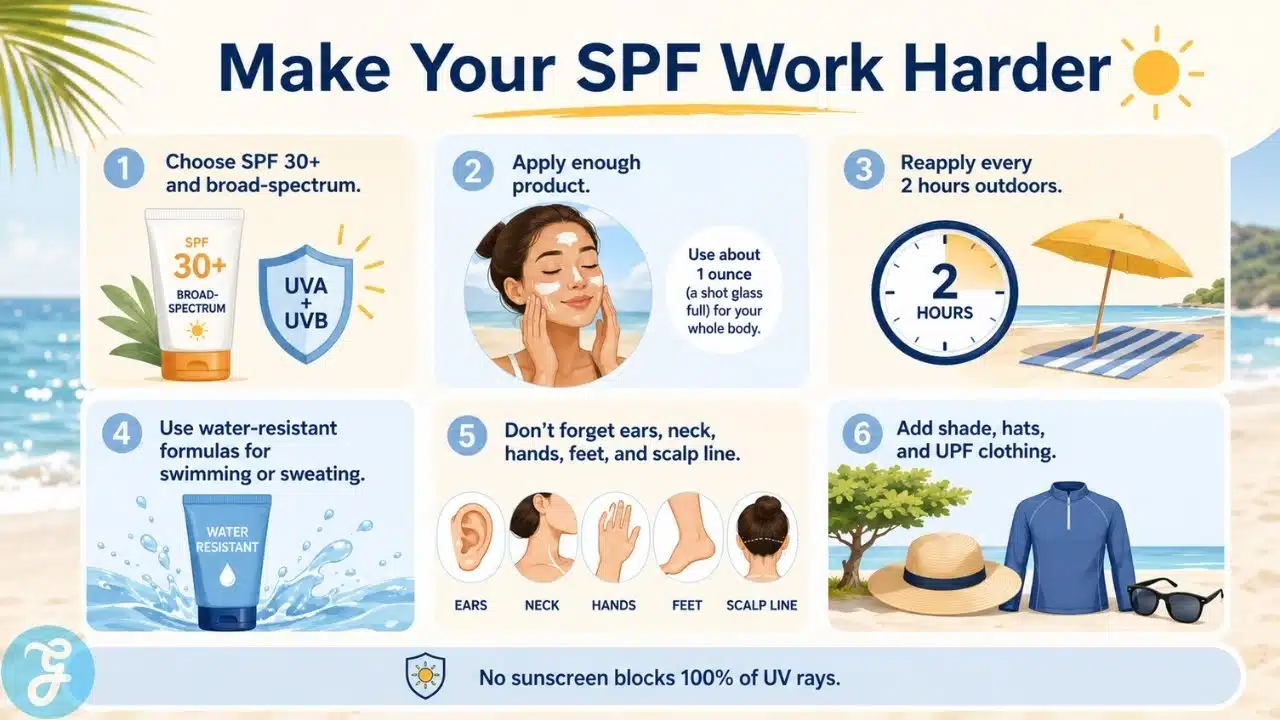
The AAD recommends SPF 30 or higher and says SPF 30 blocks about 97% of UVB rays when used correctly, while no sunscreen blocks 100% of UVB rays. It also recommends reapplying about every two hours when outdoors, or after swimming or sweating.
For natural sunscreen to actually work, it should meet these basic conditions:
| Requirement | Why It Matters |
|---|---|
| SPF 30 or higher | Gives strong baseline UVB protection |
| Broad-spectrum label | Covers UVA and UVB protection |
| Enough product applied | Thin application reduces real SPF |
| Reapplication every two hours outdoors | Protection wears down with time, sweat, and rubbing |
| Water-resistant formula for swimming or sweating | Regular formulas can wash off faster |
| Proper storage | Heat and expiration can affect reliability |
A natural sunscreen that meets these requirements can absolutely work. A DIY sunscreen made from oils, butter, and optimism should not be trusted. Please do not let Pinterest give you a sunburn with branding.
Natural Sunscreen Vs Conventional Sunscreen: Real Comparison
This is the comparison I would actually use when choosing between mineral and conventional sunscreen. Not the marketing version. The real-life version.
| Category | Natural / Mineral Sunscreen | Conventional / Chemical Sunscreen |
|---|---|---|
| Active filters | Zinc oxide, titanium dioxide | Avobenzone, octocrylene, octisalate, homosalate, and others |
| Protection | Can be broad-spectrum when properly formulated | Can be broad-spectrum when properly formulated |
| Skin feel | Often thicker, sometimes chalky | Usually lighter and clearer |
| White cast | More common | Usually minimal |
| Sensitive skin | Often better tolerated | Can irritate some skin types |
| Darker skin tones | Tinted formulas may work better | Often easier to blend invisibly |
| Water resistance | Available, but check label | Often strong in sport formulas |
| Eco preference | Often preferred near reefs and oceans | Some chemical filters raise aquatic concerns |
| Daily compliance | Depends on texture and finish | Often easier for daily wear |
| Best use case | Sensitive skin, eco-conscious use, children, beach days | Daily invisible wear, sports, makeup layering |
The winner depends on your skin, your lifestyle, your ethics, and whether you will use enough product without whining. I say that with love. Mostly.
Which One Is Better For Sensitive Skin?
Natural sunscreen usually has the edge for sensitive skin. Mineral filters like zinc oxide and titanium dioxide tend to be less irritating for many people, and they are commonly recommended for babies, children, and sensitive skin types. Dermatology guidance often points to mineral sunscreen for people who react to chemical filters or fragrances.
That said, not every mineral sunscreen is automatically gentle. The inactive ingredients matter too. Fragrance, essential oils, preservatives, alcohols, and botanical extracts can still irritate skin. A sunscreen can be mineral-based and still behave like a tiny rash factory if the formula is poorly chosen.
For sensitive skin, I would look for:
| Better Choice | Why |
|---|---|
| Zinc oxide-based formula | Strong protection and usually good tolerance |
| Fragrance-free | Reduces irritation risk |
| Tinted mineral sunscreen | Helps reduce white cast |
| Cream or lotion | Easier to apply evenly than sprays |
| Non-comedogenic label | Better for acne-prone skin |
| Patch testing | Helps catch irritation before full-face use |
The mistake is thinking “natural” means gentle. Poison ivy is natural. So are mosquitoes. Nature has range.
Which One Is Better For Darker Skin Tones?
This is where conventional sunscreen often wins in daily use. Many chemical sunscreens blend more invisibly, which makes people more likely to apply enough and use them consistently. That matters because sunscreen only works when it leaves the drawer.
Natural sunscreen has improved a lot, especially tinted mineral formulas. The American Cancer Society notes that micronized zinc oxide or titanium dioxide formulas can now come in clearer or sheerer versions that leave less whitish residue than older mineral sunscreens. It also quotes guidance suggesting mineral sunscreens with zinc oxide concentration of 20% or higher for strong protection.
For darker skin tones, the practical choice often looks like this:
| Concern | Better Option |
|---|---|
| No white cast | Chemical or sheer hybrid sunscreen |
| Sensitive skin | Tinted mineral sunscreen |
| Hyperpigmentation concerns | Tinted broad-spectrum sunscreen |
| Makeup layering | Lightweight chemical or hybrid sunscreen |
| Beach or outdoor use | Water-resistant mineral, chemical, or hybrid formula |
A sunscreen that looks terrible on your skin is not a good sunscreen for you, no matter how virtuous the ingredient list looks. Daily use beats theoretical perfection.
Which One Is Better For The Environment?
If you are eco-conscious, mineral sunscreen is usually the better starting point, especially near oceans, reefs, rivers, and lakes. NOAA says specific chemical UV filters found in chemical sunscreen can harm aquatic life, including corals, and that mineral sunscreen is considered a better option because it has fewer effects on aquatic organisms. NOAA also recommends UV-protective clothing, such as sun shirts and pants as a strong option.
But let’s not turn mineral sunscreen into a halo product. “Reef-safe” is not a perfectly regulated or universally defined claim. A 2020 dermatology review described “reef safe” as an unregulated marketing term with no strict definition.
The most eco-friendly sun protection is often not more sunscreen. It is less exposed skin.
That means:
| Eco-Friendly Sun Strategy | Why It Helps |
|---|---|
| UPF clothing | Reduces how much sunscreen you need |
| Wide-brim hat | Protects face, ears, and neck |
| Shade | Cuts UV exposure without product waste |
| Mineral sunscreen | Often preferred near marine environments |
| Non-spray formulas | Less inhalation risk and less product drift |
| Refillable or lower-plastic packaging | Reduces packaging waste where available |
I care about greener swaps, but the best swap is not always another product. Sometimes it is a hat. Very glamorous? No. Effective? Yes.
The Problem With DIY Natural Sunscreen
Do not make sunscreen at home. That is the sentence.
DIY sunscreen recipes are one of the worst corners of natural living content. They usually involve coconut oil, shea butter, essential oils, zinc powder, and a level of confidence not supported by testing. The problem is that SPF protection requires proper formulation, even particle distribution, stability testing, and effectiveness testing. You cannot eyeball sun protection in a mixing bowl.
The FDA regulates sunscreen products as over-the-counter drugs in the United States, and OTC sunscreens must follow Drug Facts labeling and effectiveness testing requirements. That should tell us something obvious: sunscreen is not body butter with ambition.
DIY sunscreen may spread unevenly, separate over time, provide an unknown SPF, fail to provide broad-spectrum protection, or give users a false sense of safety. That last part is the real danger. Bad sunscreen is worse when it convinces you that you are protected.
If the product does not have a tested SPF label and a broad-spectrum claim, it is not a sunscreen I would trust. It is skincare roulette with UV damage as the prize.
How To Choose A Natural Sunscreen That Actually Works
A good natural sunscreen should not require blind faith. It should pass a basic label check.
Here is what I would look for before buying:
| Label Feature | What To Look For |
|---|---|
| Active ingredient | Zinc oxide, titanium dioxide, or both |
| SPF | SPF 30 or higher |
| Coverage | Broad-spectrum |
| Water resistance | 40 or 80 minutes if swimming or sweating |
| Skin fit | Fragrance-free, non-comedogenic, or tinted if needed |
| Texture | Something you will actually wear enough of |
| Packaging | Lower-plastic, recyclable, or refill-conscious if available |
| Claims | Specific and believable, not vague green poetry |
The AAD says sunscreen should be reapplied every two hours when outdoors and immediately after swimming or sweating. So if a product claims all-day protection with no reapplication, treat that claim like a suspiciously cheap airline ticket: read the fine print before trusting it.
How To Choose Conventional Sunscreen Without Feeling Guilty
If conventional sunscreen is the only type you will wear daily, use it. The sunscreen you actually apply is better than the perfect mineral sunscreen you hate and therefore ignore.
Choose conventional sunscreen when you need:
| Situation | Why Conventional May Work Better |
|---|---|
| Daily face use | Lighter, more invisible texture |
| Makeup layering | Less pilling and white cast |
| Sports | Strong water-resistant formulas |
| Darker skin tones | Better invisible finish |
| Oily skin | Gel or fluid formulas may feel better |
| Frequent reapplication | Easier texture encourages repeat use |
That does not mean you should ignore ingredients or eco concerns. If you swim in oceans often, mineral may be a better choice. If you have sensitive skin, minerals may be better. If your skin hates mineral sunscreen and you skip it completely, conventional may be better because the sunscreen you use beats imaginary sunscreen.
Application Matters More Than The Natural Label
This is the part people underplay. Sunscreen failure often comes from bad use, not bad product.
People use too little. They forget ears, neck, scalp, hands, and feet. They apply once in the morning and act like SPF works on a 12-hour shift. They swim, sweat, towel off, and then wonder why their skin looks like grilled regret.
The CDC recommends broad-spectrum sunscreen that filters both UVA and UVB rays with SPF 15 or higher before going outside, while dermatology groups commonly recommend SPF 30 or higher for stronger routine protection. CDC also advises reapplying at least every two hours and after swimming or heavy sweating.
For real-world protection, follow this:
| Application Rule | Practical Meaning |
|---|---|
| Apply enough | Thin layers reduce actual protection |
| Cover exposed areas | Ears, neck, lips, scalp, hands, and feet matter |
| Apply before sun exposure | Let the formula settle properly |
| Reapply every two hours outdoors | More often after swimming or sweating |
| Use water-resistant sunscreen near water | Regular formulas wash off faster |
| Combine with shade and clothing | Sunscreen is not a force field |
Natural sunscreen does not get a pass here. If you apply too little mineral sunscreen, you are still underprotected. A white cast is annoying. Sun damage is more annoying.
Natural Sunscreen Vs Conventional: Which Should You Pick?
Pick a natural sunscreen if you have sensitive skin, prefer mineral filters, spend time near reefs or water, want a more eco-conscious option, or do not mind a slightly heavier texture. Choose zinc oxide-based formulas, broad-spectrum SPF 30 or higher, and water resistance if you need it.
Pick conventional sunscreen if you need something lightweight, invisible, easy under makeup, better for daily compliance, or more comfortable during exercise. Choose broad-spectrum SPF 30 or higher and reapply properly.
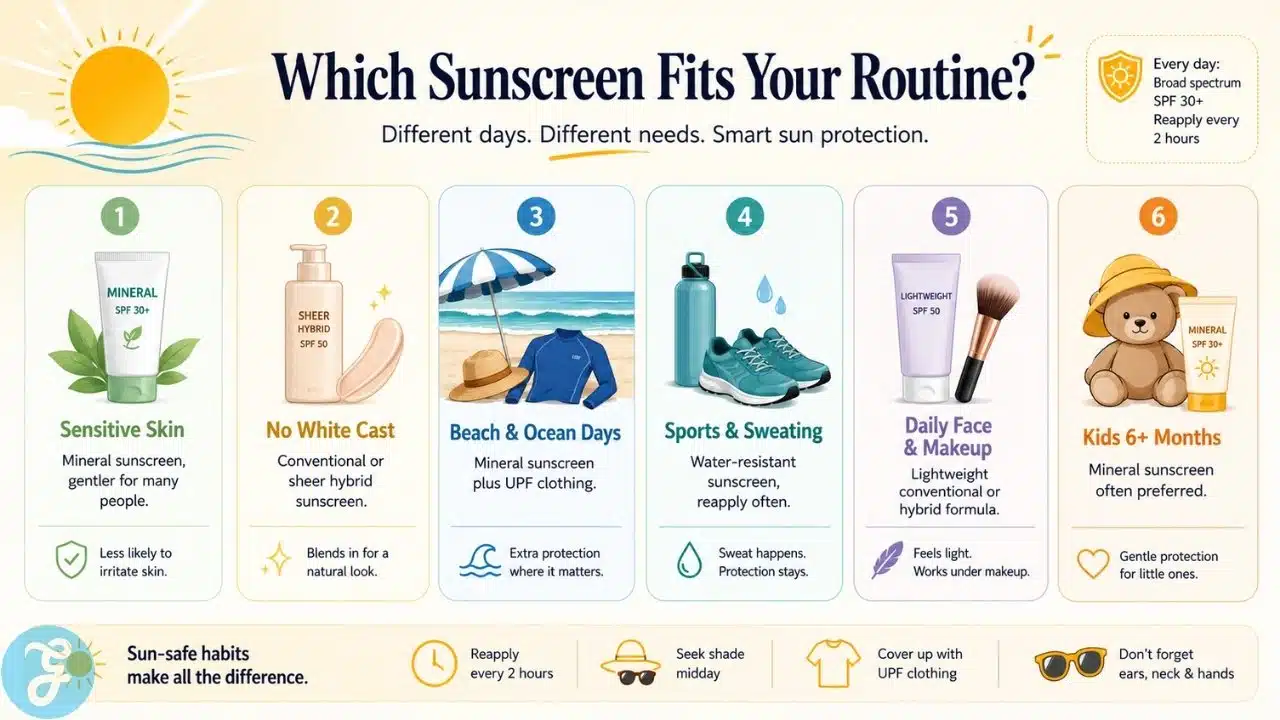
Here is my practical decision guide:
| Your Priority | Better Starting Point |
|---|---|
| Sensitive skin | Natural / mineral sunscreen |
| No white cast | Conventional or tinted mineral sunscreen |
| Ocean swimming | Mineral sunscreen plus UPF clothing |
| Daily office routine | Any comfortable broad-spectrum SPF 30+ |
| Heavy sweating | Water-resistant sport sunscreen |
| Baby or toddler over 6 months | Mineral sunscreen often preferred |
| Acne-prone skin | Non-comedogenic formula, mineral or chemical |
| Lowest product use | UPF clothing, hats, shade, plus sunscreen |
The best choice is not about winning an internet argument. It is about protecting your skin without abandoning your values or your common sense.
The SPF Choice That Does Not Need A Halo
Natural Sunscreen works when it is a real sunscreen, not a homemade experiment, not a lifestyle claim, and not a greenwashed tube with a beachy font. Mineral formulas with zinc oxide or titanium dioxide can protect your skin well when they are broad-spectrum, SPF 30 or higher, applied generously, and reapplied correctly.
Conventional sunscreen also works. In some situations, it works better for daily habits because people are more likely to use a product that feels light, blends well, and does not make them look like they lost a fight with a chalkboard.
So the smarter answer is not “natural good, conventional bad.” That is too lazy. The smarter answer is: choose the sunscreen that meets dermatologist-backed protection standards, fits your skin, respects your lifestyle, and does not use eco language as decoration.
For me, the ideal setup is practical. Mineral sunscreen for beach days, sensitive-skin moments, and water-heavy outdoor use. Comfortable broad-spectrum sunscreen for daily wear when texture matters. UPF clothing, hats, and shade whenever possible because the greenest sunscreen is sometimes the one you do not need to apply everywhere.
Protect your skin. Avoid nonsense. Read the label. Reapply. And please, for the love of every dermatologist who has ever sighed quietly, do not make sunscreen in your kitchen.