Elon Musk has once again captured the world’s imagination with an audacious plan: a high-speed transatlantic tunnel that could potentially render long-haul air travel obsolete. In his latest pitch, Musk envisions a future where the journey between New York City and London—currently over seven hours by plane—could take just 54 minutes using advanced tunnel and vacuum technologies.
The proposed project, estimated to cost between $20 billion and $25 billion, would be the most ambitious infrastructure undertaking in modern history. If successful, it could completely redefine global transportation. However, experts are split: some call it visionary, others say it’s another overly ambitious idea with no clear path to execution.
What Musk Is Proposing: The Transatlantic Vacuum Tunnel
At the core of Musk’s proposal is the idea of building a hypersonic underwater tunnel that would span more than 3,000 miles across the Atlantic Ocean, connecting the eastern U.S. to Western Europe. This tunnel would use a cutting-edge vacuum tube system, where passenger pods or pressurized vehicles travel inside sealed tubes at speeds of up to 3,000 miles per hour—approximately five times faster than today’s commercial aircraft.
This idea builds on Musk’s earlier Hyperloop concept, first introduced in a 2013 white paper, which proposed using magnetic levitation (maglev) and vacuum pressure to create ultra-high-speed terrestrial transportation. That vision has since been tested in places like India, China, and the United Arab Emirates, though none have achieved full-scale success.
Musk’s company, The Boring Company, has been central to these innovations. It was founded specifically to address the high costs and inefficiencies in traditional tunneling, aiming to make tunnel construction faster, cheaper, and more scalable for both urban and transcontinental projects.
What Technology Is Needed—and What’s Missing
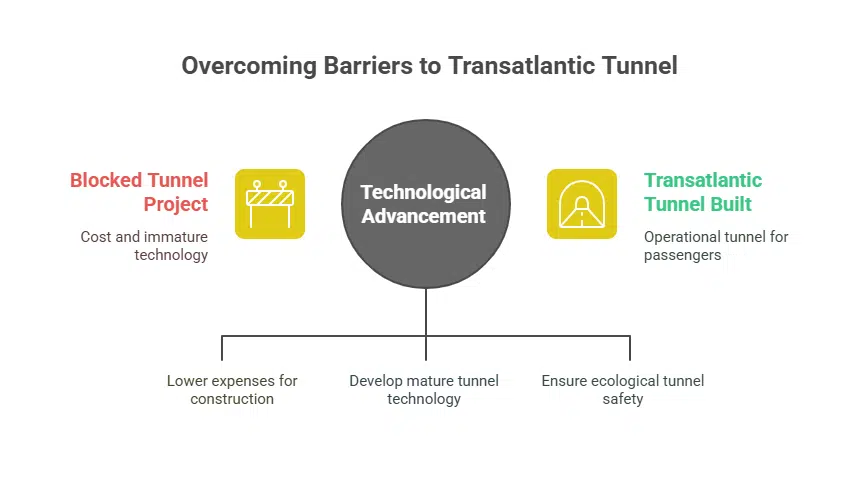
For Musk’s underwater tunnel dream to become a reality, several major technological hurdles must be overcome. These include:
1. Vacuum Environment Maintenance
Creating a sustained vacuum across thousands of miles underwater is no small feat. The tunnel would need to eliminate air resistance to enable hypersonic travel, which requires cutting-edge sealing technology and continuous pressure control.
2. Structural Safety in Ocean Conditions
The tunnel must be capable of withstanding immense water pressure, potential earthquakes, and seafloor instability. Musk’s team proposes a combination of anchored floating structures and deep-sea trench tunnels, but the real-world feasibility remains unproven.
3. Thermal Management at Hypersonic Speeds
At speeds reaching 3,000 mph, enormous heat is generated through friction—even inside vacuum tubes. Efficient heat dissipation and vehicle cooling systems are critical to avoid mechanical failure or passenger discomfort.
4. Cost-Efficiency at Scale
While Musk claims the Boring Company can build this megastructure at a fraction of current cost estimates—thanks to its proprietary tunneling machines—many engineers argue that even $25 billion may be optimistic. Other independent estimates, including from transportation analysts in the EU and Japan, suggest costs could balloon into the hundreds of billions or even trillions.
Historical Inspiration: The Transatlantic Tunnel Concept Isn’t New
Interestingly, Musk isn’t the first to propose a tunnel linking North America and Europe. The “Transatlantic Tunnel” has been part of science fiction and speculative engineering for over a century. In 1913, American engineer Elmer Sperry imagined a transoceanic railway tunnel, and in the 1970s, physicist Robert Salter introduced the concept of a “vacuum tube train” that would zip passengers across the Atlantic in under an hour.
However, every attempt to move this concept forward has been blocked by a mix of cost, technological immaturity, and environmental risk.
Environmental and Geopolitical Concerns
Environmental activists and regulatory agencies have also voiced concerns. Constructing such an extensive underwater network could disrupt marine ecosystems, alter migratory routes for aquatic species, and lead to the destruction of seabed habitats. Moreover, the political complexity of an international infrastructure project involving multiple governments, especially in protected oceanic zones, could create long-term bureaucratic roadblocks.
There’s also the question of maintenance and emergency protocols. What happens if a pressurized pod fails mid-journey in the middle of the Atlantic? Unlike air travel, there are no mid-route rescue options. Such vulnerabilities raise red flags for safety officials and transportation regulators on both sides of the Atlantic.
Musk’s Track Record: Visionary or Overpromiser?
Musk’s track record for big promises has always been controversial. While he has successfully revolutionized the auto industry with Tesla and commercial spaceflight with SpaceX, many of his boldest projects remain unfinished or only partially completed. For example:
-
The Hyperloop system has not progressed beyond small-scale testing.
-
His Mars colonization project through SpaceX remains in early prototype stages.
-
The Starbase spaceport and Neuralink projects are still navigating regulatory hurdles and scientific feasibility.
Critics argue that Musk’s announcements often serve to stir excitement, attract investors, and set the narrative, rather than reflect ready-to-execute strategies.
Could New York Become the Capital of Underwater Travel?
Despite skepticism, there is significant interest from both public and private stakeholders in Musk’s idea. If realized, the tunnel could turn New York City into a global hub for underwater transit, connecting it to major cities like London, Paris, and possibly even Madrid or Berlin.
Such a development would have profound implications for tourism, business, and diplomacy. Imagine boarding a capsule in Manhattan and arriving in central London before your coffee gets cold.
Visionary Leap or Fictional Fantasy?
Elon Musk’s idea to build a transatlantic underwater tunnel might seem like something out of a sci-fi film—but parts of it are grounded in ongoing research and tangible prototypes. Still, the enormous technical, environmental, and political challenges cannot be ignored.
Will it transform the way the world travels, or will it remain another line in Musk’s long list of “what could have been” projects?
For now, we wait—watching to see if technology, funding, and global cooperation can catch up with this billion-dollar dream.