Virtual world budgets routinely collapse when production teams treat spatial infrastructure like a standard client-server video game. The initial build cost represents only the baseline fee to open a virtual environment; managing continuous position state synchronization, spatial audio routing, and real-time GPU delivery determines whether a project survives past launch day.
Calculating a realistic metaverse game development costs requires isolating individual spatial engineering requirements. A bounded, browser-based social room typically lands between $30,000 and $65,000. Scaling to a persistent multi-zone virtual world with customized avatar engines ranges from $65,000 to $180,000. Enterprise open-world environments with cross-platform VR support and complex user-driven economies frequently exceed $350,000.
Baseline Budgeting Assumptions
Engineering estimates fluctuate significantly depending on team geography, client rendering targets, and network complexity. The figures in this guide reflect the following production parameters:
-
Regional Engineering Rates: Estimates reflect mid-tier agency rates ($60 to $110 per hour) across Eastern Europe and Latin America. Onshore teams in North America or Western Europe ($120 to $220 per hour) double these projected budgets.
-
3D Asset Pipeline Constraints: Figures assume original low-to-mid poly environment models, optimized texture atlases, and custom rigged avatar skeletons rather than generic store-bought assets.
-
Client Execution: Baseline estimates assume native client builds compiled in Unity or Unreal Engine. Cloud streaming hosting fees are calculated as separate operational line items.
-
Scope Exclusions: Budgets cover core engine code, spatial networking, databases, and UI systems. They exclude token exchange listings, legal licensing, and tokenomic market making.
Metaverse Game Development Costs Tiers
Spatial volume, target tick rates, and maximum concurrent users (CCU) per room instance dictate production spend far more than surface visual polish.
Tier 1: Bounded Social Hub ($30,000 to $65,000)
Single-room environments such as virtual showrooms, galleries, or auditoriums. These builds cap concurrent density at 30 users per instance and use simplified WebGL graphics or pre-built avatar frameworks. A three-person team (3D artist, game engineer, UI developer) can deliver a functional build in three to five months.
Tier 2: Persistent Multi-Zone World ($65,000 to $180,000)
Mid-scale virtual worlds featuring interconnected districts, persistent user inventory, custom avatar customization, and spatial voice channels. Development requires dedicated backend engineers to manage relational databases for player items alongside state-synchronization servers. Delivery takes six to twelve months.
Tier 3: Enterprise Interoperable Open World ($180,000 to $350,000+)
Massive multiplayer ecosystems supporting cross-platform VR and desktop play, real-time physics, user-generated content (UGC) toolkits, and live token economies. Production spans 12 to 24 months across senior graphics programmers, network architects, and security auditors.
At this scale, the architecture demands specialized backend engineering:
-
Grid-Based Spatial Partitioning: Writing algorithms that divide the map into dynamic interest cells, ensuring players only receive network packets for entities within their immediate visibility cone.
-
Hybrid Database Architectures: Pairing high-speed memory stores (like Redis) for sub-second player position updates with persistent databases for asset ownership.
-
Performance Profiling Across Platforms: Optimizing shaders and draw calls to run at stable frame rates on standalone VR headsets (such as Meta Quest 3) alongside high-end desktop GPUs.
Estimated Budget Breakdown by Category
| Production Category | Bounded Social Hub ($30k–$65k) | Multi-Zone World ($65k–$180k) | Enterprise Open World ($180k–$350k+) |
| 3D Environments & Avatar Rigging | $11,000 – $22,000 | $26,000 – $62,000 | $70,000 – $135,000 |
| Spatial Netcode & Physics Sync | $6,000 – $14,000 | $15,000 – $38,000 | $40,000 – $85,000 |
| Backend Databases & Inventory State | $4,000 – $9,000 | $10,000 – $26,000 | $28,000 – $60,000 |
| UI/UX, Spatial Voice & Audio Routing | $3,000 – $8,000 | $8,000 – $22,000 | $22,000 – $45,000 |
| Load Testing, QA & Security Audits | $4,000 – $7,000 | $7,000 – $18,000 | $20,000 – $45,000 |
| Server Infrastructure & DevOps Setup | $2,000 – $5,000 | $4,000 – $14,000 | $15,000 – $30,000 |
Critical Technical Drivers of Metaverse Game Development Costs
Evaluating your overall metaverse game development costs requires looking directly at the underlying networking and rendering trade-offs.
Rendering Delivery Models and Hardware Overhead
How a project delivers graphics to the user dictates both initial development hours and post-launch server bills.
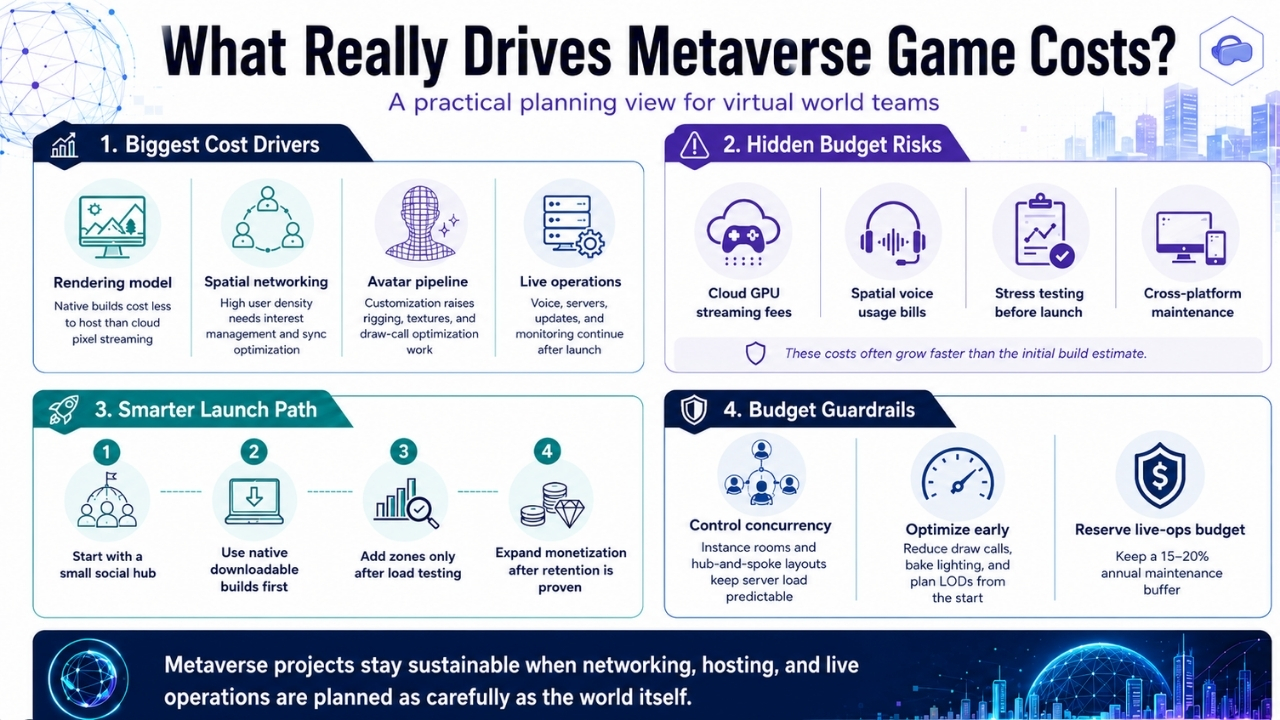
Native downloadable applications compile directly for PC, mobile, or VR hardware. This offloads 100% of the rendering workload to the player’s local GPU, keeping hosting costs strictly limited to basic network state data exchange.
WebGL browser builds remove installation friction by running directly inside a web browser, but web memory caps (often under 2GB) force strict draw-call limits. Technical artists spend 20% to 30% more time manual-optimizing geometry, baking lightmaps, and building texture atlases to avoid browser crashes.
Cloud Pixel Streaming hosts Unreal Engine builds on cloud GPU instances (like AWS G4dn/G5) and streams video directly to the user’s browser. While this provides cinematic visuals on low-end mobile devices, running costs of $0.50 to $1.50 per active stream hour mean hosting costs rapidly escalate during high-traffic events.
Spatial Networking and High-Density Synchronization
Standard multiplayer games sync 16 to 64 players using basic authoritative client-server models. In a virtual world where hundreds of players gather in a central plaza, unoptimized network bandwidth scales quadratically, causing immediate server lag and disconnected sockets.
Preventing server crashes requires spatial interest management, which filters network packets so clients only receive transform data for avatars within their visible radius. Building this logic on established spatial networking engines (such as Photon Fusion or dedicated server clusters) controls initial engineering hours, though third-party CCU licensing fees scale alongside user growth.
Avatar Pipelines and Draw-Call Bottlenecks
Performance degradation in virtual worlds rarely comes from the static environment. It happens when 50 player avatars enter the same frame, each wearing distinct accessories, hair meshes, and clothing items.
If every avatar mesh calls a separate material slot, the render thread chokes on draw calls. Mitigating this requires building automated ingestion pipelines that merge avatar sub-meshes, combine textures into single atlases on the fly, and dynamically generate lower Level of Detail (LOD) models for distant characters.
Post-Launch Operating Overhead
The initial build phase gets the game to launch, but maintaining spatial servers introduces fixed monthly operating fees.
Positional Spatial Audio Routing
Spatial voice chat lets players hear nearby users with 3D directional positioning. Third-party voice SDKs (such as Vivox or Agora) bill based on total active voice participant minutes. In a populated world running multiple active voice channels, hosting fees range from $1,200 per month for casual traffic to over $8,000 per month during major events.
Engine Maintenance and Platform SDK Updates
Game engines release regular version upgrades, while VR operating systems frequently update their tracking and rendering SDKs. Teams should reserve 15% to 20% of their initial build budget annually to patch client bugs, update security certificates, and maintain cross-platform device compatibility.
Architecture Strategies to Protect Runway
Engineering decisions made during early scoping heavily influence long-term burn rates:
-
Deploy initial builds as native downloadable executables rather than cloud pixel streams, shifting rendering math to client GPUs and eliminating hourly cloud server charges during early playtests.
-
Implement interest management on the game client before expanding server capacity, filtering out unnecessary position updates to cut outgoing network bandwidth usage.
-
Use a hub-and-spoke world layout where players spawn in a small, tightly optimized central lounge connected to instanced sub-zones, keeping spatial server memory footprints predictable.
Managing Metaverse Game Development Costs for Long-Term Stability
Ultimately, controlling your metaverse game development costs comes down to sequencing engineering risks before scaling visual fidelity. Virtual world projects rarely fail because their shaders were inadequate; they fail when real-time spatial networking overhead and server tick-rate degradation outpace user monetization.
By prioritizing client-side rendering, locking down a performant spatial interest pipeline, and executing realistic load tests inside a controlled single-zone environment, project leaders can protect operating runway while validating core multiplayer loops. Building a sustainable metaverse game requires treating your spatial environment not as a static visual deliverable, but as an ongoing live-ops infrastructure service built to scale alongside verified player demand.
Frequently Asked Questions(FAQs) on Metaverse Game Development Costs
Should a studio choose Cloud Pixel Streaming or native downloadable builds?
Native downloadable builds are recommended for long-term games because they offload rendering to player hardware, keeping hosting costs limited to basic network sync. Cloud Pixel Streaming offers instant web access with high visual fidelity, but hourly cloud GPU fees of $0.50 to $1.50 per user session make it cost-prohibitive for extended daily gameplay without strong monetization.
How does WebGL affect the overall budget compared to desktop builds?
-
Direct Cost Impact: Adds 20% to 30% to 3D technical art hours due to aggressive asset optimization requirements.
-
Performance Constraints: Limits memory allocations (usually under 2GB) and requires strict draw-call management (under 1,000 draw calls per scene).
-
Strategic Advantage: Eliminates download friction, boosting initial user conversion rates for web-based marketing activations and social spaces.
Is it viable to build a custom spatial networking engine from scratch?
Building custom netcode for spatial synchronization is rarely cost-effective. Developing authoritative custom server architectures with client-side prediction, delta compression, and spatial interest management adds $80,000 to $150,000 in senior networking engineering salaries alone. Pre-built networking frameworks allow teams to launch faster while capping upfront netcode development costs.
What hosting expenses should be expected for real-time spatial voice chat?
Spatial voice integration typically costs $6,000 to $12,000 during initial client setup. Post-launch hosting scales on active usage: voice middleware providers charge based on user voice minutes, translating to roughly $1,500 to $6,000 per month for an active world running 500 peak CCU.
How much contingency budget is required for pre-launch server stress testing?
Plan to allocate $12,000 to $25,000 strictly for load testing before opening to the public. This process requires:
-
Generating headless bot clients to simulate hundreds of concurrent moving players in a single server instance.
-
Stress-testing database write limits under heavy inventory transaction spikes.
-
Profiling server tick rate degradation under high physics density to fix memory leaks before launch.