
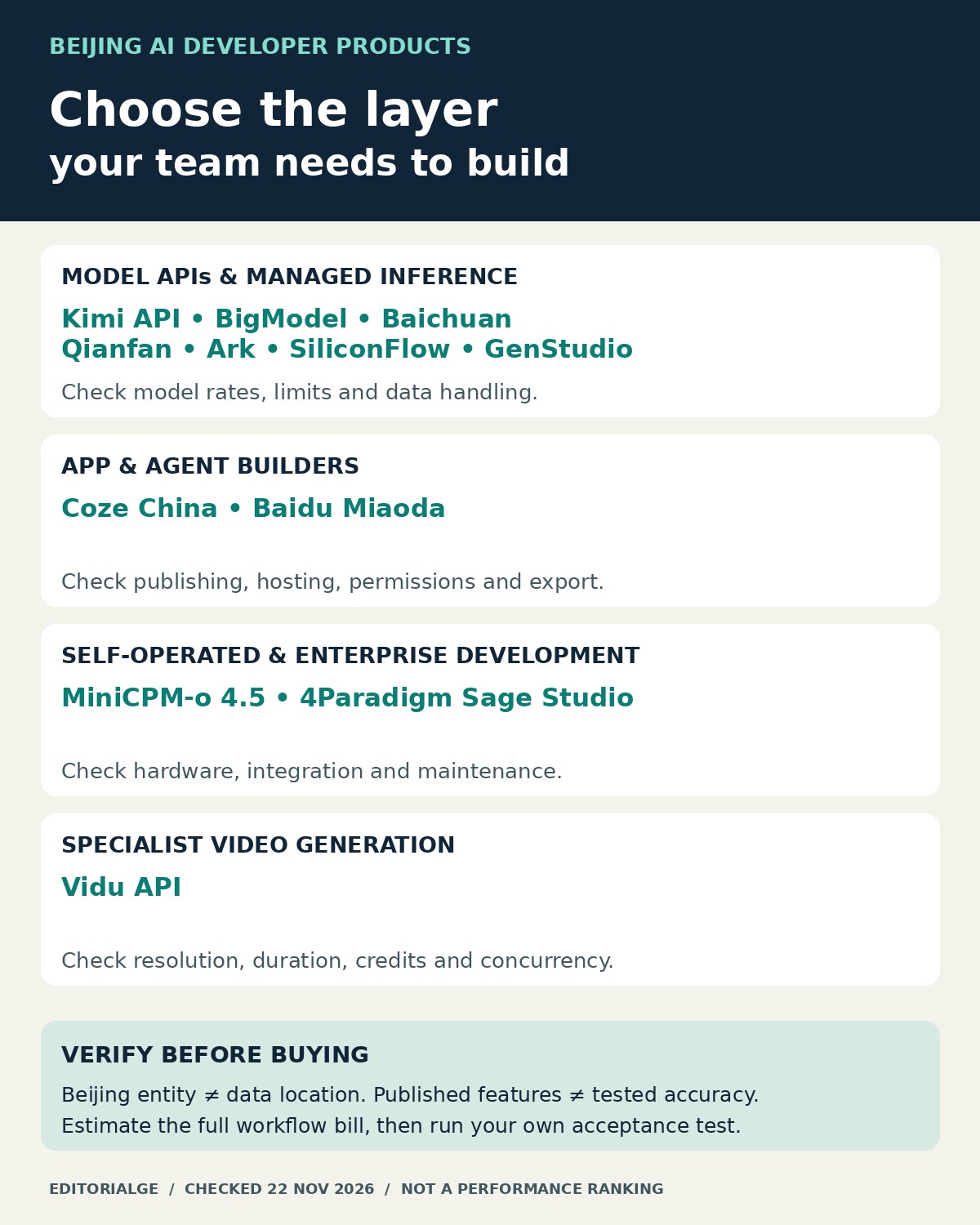
Beijing-based AI developer products can help you add document analysis, search, conversation, video generation or a complete application interface to a business workflow. The useful shortlist depends on what your team needs to build: a model endpoint, a managed development platform, an app builder or a deployment you operate yourself.
Start with Kimi, BigModel or Baichuan for a direct model API; SiliconFlow or Infini-AI GenStudio for access to multiple models; and Qianfan or Volcengine Ark for a broader cloud development environment. Coze and Miaoda suit application-building work, while MiniCPM and 4Paradigm Sage Studio address different deployment and integration needs. Vidu belongs on the list when video generation is part of the application.
These 12 products are grouped by the work they support. The order is not a performance ranking, and a Beijing address does not establish where your application data will be processed.
What We Checked
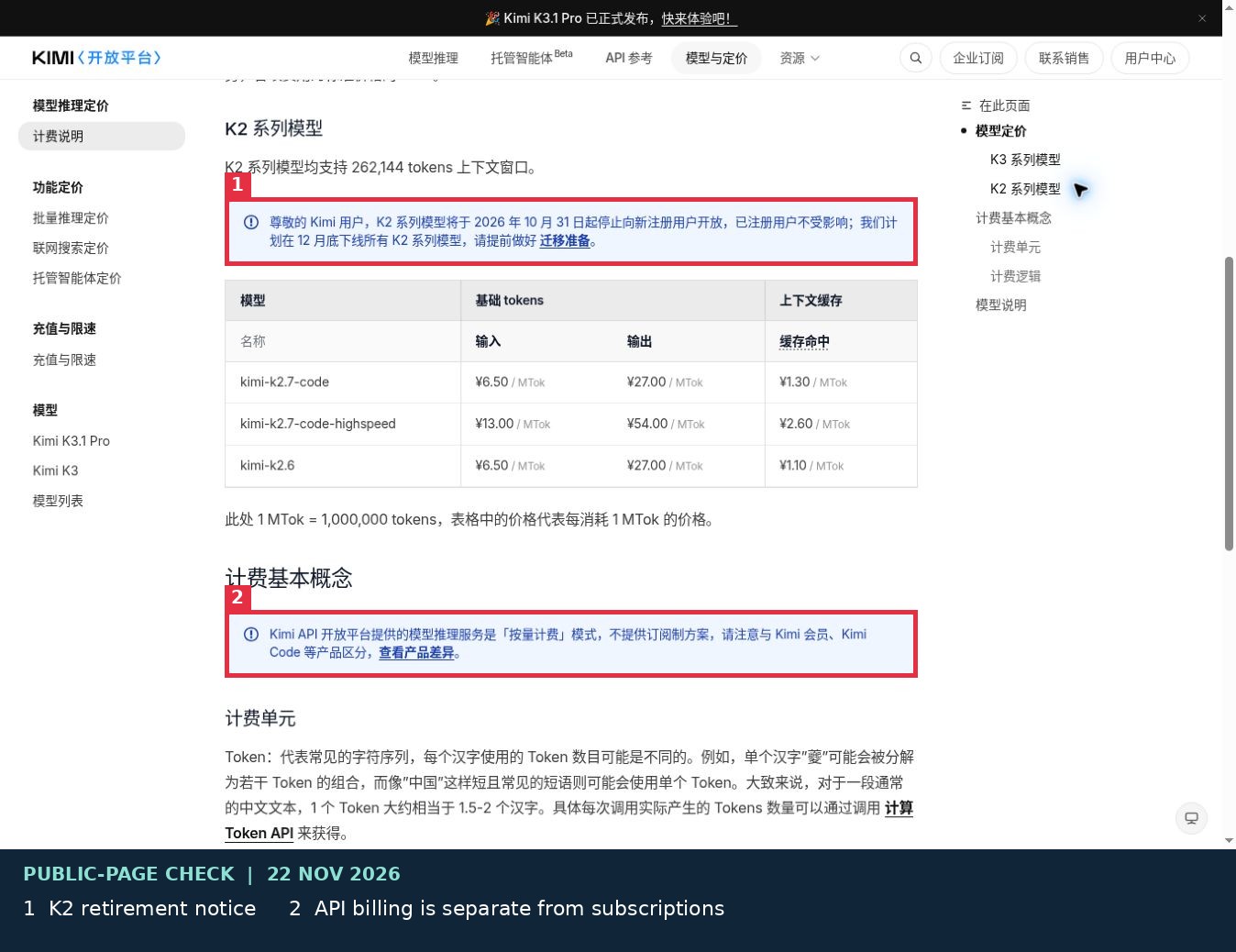
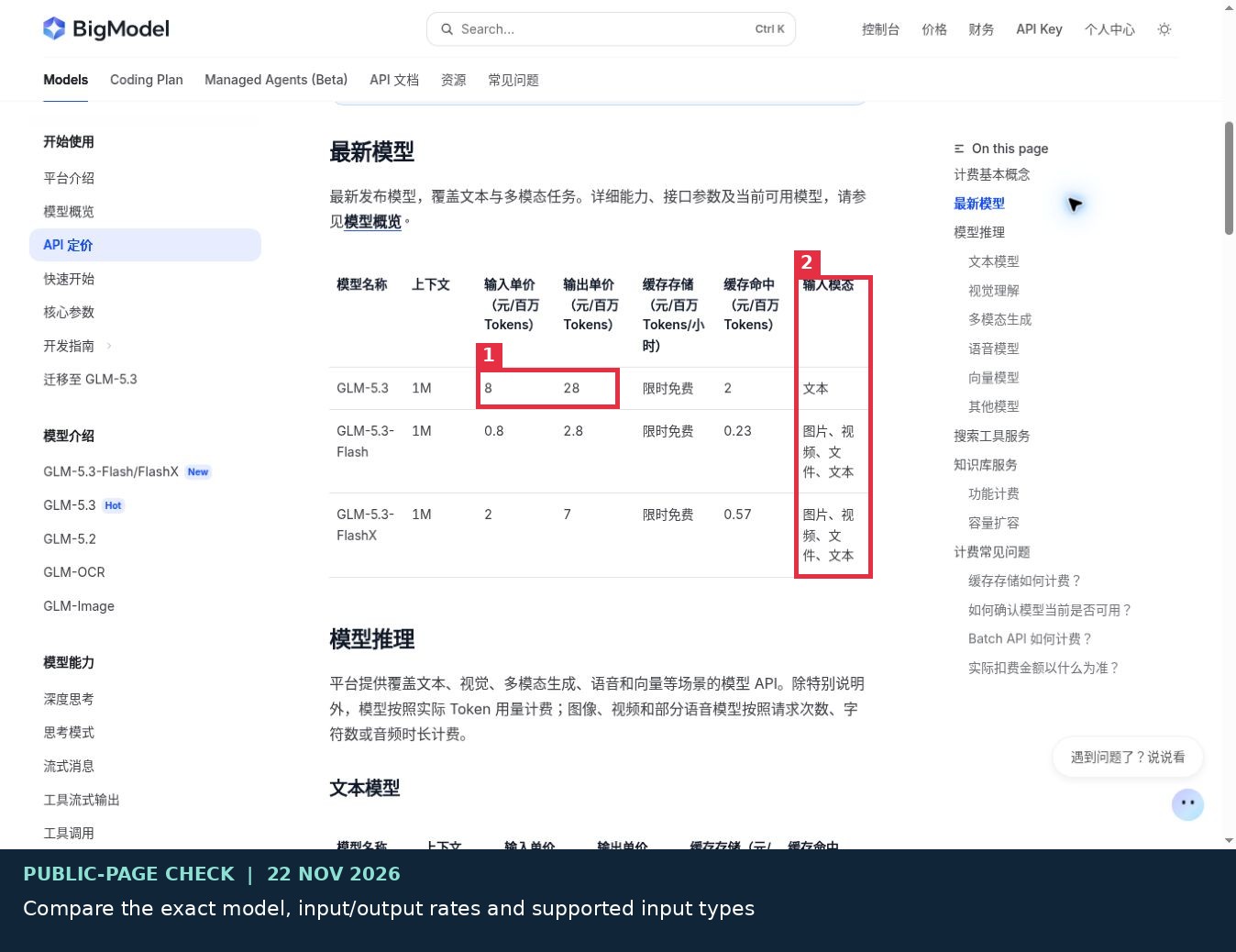
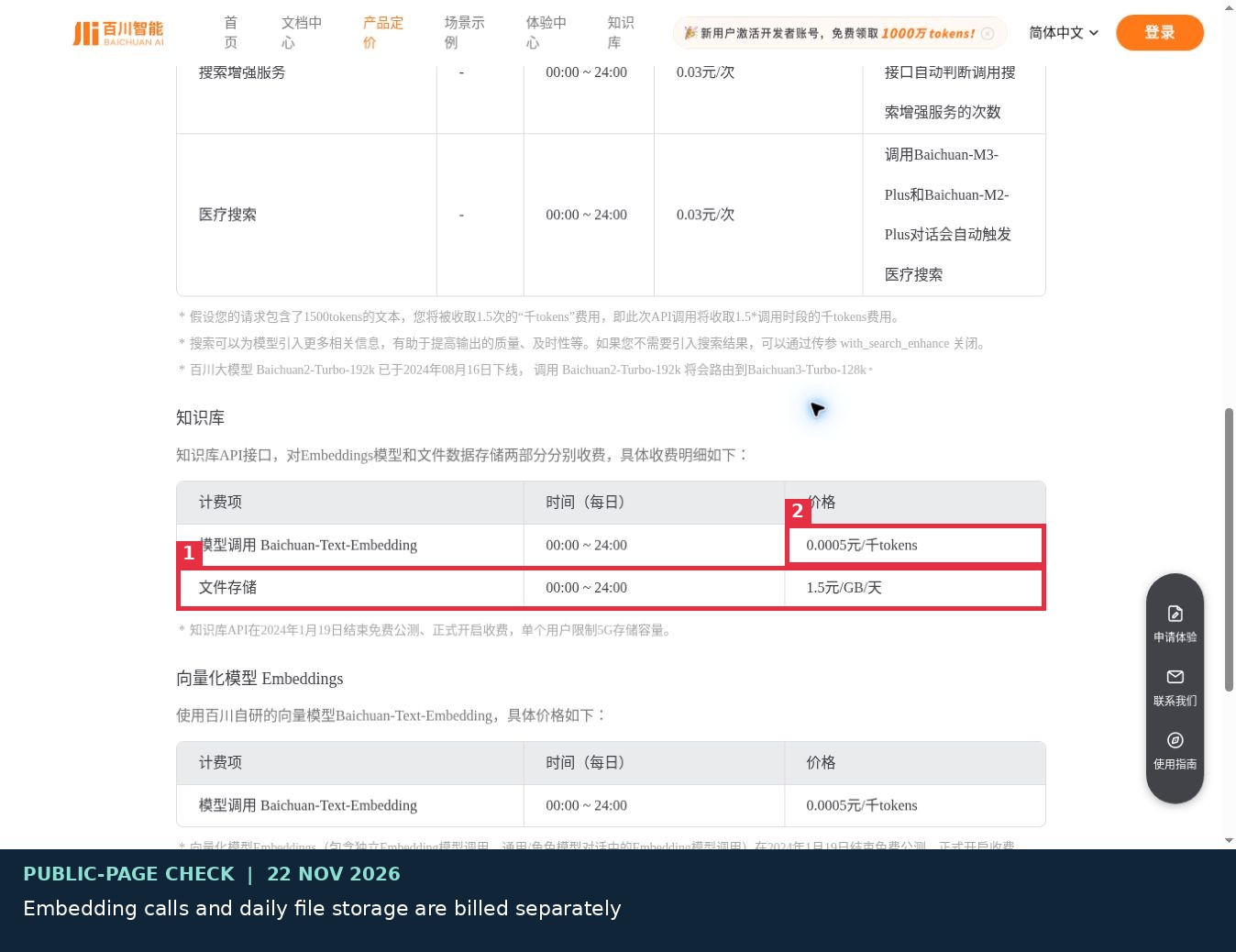
On November 22, 2026, this review checked official product documentation, pricing pages, corporate information and service policies. Three public interfaces were inspected directly: Kimi’s model-pricing navigation, BigModel’s latest-model pricing table and Baichuan’s knowledge-base charges. The annotated screenshots record the relevant page states and their buying implications.
These were public-page checks, not authenticated API trials. No customer data was uploaded, no model requests were purchased and no accuracy or latency benchmark was run. Software build numbers were not exposed on the captured pages. The cost example below is a reproducible calculation using published rates and a hypothetical workload; it is not a measured production bill.
How Beijing eligibility was established
Each selection has an identifiable Beijing headquarters or operating entity supported by official corporate information, a service policy or a corporate filing. Infini-AI qualifies through a named Beijing co-operator alongside its Shanghai operator. Coze qualifies through its Beijing operators. Neither is described here as an exclusively Beijing-headquartered business.
Qianfan and Miaoda are separate Baidu products serving different development stages. Ark and Coze also have related operators, but one supplies model infrastructure while the other supports application and agent construction. They should not be treated as independent supplier diversification.
Beijing-Based AI Developer Products at a Glance
Pricing checked November 22, 2026. CNY means Chinese yuan. Rates below describe the named service or model, not an entire application. “Not publicly established” means a reliable comparable amount was not available in the reviewed material.
| Product | Best starting point | Commercial basis | Main buying constraint |
|---|---|---|---|
| Kimi API | Document-heavy assistants | K3.1 Pro: CNY 13 input / 68 output per million tokens, before cache charges | K2 retirement makes model selection time-sensitive |
| Zhipu BigModel | Text and multimodal application endpoints | GLM-5.3: CNY 8 input / 28 output per million tokens | Capabilities and prices differ by model |
| Baichuan Open Platform | Text applications with retrieval | Baichuan4-Air: CNY 0.00098 per 1,000 tokens, input and output counted | Embedding, search and storage can add charges |
| Baidu Qianfan | Model development within Baidu Cloud | Model usage; training, evaluation and other services priced separately | Choose the production API billing route carefully |
| Volcengine Ark | Managed model services and capacity planning | Token billing, with model-specific capacity options | Region, model version and capacity tier matter |
| SiliconFlow | Comparing models behind familiar API protocols | Usage-based; exact selected-model tariff must be confirmed | Authentication, model limits and licenses need separate checks |
| Infini-AI GenStudio | Multi-model integration with tenant administration | Token usage; eligible models offer concurrency subscriptions | Tenant model prices and overflow policy affect the bill |
| Coze China | Agent and application workflows | Personal entry paid tier: CNY 49 for one month; recurring terms differ | Enterprise new sales are due to pause November 30 |
| Baidu Miaoda | Building a business app from a written brief | Membership plus usage points and backend resources | Generation, hosting and export are separate cost events |
| ModelBest MiniCPM-o 4.5 | Self-operated multimodal applications | Released code and weights; budget separately for infrastructure | Deployment and maintenance remain your responsibility |
| 4Paradigm Sage Studio | Enterprise model-to-application development | Public subscription tariff not established; scoped sales discussion | Implementation effort can outweigh a small pilot’s needs |
| Vidu API | Video-generation features inside a product | CNY 0.03125 per credit; consumption depends on model and output | Duration, resolution, concurrency and credit expiry |
1. Kimi API: For Document-Heavy Business Assistants
Best for teams adding document analysis or a knowledge assistant to an existing application. Kimi’s developer platform separates model inference from its consumer membership and coding subscriptions. That distinction matters when a founder buys a chat plan expecting it to fund a customer-facing API.
Why it belongs here: the platform documents API inference, caching and batch processing, and its operator, Beijing Moonshot, lists a Haidian address. The current pricing page identifies the K3 family rather than treating every older model as a safe starting point.
Pricing: Kimi K3.1 Pro lists CNY 13 per million input tokens and CNY 68 per million output tokens. Cache hits and cache writes have their own rates. Check the full request pattern before estimating savings.
Observed limitation: the pricing page says K2 stopped opening to new users on October 31, 2026, with all K2 models planned to retire at the end of December. A new integration should include a model migration plan. Skip a K2-dependent design that cannot be retested before retirement.
2. Zhipu BigModel: For Text and Multimodal API Development
Best for developers who want model endpoints plus documented tools for structured output, function calling and retrieval. BigModel is operated by Beijing Zhipu Huazhang; its corporate filing gives a Zhongguancun East Road address.
Why it was chosen: the developer documentation distinguishes model capabilities rather than presenting one universal endpoint. The current table labels GLM-5.3 as text input, while GLM-5.3-Flash lists image, video, file and text inputs. Select the actual model your workflow requires.
Pricing: GLM-5.3 lists CNY 8 input and CNY 28 output per million tokens. GLM-5.3-Flash lists CNY 0.8 and CNY 2.8 respectively. Cache-hit rates differ; cache storage is marked temporarily free, not permanently included.
Observed limitation: a lower-priced model is not evidence of equivalent task quality. The billing guidance also warns that disconnecting a request does not erase usage already incurred. Test cancellation and retries before offering an uncapped customer feature.
3. Baichuan Open Platform: For Text and Retrieval Workflows
Best for a text application that needs a direct model API and an embedding or knowledge-base route. Beijing Baichuan’s policy gives its address in the Sair Building at Tsinghua Park.
Why it was chosen: its public pricing separates general-model calls, embeddings and file storage. This makes it possible to identify costs that a simple “price per token” comparison misses.
Pricing: Baichuan4-Air lists CNY 0.00098 per 1,000 tokens, counting both input and output. Baichuan4-Turbo lists CNY 0.015 on the same basis. Knowledge-base storage is CNY 1.5 per GB per day, with embeddings billed separately.
Observed limitation: keeping files available can cost money even when few people ask questions. At the posted storage rate, 1 GB held for 30 days is CNY 45 before embedding and model calls. Skip the hosted knowledge-base route if that storage model conflicts with your budget or retention requirements.
4. Baidu Qianfan: For a Managed Model Development Environment
Best for teams already building on Baidu Cloud or needing model selection, tuning, evaluation and inference in one environment. Beijing Baidu Netcom’s cloud billing documentation lists its Shangdi address.
Why it was chosen: Qianfan’s current product page covers the model lifecycle, including data preparation, fine-tuning and evaluation. Its quick-integration flow distinguishes general API keys from keys associated with Token Plan subscriptions.
Pricing: inference is model-specific; the published ERNIE-5.5-Flash-Preview example shows CNY 0.001 per 1,000 input tokens and CNY 0.004 per 1,000 output tokens for the displayed 08:00–22:00 period. Training and evaluation can generate separate charges.
Drawback: a broad platform introduces more billable components and configuration choices. Ask which model, region and billing route your production request will use. Skip the full platform if you only need a small standalone endpoint and cannot justify its operating overhead.
5. Volcengine Ark: For Model Infrastructure and Capacity Choices
Best for application teams that need to plan model throughput alongside inference costs. Ark is part of Beijing Volcengine, whose official contact information gives a Dazhongsi Square address in Haidian.
Why it was chosen: Ark documents token-based usage, throughput-oriented options and model units. These serve different workload patterns; a prototype and a busy customer assistant should not automatically use the same purchasing arrangement.
Pricing: the current table lists doubao-seed-2.1-lite at CNY 0.80 per million non-audio input tokens and CNY 2.70 per million output tokens for its listed input-length band. Audio, cache storage and cache hits have separate prices.
Drawback: one headline rate cannot represent every modality or capacity arrangement. Check the specific endpoint and version, then load-test the intended tier. Skip reserved capacity until you have enough traffic evidence to justify the commitment.
6. SiliconFlow: For Comparing Models Through a Common Interface
Best for developers who want to evaluate several models without building an entirely new client for each provider. Beijing SiliconFlow’s policy lists its office at Zhongguancun East Road, Building 8, Tower D.
Why it was chosen: the platform documents OpenAI- and Anthropic-compatible protocols, with APIs spanning text, embeddings, reranking and media. Compatibility can reduce integration work, although it does not make every parameter behave identically.
Pricing: usage-based, with the selected model’s tariff requiring confirmation. The finance guide requires real-name authentication before balance recharge and lists local payment routes. No universal monthly application price was established.
Drawback: model-specific limits, terms and output permissions still apply. Its November 16 update introduced dynamic rate limits for selected models, so an older fixed-limit assumption may be wrong. Skip it if your procurement process requires a guaranteed capacity commitment that the chosen service does not provide.
7. Infini-AI GenStudio: For Multi-Model Services With Tenant Controls
Best for teams combining model access with tenant administration and usage management. Infini-AI’s policies name both Shanghai and Beijing operators; the Beijing entity has a Dongsheng Building address.
Why it was chosen: GenStudio documents model APIs, embeddings, reranking and integration guides. Its billing documentation explains both token usage and concurrency subscriptions for eligible models.
Pricing: input and output rates are shown in the tenant’s service list or model details, including applicable discounts. A single publicly comparable amount was not established. Concurrency subscriptions may reject overflow or send it to usage-based billing.
Drawback: those overflow choices have different budget consequences. A subscription is not necessarily a hard spending ceiling. Skip a concurrency package until you know whether excess demand should wait, fail or generate additional charges. Confirm the contracting entity and processing location separately from the Beijing eligibility finding.
8. Coze China: For Agent and Application Workflows
Best for teams assembling agents or applications with reusable workflows. Coze’s Chinese service terms identify Beijing Chuntian Zhiyun and named Beijing affiliates, including Volcengine for relevant services.
Why it was chosen: it provides an application-building layer rather than only a raw model endpoint. That can suit an internal assistant that needs several steps and connections to other tools.
Pricing: following the November 14 change, the entry paid personal tier lists CNY 49 for a single month, or an eligible first recurring month at CNY 39 followed by CNY 45 monthly. These are personal-plan terms, not an enterprise procurement quote.
Drawback: the enterprise announcement says new sales of the standard and flagship enterprise plans will pause November 30, 2026. It also gives retirement dates and says export arrangements will be clarified later. Skip a new long-term enterprise dependency until the replacement offering and exit route are confirmed.
9. Baidu Miaoda: For Turning a Business Brief Into an Application
Best for a small team building an internal tool or business app from written requirements. Miaoda’s agreement identifies Beijing Baidu Netcom as the service provider, with a Shangdi contact address.
Why it was chosen: its documentation covers application creation, preview, publishing, backend services and source export. Unlike Qianfan’s model-development focus, Miaoda addresses the application itself.
Pricing: membership plus usage points, with backend resources also affecting cost. The November 12 billing guide says actions such as conversations, publishing, backend activation and source downloads consume points. A comparable all-inclusive monthly price was not established.
Drawback: generating a convincing interface does not establish correct permissions or data handling. Before committing, build a small workflow with two user roles and verify that one user cannot access the other’s records. Skip it for a production launch that has no owner for testing, backups and exported-code maintenance.
10. ModelBest MiniCPM-o 4.5: For Self-Operated Multimodal Applications
Best for teams that can run their own model service and need voice, image or video interaction. ModelBest’s official company profile identifies its Beijing headquarters at Zhongguancun East Road, Building 6.
Why it was chosen: MiniCPM provides a different deployment path from a hosted API. The MiniCPM-o 4.5 documentation describes real-time interaction and a deployable service; the project states that its code and model weights are released under Apache-2.0.
Pricing: there is no hosted per-token tariff for this self-operated configuration. Budget for compute, storage, monitoring and engineering. The reviewed deployment guide specifies Linux and an NVIDIA GPU with more than 28 GB of memory for that configuration.
Drawback: operating it yourself transfers responsibility for availability, security and retention to your team. The documented setup is not proof that every laptop can run it. Skip this route if nobody can maintain the serving stack or validate the exact model release and dependencies.
11. 4Paradigm Sage Studio: For Enterprise Model-to-Application Development
Best for organizations turning business datasets and trained models into maintained applications. 4Paradigm’s official contact page identifies its Beijing headquarters on Shangdi West Road.
Why it was chosen: Sage Studio documents visual and notebook-based modeling, model management, evaluation reports and an application IDE. Its application layer can package a model for use by a front-end business system.
Pricing: no public subscription tariff was established on the reviewed product page, which directs buyers toward a demonstration and sales discussion. Request a scope covering deployment, implementation, support and infrastructure rather than asking only for a software seat price.
Drawback: this is a broader enterprise platform decision. A small team needing one summarization endpoint may find the implementation effort disproportionate. Ask the supplier to demonstrate your own workflow and an export or migration path before accepting a platform-wide commitment.
12. Vidu API: For Video Features Inside Business Applications
Best for a product that needs programmatic video generation, such as a campaign-asset or product-content workflow. Shengshu’s official corporate policy identifies Beijing Shengshu and its Dongsheng Building address; its site links directly to Vidu API.
Why it was chosen: Vidu exposes a developer service rather than requiring every user to work manually in a consumer video editor. The pricing documentation distinguishes models, output duration and resolution.
Pricing: one credit is CNY 0.03125. The listed CNY 500 recharge provides 16,000 credits with a one-year validity period. Vidu Q3 Pro at 1080p lists 24 credits per second in the standard tier; discounts and other configurations differ.
Drawback: the documented maximum of five concurrent tasks is not a promise of five completed videos at once; extra work queues, and load can reduce available concurrency. Skip it when video is not central to the application, and verify asset rights and retention before uploading customer media.
Calculate the Cost of a Completed Workflow
Suppose a document assistant handles 10,000 requests monthly, each using 2,000 input tokens and 500 output tokens. That is 20 million input tokens and 5 million output tokens. With no caching, retries, tools or discounts, the arithmetic is:
| Published model rate used | Input calculation | Output calculation | Illustrative inference subtotal |
|---|---|---|---|
| Kimi K3.1 Pro | 20 × CNY 13 | 5 × CNY 68 | CNY 600 |
| GLM-5.3 | 20 × CNY 8 | 5 × CNY 28 | CNY 300 |
This checks billing arithmetic, not model quality. The same documents may tokenize differently across providers, and a more expensive model may complete a task with fewer retries. Conversely, long outputs can make an apparently small request expensive. Add retrieval, storage, search, hosting, failed attempts and human review before choosing a provider.
For tenant-level controls, see our guide to AI API budget alerts by customer workspace. An alert and a hard spending limit serve different purposes.
A Practical Selection Checklist
Choose two or three candidates for one defined job. A support assistant, a sales-forecasting application and a video-generation feature need different evidence.
| Decision | Evidence to collect in your pilot | Reason to stop |
|---|---|---|
| Task accuracy | Representative examples with an agreed correct result or rubric | Critical facts or required fields remain wrong |
| Repeatability | Repeated runs with saved model ID, prompt, parameters and source data | Unexplained changes break the workflow |
| Language | Your actual Chinese, English or mixed-language documents | Published language support fails on your terminology |
| Rights | Applicable model license, output terms and source-asset permissions | Your intended distribution is not covered |
| Retention and access | Written terms for prompts, files, logs, deletion and subprocessors | Required data boundaries remain unresolved |
| Total cost | Successful-task cost including retries, tools and maintenance | The realistic bill exceeds the operating budget |
| Exit | A tested export and a fallback model or deployment | Essential data or workflows cannot be recovered |
These are proposed pilot checks, not results claimed for the products above. Use a written evaluation rubric so the team can explain why an answer passed. The voluntary NIST AI Risk Management Framework can help organize risk ownership and evaluation; it does not certify a vendor.
Match the shortlist to your situation
- Already have an application and need model inference? Compare a direct API with a multi-model service.
- Need to build the interface and workflow as well? Examine Miaoda or Coze, including export and current plan changes.
- Need centralized model development and cloud operations? Compare Qianfan, Ark and the appropriate GenStudio service.
- Need to operate the model yourself? Assess MiniCPM’s deployment requirements before estimating savings.
- Have enterprise datasets and several production models? Ask Sage Studio to demonstrate the full model-to-application process.
- Need generated video inside your software? Evaluate Vidu against a video-specific quality and cost brief.
Chinese documentation, a Beijing office and a reachable homepage do not establish overseas account eligibility. Confirm your legal entity, phone verification, payment method, contract, processing region and target-user markets. Our enterprise LLM API selection guide provides a broader procurement framework.
Choose the Product That Fits the Application
The strongest shortlist of Beijing-based AI developer products starts with the application’s job and your team’s ability to operate it. Compare current endpoints and contracts, preserve a small test set, and calculate the cost of accepted outputs. Treat a low token price as one input to the decision, then check what happens when traffic grows, a model retires or the application needs to move.
Frequently Asked Questions
Are these 12 products from 12 independent companies?
No. Qianfan and Miaoda are Baidu products, while Ark and Coze have related operators. They are listed separately because they serve distinct development jobs, not because they diversify corporate ownership.
Can an overseas business use every product on this list?
That was not established. Public documentation does not confirm eligibility for every country or legal entity. Verify registration, payment, supported deployment region and contract requirements for the exact service you intend to buy.
Does a Beijing-based provider keep all data in Beijing?
No. A company address does not identify every processing, storage or backup location. Obtain service-specific terms for the endpoint, model, files, logs and any third-party tools your application uses.
Which product is cheapest?
There is no verified overall winner. These products perform different jobs, and even comparable APIs can consume different token counts or require different numbers of retries. Compare the cost of a completed, accepted task.
Were the products benchmarked hands-on?
No model-performance benchmark was performed. The original evidence consists of three direct public-page checks and a documented pricing calculation. The article distinguishes those observations from supplier-described capabilities and proposed pilot tests.