
A strong machine learning portfolio needs more than just basic scripts that stop at standard fitting. The most valuable machine learning project ideas challenge you to solve real-world problems: handling data leakage, establishing reliable validation, performing thorough error analysis, and deploying production-ready systems.
Whether you are an aspiring data scientist or an ML engineer, building projects that demonstrate the entire pipeline—from raw, noisy data to a deployed model—is what separates top candidates from the crowd.
Every high-impact project repository should include:
- Clear Problem Statement: Defined objectives and target users.
- Simple Baseline: A basic benchmark to measure model improvements against.
- Reproducible Data Pipeline: Clean, documented preprocessing and feature engineering code.
- Realistic Validation: Evaluation methods that mirror real-world inference settings.
- Error & Failure Analysis: Deep dives into edge cases, limitations, and false positives/negatives.
- Production-Ready Setup: Modular codebase, clear README, and deployment configurations.
What Most Machine Learning Project Lists Get Wrong
A dataset is not the same thing as a real problem. Before choosing an algorithm, decide when the prediction would happen, which inputs would be available at that moment, and what different errors would cost.
Repository design matters too. Exploratory work can remain in a notebook, but data preparation, training, evaluation, and inference should become separate modules when the project grows. The README needs to explain the decision being supported, not merely list installation commands.
There is no prize for unnecessary complexity. Five loosely connected cloud services do not improve a small portfolio project if the model cannot be reproduced locally. Finish the core workflow first.
12 Machine Learning Project Ideas Worth Building
Machine Learning Project Ideas were selected for the skills they reveal, not because the datasets are fashionable. Each project creates room to demonstrate problem framing, data preparation, appropriate validation, error analysis, and clean implementation. Choose the option that fills a genuine gap in your portfolio, then complete it properly.
1. Customer Conversion Prediction With Cost-Based Decisions
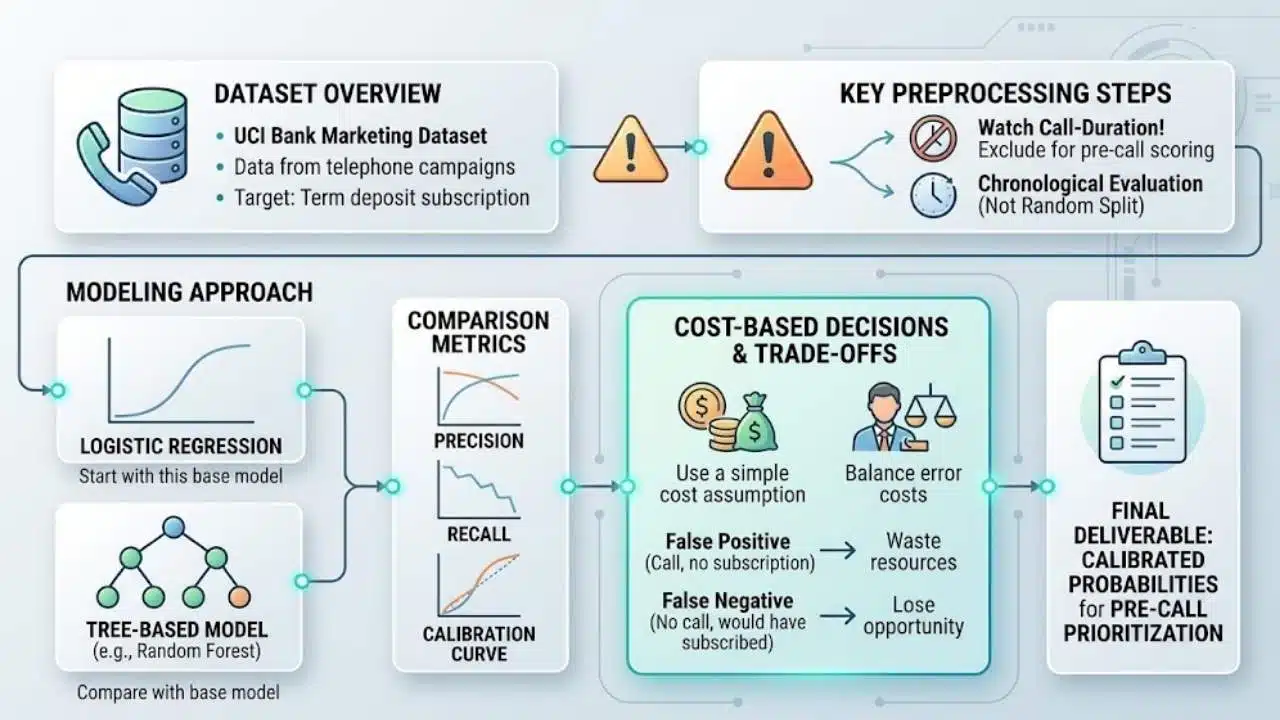
This is the strongest first project for most aspiring data scientists because the modeling is manageable while the decision-making is not. The UCI Bank Marketing dataset contains records from telephone campaigns and a target showing whether a customer subscribed to a term deposit. Treat it as a pre-call prioritization problem. Start with logistic regression, then compare it with a tree-based model using precision, recall, calibration, and a simple cost assumption.
Watch the call-duration field. If the model is meant to score customers before contact, duration would not yet exist and must be excluded. The full dataset versions are ordered by date, allowing chronological evaluation rather than an easy random split.
2. Retail Demand Forecasting System
The M5 competition data offers a substantial forecasting challenge built around hierarchical Walmart unit-sales series. It is also more data than many beginners need.
A smaller alternative is the UCI Online Retail dataset, but it was not designed as a forecasting benchmark. Transactions must be cleaned and aggregated into product-level or category-level time series. Invoice numbers beginning with “C” identify cancellations, which should not be quietly counted as normal demand.
Compare the model with a seasonal naive forecast and use rolling validation. An inventory simulation can then show how overforecasting creates excess stock while underforecasting leads to missed demand.
3. Two-Stage Movie Recommendation Engine
Movie recommendations are common portfolio material, sometimes painfully so. The project becomes more credible when it covers candidate retrieval, ranking, cold starts, and evaluation rather than stopping at matrix factorization.
Use a stable MovieLens release. GroupLens warns that its “latest” datasets can change and are unsuitable for reproducible research reporting. Compare personalized results with a popularity baseline, report Recall@K or nDCG@K, and examine catalog coverage.
Use timestamps for a time-aware split when the selected release provides them. New users should receive a documented fallback instead of empty recommendations.
4. Consumer Complaint Routing Tool
The CFPB Consumer Complaint Database can support a useful NLP system: read a complaint, predict its product or issue category, and route low-confidence cases to manual review.
The dataset needs careful interpretation. Public narratives appear only when consumers consent and after personal information is removed. The records are not a representative sample of all consumer experiences, and product categories have changed over time.
Those changes can create label inconsistencies or apparent language drift. Do not turn raw complaint counts into a ranking of financial companies without considering company size, reporting behavior, and the limits of the sample.
5. Semantic Search With Measured Retrieval Quality
Do not begin this project with a chatbot interface. Begin with search. Use a manageable BEIR subset to compare BM25, dense retrieval, and optional reranking. Measure nDCG@10 or another suitable ranking metric, then record query latency and index size. BEIR research found BM25 to be a strong baseline across varied retrieval tasks, so replacing it with embeddings does not automatically count as an improvement.
Answer generation can be added later, once document retrieval has been evaluated.
6. Industrial Defect and Anomaly Detector
MVTec AD is a more distinctive computer vision choice than another general image classifier. It contains more than 5,000 high-resolution images across 15 object and texture categories. Training examples are defect-free, while the test data includes normal and anomalous images with pixel-level annotations.
Compare a reconstruction method with pretrained visual features. Per-category errors and localization maps matter more than a single overall score because they reveal what triggers false alarms and where the suspected defect appears. One practical limit is licensing: MVTec AD uses CC BY-NC-SA 4.0 and prohibits commercial use.
7. Predictive Maintenance From Sensor Data
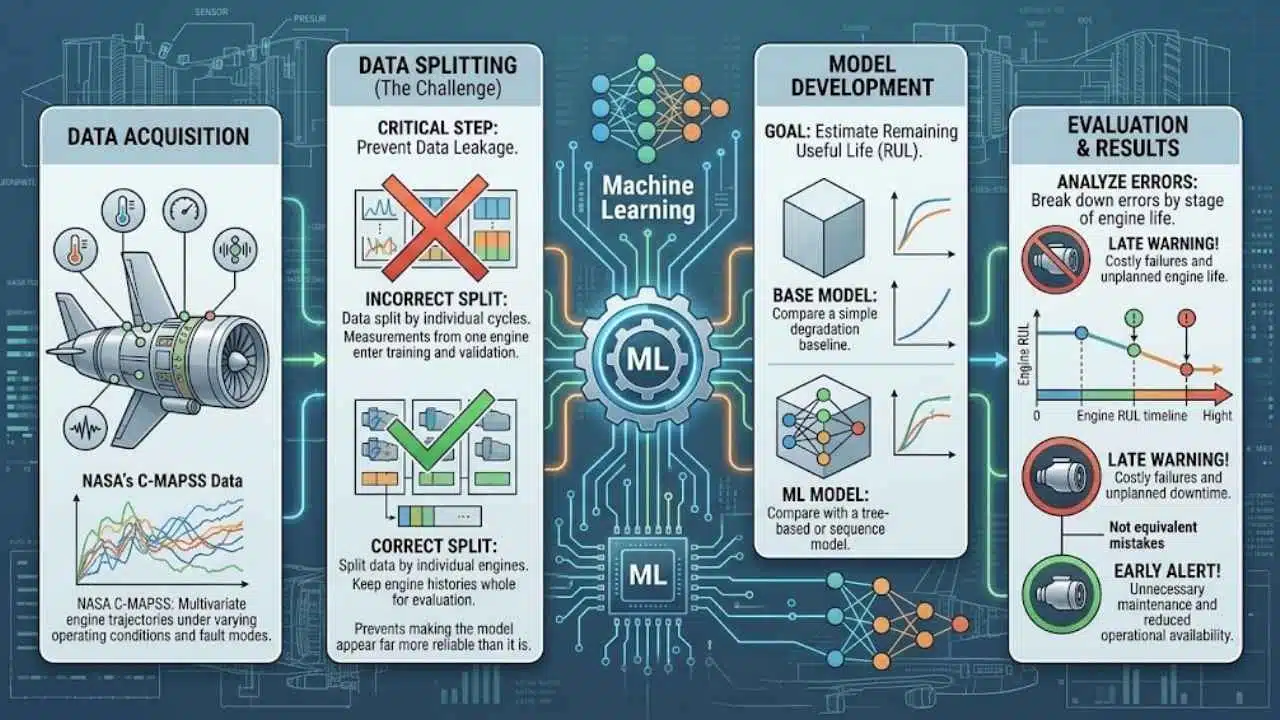
NASA’s C-MAPSS data contains multivariate engine trajectories under different operating conditions and fault modes. The usual challenge is estimating remaining useful life.
Split the data by engine, never by individual cycles. Otherwise, measurements from one engine can enter both training and validation and make the model appear far more reliable than it is.
Compare a simple degradation baseline with a tree-based or sequence model. Break down errors by stage of engine life; a late warning and an unnecessarily early maintenance alert are not equivalent mistakes.
8. Keyword Spotting for Small Devices
TensorFlow’s Speech Commands dataset is intended for recognizing short spoken keywords. Its training and validation sets also contain a large “unknown” class, so false activations deserve as much attention as ordinary accuracy.
Test background noise, different speakers, and unrelated words. For a small-device project, report model size and inference time. A slightly more accurate network may still be the wrong choice if the target hardware cannot run it efficiently.
9. Hourly Taxi Demand Forecasting
NYC Taxi and Limousine Commission trip records include pickup and drop-off times and locations, fares, distances, payment types, and passenger counts. Aggregate pickups by taxi zone and hour, then forecast near-term demand.
The difficult part is deciding which fields are legitimate. Drop-off information, completed-trip fares, and payment details may not exist when the forecast is made. Using them can leak future information. Validate chronologically and map errors by zone. Citywide averages often hide weak results in areas with fewer trips.
10. Fairness Audit of a Tabular Classifier
The UCI Adult dataset contains 48,842 records extracted from 1994 Census data, including demographic fields and some missing values. It is suitable for learning how to audit a classifier, but it should not be presented as a realistic modern employment or lending model.
Use Fairlearn to compare selection rates and error rates across groups. Examine group intersections only when sample sizes support them, and publish the counts or uncertainty behind each comparison.
Avoid producing a single “fairness score.” Different metrics represent different ideas of harm and can recommend conflicting changes. The project should explain why a measure was chosen and what it does not establish.
11. Data Drift and Model Monitoring Simulator
Train a model on one period, treat a later period as incoming data, and monitor features, predictions, missingness, and eventual model quality. Evidently can compare reference and current datasets, but its drift results remain proxy signals when ground-truth labels are unavailable. Missing-value checks also need separate attention because null values can be filtered during drift calculations.
Introduce controlled changes, such as shifting one numerical feature or altering category frequencies, and show which alerts fire. Do not make automatic retraining the default response. Drift may be harmless, while performance can decline without an obvious input shift.
12. Production-Ready Machine Learning Service
For candidates who already have several trained models, this is the most valuable next project. Reuse the strongest model rather than collecting another dataset.
Serve predictions through FastAPI, validate request schemas, package the application in a container, and run automated tests through GitHub Actions. MLflow can record parameters, metrics, code versions, and output artifacts across experiments.
The repository should include:
- Unit tests for feature transformations
- An integration test for the prediction endpoint
- A reproducible training command
- Clear input validation and error responses
- Basic latency and failure logging
- A model card covering intended use and limitations
A local container and a short demonstration can establish that the workflow runs. Cloud deployment is useful when it proves a missing skill, not when it merely adds infrastructure and expense.
Final Thoughts
Choosing among these machine learning project ideas is less about finding the most advanced dataset and more about finishing a project that reveals sound judgment. For a first end-to-end project, start with customer conversion or demand forecasting. If the portfolio already contains several trained models, turn the strongest one into a tested, documented service.
Before writing code, define when the prediction happens, which data will be available, what baseline must be beaten, and which errors matter most. A recruiter should be able to open the repository, understand the problem, reproduce the workflow, and see where the model struggles. That evidence carries far more weight than an impressive score without context.