
Ever finish a course, project, or internship and then realize your resume still does a weak job proving what you can actually do? That is why a skill wallet matters.
I wanted one place to keep my certifications, project proof, badges, and work evidence without digging through old inboxes and downloads.
What made me take Skill Wallet seriously is scale. SmartBridge now says its ecosystem has reached more than 2 million learners and 4,000 institutions, which tells me this idea has moved well past the experiment stage.
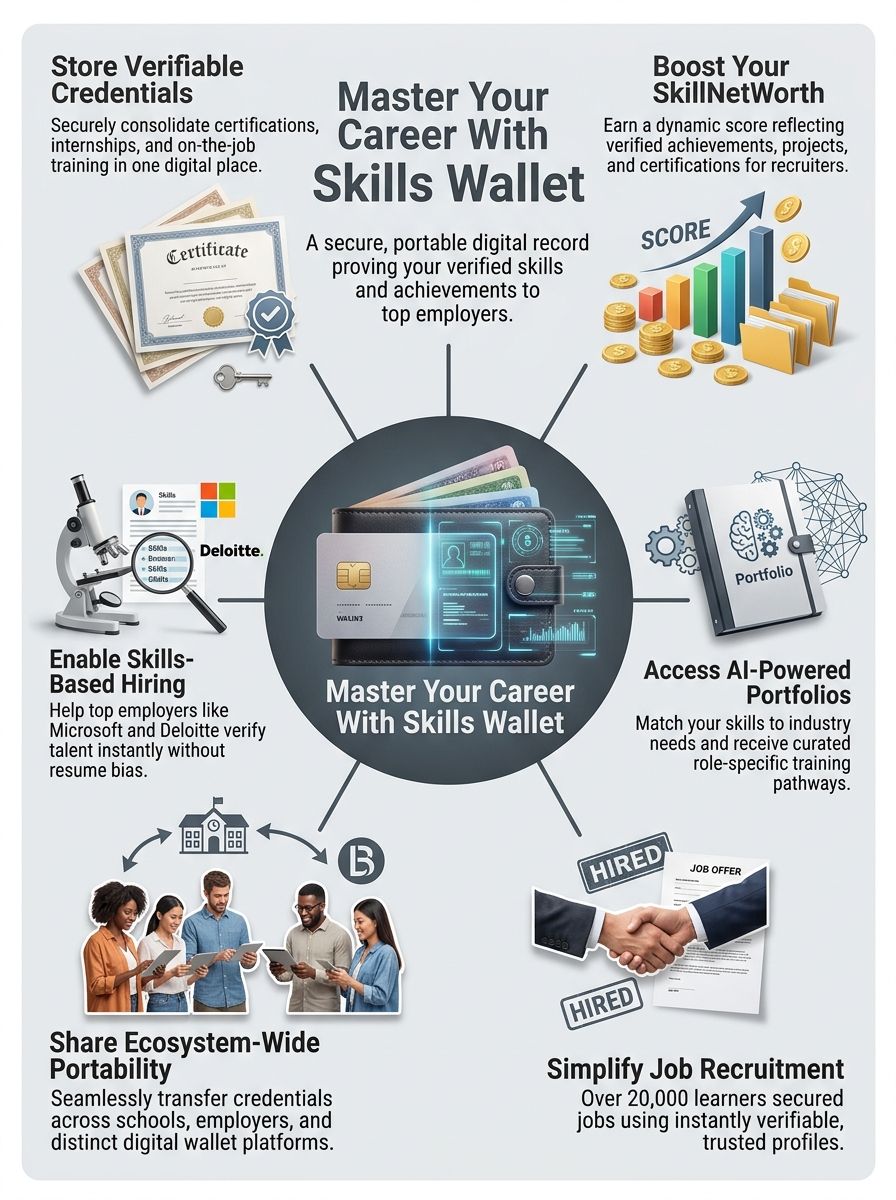
What is a Skills Wallet?
A Skills Wallet is a portable record of learning and capability. I think of it as a digital skills wallet that keeps my credentials, project work, work experience, and verified achievements in one place so I can use them across school, training, and hiring systems.
NIST describes this kind of setup in a simple way: the credential gets issued by a trusted source, stored in a wallet, and then presented to a verifier. That flow matters because a good wallet does more than display claims, it helps an employer or school check whether the claim is real.
- Learning records: course completions, credit courses, transcripts, and badges.
- Work evidence: internships, capstones, labs, portfolios, and job experience.
- Verified credentials: certificates or badges tied to an issuer, dates, and status.
- Portable proof: records you can reuse when you apply for jobs, programs, or internal promotions.
That is the big shift. A regular resume tells a story. A Skills Wallet can also carry proof.
Key Features of a Skills Wallet
I keep coming back to one test: does the wallet help me prove real ability faster, with less friction for me and less guesswork for the employer? The best versions of Skill Wallet do that by combining AI guidance, verifiable credentials, secure storage, and interoperability.
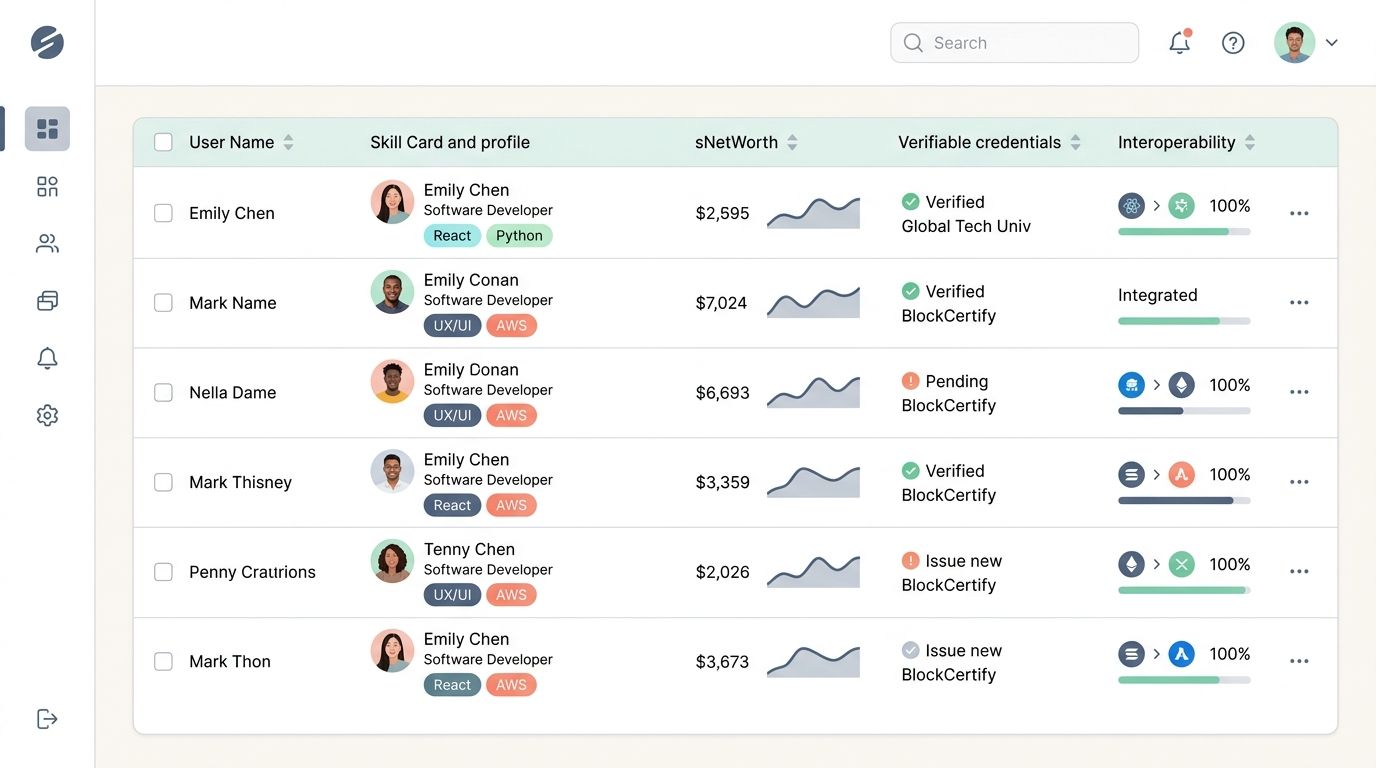
| Feature | What it does | Why I care |
| Skill Card and profile | Pulls skills, badges, and achievements into one view | I can share a cleaner, job-ready snapshot |
| sNetWorth | Turns verified learning evidence into a visible skill score | Recruiters can scan progress faster than they can from a plain resume |
| Verifiable credentials | Shows issuer-backed proof instead of self-reported claims | That cuts down on manual checking |
| Interoperability | Lets records move between issuers, wallets, and verifiers | I am not stuck inside one platform |
AI-powered digital portfolio
This is where Skill Wallet feels different from a static portfolio. As of July 2026, Google Play describes the app as an AI-powered learning platform for students and early professionals, with guided courses, hands-on projects, AI-driven interview prep, certification prep, Skill Card sharing, and sNetWorth tracking.
The newer mySkillWallet experience also adds a named AI companion called Zaby. It maps skill gaps to roles, gives instant feedback, supports 14-plus languages, and organizes learning across 498-plus skills and 120-plus career roles. For me, that means the wallet can help with the next step, not just archive the last one.
- Career Navigator: points out missing skills before I apply blindly.
- AI Tutor Chat: helps me turn a weak topic into a finished skill faster.
- Code Playground and labs: give me evidence I can attach to a role, not just a completion badge.
- Certification prep: makes the wallet useful for exam goals, especially in cloud, Salesforce, ServiceNow, and cybersecurity tracks.
The strongest digital portfolio does not just say, “I learned this.” It shows where I learned it, how I practiced it, and what I built with it.
A practical tip I always use is to pair every badge with one artifact. Add a capstone, a lab result, a code sample, or a short project summary. That makes the AI layer much more useful, because it has evidence to organize instead of empty claims.
Secure and portable record-keeping
A wallet only helps if I trust it with sensitive records. NIST explains that digital credentials sit inside a wallet application and are protected with cryptograpcrehic verification, while the issuer and verifier each play a separate role in checking authenticity.
That model is useful because it keeps the system simple. The issuer signs the credential, I hold it, and the verifier checks it. I do not have to reprove the same internship or certification every single time I apply.
- Security: the current Android listing says data is encrypted in transit.
- Control: the same listing says users can request deletion of their data.
- Portability: a good wallet lets me present records without rebuilding my profile from scratch.
- Longevity: I can keep learning and employment records together across different stages of my career.
If I were helping a veteran, a career changer, or someone with mixed formal and informal learning, this would be the first value I would point to. Their proof is often scattered. A secure wallet turns scattered proof into usable proof.
Verifiable credentials and achievements
The phrase verifiable credentials sounds technical, but the idea is simple. A real credential should tell me who issued it, what it covers, when it was awarded, and whether it is still valid.
That is why the W3C standard matters here. Since May 2025, Verifiable Credentials 2.0 has given platforms a clearer standard for expressing, exchanging, and verifying digital credentials across education and work settings.
- Issuer identity: I should be able to see who stands behind the credential.
- Status or revocation: if the credential has been revoked, that should be visible.
- Dates: issue dates and validity windows help employers judge freshness.
- Claim detail: the best credentials say what skill or achievement was actually earned.
That last point is easy to miss. A badge labeled “Cloud” is weak. A badge tied to AWS fundamentals, project work, and an assessment tells a recruiter something concrete.
Interoperable ecosystem for education and work
Interoperability is the feature most people skip until they need it. I care about it because the whole point of a digital wallet is portability. If my records cannot move, then I do not really own the value of my learning.
JFF has been pushing this issue for years, and its interoperability work gives a useful benchmark. In the first plugfest in June 2022, digital wallets had to show they could hold a record in the W3C verifiable credential format. JFF later reported that more than 40 developers were working to incorporate that standard into wallet or credential products.
| Question I ask | What a strong wallet should answer |
| Can it accept credentials from different issuers? | Yes, across education and workforce sources |
| Can I present records to an employer or school? | Yes, without retyping everything into a new form |
| Can status be checked? | Yes, including whether a credential is valid or revoked |
| Can it outlive one course provider? | Yes, or it is just a closed platform profile |
ASU Pocket is a good real-world example of why this matters. It is built to store learning and employment records, issue verified credentials, and let learners share them across organizations. That is the direction I want any serious Skill Wallet platform to move.
Benefits of Using a Skills Wallet
I use a skills wallet because it turns vague learning into visible value. Done well, it helps me showcase ability, build credibility, speed up hiring, and fit into the growing shift toward skills-based hiring.
Showcase skills and achievements
This is the most immediate win. Instead of hoping someone reads between the lines of my resume, I can show the certification, the project, the internship, and the skill tag together.
SmartBridge gives this idea scale. Its current public materials highlight 580,000-plus AICTE virtual internships, more than 100,000 learners upskilled through Salesforce workforce programs, and 15,000-plus graduates who started careers in the Salesforce ecosystem. Those numbers matter because a wallet becomes more useful when it is tied to real pathways, not just one-off courses.
- Add completed internships, not just classroom certificates.
- Keep hands-on projects beside the badge that led to them.
- Show both technical and professional skills in the same profile.
- Update the wallet after every new accomplishment, not once a year.
That last point is bigger than it sounds. A wallet works best as a living profile, not an emergency document I touch only when I am job hunting.
Build credibility for future opportunities
Credibility usually comes from names, evidence, and consistency. Skill Wallet gains strength when the issuers and training partners are recognizable and the achievements are specific.
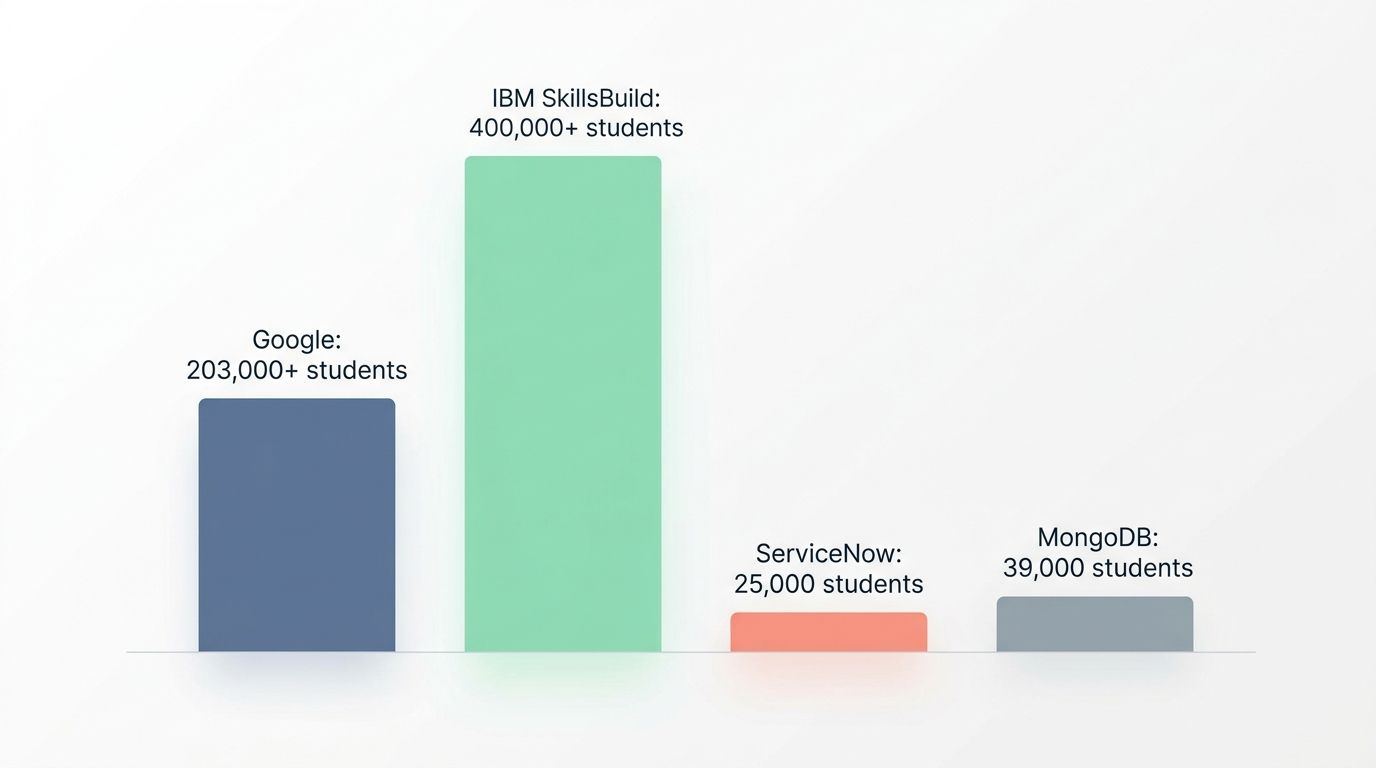
SmartBridge’s official industry pages currently point to several concrete pipelines: Google programs that trained 203,000-plus students and 2,000-plus faculty, IBM SkillsBuild initiatives that reached more than 400,000 students and 20,000-plus educators, ServiceNow programs that trained 25,000 students across 20 Indian states, and MongoDB programs that trained 39,000 students across 9 states with 500-plus associate developer certifications.
| Signal | Why it adds trust |
| Recognizable issuer | An employer already knows what the partner name means |
| Verified badge or certificate | The achievement is easier to validate |
| Project evidence | I can show application, not just attendance |
| Consistent progression | The wallet shows growth over time instead of random course collecting |
For me, that is the real credibility play. I do not want a long list of logos. I want a profile where each logo is attached to evidence that explains what I can now do.
Simplify hiring and recruitment processes
Hiring gets messy when recruiters have to chase proof in five different places. A skill wallet shortens that loop because the evidence and the identity of the issuer sit closer together.
Skill Wallet’s current company-facing materials market two very clear recruiting benefits: up to 60% lower time-to-hire and 85% hiring accuracy when employers screen against verified skills instead of resume keywords alone. Even if I read those as platform claims, the direction makes sense.

The more verification happens inside the record itself, the less time recruiters waste on back-and-forth email proof.
- Recruiters can scan one profile instead of opening several attachments.
- Hiring teams can compare candidates against role-specific skills.
- Candidates who learned through internships, bootcamps, military service, or short-term retraining get fairer visibility.
- Shared portfolios reduce the guesswork around what a certificate actually means.
There is also a broader U.S. angle here. Indeed Hiring Lab found that business operations skills appeared in nearly three-quarters of U.S. job postings in late 2025, while customer service skills showed up in 37.1% of postings and administrative skills in 35.8%. So I would never use my wallet to show only technical badges. Transferable skills belong there too.
Enable skills-based hiring
This is where the wallet becomes more than a nice portfolio. It starts supporting a different hiring model.
A 2024 JFFLabs survey of more than 2,000 jobseekers found that 75% said a digital wallet would be helpful in a job search, and 58% said they would include digital credentials in applications even when employers did not ask for them. That tells me workers are ready for this shift, even if many hiring processes still lag behind.
- For jobseekers: show proof of competence, not just job titles.
- For employers: look beyond degree filters and check verified evidence.
- For career changers: use the wallet to connect older experience to new skill pathways.
- For veterans: translate military training and service into civilian-readable proof.
I like this model because it is more honest. It asks, “Can you do the work?” before it asks, “Did you follow one traditional path?”
Who Can Use a Skills Wallet?
I see Skills Wallet as useful for almost anyone who learns, teaches, hires, or changes roles. The details change by audience, but the value stays the same: clearer proof.
Students and early professionals
Students get one of the biggest benefits because they often have more proof than they realize. They may have class projects, hackathons, internships, badges, labs, and short certifications, but none of it is organized in a way a recruiter can read quickly.
Skill Wallet is built with this group in mind. Its app listing names students and early professionals directly, while SmartBridge’s campus programs describe 6 to 8 week virtual internships, credit courses, certification prep, and project-first bootcamps in roles like AI, cloud, full-stack development, and cybersecurity.
- Use the wallet if you have coursework but limited full-time experience.
- Use it if your best proof lives in projects, not job titles.
- Use it if you want to apply for internships and jobs from the same evidence base.
- Use it if you are part of the large U.S. group with some college but no credential. The National Student Clearinghouse Research Center reported in 2024 that 36.8 million Americans ages 18 to 64 fit that description.
That last group matters a lot. A wallet can help turn partial progress into visible momentum.
Educators and training institutions
Schools and training providers need better ways to show outcomes, not just enrollments. A wallet helps them issue proof that students can actually carry into the labor market.
SmartBridge’s institution-facing materials now talk about 3,500 to 4,000 supported institutions, skill-embedded credit courses, faculty development, dashboards, and campus models that connect learning to certification, internship, and placement. Its CFSI offering even lays out a clear structure for institutions, with a Career Basic tier at $50 per student per semester and a Career Pro tier at $500.
- Issue credentials that describe the actual skill earned.
- Attach one project or assessment to each meaningful badge.
- Map courses to job roles, not just syllabus units.
- Train faculty to treat the wallet as part of the learning process, not a final admin task.
When educators do this well, students leave with more than a transcript. They leave with a usable record of capability.
Employers and recruiters
Employers can use Skills Wallet to find better evidence faster. That is especially helpful when a role needs proof of hands-on work, not just a polished resume.
The platform’s employer pages focus on verified skill badges, role-specific candidate screening, and direct access to career-ready talent in tracks like Salesforce, ServiceNow, AWS, MongoDB, AI, cloud, and software engineering. I also like that the Salesforce career fair workflow asks for technical skills, soft skills, documents, relocation preferences, and course details together. That mirrors how real screening decisions actually happen.
- Ask candidates for a live credential view, not a screenshot.
- Check project evidence beside the badge.
- Look for transferable skills, especially communication and problem-solving.
- Use the wallet to widen the pool beyond degree-only filters.
If I were hiring for junior talent, that last point would matter most. Good people often have the skills before they have the perfect title.
How to Use a Skills Wallet
I like to think of this as a three-part job: activate the wallet, load it with verified proof, and then shape it around the roles I actually want.
Activating your Skills Wallet
The setup is simpler than most people expect. The current Skill Wallet sign-up flow asks you to choose whether you are a student or educator, then enter your name, email, mobile number, and password. The login flow also shows email-based sign-in and OTP verification.
- Create the account with the role that fits you now.
- Complete any email or OTP verification right away.
- Fill in your core profile before you start uploading credentials.
- Turn on the app or dashboard view you are most likely to share with others.
- Add your first verified record immediately so the wallet starts working for you on day one.
I always tell people to do step five on the spot. An empty wallet is easy to ignore. One visible credential creates momentum.
Storing and sharing verified credentials
Once the account is active, the real job begins. I want the wallet to hold the records that actually move a decision: internships, project work, credit courses, badges, certifications, and recent work experience.
There is one common mistake I would avoid. Do not rely on screenshots of certificates if the platform supports live verification. Skill Wallet’s certificate pages are built to show whether a record is being verified, and they can also flag a certificate as not found or revoked. That makes a live credential much stronger than a static image.
- Add verified badges and certificates first.
- Attach internships and capstone projects next.
- Keep transcripts or course records where they help the story.
- Share the smallest set of proof needed for the role, not your entire archive.
- Recheck credential status before interviews, especially for older records.
That last step is easy to skip. It is also one of the fastest ways to look organized.
Aligning with learning and employment pathways
A good Skill Wallet should help me decide what to do next, not just remember what I already did. The mySkillWallet model lays this out clearly: earn skills, build sNetWorth, and connect to opportunity.
I find that most useful when I work backward from a role. Pick the role first, then compare your current evidence against what that role expects. If the gap is cloud basics, cybersecurity foundations, or interview readiness, the wallet should guide the next move.
- Choose a target role, such as cloud engineer, Salesforce developer, or cybersecurity analyst.
- Audit your current wallet for proof that already fits that role.
- Fill the missing pieces with one focused course, lab, internship, or certification path.
- Update the wallet as soon as the new evidence is earned.
- Share a role-specific version of the profile instead of a generic one.
This is also where retraining becomes more practical. The U.S. Department of Veterans Affairs now promotes IBM SkillsBuild pathways in AI, cybersecurity, and data analytics that award digital credentials. That is a strong example of how a wallet can connect short learning cycles to real career movement.
The Role of Technology in Skills Wallets
The technology behind a skills wallet matters because it shapes how trustworthy, useful, and portable the record really is. I care most about two pieces: AI that helps interpret skills, and standards that let the records move.
AI integration for skill assessment
AI can make a wallet much more practical if it does three jobs well: identify skill gaps, organize evidence, and suggest the next best learning step. Skill Wallet’s current AI stack does all three through Zaby, skill mapping, sNetWorth scoring, and role matching.
I still use one rule here: AI should summarize evidence, not replace it. A strong wallet can tell me I look like a fit for a cloud role, but it still needs labs, projects, certifications, or verified internships to prove that fit.
- Gap analysis: shows what skill is missing for a target role.
- Role matching: connects verified profiles to job categories.
- Evidence weighting: values stronger proof such as assessments, labs, capstones, and certifications.
- Progress tracking: keeps growth visible so I can plan the next move.
That is why I like AI in a skill wallet more than I like AI in a generic resume builder. Here, the model has structured proof to work with.
Enhancing interoperability across platforms
This part sounds technical, but it affects daily use. If a credential cannot move between issuer, wallet, and verifier, the record becomes harder to trust and harder to reuse.
The strongest systems follow the standard roles laid out by W3C and the wallet ecosystem described by NIST. That means clear issuer identity, tamper-evident credentials, status checking, and a way for holders to present records to verifiers without rebuilding them every time.
| Technology layer | What it solves |
| W3C verifiable credential standard | Makes credentials easier to exchange and verify across systems |
| Issuer, holder, verifier model | Clarifies who creates, stores, and checks the record |
| Status and revocation checks | Stops expired or withdrawn credentials from being treated as current |
| Secure wallet storage | Lets me control when and how I share proof |
If a platform fails on those basics, I treat it as a portfolio tool, not a real learning and employment record system.
Future of Skills Wallets in Workforce Development
I do not see skills wallets as a side tool anymore. I see them becoming part of how education, workforce systems, and hiring processes talk to one another.
In January 2026, the U.S. Department of Education launched the Connecting Talent to Opportunity Challenge to help states build talent marketplaces that combine learning and employment records, credential registries, AI tools, and skills-based job descriptions. The department also noted that the country now has nearly 2 million unique credentials from more than 130,000 providers. That is exactly the kind of complexity a wallet is built to handle.
- More portable records: workers will expect their skills and credentials to move with them.
- Better pathway planning: wallets will show which course, internship, or certification closes the next gap.
- Stronger employer matching: hiring systems will read verified skills instead of only scanning resumes.
- More public-sector use: education and workforce programs are already moving toward learning and employment records solutions.
JFF’s 2025 market scan also points in the same direction. It says digital wallets are gaining momentum fast, and more than 500 million smartphone users worldwide are expected to use digital identity wallets regularly by 2026. For me, that makes Skill Wallet feel less like a niche education product and more like an early version of future workforce infrastructure.
The next big challenge is trust. People need wallets that are useful, open enough to interoperate, and clear enough that a recruiter can understand what a credential actually proves. The platforms that solve that problem will have a real advantage.
The Bottom Line
I use a skill wallet because it gives my learning a shape that employers can actually verify.
Skill Wallet brings together verified credentials, AI guidance, project evidence, and portable records in a way that fits where hiring is heading. If I want my learning to translate into career momentum, a digital skills wallet is one of the smartest tools I can carry.
Frequently Asked Questions on Skills Wallet
1. What is a Skills Wallet?
A Skills Wallet is a portable record of learning and capability. It keeps proof of your skills and projects, so you can take your work with you.
2. How does a Skills Wallet work?
You add proof and project notes, the wallet links them to your profile, then you share a secure link with employers or schools.
3. Why should I use a Skills Wallet?
It makes hiring easier, it lets your skills speak for themselves. Employers see real learning and capability, fast.
4. Who should use a Skills Wallet, and how do I start?
Anyone who learns, seeks work, or wants to track growth should use one. Start by adding one proof or a short project, then build it over time, like a digital briefcase.