

Local Search Ranking Factors determine which businesses appear in Google’s Local Map Pack and local organic search results. Google evaluates three core pillars to rank local businesses: Relevance (how well a business matches the query), Distance (proximity to the searcher), and Prominence (online reputation and authority).
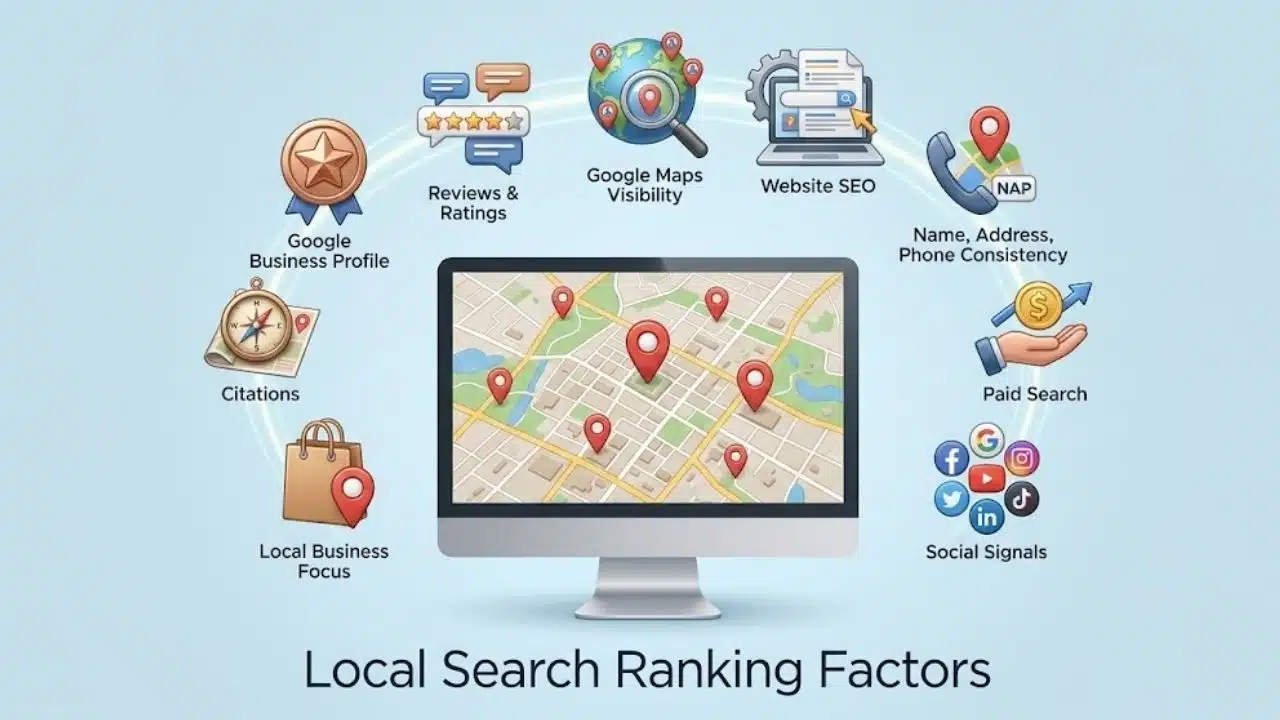
While completing a Google Business Profile is essential, winning competitive local searches requires optimizing multiple interconnected signals. The primary local search ranking factors include Google Business Profile optimization, on-page localized signals, review volume and sentiment, local backlinks, citation consistency, schema markup, and behavioral user engagement. Understanding these signals helps local businesses focus on impactful optimizations that drive visibility, AI Overview inclusions, and real customer leads.
What Most Local SEO Lists Miss
Business does not have one permanent local ranking. A dentist may appear near the top for someone searching two blocks away but much lower for a person across town. The same clinic might rank well for “emergency dentist” and poorly for “cosmetic dentistry” because its profile, website, reviews, or actual services match those searches differently.
That makes one manual search from the office a poor performance check. Incognito mode does not remove location from local results. Businesses should examine several commercially useful searches from different points across the area they genuinely serve.
10 Local Search Ranking Factors That Matter Most
1. Primary Business Category
The primary Google Business Profile category is one of the strongest relevance signals a business can control. It describes what the business fundamentally is, not every service or product it offers.
Google advises choosing the most specific category that accurately completes the sentence, “This business is a…” A delivery-only pizza company, for example, should not choose a category suggesting that customers can dine on-site.
Additional categories are useful when they describe genuine secondary parts of the operation. They should not be added merely because a related keyword receives searches. Individual treatments, products, or minor services belong in the services section and on the website.
Review categories when the business changes or Google introduces a more precise option. Constant switching makes results difficult to measure and may weaken the profile’s relevance.
2. Distance Between the Searcher and the Business
Distance is powerful and largely outside the marketer’s control. Google considers how far a suitable business is from the person searching. If the user does not enter a location, Google estimates one from the information available.
This explains why a nearby competitor with fewer reviews may still rank higher. It may simply be the closest relevant option. The business address and map pin must be correct. Service-area businesses should use their real operating base and hide the address when customers are not served there. Google currently allows up to 20 service areas and advises keeping the overall area within roughly two hours’ driving time, although exceptions may make sense for some businesses.
Independent local-search testing indicates that adding cities to the service-area field does not move the location used for proximity calculations. The field tells customers where the business works; it does not guarantee rankings throughout every listed city.
Virtual offices, rented mailboxes, and invented locations are not acceptable substitutes. A co-working office must meet Google’s conditions, including clear signage, business staff, and the ability to receive customers during stated hours.
3. The Real-World Business Name
Relevant words in a genuine business name can help Google understand what the company does. They have also encouraged widespread name stuffing.
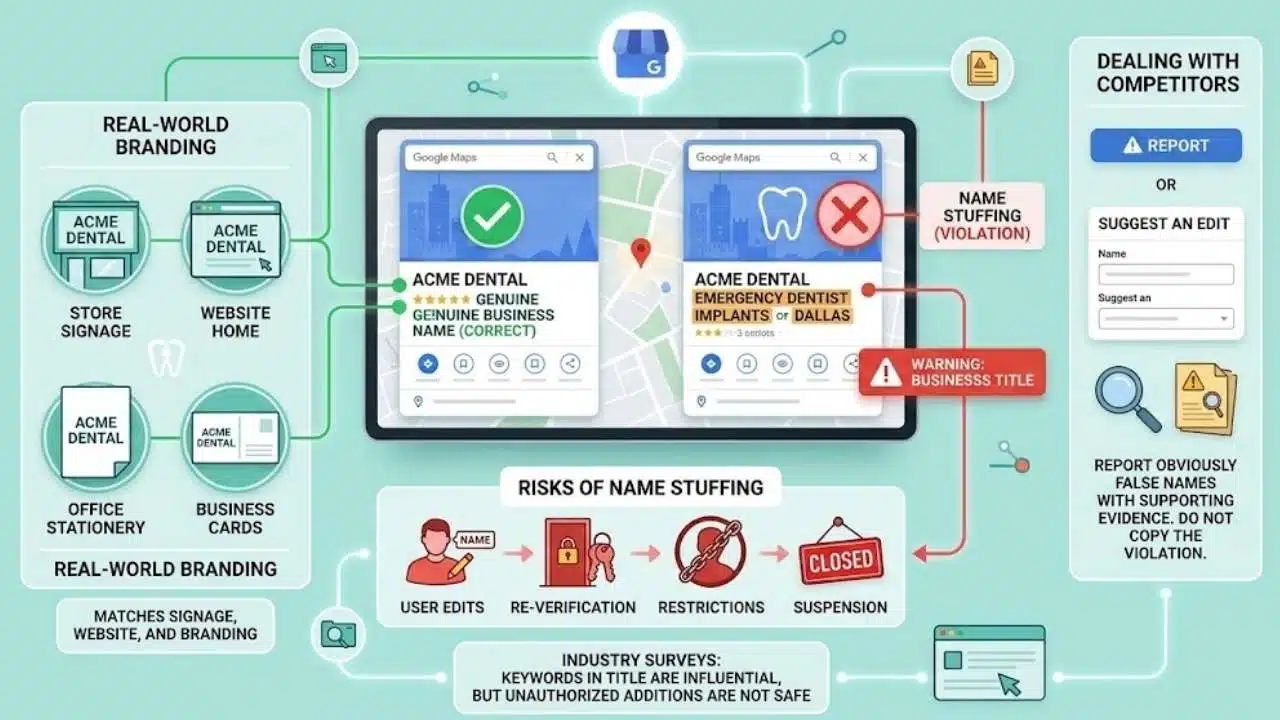
A profile for “Acme Dental” should not become “Acme Dental Emergency Dentist Implants Dallas” because those phrases attract searches. Google requires the profile name to match the name used on signage, the website, stationery, and other real-world branding.
Industry surveys continue to rate keywords in the business title as influential. That does not make unauthorized additions safe. Name stuffing can lead to user edits, re-verification, restrictions, or suspension.
If a competitor is using an obviously false name, report or suggest an edit with supporting evidence. Copying the violation only creates another vulnerable profile.
4. Review Rating, Quantity, Recency, and Authenticity
Google confirms that more reviews and positive ratings can improve local ranking. Reviews also influence whether customers choose the business once it appears.
There is no universal number to aim for. A bakery, hotel, law firm, and plumbing company face very different review environments. Compare the business with legitimate competitors in the same category and market rather than chasing an arbitrary target.
A credible review profile normally grows steadily. It includes recent feedback, varied comments from real customers, and a rating that reflects the service delivered. A sudden burst followed by months of silence is less useful than a routine request process tied to completed transactions.
Businesses may request honest reviews using a Google review link or QR code. Payments, discounts, free products, and other incentives are prohibited. Google also bans review gating—discouraging unhappy customers while asking only likely supporters to post publicly.
Do not require five stars or tell customers which words to include. Review replies should address the person, not serve as another place to repeat search terms.
5. Complete and Accurate Profile Information
Google says businesses with complete, current information are more likely to appear for relevant searches. At minimum, check:
- Business name and categories
- Address or service area
- Phone number and website
- Regular, holiday, and seasonal hours
- Services and applicable attributes
- Appointment, ordering, or menu links
- Representative photos and videos
Not every completed field is an independent ranking signal. A parking attribute may help a customer without changing the business’s position.
Photos deserve the same restraint. Clear images of the storefront, staff, products, or completed work can build trust. Uploading files on a rigid schedule should not take priority over categories, reviews, hours, or location accuracy.
Owners should also monitor their profiles. Google can propose or apply changes using public information, licensed data, and user contributions.
6. Accurate Hours and Open Status
Operating hours may affect more than customer convenience. Independent testing has found meaningful local ranking changes depending on whether a business is open when the search occurs. Open status also ranked highly in the 2026 Whitespark expert survey.
Google has not explained the precise strength of this signal across every industry, so it should not be treated as a guaranteed rule.
Regular, holiday, and seasonal hours must reflect when customers can genuinely receive service. A storefront marked open at 10 p.m. needs to be capable of serving someone who arrives then.
Claiming 24-hour availability solely for visibility can produce missed calls, wasted journeys, poor reviews, and policy trouble. Accurate hours remain the safer decision for both rankings and customers.
7. Local Landing Pages and Service Content
The website supports local relevance and carries particular weight in the organic results around or below the map pack. A useful location page should explain what customers can obtain there. Depending on the business, that may include services, hours, contact information, directions, nearby landmarks, staff details, service conditions, and original examples of completed work.
Multi-location companies generally need a page for each real location. Those pages should contain genuine differences. Copying the same text across dozens of pages and replacing only the city name gives readers little reason to use them.
Service pages need substance too. A roof-repair page should explain which problems are handled, how estimates work, any service limitations, and where help is available. “Best Roof Repair in Phoenix” is a claim, not useful information.
Each Business Profile should link to its most relevant page. A national company should usually send customers to the appropriate location page rather than its corporate homepage.
8. Relevant Links and Local Prominence
Google describes prominence as how well known a business is and specifically mentions links and reviews. Useful local links often come from relationships that exist beyond SEO: chambers of commerce, suppliers, trade associations, professional bodies, community organizations, local news coverage, and relevant business partners.
A genuine link from a respected local publication is more valuable than hundreds of automated directory pages. Bulk citation packages often produce listings that receive no meaningful traffic and may preserve outdated information.
Prominence takes time because it reflects reputation, customer interest, partnerships, and recognition. Publishing generic articles every week cannot replace those things.
9. Consistent Information Across Important Sources
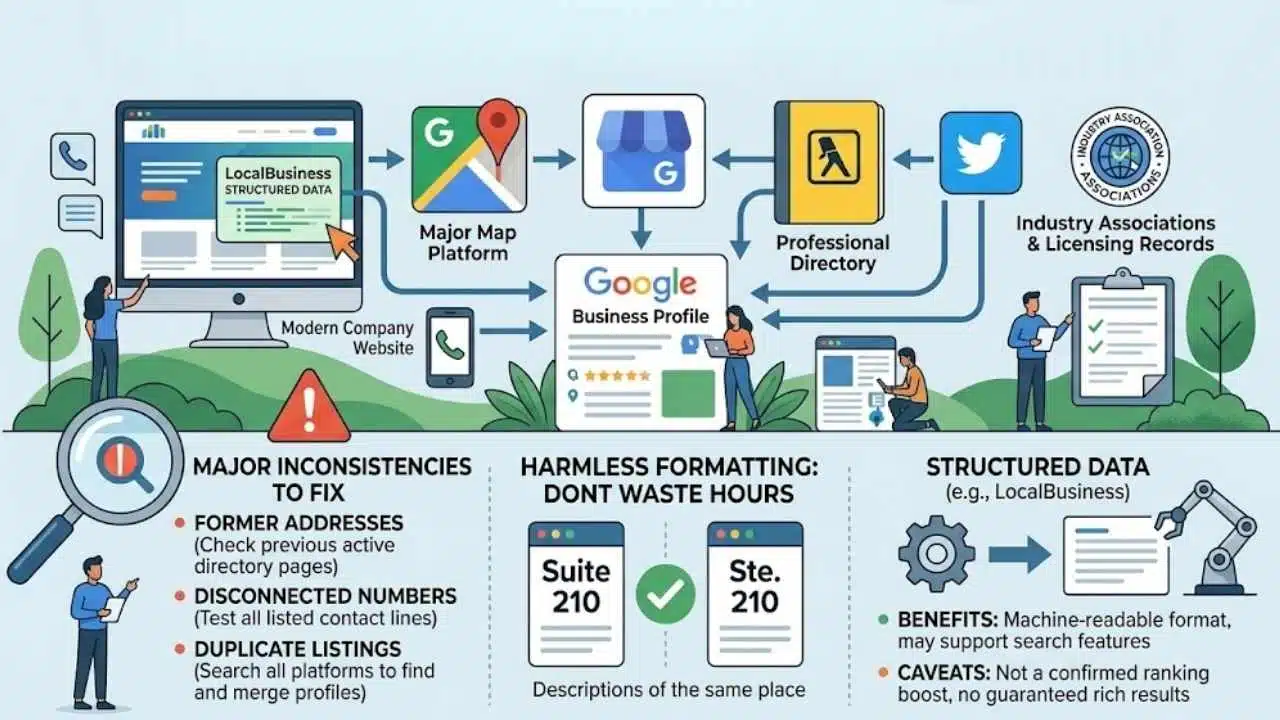
Google builds local business information from profiles, official websites, public data, third-party providers, and user contributions. Check the sources customers are most likely to encounter: the company website, major map platforms, professional directories, social profiles, industry associations, and licensing records where relevant. Correct former addresses, disconnected numbers, duplicate listings, and materially different business names.
Do not waste hours standardizing harmless formatting. “Suite 210” and “Ste. 210” describe the same place. An active directory page showing the company’s previous location is the more serious problem.
LocalBusiness structured data can present business details in a machine-readable format and may support certain search features. It is not a confirmed local ranking boost, and valid markup does not guarantee a rich result.
10. Eligibility, Verification, and Policy Compliance
Eligibility is not a conventional ranking signal, but it determines whether the rest of the work has a stable foundation. Google Business Profiles are generally intended for companies that serve customers in person at a location or travel to them. Online-only brands, lead-generation companies, remote mailboxes, and other ineligible operations do not become valid through optimization.
Eligible businesses should claim and verify their profiles, retain owner access, and add agencies as managers. Each real location should usually have one profile unless Google’s rules permit separate profiles for departments or public-facing practitioners.
Duplicate listings created to target extra cities or categories can cause display problems and increase suspension risk. A suspended profile cannot compete normally, regardless of its reviews or website authority.
A Practical Starting Order
Start with the details that define the business: eligibility, ownership, name, primary category, address, map pin, phone number, and hours. Fixing those matters more than publishing another Google Post.
Next, complete the remaining profile information and establish a policy-compliant review request process. Improve the location or service page linked from the profile, correct serious data conflicts, and then pursue relevant local links.
Measure calls, bookings, direction requests, qualified leads, and visibility across the real market—not one ranking checked from one desk. A top position for an obscure phrase has little value if it produces no customers.
Working with local search ranking factors is mostly about removing ambiguity. Google should be able to understand what the business is, where it operates, when it is available, and why customers consider it credible.
Frequently Asked Questions
Do Google Business Profile posts improve local rankings?
Google does not identify frequent posting as a major direct ranking factor. Posts can communicate offers, events, and current information, but they should come after categories, reviews, hours, website content, and inaccurate business data.
Can paying for Google Ads improve local rankings?
No. Advertising can buy paid visibility, but Google states that businesses cannot request or pay for better unpaid local rankings. Measure ad performance and organic local visibility separately.
How long do Business Profile changes take to appear?
Current Google guidance says profile edits can take up to three days to affect search results, while rankings for a new business may take up to a month to appear. Service-area edits may take up to 48 hours to display. Reviews, links, and website improvements have no guaranteed timetable.






















