Social media has become an essential part of our lives, allowing us to share updates, thoughts, and experiences in real time. However, after an accident, a simple post, comment, or even a like can have serious legal consequences.
Many people don’t realize that their social media activity can be used as evidence in personal injury claims, criminal cases, and insurance settlements.
The legal landscape surrounding social media evidence is constantly evolving. Recent cases have demonstrated that even deleted content can resurface in court. In this article, we will explore the legal consequences of social media posts after an accident, how they can impact your case, and best practices for protecting yourself online.
How Social Media Posts Can Affect Your Accident Case?
In today’s digital age, social media platforms have become a primary means of communication and self-expression. However, what you post online after an accident can have serious legal consequences.
Whether it’s a seemingly harmless status update or a shared photo, these digital footprints can be used as evidence against you in legal proceedings. Understanding the potential risks and how social media activity is monitored can make a significant difference in the outcome of your case.
Impact on Personal Injury Claims
If you are filing a personal injury claim after an accident, your social media activity can be used against you. Insurance companies and defense lawyers actively monitor claimants’ profiles to find inconsistencies that may weaken their cases.
How Social Media Can Harm Your Personal Injury Claim:
| Factor | Impact |
| Contradictory Statements | If you claim severe injuries but post pictures of yourself engaging in physical activities, your credibility may be questioned. |
| Check-Ins and Location Tags | Visiting places that suggest you are in good health can be used as evidence that your injuries are not as severe as you claim. |
| Photos and Videos | Any visual content that contradicts your statements about pain or disability can reduce your compensation. |
| Comments and Conversations | Engaging in discussions about your accident online can be used to challenge your official statements. |
Legal Risks in Criminal Cases
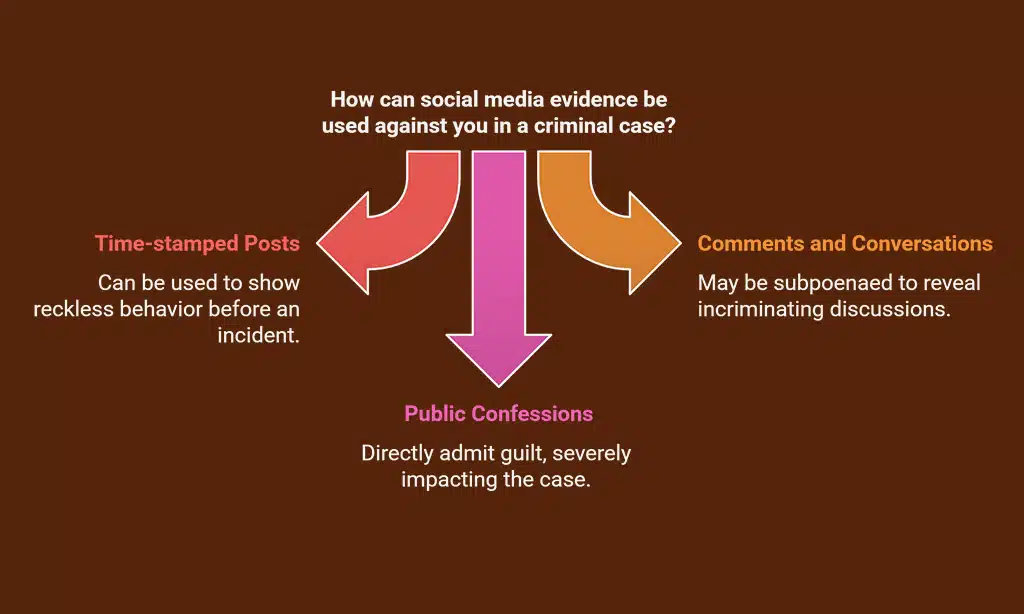
When facing potential criminal charges after an accident, such as a DUI or reckless driving, every social media post can become critical evidence. The legal consequences of social media posts after an accident can be severe, as prosecutors and investigators often analyze digital footprints to establish fault and intent.
Even seemingly harmless interactions, like responding to comments or sharing related content, can be misinterpreted and used against you in court.
How Prosecutors Use Social Media:
| Evidence Type | How It Can Be Used Against You |
| Time-stamped Posts | If you posted about drinking or reckless behavior before the accident, prosecutors might use it as evidence against you. |
| Comments and Conversations | Even private messages discussing the accident can be subpoenaed and used in court. |
| Public Confessions | Posting something like “I can’t believe I crashed my car last night” can severely impact your case. |
Influence on Settlement Negotiations
The legal consequences of social media posts after an accident extend beyond just court proceedings; they also impact settlement negotiations. Insurance companies and legal teams often scrutinize social media activity to find reasons to minimize payouts.
Even a single post showing you engaged in activities that seem inconsistent with your injury claims can weaken your negotiating position. Understanding how insurers leverage social media can help you avoid costly mistakes.
| Strategy Used by Insurers | Potential Impact on Settlement |
| Monitoring Claimants’ Profiles | Insurers may use your social media to argue that your injuries are exaggerated. |
| Finding Inconsistent Statements | If they find content that contradicts your claims, they may offer a lower settlement or deny your claim. |
| Surveillance and Tracking | Location tags and activity check-ins can be used to undermine your case. |
Legal Precedents and Court Rulings on Social Media Evidence
As social media has evolved, so has its role in the courtroom. Courts worldwide increasingly accept digital content as legitimate evidence in legal proceedings. This trend highlights the importance of being mindful about what is shared online, as even a simple post can shape the outcome of an accident case.
Below are some real-life case studies demonstrating the impact of social media on legal rulings.
Case Studies Where Social Media Impacted Verdicts
The legal consequences of social media posts after an accident are evident in numerous real-world cases. Courts have repeatedly demonstrated that digital content can serve as a key piece of evidence, influencing verdicts in both civil and criminal cases. Below are some notable examples of how social media activity has shaped legal outcomes.
| Case | Key Takeaway |
| Smith v. Johnson | Plaintiff’s vacation photos posted after claiming disability led to reduced compensation. |
| Doe v. ABC Insurance | Private messages discussing accident details were admitted as evidence, impacting the claim. |
| State v. Roberts | Defendant’s post-accident tweets were used to prove reckless behavior before the crash. |
How Courts Treat Social Media as Admissible Evidence?
The legal consequences of social media posts after an accident extend to court proceedings, where such content is often considered admissible evidence. Many courts have ruled that social media content is not protected by privacy laws if it is publicly accessible.
Judges increasingly allow social media posts, comments, and even deleted content to be used as evidence to assess credibility, intent, and liability. Understanding how courts treat social media evidence can help individuals navigate legal challenges more effectively.
| Legal Consideration | Court Ruling |
| Public Posts | If your social media account is public, anything you post can be used in court. |
| Private Accounts | Even private posts and messages can be subpoenaed during legal proceedings. |
| Metadata Tracking | Courts can request timestamp and location data to verify claims. |
What Not to Post on Social Media After an Accident?

The legal consequences of social media posts after an accident can be severe, and what you share online may directly impact your case. While it may feel natural to update friends and family about your situation, even seemingly innocent posts can be misinterpreted or used as evidence against you.
To protect yourself, it is crucial to understand what should be avoided on social media after an accident.
Types of Posts That Can Harm Your Case
After an accident, your social media activity can significantly impact your legal standing. Even the most innocent post can be misinterpreted and used to undermine your claim. Whether it’s a status update, a comment, or a shared photo, every online action has the potential to affect your case negatively. Understanding the risks and knowing what to avoid is essential to protecting your legal interests.
Avoid posting any of the following content after an accident:
| Type of Post | Why It’s Harmful |
| Statements about the accident | Anything you say can be misinterpreted or used against you. |
| Details about injuries or recovery | If you claim severe pain but post about feeling fine, it may weaken your case. |
| Photos or videos of activities | Even casual activities may suggest that your injuries are not serious. |
| Complaints about the legal process | Negative posts about the insurance company, legal system, or other parties can harm negotiations. |
The Role of Privacy Settings – Do They Really Protect You?
Many users assume that enabling privacy settings on their social media accounts will shield their content from scrutiny. However, the legal consequences of social media posts after an accident remain a concern, even with the strictest privacy measures.
Insurance adjusters, opposing attorneys, and investigators can still access private posts through legal means or third-party sources. Understanding how privacy settings function and their limitations can help you make informed decisions about your online activity after an accident.
While privacy settings may help limit who sees your posts, they do not guarantee complete protection.
| Misconception | Reality |
| Private Accounts Are Safe | Friends Can Screenshot Content and Share It. |
| Investigators Cannot Access My Posts | Lawyers and insurance companies may request legal access. |
| Deleted Posts Are Gone Forever | Data Retention Policies Keep Records That Can Be Retrieved. |
Best Practices for Managing Social Media After an Accident
Navigating the legal consequences of social media posts after an accident requires a proactive approach. Social media platforms are constantly monitored by insurance companies, attorneys, and law enforcement agencies.
Even a minor online interaction can be misinterpreted and negatively impact your case. By following best practices, you can protect your rights and prevent social media from being used against you.
Steps to Protect Your Legal Interests
Follow these best practices to avoid jeopardizing your case:
- Stop Posting About the Accident: Do not discuss any details online.
- Adjust Privacy Settings: Limit who can see your posts and prevent tagging.
- Avoid Checking In or Sharing Locations: This can be used to track your movements.
- Do Not Accept New Friend Requests: Investigators may use fake profiles to access your content.
- Inform Friends and Family: Ask them not to post about the accident or tag you in posts.
Wrap Up
The legal consequences of social media posts after an accident can be severe, affecting everything from personal injury claims to criminal cases and settlement negotiations.
Even a seemingly harmless post can be used against you in court. The best course of action is to avoid discussing the accident online and consult with a lawyer to ensure you don’t unknowingly harm your case.
By following best practices and being mindful of your social media activity, you can protect your legal rights and secure a fair outcome in your case.