

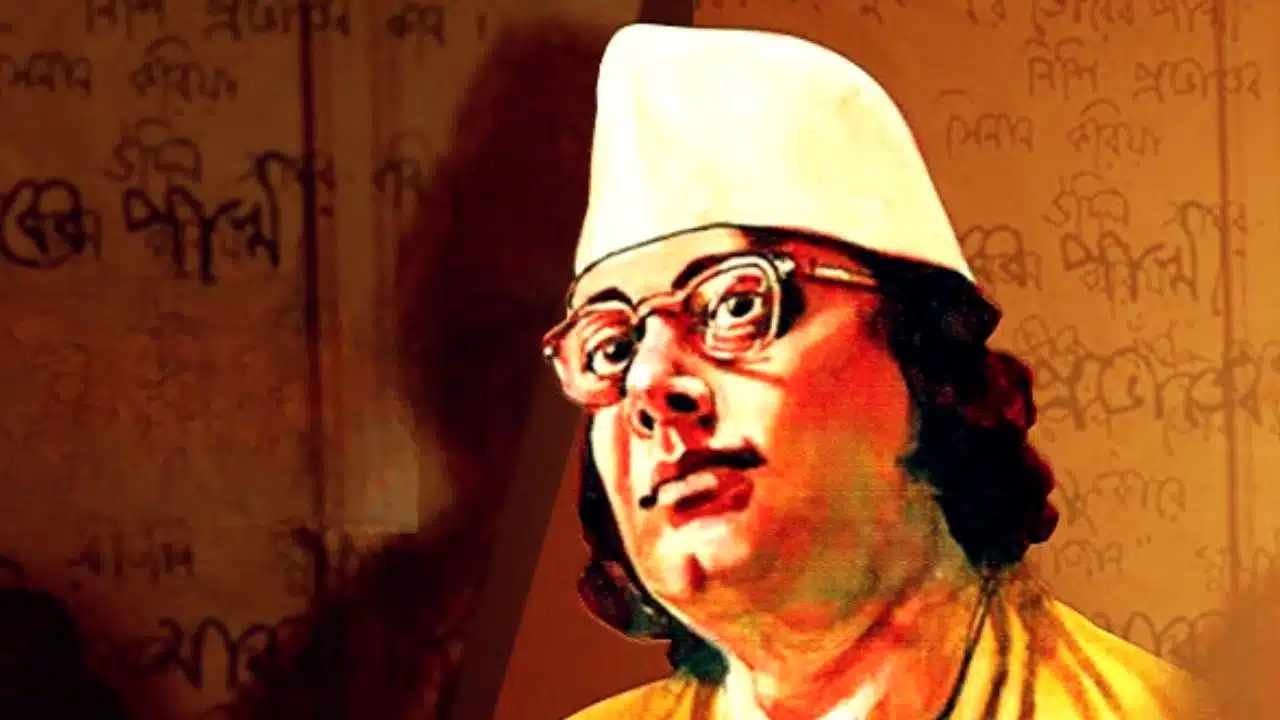
Today, the nation observes the 49th death anniversary of Kazi Nazrul Islam, the national poet of Bangladesh. Known across Bengal as the Bidrohi Kobi (Rebel Poet), Nazrul was not only a poet but also a lyricist, musician, journalist, philosopher, and revolutionary thinker. His fiery verses, soulful songs, and fearless activism made him one of the most influential cultural figures in South Asia.
On this day, cultural organizations, universities, and literary circles across Bangladesh and West Bengal remember him with recitations, musical programs, and discussions. His grave, located beside the central mosque of the University of Dhaka, has become a symbol of respect and homage to a man who shaped modern Bengali identity.
Early Life and Childhood Struggles
Kazi Nazrul Islam was born on Jyaishtha 11, 1306 in the Bengali calendar (May 24, 1899) in Churulia village, Burdwan district of West Bengal, then under British India. He came from a modest family; his father was a mosque caretaker, and poverty forced young Nazrul to take up small jobs, including working as a muezzin (mosque caller).
As a child, he joined a rural theatre group (leto dal), where he learned to act, sing, and write. These early experiences gave him exposure to Bengali folk culture, Islamic devotional songs, and Hindu epics—all of which later influenced his writing. Despite leaving school several times due to financial hardship, his passion for literature and music never faded.
Army Years and Awakening as a Writer
In 1917, at the age of 18, Nazrul joined the British Indian Army as a non-commissioned officer. He was posted to Karachi, where he spent nearly three years during the First World War. The military life exposed him to discipline, global politics, and the injustices of colonial rule. It was during this time that he began writing poems and short stories that reflected his observations of oppression and inequality.
After leaving the army in 1920, he moved to Calcutta, where he fully dedicated himself to literature and journalism. His arrival in the city marked the beginning of a new era in Bengali literary history.
Rise of the Rebel Poet
Nazrul’s breakthrough came in 1922 with the publication of his iconic poem Bidrohi (The Rebel). The poem, with its thunderous tone and imagery, symbolized defiance against tyranny and became a rallying cry for freedom. It established him as the “Rebel Poet” and secured his place among the leading voices of Bengal.
The same year, he launched his own magazine, Dhumketu (The Comet). Through fiery editorials, poems, and essays, Nazrul criticized British rule, exposed social inequalities, and called for justice. His writings quickly caught the attention of colonial authorities. In 1923, he was arrested for sedition after publishing the poem Anandamayeer Agomone.
Defiance in Prison
Imprisonment did not silence him. In jail, he continued to write powerful works such as Rajbandir Jabanbandi (Deposition of a Political Prisoner). He also went on a hunger strike that lasted nearly 40 days, demanding fair treatment for political prisoners. His health suffered, but his determination made him a symbol of courage and resistance.
Throughout the 1920s, many of his works were banned by the British administration. But censorship only made him more popular among the youth and political activists who saw him as a fearless voice for freedom.
A Multifaceted Literary Genius
Though remembered mainly as a revolutionary poet, Nazrul’s writings were not confined to politics. He explored themes of love, romance, devotion, and spirituality with equal passion. His works often merged Islamic and Hindu traditions, reflecting his secular vision.
-
His romantic poems and ghazals showcased tenderness and lyrical beauty.
-
His devotional songs—whether dedicated to Allah or to Hindu deities—brought communities together.
-
His essays and stories dealt with issues like women’s rights, poverty, and human dignity.
Nazrul also introduced Arabic, Persian, and Urdu words into Bengali literature, expanding the language’s richness and modernity. His bold experimentation with vocabulary and rhythm opened new literary horizons.
Nazrul Gīti—A Treasure of Music
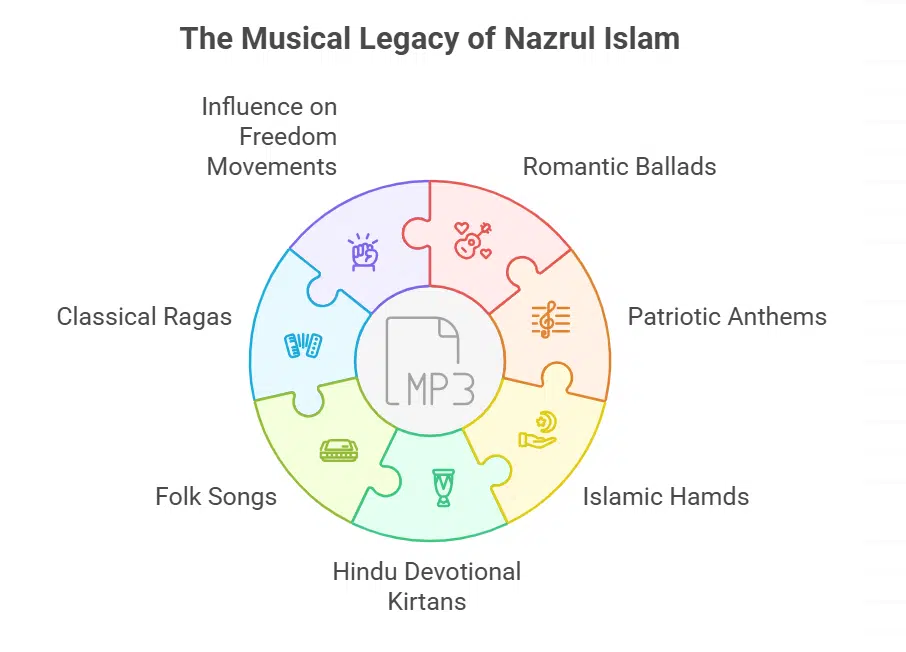
One of Nazrul’s greatest contributions was his music. He composed and wrote more than 2,400 songs, now collectively known as Nazrul Gīti. These songs span a wide variety of genres—romantic ballads, patriotic anthems, Islamic hamds, Hindu devotional kirtans, folk songs, and even classical ragas.
He often composed the tunes himself, creating melodies that were both original and deeply rooted in tradition. In the 1930s, the famous record label HMV hired him as a lyricist, and later, he worked with All India Radio, cementing his place as one of the most versatile figures in South Asian music.
His songs inspired the people of Bengal during the freedom movement against British rule and later played a key role in fueling the spirit of the Bangladesh Liberation War in 1971.
Illness and Silent Years
In 1942, Nazrul’s life took a tragic turn when he developed a rare neurological disorder, later identified as Pick’s disease. The illness slowly robbed him of his voice, memory, and ability to write. Despite treatments in India, London, and Vienna, his health never recovered. For the last three decades of his life, he remained mostly silent, a heartbreaking contrast to his once-thunderous voice.
Arrival in Independent Bangladesh
After the War of Independence in 1971, the new government of Bangladesh decided to honor Nazrul, who had long been considered a national treasure. On May 24, 1972, with the consent of the Indian government, Sheikh Mujibur Rahman brought Nazrul and his family from Kolkata to Dhaka.
He was provided a residence in Dhanmondi, treated with the nation’s highest respect, and declared the National Poet of Bangladesh.
-
In 1974, Dhaka University awarded him an honorary D.Litt.
-
In January 1976, he was granted Bangladeshi citizenship.
-
In February 1976, he received the Ekushey Padak, the nation’s second-highest civilian award.
Death and Burial
Kazi Nazrul Islam passed away on August 29, 1976 (12 Bhadra 1383 Bengali year) in Dhaka. He was laid to rest beside the central mosque of Dhaka University, in accordance with his wish. His grave remains a site of national homage, often visited by students, writers, and admirers.
In 2009, a mausoleum designed by architect Muzharul Islam was inaugurated at his gravesite, further cementing the site as a place of cultural significance.
Everlasting Legacy
Nazrul’s influence goes far beyond literature. He was a revolutionary who fought against injustice, but also a humanist who promoted love, equality, and harmony. His secular outlook, blending Islamic and Hindu traditions, made him a symbol of unity in a region often divided by faith.
- His poems inspired freedom fighters.
- His songs uplifted hearts during struggles for independence.
- His ideas continue to inspire movements for democracy and social justice.
Even today, in a world battling inequality, extremism, and intolerance, Nazrul’s words remain relevant. His vision of a just society, free from oppression and discrimination, continues to inspire younger generations in Bangladesh, India, and across the globe.
As Bangladesh remembers Kazi Nazrul Islam on his 49th death anniversary, the poet’s life continues to remind us of the power of words against tyranny and the healing force of music in times of despair. His message of love, equality, and defiance against oppression remains timeless. Nazrul was not just the poet of rebellion—he was the poet of humanity.
























