In the southern state of Karnataka, which is governed by Prime Minister Narendra Modi’s Bharatiya Janata Party, an Indian court has upheld a prohibition on wearing the hijab in class (BJP).
In a ruling issued on Tuesday, Chief Justice Ritu Raj Awasthi of the Karnataka High Court stated, “We are of the considered judgment that wearing of hijab by Muslim women does not form a part of important religious practice.”
He claimed that the government had the authority to issue standard guidelines, and he dismissed many petitions opposing the decision.
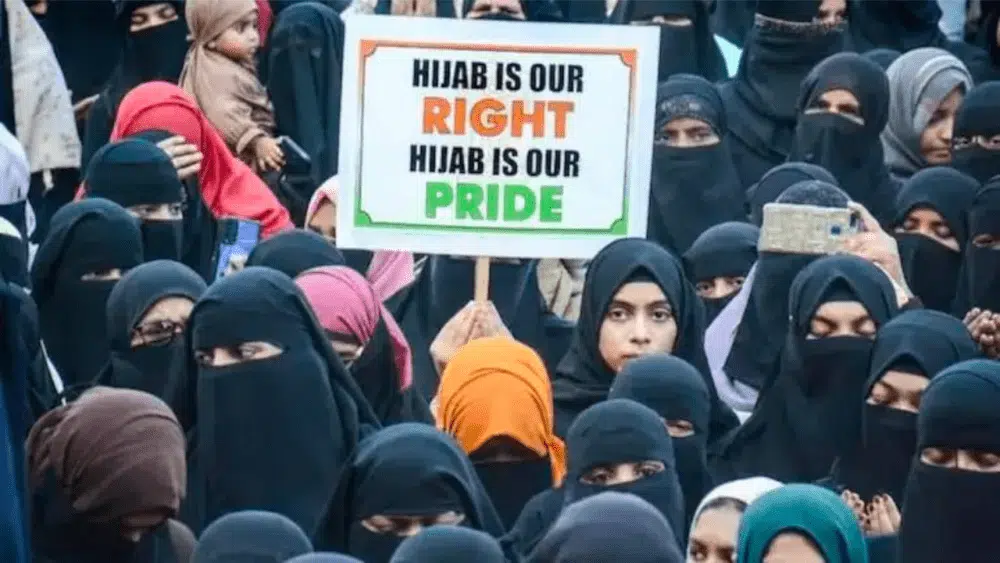
Wearing the hijab is a fundamental right granted by India’s constitution and integral practice of Islam, according to students who challenged the ban in court.
The Karnataka court’s verdict was “disappointing” and “erroneous,” according to lawyer Anas Tanwir, who said he will defend the girls in their appeal to the Supreme Court.
He told News Media, “I feel it is an erroneous interpretation of the law.”
“In terms of fundamental religious practice, [that] should not have been a question. The question should have been whether such directives could be issued by the [authorities].”
The verdict on Tuesday might create a precedent for the remainder of the country, which is home to more than 200 million Muslims, or nearly 14% of India’s 1.35 billion people.
Currently, there is no national legislation or regulation governing school uniforms, but the Karnataka decision may push other states to do so.
Apartheid is ‘judicially sanctioned,’ according to the verdict.
The court’s decision is “extremely unsettling,” according to Afreen Fatima, a student activist with the Muslim group Fraternity Movement.
“It is a legal justification for apartheid.” It will create a troubling precedent and further marginalize Muslim women in educational settings. Its ramifications will be seen throughout the United States. It will encourage Hindu fanatics to denigrate Muslim women in public areas,” she told News Media.
The hijab controversy in Karnataka began in January when a government-run school in the state’s Udupi district prevented pupils wearing hijabs from attending classrooms, sparking Muslim protests and Hindu counter-protests.
More schools and colleges in the state followed suit, and the state’s highest court temporarily prohibited students from wearing the hijab until a decision was reached.
In India, the hijab has never been outlawed or restricted in public spaces.
Many people in Karnataka believe that Muslim girls have been wearing the hijab in schools and universities for decades, just as Hindus, Sikhs, and Christians have done with their various symbols.
The court’s verdict was “unconstitutional,” according to Syed Sarfraz, the Karnataka state secretary of the Campus Front of India, a Muslim students’ association.
He told News Media, “The legal struggle against the hijab ban will continue.”
“The court’s decision that hijab is not an important Islamic practice astounds us. It is not up to them to make the decision. In the Quran, the hijab is clearly mandated.”
The hijab controversy has sparked accusations that India’s Muslims are being marginalized even more.
To avoid potential unrest, Karnataka officials announced the closure of schools and colleges, as well as limitations on public gatherings in various areas of the state, ahead of the ruling.
Amit Shah, the federal home minister, said last month that he prefers pupils to wear school uniforms rather than religious garb.
The ban in Karnataka sparked protests across the country and garnered condemnation from the United States and the Organization of Islamic Cooperation.
Aysha Nourin, a 16-year-old student at RN Shetty PU College in Karnataka’s Kundapura town in the Udupi district, said the court judgment is “not acceptable” to her and that she will not compromise on “our hijab.”
“I and about 50 other students from my institution have not attended courses for more than a month, and others have missed examinations,” she told News Media.
“We should be able to choose what we wish to wear.” They have no authority over what we should or should not wear.”