


Shigeru Ishiba, Japan’s prime minister since October 2024, has announced his resignation after serving less than a year in office. His departure follows a dramatic collapse in the Liberal Democratic Party’s (LDP) political dominance, leaving Japan facing renewed uncertainty at home and abroad.
Ishiba’s government had already been under pressure following the loss of its lower house majority in the 2024 general election — the first time in 15 years the LDP failed to control that chamber. The situation worsened in July 2025 when the party also lost its majority in the upper house. These back-to-back setbacks signaled declining voter confidence in a party that has governed Japan almost continuously since 1955.
As calls for change grew inside the LDP, Ishiba faced the prospect of an internal leadership challenge. To avoid a divisive showdown within the party, he announced he would step aside, clearing the way for a successor to take charge.
The US Trade Deal as a Final Priority
Despite mounting criticism, Ishiba resisted resignation until a critical trade dispute with the United States was resolved. A preliminary agreement was signed with Washington just days before his announcement, easing tariffs that had been imposed on Japanese cars and other exports by President Donald Trump.
For Ishiba, the deal was a matter of national importance. The tariffs had threatened one of Japan’s most vital industries and were seen as a major test of the government’s economic management. By ensuring that an agreement was reached before leaving office, Ishiba aimed to secure a measure of stability in relations with the United States, Japan’s most important ally.
Domestic Economic Pressures
While international diplomacy was a focus, Ishiba’s domestic challenges proved more damaging to his political survival. Japan’s economy — the world’s fourth largest — has faced ongoing inflationary pressures. Rising costs for everyday goods hit households hard, with the doubling of rice prices in the past year becoming a potent symbol of the cost-of-living crisis.
The government’s failure to curb inflation undermined public trust, particularly among lower- and middle-income families already struggling with stagnant wages. Voters expected relief, but instead saw prices for food, energy, and housing climb further.
Political Controversies and Declining Popularity
Ishiba also struggled with political controversies that fueled perceptions of weak leadership. Critics pointed to his decision to appoint only two women to his cabinet, a move widely seen as failing to reflect Japan’s calls for greater gender equality in politics. Another damaging episode was his decision to distribute expensive gift certificates to party members. Although Ishiba insisted these gifts were from personal funds, the practice was perceived as an outdated and inappropriate gesture at a time when ordinary citizens faced rising living costs.
These issues eroded his approval ratings, which fell to record lows for a Japanese prime minister so soon after taking office. By mid-2025, surveys showed public support had collapsed to levels that made his continued leadership untenable.
A Party in Decline an the Rise of Rivals
 d
d
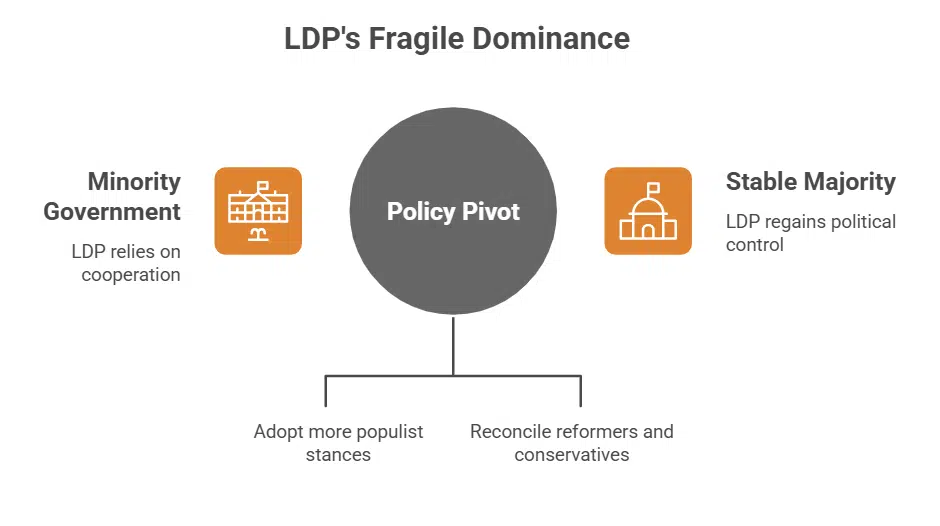
The LDP has dominated Japanese politics for most of the post-war period, but Ishiba’s tenure highlighted the fragility of that dominance. For the first time in decades, the party is forced to operate as a minority government, relying on cooperation from smaller opposition groups to pass legislation. This has emboldened rivals, including the populist Sanseito party, which has capitalized on voter frustration by presenting itself as a more forceful alternative.
Within the LDP, divisions deepened as lawmakers debated whether to stick with traditional policies or pivot toward more populist stances. Ishiba, known for his technocratic style, often appeared caught between these competing pressures, leaving both reformers and conservatives dissatisfied.
Who Could Succeed Ishiba?
The LDP will now hold a leadership election, with the winner set to become prime minister following a parliamentary vote. Several names have already emerged as frontrunners.
-
Sanae Takaichi, a former economic security minister, is viewed as a strong contender. If selected, she would become Japan’s first female prime minister. Takaichi is popular among conservative factions within the party and has built her reputation on security and defense issues.
-
Shinjiro Koizumi, the agriculture minister and son of former prime minister Junichiro Koizumi, is another leading candidate. He has gained attention for his handling of the rice price crisis and is seen as a younger figure capable of appealing to centrist and reform-minded voters.
-
Other senior party figures may also enter the race, but whoever wins will face the daunting task of restoring both the LDP’s credibility and Japan’s economic stability.
The leadership contest is expected to be hard-fought, as the party cannot afford further losses with public trust at historic lows.
International Implications
Japan’s political instability comes at a sensitive time for global relations. The country remains a key strategic partner for the United States in the Indo-Pacific region, particularly amid heightened tensions with China over Taiwan and disputed maritime territories. Ishiba’s resignation raises questions about continuity in foreign policy at a time when regional security concerns are intensifying.
Diplomats in Washington, Beijing, and Seoul will be closely watching the leadership transition in Tokyo, wary of any signs that Japan’s political volatility might weaken its ability to respond to regional crises.
A Turning Point in Japanese Politics
Shigeru Ishiba entered office in late 2024 promising to tackle inflation, stabilize relations with the United States, and strengthen Japan’s political system. Less than a year later, his government has collapsed under the weight of electoral defeats, economic turmoil, and declining confidence within his own party.
His resignation marks not only the end of his brief leadership but also a pivotal moment for Japanese politics. For the LDP, it is an opportunity to reset after losing control of both houses of parliament. For Japan, it is a moment of uncertainty as the country faces both domestic economic struggles and regional security challenges.
The next prime minister will inherit a nation looking for solutions to rising prices, political disillusionment, and an increasingly dangerous international environment. Whoever takes office will need to restore stability quickly — or risk further erosion of Japan’s long-standing political order.





















