

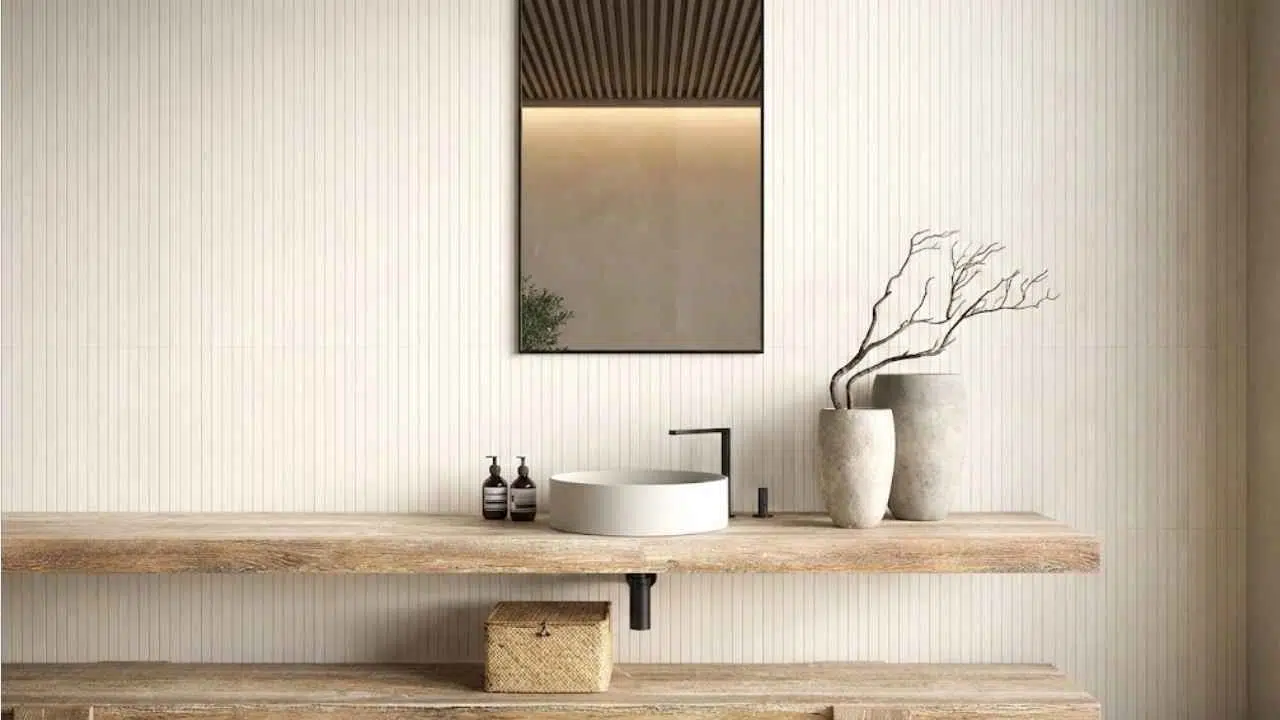
Architectural spaces are not neutral containers. They influence how people move, pause, interact, and perceive their surroundings. While volumes and layouts define the structure of a space, surfaces play a crucial role in shaping how that space is experienced daily. Floors and walls guide movement, suggest boundaries, and affect comfort, often in ways that are subtle but decisive.
Within this perspective, surface choices become tools for influencing spatial behavior. Italian porcelain tiles, in particular, are often selected not for visual impact alone, but for their ability to support controlled, intuitive environments. Through continuity, material consistency, and measured expression, these surfaces contribute to spaces that feel natural to inhabit, easy to navigate, and coherent over time.
Surfaces as active elements in spatial experience
Surfaces actively participate in the way architecture is used. The materials chosen for floors and walls influence how people enter a space, how long they remain in certain areas, and how they move between functions. A continuous surface can encourage fluid circulation, while abrupt changes may signal transitions or boundaries.
Porcelain tiles support this spatial logic by offering visual stability and material clarity. Their presence is constant without being intrusive, allowing users to focus on the space itself rather than on the material. In this way, surfaces become silent guides, reinforcing the intended use of an environment without explicit direction.
Continuity and movement within architectural space
Movement through space is often shaped by continuity. When surfaces remain consistent across rooms or zones, transitions feel natural and uninterrupted. This visual alignment supports a sense of orientation, helping users intuitively understand how spaces connect.
Italian porcelain tiles are particularly effective in this role, as they allow for coherent surface applications across different functions and scales. By reducing fragmentation, they help architecture maintain a clear flow, whether in residential interiors, public buildings, or commercial environments. The result is a spatial experience that feels fluid rather than segmented, where movement follows logic instead of impulse.
Texture, light, and interaction with space
Spatial behavior is also influenced by the way materials interact with light and touch. Texture affects comfort and perception, while light reveals or softens material presence. Surfaces that are overly expressive can distract from spatial clarity, while controlled finishes support a more balanced experience.
Porcelain tiles interpret texture and finish with restraint. Matte and softly textured surfaces interact predictably with natural and artificial light, reducing glare and visual noise. This measured approach enhances comfort and orientation, allowing spaces to be experienced calmly and intuitively. Users engage with the environment without being overstimulated by the material itself.
The Italian porcelain approach to spatial control
The Italian approach to porcelain surfaces is rooted in a broader culture of spatial awareness. Rather than treating surfaces as decorative elements, this approach considers how materials influence use, perception, and behavior. The focus is on control rather than emphasis.
Italian porcelain tiles are developed to support everyday interaction with space. Their consistency, durability, and visual balance allow architecture to guide behavior subtly, without imposing rigid cues. Surfaces become part of the spatial strategy, reinforcing how environments are meant to be lived rather than simply observed.
Designing environments shaped by material awareness
Spaces shaped by thoughtful material choices tend to feel intuitive and enduring. When surfaces are selected with awareness of their behavioral impact, architecture becomes easier to use and more comfortable to inhabit.
Italian porcelain tiles contribute to this quality by acting as a stable framework for spatial experience. They support movement, enhance clarity, and maintain balance over time. In projects where surface choices are aligned with spatial intent, materials do more than finish a space – they help define how it is lived, day after day.
A surface culture shaped by research and project awareness: Ceramiche Keope
Since its establishment in 1995, Ceramiche Keope has cultivated a design culture grounded in observation, research, and a deep understanding of how architectural projects evolve. As part of the Concorde Group, the company operates within a solid industrial framework while maintaining a design-driven mindset that places project awareness at the center of surface development.
Continuous investment in research and production technologies allows Ceramiche Keope to anticipate architectural needs and translate them into reliable porcelain solutions for contemporary spaces.
Rather than responding to trends in isolation, the company approaches each collection as the result of an ongoing dialogue between material, space, and use. This sensitivity to context supports architects and designers working across a wide range of environments, from private residences to commercial, cultural, and hospitality projects.
Coordinated collections, available in multiple sizes, thicknesses, and finishes, provide the flexibility required to manage transitions between floors and walls, indoor and outdoor areas, while preserving design coherence.
Ceramiche Keope’s collections express this research-driven approach through a rich yet controlled aesthetic vocabulary. Marble-look surfaces reinterpret classic elegance with depth and refined veining, while wood-effect tiles introduce warmth and natural tactility. Stone, metal, resin, and concrete inspirations expand the expressive possibilities, offering designers a versatile palette to shape spaces with clarity and intent. Each surface is conceived to contribute to a broader architectural narrative rather than stand out as an isolated element.
This project-oriented culture is reinforced by a responsible industrial model. Production processes prioritize efficiency and circularity, with full recovery of fired scraps and complete reuse of water and raw material residues. Around 75% of energy needs are met through in-house generation, with the remainder sourced exclusively from certified renewable suppliers.
International certifications such as ISO 17889, WELL Building Standard V2, and Declare confirm an approach in which research, environmental responsibility, and architectural relevance are intrinsically connected.





















