

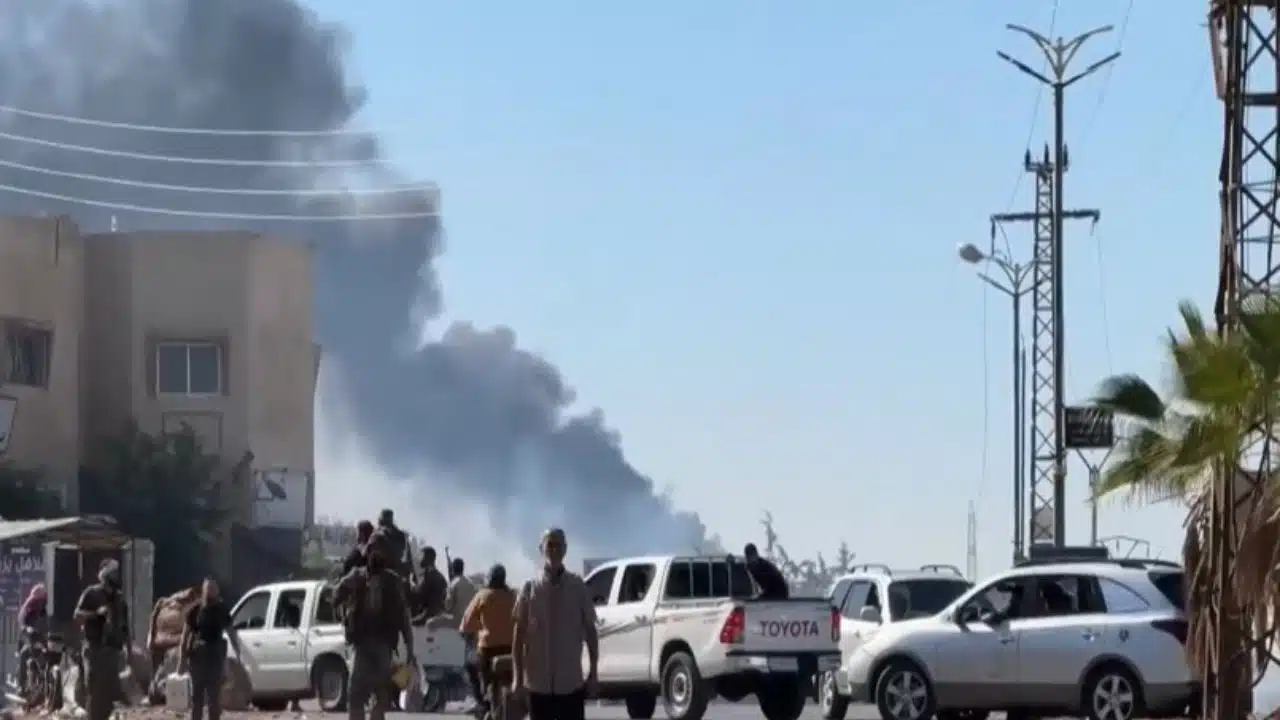
In a significant escalation of regional tensions, Israel launched airstrikes on Syrian government military units that were advancing toward the city of Sweida, a Druze-majority city in southern Syria. The strikes come amid violent ethnic clashes in the region and mark a rare direct military confrontation between Israel and forces loyal to the Syrian government, which is currently under new Islamist leadership.
The Israeli government stated that its actions were aimed at protecting the Druze minority community in Sweida, citing deep historical and familial ties between Israel’s Druze citizens and the Druze population in Syria. The military operation was also framed as a strategic move to uphold the demilitarization agreement in southern Syria, which aims to prevent any buildup of weapons or troops near the Israeli border.
What Triggered the Israeli Airstrikes?
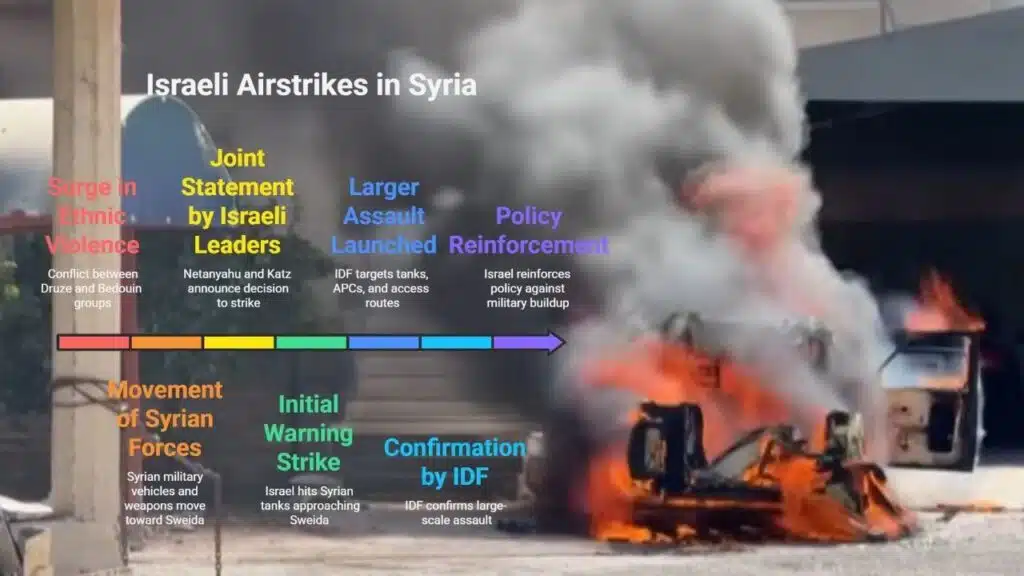
The decision to strike Syrian targets was announced in a joint statement by Israeli Prime Minister Benjamin Netanyahu and Defense Minister Israel Katz. The statement explained that the strikes were ordered after Syrian military vehicles and weapons began moving toward Sweida during a surge in ethnic violence between Druze residents and Bedouin tribal groups.
Following the attack on the Druze,” the Israeli leaders said, “we instructed the Israel Defense Forces (IDF) to strike Syrian forces and arms convoys advancing toward Sweida.
This followed an earlier warning strike where Israel hit several Syrian tanks approaching the area. The Israeli Defense Forces later confirmed that a much larger assault had been launched targeting:
- Tanks
- Armored personnel carriers
- Multiple rocket launchers
- Access routes used by Syrian troops
According to a senior Israeli defense official, the strikes were “exceptionally large-scale” and intended to reinforce Israel’s long-standing policy of preventing any military buildup in southern Syria — especially movements seen as threatening the Druze population or Israeli national security.
Unfolding Violence in Sweida: What’s Happening on the Ground?
The recent wave of violence in Sweida began on Sunday, when Bedouin militants reportedly abducted a Druze vegetable vendor from a local market. In retaliation, Druze factions carried out counter-kidnappings, and armed confrontations escalated quickly between both groups. These clashes rapidly spread into urban neighborhoods and surrounding areas.
The UK-based Syrian Observatory for Human Rights reported that at least 99 people have been killed in the violence so far, including:
- 60 Druze fighters and civilians
- 18 Bedouin militants
- 14 Syrian government soldiers
- 7 individuals whose identities remain unconfirmed
While these numbers have not yet been independently verified, they reflect the deadliest outbreak of intercommunal violence in Sweida in years.
Syrian Government’s Response and Ceasefire Declaration
In response to the mounting bloodshed, the Syrian government sent troops into Sweida in an attempt to restore order. However, the deployment quickly triggered concerns among Druze leaders and Israel alike.
Fighting briefly broke out between Syrian government soldiers and armed Druze factions, who have long held semi-autonomous control of Sweida and mistrust the Syrian central government—especially under its current interim Islamist leader, Ahmad al-Sharaa, who replaced Bashar al-Assad in December 2024.
On Tuesday, following Israeli strikes and pressure from community leaders, Syria’s Defense Minister Murhaf Abu Qasra announced a ceasefire, stating:
“To all units operating within the city of Sweida, we declare a complete ceasefire after an agreement with the city’s notables and dignitaries.”
Despite this declaration, tensions remain high. Local Druze leaders are split — some welcomed the ceasefire and government presence, while others remain skeptical, fearing renewed oppression or forced disarmament.
Druze Religious Leaders Divided Over Security Forces
Many Druze religious leaders and spiritual elders initially called on fighters to lay down arms and allow the Syrian army to enter peacefully to restore law and order. But not everyone agreed.
Sheikh Hikmat al-Hijri, a senior Druze cleric, rejected the government’s presence and instead issued a plea for international protection. He argued that the situation required external mediation, fearing that the Islamist-led government could eventually target the Druze population the same way other minorities were persecuted in previous years.
Israel’s Stance: Ties with the Druze and Border Policy
The Israeli leadership emphasized that their airstrikes were not just military actions, but part of a humanitarian and strategic mission to protect the Druze people in Syria and maintain the fragile security situation along the Israeli-Syrian border.
The joint statement from Netanyahu and Katz noted:
“Israel is committed to preventing harm to the Druze in Syria due to the deep brotherly alliance with our Druze citizens in Israel, and their familial and historical ties to the Druze in Syria.”
Israel views the entry of Syrian military forces and heavy weapons into southern Syria as a violation of the deconfliction and demilitarization agreements established over recent years — especially since these agreements are meant to prevent any armed threats close to Israeli territory.
The Israeli military said its strikes were carried out “based on the directives of the political echelon,” reinforcing the strategic nature of the operation rather than treating it as a one-off military engagement.
Druze Veterans in Israel Call for Support
The military intervention was also prompted by strong appeals from Israeli Druze veterans, who urged the government to take decisive action to defend their Syrian kin. The Association of Druze Discharged Soldiers and Reservists issued a statement that said:
“There is an unending series of massacres, kidnappings, looting, and harm to innocent civilians — women, children, and the elderly alike.”
They asked for both humanitarian and military assistance, suggesting that inaction would send a dangerous message to terrorist groups and weaken trust among Druze communities on both sides of the border.
Who Is Ahmad al-Sharaa and Why Are Minorities Concerned?
The new interim Syrian leader, Ahmad al-Sharaa, who replaced Bashar al-Assad last year, has been a polarizing figure. His Islamist policies and affiliations have raised alarms among religious and ethnic minorities, including Christians, Kurds, Alawites, and Druze.
Many Druze residents fear that under al-Sharaa’s rule, the central government could marginalize or even persecute communities seen as ideologically or religiously distinct.
This fear has intensified in Sweida, which has long operated as a semi-autonomous zone with minimal interference from Damascus, especially during Syria’s long civil war. Druze militias in Sweida have provided local security in the absence of government forces — and now feel that disarming would leave them vulnerable to potential atrocities.
As one resident, Amal, a 46-year-old Druze woman, told local media:
“We are not against the state, but we are against surrendering our weapons without a state that treats everyone the same.”
What Comes Next for Sweida and Southern Syria?
The situation in Sweida remains tense but temporarily calm under the declared ceasefire. However, the larger implications are clear:
- Israel has signaled it will intervene militarily to protect the Druze if necessary.
- The Syrian government, under new leadership, faces deep mistrust from minorities it seeks to control.
- The fragile demilitarization policy in southern Syria is being put to the test, with both local and regional consequences.
While the ceasefire may offer temporary relief, the future of Sweida — and of intercommunal relations in Syria’s southern regions — remains uncertain. The role of international actors, especially Israel, will likely continue to shape the security dynamics in the weeks and months ahead.
The Information is Collected from BBC and MSN.





















