

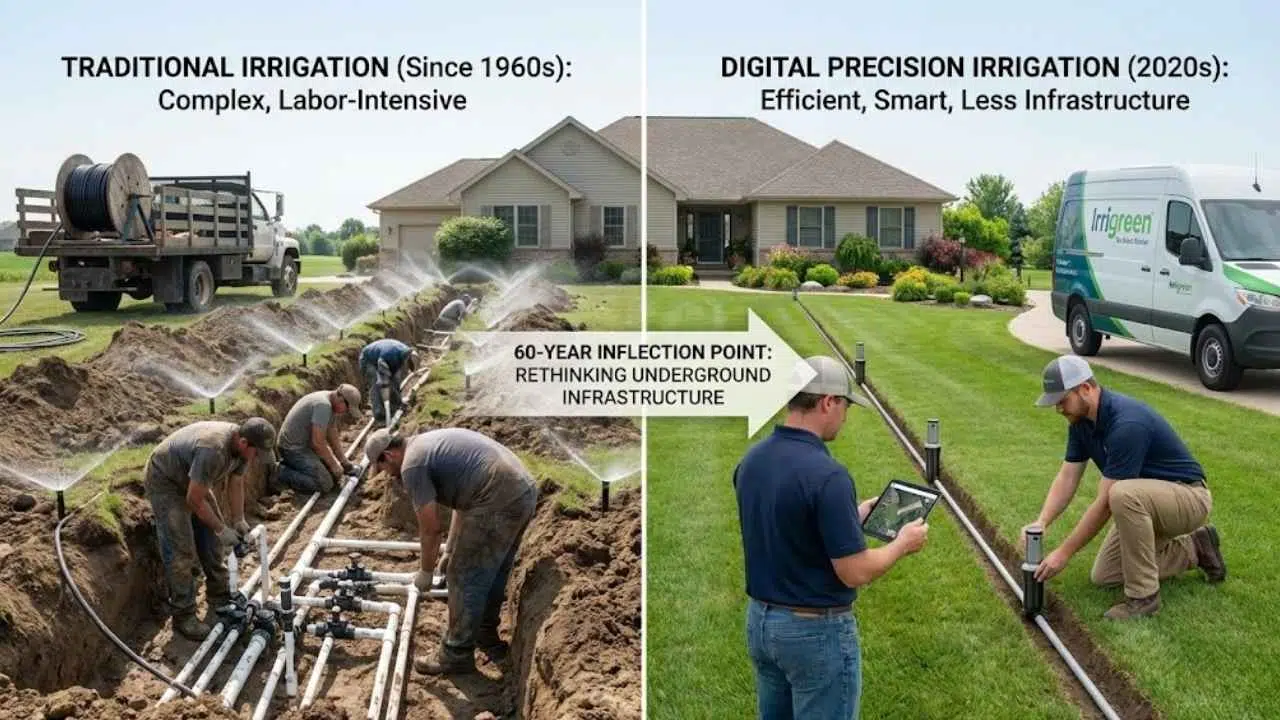
The irrigation contractor’s business model has remained unchanged since residential sprinkler systems became widespread in the 1960s. Install dozens of spray heads around property perimeters, connect them with extensive underground piping, wire multiple zone valves, and charge based on parts count and labor hours. More heads meant more profit. Complex installations with 40, 50, even 60 spray heads represented premium jobs justifying higher bids and longer timelines.
Then digital irrigation technology disrupted the math. When a single precision sprinkler head can replace six to ten traditional heads, the entire economic model shifts. Fewer components don’t mean less profit, they mean faster installations, lower material costs, and more jobs per season with the same crew. The transition hasn’t been immediate, but across the country, irrigation contractors are reconsidering assumptions that have defined their industry for over half a century.
The Infrastructure Paradigm That Defined an Industry
Traditional residential irrigation operates on overlapping coverage zones. Achieving uniform water distribution requires mechanical heads spaced so spray patterns overlap by at least 100%. The result is infrastructure density bordering on redundant. A typical 8,000 square foot lawn requires 40 to 50 fixed spray heads, each connected to underground PVC supply lines branching from multiple zone valves. Installation involves extensive trenching, often 300 to 500 feet of pipe runs.
The labor investment is substantial: three to four days for a competent two-person crew, with significant time devoted to trenching, laying pipe, making connections, and testing for leaks. Contractors built businesses around this component count, developing pricing structures that treated infrastructure density as inevitable rather than negotiable.
The Pro Select Partner Program: Irrigreen’s Contractor Support
Recognizing that technology alone wouldn’t drive adoption, Irrigreen developed a comprehensive contractor support program. The Pro Select Partner Program launched in 2024 and has expanded to all 50 U.S. states and Puerto Rico, representing fivefold growth in the contractor network year-over-year.
The three-tier structure rewards volume with progressively better discounts. Partners receive dedicated technical support through a Minnesota-based team, marketing co-op funds, and training resources. Most significantly, a self-service design portal allows contractors to quote jobs remotely using satellite imagery, dramatically reducing bidding time and eliminating guesswork around component counts.
Shane Dyer, CEO of Irrigreen, frames the contractor relationship as central: “Our partners are the backbone of Irrigreen’s next phase of growth… our goal is to make smart, sustainable, and precise irrigation as simple to sell and install as traditional systems.”
Installation Efficiency and the New Profit Model
The dramatic reduction in component count translates directly to time savings. Where traditional systems require extensive trenching to connect dozens of heads, precision irrigation typically needs six to eight heads for the same coverage. Contractors report typical residential installations taking one to two days compared to three to four days traditionally. This compression happens across phases: minimal trenching, fewer components to position, and simplified testing with fewer leak points.
Third-generation horizontal inlet design eliminates blind connections, installers visually confirm connections rather than working by feel. Bluetooth identification in each head allows instant configuration without referencing diagrams. Zone-agnostic heads mean no pre-programming during installation.
This efficiency shift forces contractors to reconceive profit models. Traditional pricing calculated profit through material markup and multi-day labor rates. With digital systems, labor hours drop significantly while material costs remain comparable per head (higher cost per unit, but far fewer units needed). Smart contractors recognize this favors profitability, completing jobs in two days instead of four means crew capacity doubles.
One contractor perspective captures this: installing only nine precision heads versus 40-plus traditional heads is “insane” efficiency. Even accounting for higher per-head costs, total material expense often matches traditional installations once all pipe, fittings, valves, and wire are factored. Labor savings, however, are unambiguous. This enables competitive pricing that maintains healthy margins through reduced labor investment.
Addressing Reliability Concerns
Contractor hesitation centers on reliability and warranty duration. Underground equipment failures are expensive, requiring excavation and landscape restoration. A two-year warranty feels short to professionals accustomed to components lasting five to ten years.
Irrigreen’s response combines transparency with responsive support. The company acknowledges earlier generations experienced growing pains, candor that builds credibility. Third-generation hardware addresses specific failure modes: SmartRinse technology preventing sediment buildup, horizontal inlets reducing connection stress, and modular designs enabling tool-free replacement.
Support infrastructure matters as much as hardware reliability. Same-day warranty replacement shipping and remote diagnostics reduce contractor exposure to extended liability. Extended warranty options provide additional security. Critically, the modular design means failures don’t require excavating entire assemblies, swap the malfunctioning module and resume operation.
The Business Case Beyond Individual Jobs
The transition presents advantages extending beyond job efficiency. Inventory management simplifies, stocking six to eight identical heads versus dozens of different fixed-pattern heads, nozzles, and valves. This frees capital and truck space while reducing supply chain complexity.
Training new installers becomes more straightforward when component count drops. A new crew member contributes productively to precision installations faster than mastering traditional overlap patterns and zone balancing. Marketing differentiation matters in commoditized industries, contractors offering precision irrigation position themselves as technology leaders rather than competing primarily on price.
Geographic adoption reveals market forces at work. Western and Southwestern states facing chronic water scarcity show disproportionate adoption. California, Arizona, Nevada, and Texas, where outdoor irrigation accounts for 50-70% of summer residential water consumption, see both homeowner demand and contractor interest exceed national averages.
Municipal water utility rebate programs amplify this trend. Several cities offer financial incentives for precision irrigation, recognizing that subsidizing residential efficiency costs less than supply-side infrastructure expansion. These rebates, sometimes covering several hundred dollars, improve the cost equation while creating marketing angles for contractors who navigate the application process.
Why Now? The 60-Year Inflection Point
This transformation is happening now due to converging factors. The smartphone revolution created an installed base of billions of handheld computers with GPS, cameras, and wireless connectivity, infrastructure making app-controlled irrigation practical. IoT hardware and software platforms matured, reducing smart device development costs. Cloud computing enables weather integration and remote access differentiating modern systems.
Simultaneously, water scarcity transformed from abstract concern to practical constraint. Western U.S. droughts, increasing water rates, and climate awareness created market receptivity to conservation technology. The contractor community’s willingness to reconsider established practices signals recognition that the industry faces a genuine inflection point. Those adapting to emphasize efficiency over component proliferation position themselves for growth in a water-constrained future.
Infrastructure Reimagined
The transformation in residential irrigation represents more than technological substitution, it’s a fundamental reimagining of what underground infrastructure should accomplish and how contractor businesses can thrive. For six decades, the industry optimized for dense networks of fixed-pattern sprinklers requiring extensive piping and component counts correlating with profitability. Digital precision irrigation proves less infrastructure can deliver superior results while improving contractor economics through time efficiency.
Contractors leading this transition aren’t abandoning core expertise, they’re applying installation skills and customer relationships to better technology. The physical work of trenching, laying pipe, and ensuring proper water delivery remains central. What changes is the math: fewer components, faster installations, and business models built on operational efficiency rather than infrastructure complexity.
As the Pro Select Partner network expands and more contractors share success stories, the adoption curve will likely accelerate. After 60 years of stasis, the irrigation industry is finally evolving. Contractors adapting their business models to capitalize on efficiency advantages are discovering that sometimes, less infrastructure means more opportunity.






















