

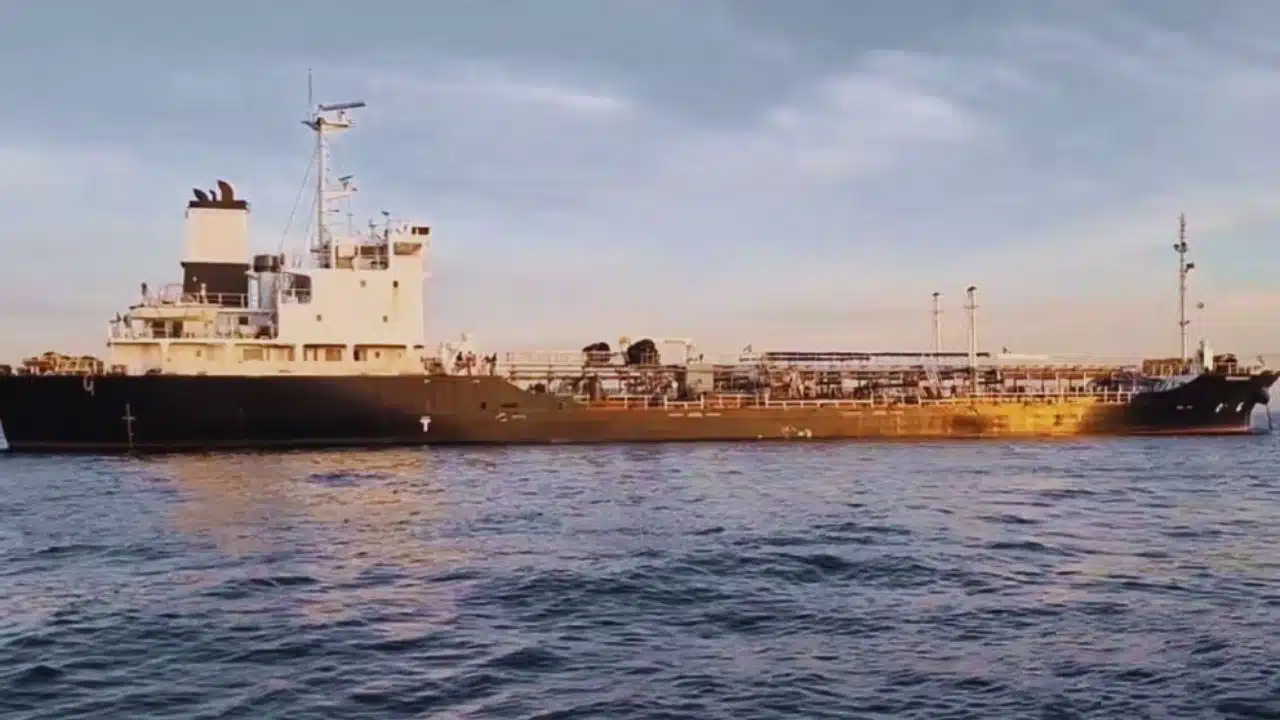
Iran seized an oil tanker in the Persian Gulf carrying about 4 million litres of “smuggled fuel” and detained 16 foreign crew members, days after authorities reported another tanker seizure in the Gulf of Oman with 18 crew and an alleged 6 million litres of illicit diesel.
What happened in the Persian Gulf
Iran’s Islamic Revolutionary Guard Corps (IRGC) said its naval forces intercepted an oil tanker as it was attempting to leave Iran’s territorial waters in the Persian Gulf.
Iranian state media quoted IRGC Navy commander Brig. Gen. Abbas Gholamshahi as saying the vessel carried about 4 million litres of smuggled fuel and had 16 non-Iranian crew members on board.
Iran said the crew was detained and the case was referred to judicial authorities for investigation, while officials did not disclose the ship’s flag, ownership, or destination.
Iran’s stated allegation: fuel gathered at sea
Iranian media reports said intelligence findings indicated the tanker had allegedly received fuel from smaller vessels and was preparing to transfer it onward outside the Gulf, a pattern Iran describes as part of organized fuel-smuggling networks.
Iran has repeatedly linked such operations to the profitability created by domestic fuel subsidies and large price gaps with neighboring markets.
The earlier tanker seizure in the Gulf of Oman
On Dec. 13, Iranian authorities reported a separate seizure of a foreign tanker in the Gulf of Oman and said they detained 18 crew members, including the captain.
Iranian media, citing the judiciary in Hormozgan province, said that vessel was allegedly carrying about 6 million litres of illicit fuel.
The same reports said the detained crew included nationals of India, Sri Lanka, and Bangladesh, and alleged the tanker committed multiple violations such as ignoring stop orders, attempting to flee, and lacking required navigation and cargo documentation.
Why these seizures matter for shipping and energy markets
The Persian Gulf and Gulf of Oman sit next to the Strait of Hormuz, one of the world’s most important energy chokepoints connecting the Persian Gulf with the Arabian Sea.
The U.S. Energy Information Administration (EIA) estimates that oil flows through the Strait of Hormuz averaged about 20 million barrels per day in 2024—around 20% of global petroleum liquids consumption—and remained relatively flat in the first quarter of 2025.
EIA also notes that flows through Hormuz account for more than one-quarter of global seaborne oil trade and that around one-fifth of global LNG trade transited the strait in 2024, mainly from Qatar.
Key Strait of Hormuz facts
| Metric | Latest figure (from EIA) |
| Average oil flow (2024) | ~20 million b/d |
| Share of global petroleum liquids consumption (2024) | ~20% |
| Share of global seaborne oil trade (2024 & Q1 2025) | >25% |
| LNG share transiting Hormuz (2024) | ~20% of global LNG trade |
| Crude/LNG destination focus | ~84% crude/condensate and ~83% LNG to Asia (2024) |
EIA warns that “very few alternative options exist” to move comparable volumes out of the Gulf if Hormuz were closed, even though some pipelines can bypass the strait.
EIA estimates about 2.6 million b/d of Saudi and UAE pipeline capacity could be available to bypass Hormuz during a disruption, a fraction of the 2024 seaborne flow it reports through the strait.
Partial bypass options (not a full substitute)
| Route | What EIA says it can do |
| Saudi East-West pipeline | Operated at 5 million b/d, temporarily expanded to 7 million b/d in 2019; used in 2024 to shift flows overland to Red Sea ports amid other regional shipping disruptions. |
| UAE pipeline to Fujairah | 1.8 million b/d pipeline to the Gulf of Oman; increased day-to-day use can limit excess capacity for rerouting. |
| Iran Goreh–Jask pipeline | Effective capacity around 300,000 b/d; EIA reports Iran exported less than 70,000 b/d in summer 2024 from related ports and stopped loading after September 2024. |
A broader crackdown on fuel smuggling
Iran has periodically announced vessel seizures tied to fuel smuggling, describing them as enforcement against illicit trade driven by subsidized domestic prices and sanctions-related economic pressures.
In late November, Iranian reports said the IRGC seized an Eswatini-flagged vessel with about 350,000 litres of smuggled fuel and a 13-person crew that included Indian nationals.
Iranian accounts of that case also referenced a separate Marshall Islands-flagged tanker incident in mid-November, after which the ship manager later confirmed the vessel was released and its 21 crew were safe.
Timeline of reported seizures (late 2025)
| Date (2025) | Reported location | Alleged cargo | Crew reported | What Iran disclosed |
| Nov. 29–30 | Persian Gulf (reported) | ~350,000 litres of smuggled fuel | 13 | Vessel reported as Eswatini-flagged; taken to Bushehr under judicial order. |
| Dec. 13 | Gulf of Oman | ~6 million litres of illicit fuel | 18 | Detentions reported; alleged violations included ignoring stop orders and lacking documentation. |
| Dec. 23–24 | Persian Gulf | ~4 million litres of smuggled fuel | 16 | Crew detained; vessel flag/owner/destination not disclosed. |
Final Thoughts
- Two tanker seizures within roughly two weeks signal intensified maritime enforcement focused on fuel-smuggling allegations along Iran’s southern coast.
- Even when incidents are framed as law enforcement—rather than state-to-state confrontation—repeated interdictions around the Strait of Hormuz can heighten perceived risk in a corridor EIA estimates carries about 20 million b/d of oil.
- The next concrete developments to watch are judicial outcomes for detained crews, any disclosure of vessel ownership/flags, and whether regional shipping advisories or insurance costs adjust in response to the latest incidents.
























