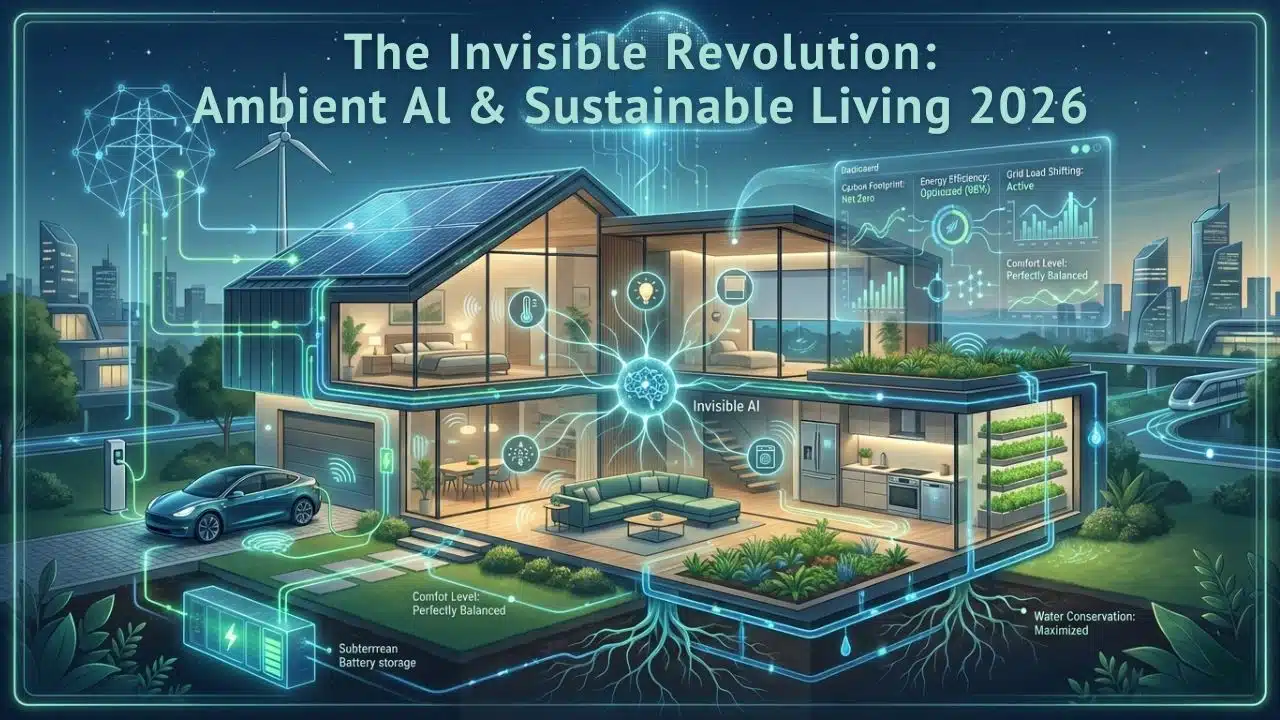
Invisible AI is moving from novelty to necessity: homes that sense, predict, and optimize energy without constant commands. In 2026, volatile power costs, stricter building expectations, and real interoperability are turning ambient tech into a climate and affordability tool. It will also reshape privacy norms, market power, and who benefits first.
How We Got Here
“Invisible AI” is a new headline for an older idea: computing that fades into the background. In the early 1990s, Mark Weiser’s concept of ubiquitous computing argued that the most important technologies become “invisible” because they blend into everyday life. That vision resurfaced in the 2010s as voice assistants, app-controlled thermostats, and smart plugs promised effortless living. In practice, most smart homes stayed stubbornly manual. People had to tap apps, build routines, and troubleshoot integrations.
The shift in 2026 is not only better AI. It is that sustainability has become the forcing function.
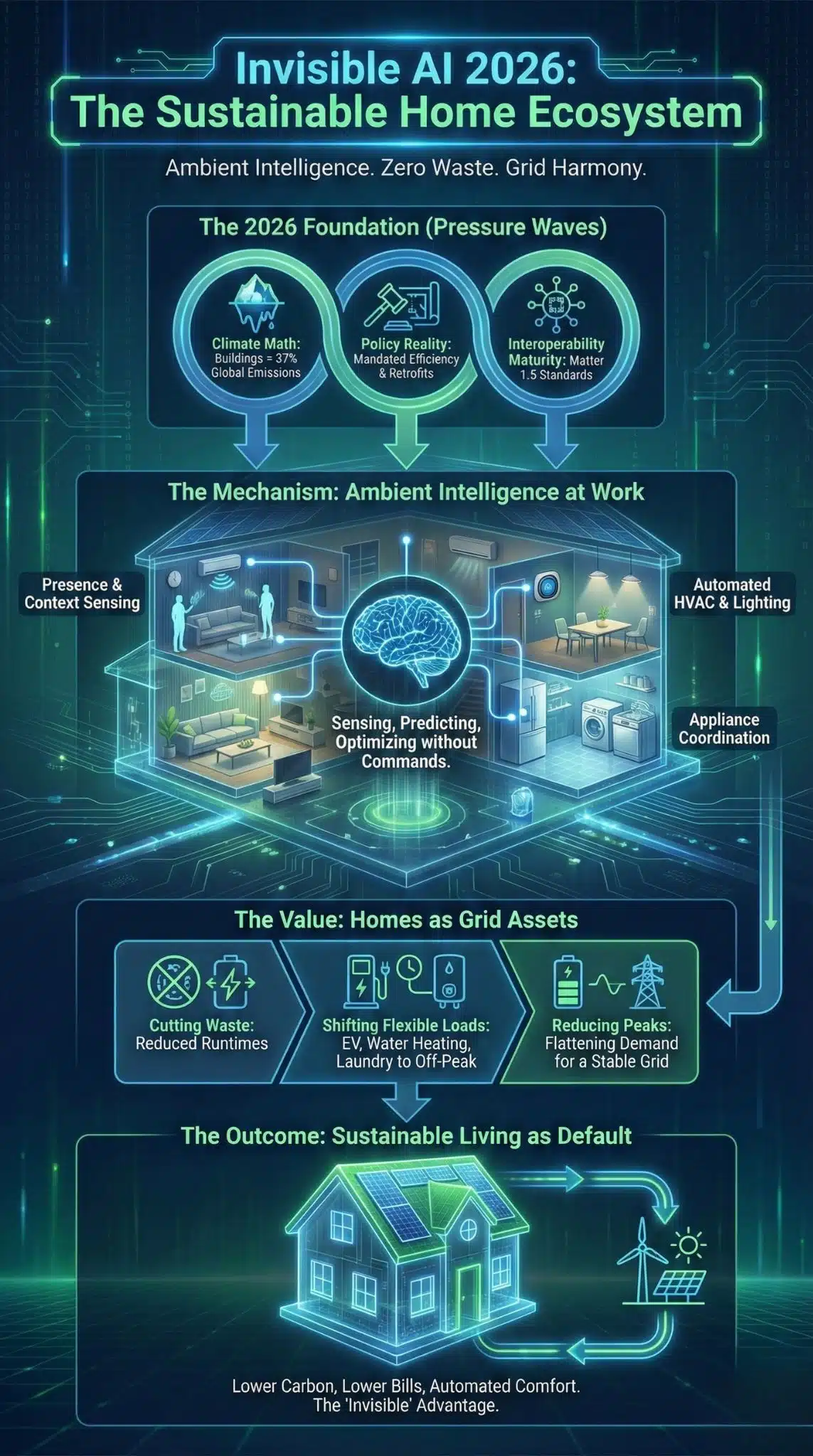
The home is now where three pressure waves meet:
- Climate math: Buildings and construction remain one of the largest emissions and energy categories, which makes everyday home efficiency a first-order issue, not a lifestyle choice.
- Policy reality: Regulations and renovation roadmaps increasingly treat home performance as infrastructure, especially in Europe, where energy performance requirements and renovation planning are tightening.
- Interoperability maturity: Standards are finally reducing the “smart home tax” of fragmented ecosystems, which is essential for whole-home optimization.
“Invisible AI” in 2026 is best defined as ambient intelligence with energy intent. Sensors and devices infer context (presence, activity, comfort) and AI coordinates heating, cooling, lighting, charging, and storage to reduce waste, reduce peaks, and lower carbon, while keeping comfort within acceptable bounds.
Key Statistics That Explain Why 2026 Is A Turning Point
- The UNEP and GlobalABC Global Status Report for Buildings and Construction 2024–2025 (published 2025) highlights that buildings and construction account for 34% of global energy demand and 37% of energy and process-related CO₂ emissions (2022 baseline that remains widely referenced in 2026).
- The International Energy Agency (IEA) continues to frame buildings as roughly about 30% of global energy demand in its operational lens, reinforcing that homes are a major energy lever even under narrower accounting.
- IDC projected about 892 million smart home devices shipped in 2024, with market narratives pointing to a rebound driven by emerging regions and broader platform support.
- ABI Research projects shipments rising from around 1.06 billion units in 2025 to around 1.5 billion by 2030, reflecting continued scale and a shift toward more capable device categories.
- Reuters reporting on Germany’s 2025 emissions pattern underscores a broader issue: buildings can lag behind national progress, with building-sector emissions rising even when overall emissions decline.
These numbers do not “prove” invisible AI will solve sustainability. They explain why the industry is suddenly treating home intelligence as a serious climate and grid lever.
Homes Are Becoming The Center Of Sustainable Living
For years, the sustainability story of the home was about visible upgrades: insulation, efficient appliances, heat pumps, solar panels. Those still matter most. Invisible AI matters because it can make those upgrades perform closer to their potential.
The central problem is operational drift. Even well-insulated homes waste energy when schedules do not match real life. People leave the house, forget settings, run appliances at peak pricing, or heat or cool rooms that nobody uses. Ambient systems try to close that gap by automating “good behavior” without requiring constant attention.
The sustainability value comes from three mechanisms:
- Cutting avoidable runtime: HVAC and water heating often run longer than needed because of conservative settings. Ambient occupancy and activity detection can reduce that waste.
- Shifting flexible loads: EV charging, water heating, laundry, dishwashing, and pre-cooling can be moved to lower-carbon or cheaper hours.
- Reducing peak demand: Peaks drive expensive generation and grid stress. If homes flatten peaks, the system needs fewer “extra” resources.
This is where 2026 feels different. With more electrification (EVs and heat pumps) and more variable renewable generation, flexibility is becoming valuable. Sustainable homes are increasingly judged not only by annual kWh, but by when kWh are used.
Buildings And Homes: The Sustainability Baseline
| Indicator | What It Signals For Invisible AI Homes |
| Buildings and construction: 34% of global energy demand (2022 baseline, UNEP/GlobalABC report published 2025) | Home operations are a major climate lever, not marginal |
| Buildings and construction: 37% of energy and process-related CO₂ (same baseline) | Efficiency plus electrification must scale quickly |
| Buildings: about 30% of global energy demand (IEA operational framing, 2025) | Even narrow accounting makes home energy a top sector |
| Buildings can lag national progress (Germany 2025 pattern reported by Reuters in Jan 2026) | Power-sector gains alone are not enough if building heat and efficiency stagnate |
Interoperability Becomes A Sustainability Enabler
The most important smart-home shift for sustainability in 2026 is not a single product. It is the steady move from fragmented ecosystems to shared standards.
Matter’s recent releases have pushed the industry closer to a world where energy devices can coordinate across brands. The Connectivity Standards Alliance positioned Matter 1.4 as expanding energy-relevant device support and capabilities. Matter 1.5 (announced Nov 20, 2025) added more explicit energy management features, including standardized ways for devices to interpret tariffs and grid carbon intensity. That matters because demand flexibility depends on consistent signals.
Why this matters in plain terms: a heat pump, EV charger, water heater, solar inverter, and battery only become a sustainability system if they can share priorities and respond to the same inputs. Without that, “optimization” becomes vendor lock-in or fragile third-party hacks.
This is also where the phrase “invisible” becomes strategic. The less friction there is between devices, the more likely households will accept automation. People tolerate complexity for a short time. They accept invisibility for years.
How Energy-Aware Standards Are Evolving
| Release | Timing | What It Changes For Sustainable Homes |
| Matter 1.4 | Nov 2024 | Broader support for energy-related device categories and features |
| Matter 1.4.1 | May 2025 | Refinement and stabilization that improves real-world compatibility |
| Matter 1.5 | Nov 2025 | Stronger energy management foundation, including standardized tariff and grid carbon intensity information |
The implication for 2026 is that “bring your own device” energy programs become more plausible. Utilities and regulators can imagine a market where households participate in flexibility programs without buying one specific vendor’s ecosystem.
From Smart Home To Invisible AI Home: What Actually Changes
A smart home is typically device automation. An invisible AI home is system orchestration.
The old model is command-driven. You set a thermostat schedule or a scene called “Goodnight.” The new model tries to learn context and propose or apply changes. If nobody is home, it reduces heating or cooling. If a room is occupied, it prioritizes comfort there rather than conditioning the whole house. If energy is cheaper or cleaner later, it delays flexible tasks. If air quality worsens, it adjusts ventilation.
The Verge’s 2025 coverage of Samsung’s SmartThings “ambient sensing” direction captures where big platforms are heading: using existing devices to infer presence and activity, then triggering actions with less explicit user input. Samsung also emphasized local hub processing for certain features to reduce cloud dependence. The key point is not Samsung’s implementation. It is the platform-level trend: less toggling, more inference.
For sustainable living, the best invisible AI products will feel less like “controlling devices” and more like “running a home efficiently.”
Traditional Smart Home vs Invisible AI Home
| Dimension | Traditional Smart Home | Invisible AI Home |
| User effort | Manual routines, frequent app use | Passive sensing plus suggestions, fewer commands |
| Control model | Device-by-device | Whole-home orchestration as one system |
| Sustainability role | Often incidental | Designed around cost, carbon, and peak reduction |
| Failure mode | Features unused after setup fatigue | Wrong inferences, privacy pushback, trust collapse |
| Ecosystem | Vendor silos | Standards-driven coordination across brands |
The real change is behavioral. Invisible AI aims to make the sustainable choice the default, without requiring sustained motivation.
The Home As A Grid Asset: Flexibility Becomes A Product
The biggest climate value of invisible AI might be invisible to homeowners too. It is the home’s role as a grid resource.
Research institutions have been describing a future where home energy management systems coordinate appliances, heating, storage, and EV charging based on household patterns and grid conditions. NREL’s work on home energy management highlights the role of coordinated control and the balance between homeowner preferences and system needs. This aligns with why standardized tariff and carbon signals matter. If the home can “understand” the grid context, it can shift demand without waiting for a manual decision.
On the market side, companies building residential flexibility platforms argue that aggregated homes can function like power plants. Some programs center on thermostats because HVAC is a large, controllable load. The exact capacity claims vary by company and program design, but the strategic direction is consistent across the sector: utilities increasingly value dispatchable demand.
Sustainable home living in 2026 is therefore moving beyond “use less” toward “use smarter.” The grid rewards behavior that reduces peaks and aligns with renewable supply. Invisible AI becomes the interface between household comfort and system efficiency.
Where The Value Goes: Winners And Losers
| Stakeholder | Likely Upside | Likely Risk |
| Homeowners | Lower bills, automated comfort, possible incentive payments | Privacy concerns, device complexity, upfront costs |
| Renters | Potential comfort and savings if upgrades happen | Split incentives, landlords may not invest |
| Utilities | Cheaper peak management, easier renewables integration | Customer trust issues, program complexity |
| Device makers | Larger market for interoperable energy devices | Margin pressure, higher compliance burden |
| Big platforms | Service revenue, ecosystem stickiness | Regulatory scrutiny, security liability |
| Regulators | A scalable decarbonization lever | Equity gaps, surveillance concerns |
This table is the political economy of invisible AI. Sustainability is not only technology. It is who controls decisions, data, and payouts.
The Hidden Catch: Rebound Effects And Always-On Overhead
A serious 2026 analysis has to acknowledge a paradox. Ambient intelligence can cut waste, but it can also create new waste.
- Rebound effect: If comfort becomes effortless, people may heat or cool more than before. Some efficiency gains can be offset by increased usage.
- Always-on overhead: Sensors, hubs, cameras, and edge compute draw power continuously. It is small per device, but not trivial at scale.
- Optimization theater: Dashboards can claim “savings” without strong baselines. If measurement is weak, sustainability becomes marketing.
This is why credible measurement frameworks matter. Work tied to smart thermostats and energy programs increasingly emphasizes verifiable outcomes such as reduced runtime, peak shifting, and measured demand reduction. The direction of travel is clear: sustainability claims will increasingly need proof, especially as regulators and utilities scale incentives.
A second catch is hardware economics. The broader AI boom is stressing component markets and influencing device costs. Reporting in 2025 highlighted tighter supplies for certain memory components due to AI demand. Even if that is not the dominant factor in every smart home category, it signals a real risk: sustainability tech becomes more expensive at the exact moment policymakers want it to spread.
Trust, Privacy, And Regulation: The Price Of Invisibility
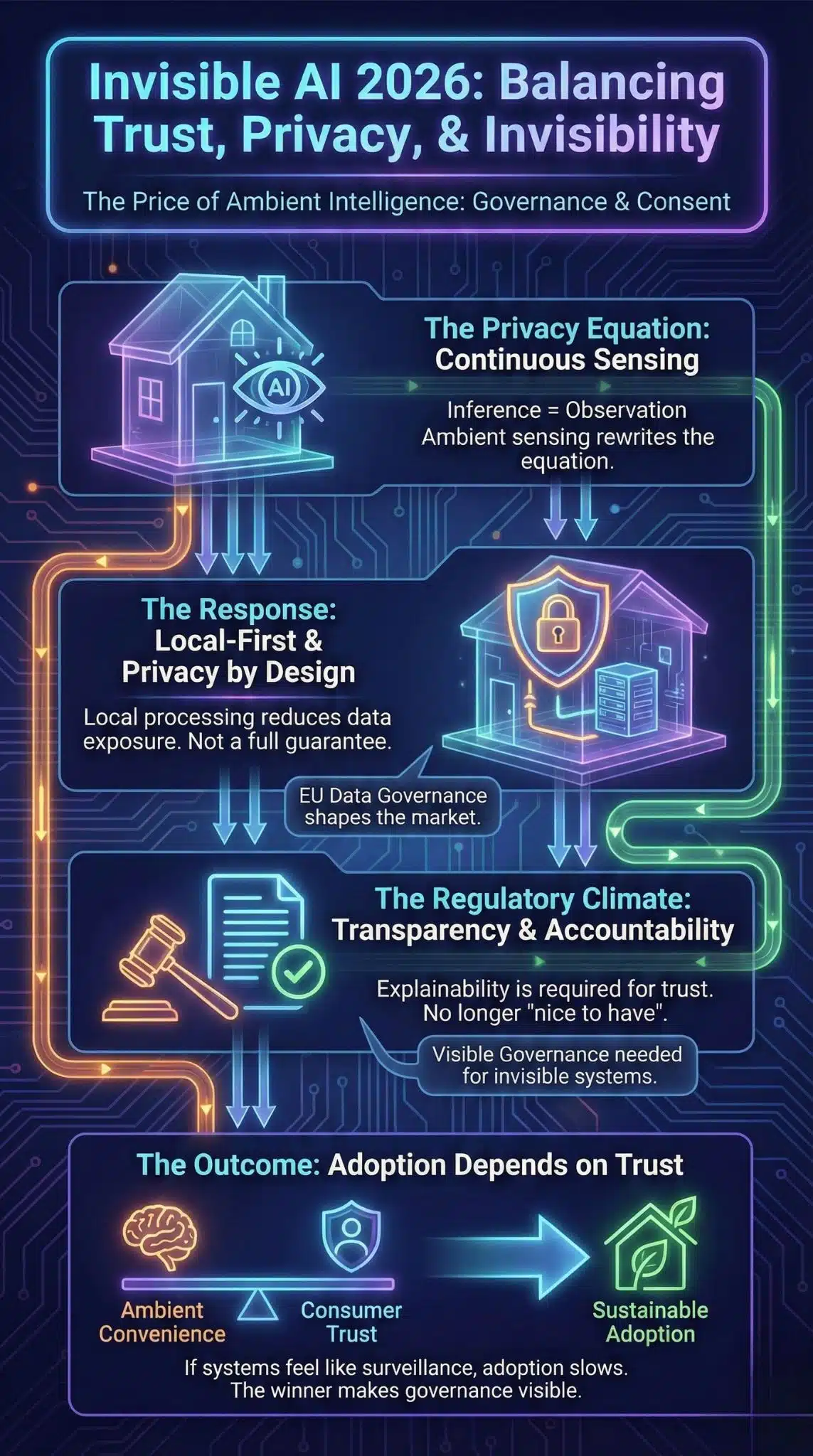
Ambient sensing rewrites the privacy equation. A home that can infer activity without being told is a home that is continuously observing something.
In 2026, platforms respond with “local-first” and “privacy by design” messaging, partly because consumers demand it and partly because regulation is moving in that direction. Local processing can reduce data exposure, but it does not eliminate risk. A compromised hub can still reveal household patterns. Inference can still feel invasive even if raw data never leaves the home.
Europe’s AI and data governance debates also shape the market. Reporting has highlighted political pressure and industry concerns about compliance timelines and obligations. Even when consumer home systems are not categorized as “high risk,” the broader climate is shifting expectations: transparency, explainability, and accountability are moving from “nice to have” to “required for trust.”
A practical reality is that sustainable ambient living is limited by trust. If people believe “energy optimization” is an excuse for surveillance or upselling, adoption slows. If utilities are seen as controlling homes without clear consent, programs face backlash. The winners will be companies that can make the system feel invisible while keeping governance visible.
Expert Perspectives: Why Reasonable People Disagree
The optimist case: Invisible AI fixes the “last mile” of decarbonization. We already know what efficient homes look like, but real performance is inconsistent because human routines are messy. Ambient systems can automate waste reduction, coordinate electrified loads, and shift demand toward cleaner hours. This view is strengthened by building-sector emissions realities and the need for flexibility as renewables grow.
The skeptic case: Invisible AI is surveillance architecture wearing a green badge. Continuous sensing normalizes data collection in private spaces. The skeptic also argues benefits will skew toward homeowners who can afford full-stack upgrades, while renters and low-income households get left behind or get managed without fair compensation.
The pragmatic case: Both can be true. Outcomes depend on governance and design. The most durable model is “ambient but auditable.” That means clear consent, local processing where possible, strong security, human override, and verifiable energy outcomes.
This debate will define the next phase. The market will not be decided only by features. It will be decided by legitimacy.
What Comes Next: The 2026 To 2028 Milestones To Watch
- Adoption of energy-aware interoperability: Matter’s energy features matter only if major platforms and appliance makers actually ship compatible products at scale and keep them updated.
- Utility program redesign: Expect more programs that pay for flexibility, not just efficiency, especially in regions facing grid constraints.
- Privacy and AI governance clarity: Enforcement actions and compliance expectations will shape whether local-first becomes the norm or a marketing claim.
- Retrofit financing and housing market signals: If renovation costs rise faster than support mechanisms, adoption slows and inequality grows.
- Equity models: Watch for landlord incentives, device rebates, and utility-owned hardware programs that give renters access to the savings.
If these milestones move in the right direction, invisible AI becomes infrastructure. If they do not, it becomes another cycle of premium gadgets.
Final Thoughts
Invisible AI is not primarily a “smart home trend.” In 2026, it is an emerging operating layer for sustainable living. Buildings remain too large a climate category to decarbonize through behavior alone, yet retrofits alone often underperform without smarter operations. Interoperability standards are reducing friction. Platforms are pushing sensing into the background. Grids are increasingly valuing flexibility. That combination makes invisible AI feel inevitable.
Still, sustainability gains are not automatic. Invisible systems require visible governance. Consent, local processing, security discipline, and credible measurement are what separate real climate value from convenience theater. If the industry treats “ambient” as permission to observe everything, consumer trust and regulation will slow the market. If it treats “ambient” as a way to reduce friction while proving outcomes and protecting privacy, invisible AI can become one of the most scalable climate tools inside the home.