Have you ever felt like a fake, even when you succeed? Maybe you work hard and achieve great things, but your brain whispers that it is just luck. You might worry that people will eventually find out you are not as smart as they think. A 2025 Kickresume survey of US professionals found that 71% of workers feel this exact same way.
This guide covers everything you need to know about imposter syndrome and why high achievers feel like fakes, so you can stop doubting yourself. I will share the signs, the reasons behind these thoughts, and the exact steps you can take to fight back. Grab a comfortable seat, and let’s figure out how to build your real confidence together.
What Is Imposter Syndrome: Why High Achievers Feel Like Fakes?

Imposter Syndrome is that nagging feeling that you do not deserve your success. Psychologists Dr. Pauline Rose Clance and Dr. Suzanne Imes coined the term in 1978 to describe people who cannot internalize their accomplishments. They constantly think others will soon discover they are pretending.
Even top executives fall into this trap. A 2024 Korn Ferry report found that 71% of US CEOs experience these exact symptoms on the job.
I have written eleven books, but each time I think, “Uh oh, they’re going to find out now,” said Maya Angelou.
These feelings spark serious fear. People end up chalking up big wins to luck instead of skill. This struggle eats away at confidence, leaving many high achievers caught in a loop of anxiety.
Signs and Symptoms of Imposter Syndrome
Many high achievers feel they wear a mask. They constantly wait for someone to call them out, pushing away their wins because they think luck played a bigger role than skill.
Persistent self-doubt
Persistent self-doubt feels like a shadow that never leaves. A high achiever may win awards, yet still think they are simply not good enough. Each new success brings more anxiety instead of relief. Perfectionism makes it worse, causing every tiny flaw to stand out.
You can be surrounded by applause and still feel like a fake, said Dr. Pauline Clance in 1978.
This constant self-doubt drains your confidence. It steals joy from even the brightest moments.
Fear of being exposed as a fraud
Many high achievers feel like actors on a stage. They worry someone will spot the mask and expose them as a fraud. This fear fills daily life with massive stress. In fact, the 2025 Kickresume survey revealed that 50% of US professionals have turned down or missed opportunities because of this exact self-doubt.
Here is what that fear usually causes:
- Overworking to prove you belong on the team.
- Seeking constant external validation from bosses.
- Skipping out on promotions or new jobs.
- Feeling like praise is just empty flattery.
Difficulty internalizing success
High achievers often shrug off their wins. They chalk them up to good timing or a simple mistake by the leadership team.
A straight-A student might look at her grades and think she just got lucky with easy tests. This type of thinking feeds anxiety and chips away at your mental health over time. People miss chances to celebrate small wins. They just keep moving the goalposts farther away.
Types of Imposter Syndrome
Imposter Syndrome wears many masks. Dr. Valerie Young, a leading expert on the topic, identified five specific types of impostors. Keep reading to spot which one might fit your habits best.
The Perfectionist
Perfectionists set very high bars for themselves. They check and double-check their work, hoping nothing slips past them.
One tiny flaw can erase an entire achievement in their mind. This search for flawless results leads directly to stress and a deep fear of failure.
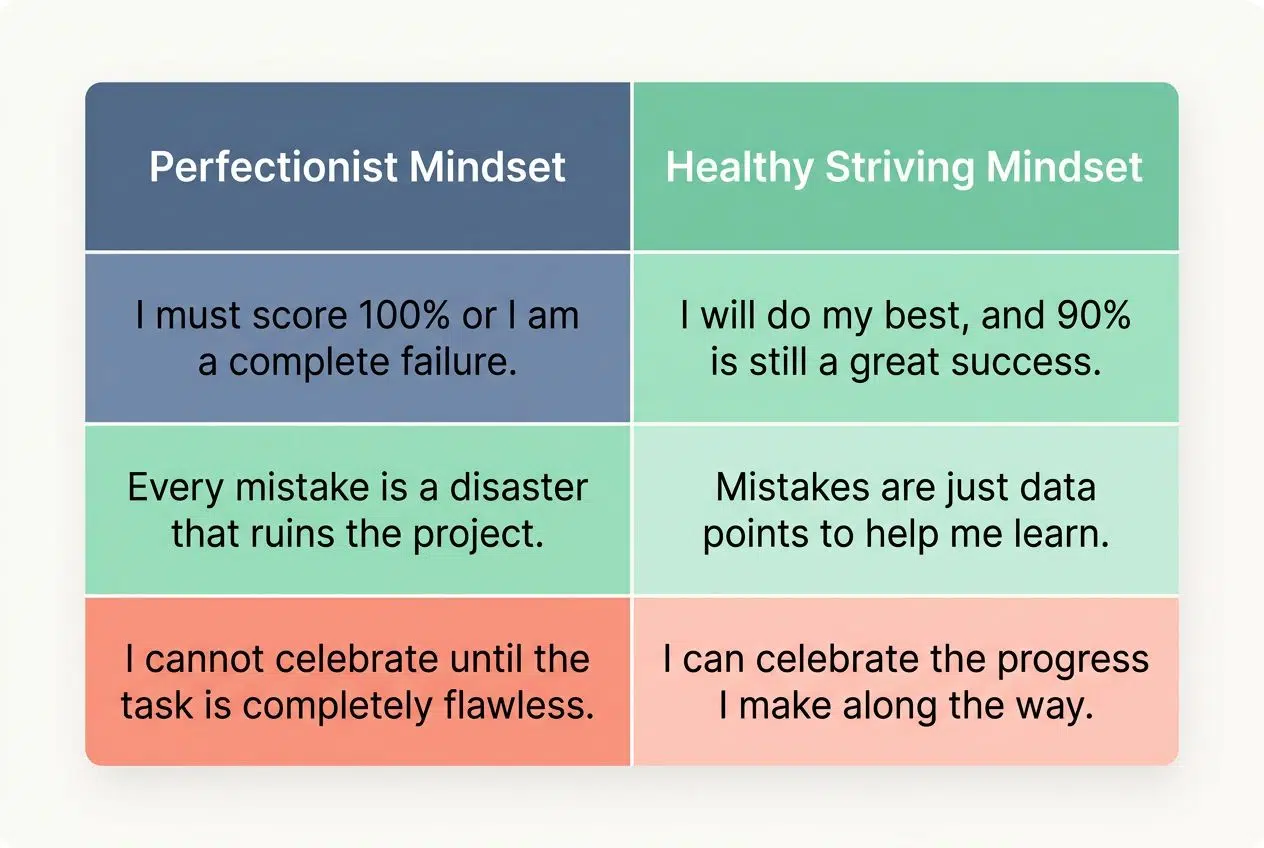
| Perfectionist Mindset | Healthy Striving Mindset |
|---|---|
| I must score 100%, or I am a complete failure. | I will do my best, and 90% is still a great success. |
| Every mistake is a disaster that ruins the project. | Mistakes are just data points to help me learn. |
| I cannot celebrate until the task is completely flawless. | I can celebrate the progress I make along the way. |
The Superwoman/Superman
This type feels the need to juggle everything perfectly. They stay late at work, rush through tasks, and take on extra jobs, even if nobody asks them to.
The 2025 Kickresume survey found that overworking is the number one reaction to imposter feelings for Gen X workers in the US. They push themselves harder than anyone else to avoid getting “caught.” Daily life becomes a race against failure. Validation from others never seems to be enough to quiet the pressure.
The Natural Genius
The Natural Genius thinks success should come fast and easy. If things get tough, anxiety kicks in like an unwanted guest.
Kids who did well in school without much effort often struggle here as adults. Once they face complex work, their old confidence completely vanishes. Tripping up once triggers intense fear. They start avoiding challenges to protect their identity as a “smart” person.
The Soloist
The Soloist ties their worth to doing things completely alone. They feel that asking for help is equal to cheating.
You might spot them refusing group projects and craving validation. They struggle to accept praise for a team effort, which leads to a few common habits:
- Working quietly in a corner to avoid collaboration.
- Refusing to delegate tasks even when overwhelmed.
- Believing that shared success is not real success.
The Expert
The Expert thinks they must know everything before they can start a task. They often chase more certificates and training. Even with years of learning, self-doubt sneaks in. They fear asking for help because others might spot their gaps in knowledge.
This creates a cycle of endless preparation, including:
- Refusing to apply for jobs unless they meet 100% of the criteria.
- Spending hours researching simple topics to avoid starting.
- Feeling anxious when someone asks a question they cannot answer instantly.
Causes of Imposter Syndrome
Many people wonder what triggers these feelings. The reasons might just surprise you.

Family upbringing
Parents can set the stage for these feelings early on. If a child grows up with constant pressure to achieve, self-doubt often follows.
Certain parents give praise only for perfect results. Kids in these homes start thinking their worth comes solely from flawless achievement. Critical words stick like glue. Childhood messages drive perfectionism deep into adult life.
Personality traits
People who naturally fear making mistakes feel they must always succeed. This rigid thinking increases daily anxiety. High achievers can struggle with low self-esteem even after major wins. This pressure builds up inside them like steam in a kettle.
A few common traits that fuel this feeling include:
- Setting sky-high goals that are impossible to reach.
- Craving constant external validation for every single task.
- Using overachievement as a mask for deep internal worries.
New challenges in work or education
Starting a new job can shake your confidence to the core. New tasks bring intense pressure to prove your worth all over again.
Even those who were at the top of their last class might stress about keeping up. Simple mistakes seem huge, like a red mark in front of everyone.
Fear of failure grows stronger with each new challenge. Having a strong support system is vital during these times.
Social anxiety
Social anxiety makes people worry about being judged or laughed at. High achievers may feel nervous before meetings or sweat during interviews.
This fear of embarrassment forces them to work even harder to hide any small mistake. They might say no to a fun project just to avoid feeling awkward.
Social anxiety feeds self-doubt and makes people second-guess every single compliment they receive.
How Imposter Syndrome Affects High Achievers
High achievers often feel like they must work twice as hard to prove their worth. This constant pressure chips away at their self-confidence.
Increased anxiety and stress
Racing thoughts can fill your mind, making you doubt every win. Each task feels heavier as anxiety builds up like a mountain of dirty laundry.
Some people feel on edge at all times, waiting for someone to call out their fraudulence. You might skip breaks just to prove yourself. Over time, this stress severely harms your mental health. Small tasks start to feel like huge hurdles.
Decreased self-confidence
Self-doubt creeps in like a shadow, making every step feel shaky. High achievers start to question if their last success was pure luck. Even after getting praise, they shrug it off. A single slip-up brings intense fear that others will see through the act. The pressure to be perfect grows with each achievement. This leaves very little room for real joy or self-acceptance.
Overworking to prove worth
High achievers often push themselves to the absolute limit. You might see someone staying at the office late every single night. They hope this overcompensation will quiet the fear of being seen as a fraud. Instead, the drive for validation keeps them going until burnout strikes.
Here are a few common signs that overworking has become unhealthy:
- You lose sleep worrying about emails you already sent.
- You feel deeply guilty when you try to relax on the weekend.
- You take on extra tasks that nobody asked you to do.
Imposter Syndrome vs. Systemic Discrimination
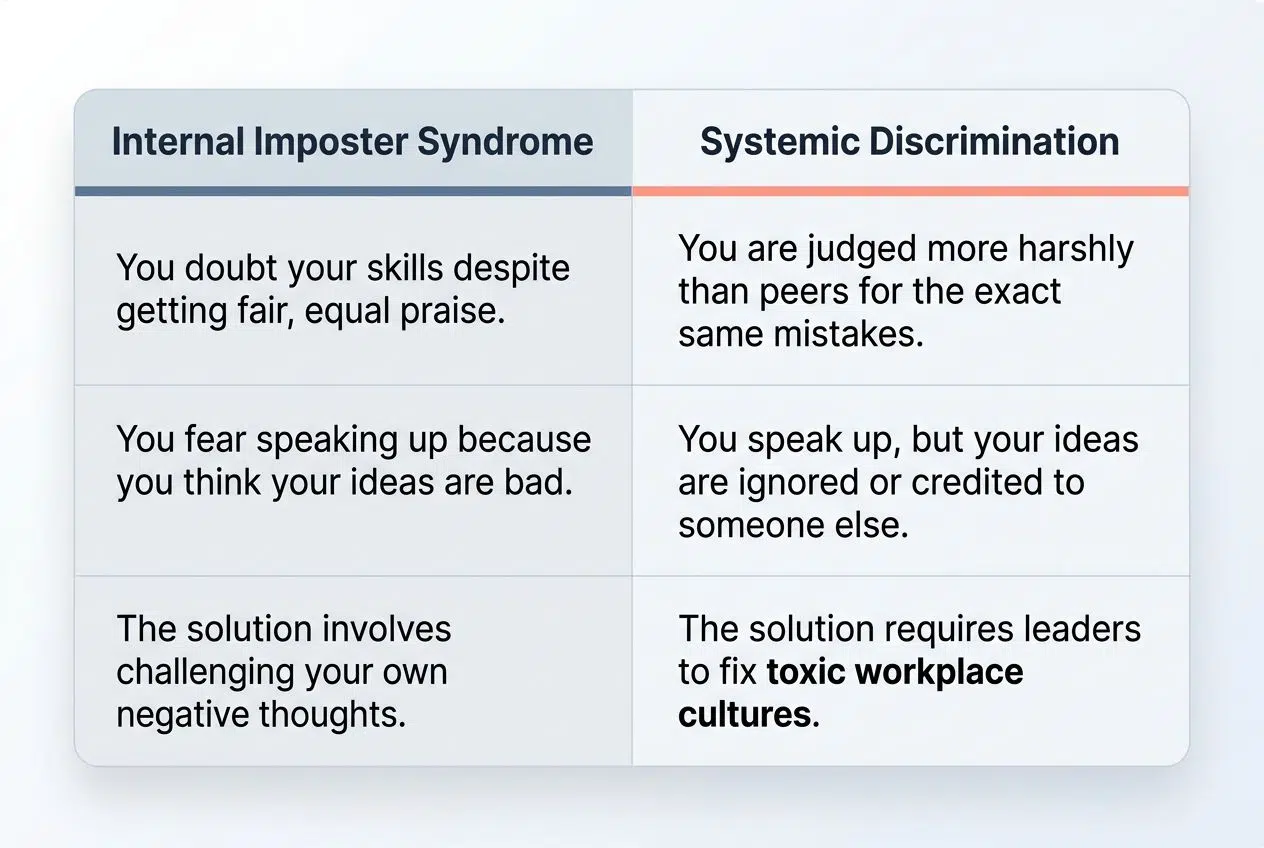
Imposter syndrome makes you feel self-doubt from the inside. Systemic discrimination comes directly from outside forces, like unfair rules or bias at work.
A famous 2021 Harvard Business Review article by Ruchika Tulshyan and Jodi-Ann Burey pointed out a massive flaw in how we view this issue. They noted that the original 1970s studies completely ignored the impact of systemic racism, classism, and bias in the US workplace.
Sometimes, people struggle with anxiety, thinking it is their fault, when real barriers are actually blocking their achievement. It is vital to learn the difference so you can find the right support.
| Internal Imposter Syndrome | Systemic Discrimination |
|---|---|
| You doubt your skills despite getting fair, equal praise. | You are judged more harshly than your peers for the exact same mistakes. |
| You fear speaking up because you think your ideas are bad. | You speak up, but your ideas are ignored or credited to someone else. |
| The solution involves challenging your own negative thoughts. | The solution requires leaders to fix toxic workplace cultures. |
Managing Imposter Syndrome
Facing these feelings can feel like climbing a mountain in flip-flops. Small steps can make each day much easier to handle.
Recognize and challenge negative thoughts
High achievers often hear a tiny, nagging voice in their heads. This voice says things like, “Someone will find out you do not belong here.”
Mental health experts often use Cognitive Behavioral Therapy (CBT) to fight this. A core CBT technique is “cognitive restructuring,” which means looking at the facts of your success instead of falling into fear.
You can practice this technique right now with a few simple steps:
- Notice the negative thought as soon as it pops up.
- Write that thought down on a piece of paper.
- Write down three factual pieces of evidence that prove the thought is wrong.
Celebrate achievements and progress
Give yourself credit for your wins, both big and small. Pause to notice what you did well, even if it feels like a fluke.
Many professionals in the US tech industry keep a “brag document.” This is a private list where you write down every project you finish, every compliment you get, and every new skill you learn.
Looking at a factual list of your wins helps quiet self-doubt. Confidence grows each time you celebrate your real progress.
Seek support from mentors or peers
Talking to a mentor can help you feel less alone. Mentors have often faced a deep fear of failure, too. Many US companies now offer formal mentoring programs because they are proven to reduce workplace anxiety. Sharing your worries with peers makes the pressure feel much lighter.
Support from trusted people brings healthy validation. Friends can remind you of your true strengths when your anxiety tries to trip you up.
Consider professional help if needed
Sometimes, friends cannot fix deep-rooted anxiety or crippling self-doubt. A mental health professional gives you tools that peers simply cannot provide.
Therapists often use structured frameworks to treat these feelings. In the US, a standard course of therapy for these specific issues usually takes about 8 to 20 sessions to show real results.
The most effective therapy options include:
- Cognitive Behavioral Therapy (CBT) to change unhelpful thoughts.
- Acceptance and Commitment Therapy (ACT) to help you pursue goals despite fear.
- Group therapy to normalize your experiences with peers.
Tips for Overcoming Imposter Syndrome
Simple tips can help you feel confident in your daily life. Keep reading to learn how small changes make a big difference.
Review your qualifications
Pull out that dusty resume in your mind. List the degrees, skills, and certificates you worked so hard to earn. High achievers often forget past wins because anxiety clouds their view. Keep track of your successes in a notebook or on your phone.
Glancing at this list during moments of doubt can boost confidence fast. It helps shut down the fear of deception for good.
Focus on continuous learning
Learning never ends. New skills help high achievers face their fear of failure with action instead of worry. Mistakes bring important lessons, not shame. Read books, ask questions, and take short courses online to boost your knowledge.
A habit of learning lets you celebrate progress. It keeps you moving forward instead of chasing perfectionism.
Accept that mistakes are part of growth
Progress often feels messy. You may view mistakes as proof of fraudulence, but errors happen to everyone with experience. A mistake does not mean failure. It acts as a teacher, pointing out where you can learn more.
Here are a few ways to reframe your mistakes:
- Keep in mind that Thomas Edison found 10,000 ways a lightbulb would not work before finding success.
- Treat a failed project as raw data to improve your next attempt.
- Share your mistakes openly with your team so everyone can learn together.
The Bottom Line
Imposter syndrome can show up in absolutely anyone. Even people with big goals and lots of success wrestle with intense self-doubt. Anxiety and fear frequently come hand in hand with high achievement, leaving smart people stressed or chasing perfectionism.
It is time to conquer imposter syndrome, so you can finally enjoy your success. You are absolutely not alone if you question your own achievements, and reaching out for a little support goes a long way for your mental health.