A public API can look polished in its documentation and still be miserable to use. The endpoint names make sense. Authentication works. Every parameter appears in the reference. Yet the developer integrating it spends days chasing vague errors, filling gaps between guides, and wondering whether the next update will break production.
I do not judge an API by the size of its endpoint catalog or how closely it follows a fashionable design style. I judge it by the work it asks customers to do.
A good public API helps someone reach a useful result, behaves consistently, makes failures recoverable, and changes without springing surprises on the people who depend on it. That is what earns developer trust.
What Makes a Public API Worth Building On?
A public API is intentionally available to developers outside the provider’s organization. It may be open to anyone, limited to approved partners, included with a paid product, or protected by authentication and contractual terms.
Public does not automatically mean free, anonymous, open source, or unrestricted. It means outside developers are expected to build against the interface.
That creates a different responsibility from an internal API. The provider does not control its customers’ code, release schedules, or production environments. Once people depend on the contract, even a small change can create work far beyond the company that made it.
I find it useful to consider four moments in the customer experience:
| Moment | The customer’s question |
| Start | Can I understand this API and complete one useful workflow? |
| Build | Will the rest behave like the part I have already learned? |
| Recover | Can I diagnose a failure and retry without causing damage? |
| Evolve | Can I trust this integration to keep working as the product changes? |
An API that succeeds only on the happy path is unfinished. The difficult moments are where trust is either earned or lost.
How to Build a Public API Customers Can Trust
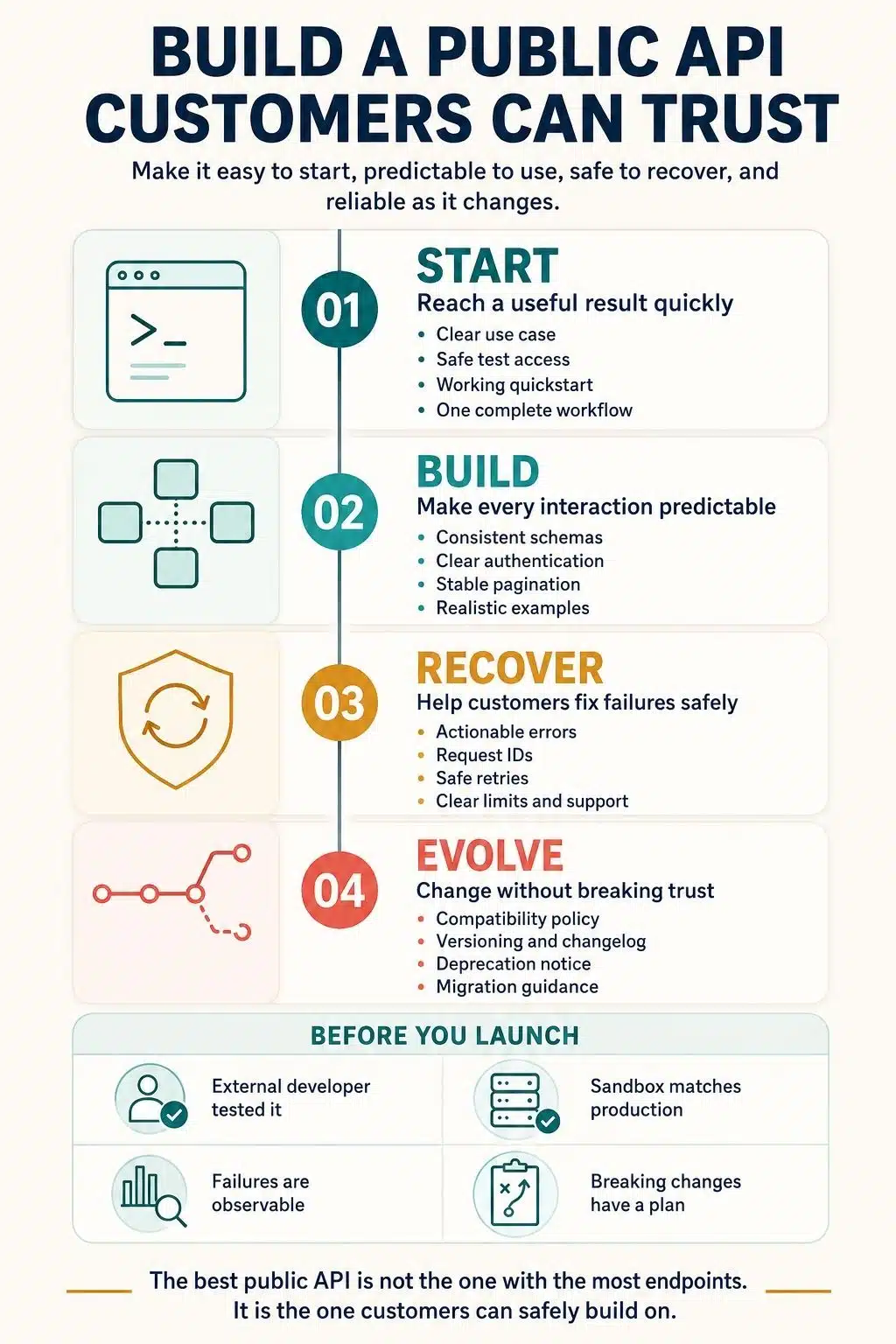
Customers trust a public API when it behaves predictably from the first request through future updates. That means making authentication clear, responses consistent, errors useful, retries safe, and changes carefully managed. I would focus less on exposing as many endpoints as possible and more on creating a stable contract that developers can understand, operate, and depend on in production.
1. Start With One Valuable Customer Workflow
The first question should not be, “Which internal services can we expose?” It should be, “What useful result is the customer trying to achieve?”
An API modeled directly on internal database tables or service boundaries often passes the provider’s organizational complexity to the customer. Developers end up learning concepts that exist because of the company’s architecture, not because those concepts help them complete a task.
Begin with one narrow but complete workflow. A billing API might let a customer create and retrieve an invoice. A scheduling API might let them check availability and confirm a booking. A support API might let them open a ticket and follow its status.
Before designing endpoints, work through the whole job:
- Who will build and maintain the integration?
- What outcome are they trying to produce?
- What data and permissions are genuinely required?
- What can go wrong, and what must happen next?
- What will the customer need to store, reconcile, or audit later?
This will usually produce a smaller first release. That is a strength. A focused API that completes a real job is more useful than a large collection of disconnected capabilities.
The workflow should also influence the interaction style. REST over HTTP is a practical choice for many resource-based public APIs. GraphQL can suit clients that need flexible access to connected data. gRPC is often a better fit for controlled service-to-service environments than for a broad external audience. Webhooks or event streams can complement a request-response API when customers need timely updates.
There is no prize for choosing the most fashionable approach. The right one is the least surprising fit for the customer’s work.
2. Design the Contract Before the Code Hardens
It is cheaper to challenge an API design before customers depend on it.
Define the resources, schemas, permissions, errors, pagination, limits, and change rules before implementation makes them difficult to reconsider. A machine-readable OpenAPI description is useful here because teams can review the contract, generate reference material, and support testing. It cannot tell you whether the contract itself makes sense.
The review should extend beyond the engineers building the service. Product can test whether the workflow is complete. Security can challenge permissions and data exposure. Documentation and support teams often spot language that will confuse customers. Prospective users will notice assumptions the internal team has stopped seeing.
Predictability matters more than cleverness. Once a developer learns one part of the API, that knowledge should transfer to the next. Set consistent rules for:
- Resource names and identifiers
- Dates, time zones, currencies, and units
- Required, optional, and nullable fields
- Filtering, sorting, pagination, and long-running operations
- Validation and error responses
Collections need special care. If a result set could grow, paginate it from the beginning. Adding pagination later can break integrations or, worse, quietly change the records a customer’s software processes.
Do not let accidental behavior become an undocumented promise. If results have no guaranteed order, say so. If they do, define the ordering. The same applies to defaults, maximum page sizes, null values, and case sensitivity.
3. Make the First Useful Result Easy
Many quickstarts end with the first successful response. That proves the connection works, but it does not prove the API is useful.
I would build onboarding around the first meaningful result: the smallest complete action that resembles why a customer chose the API. A developer should be able to move from no access to that result without piecing together several disconnected pages.
A useful quickstart includes:
- A plain-language explanation of what the API does
- Everything required before the first request
- A safe test environment or test mode where appropriate
- One verified, copyable request and a realistic response
- A clear explanation of the important response fields
- The next step in the workflow
- Direct routes to authentication, errors, limits, and production setup
Code samples should run as published. They need the correct host, headers, version, and response shape, with every placeholder clearly labeled. A command that fails because it contains an unexplained account ID is not a quickstart. It is a puzzle handed to the customer.
The test environment should also resemble production closely enough to build confidence. If validation, webhook delivery, supported fields, or rate limits differ, document those differences. Moving from test credentials to live credentials should feel deliberate, not like integrating a second API.
Reference pages and task-based guides serve different purposes. Customers need both. The reference explains each operation; the guide explains how those operations form a complete job.
4. Treat Failure as Part of the Product
The quality of an API becomes clearest when a request fails. An HTTP status code is rarely enough to fix a problem. A useful error response should include a stable machine-readable type or code, a concise explanation, field-level details where relevant, and a request ID that support can trace.
“Invalid request” leaves the developer guessing. An error that identifies billing_address.postal_code, explains the accepted format, and supplies a request ID gives them a next move.
Use one error structure throughout the API. The standard Problem Details format for HTTP APIs is a sensible option, although a well-designed custom format can work. What matters is that customers do not need a different error parser for every endpoint.
Explain enough to help without exposing stack traces, secrets, database details, or sensitive authorization information.
Retries deserve the same attention. A server may complete an operation even when the client times out before receiving the response. Repeating a request that creates a payment, booking, order, or similar resource may produce a duplicate.
Idempotency keys are a common way to make eligible operations safer to retry. If you support them, document which operations accept a key, how long it is retained, how request equality is checked, and what happens if the key is reused with different data. Do not leave customers to infer those rules from trial and error.
Rate limits should be understandable too. A 429 Too Many Requests response may include Retry-After, but customers also need to know what is being counted, which credential or account the quota applies to, whether bursts are allowed, and how capacity returns. The behavior matters more than adopting a particular set of headers.
5. Make the API Safe to Operate in Production
Public API security is not just a login problem. Authentication establishes who is calling; authorization determines what that caller may do to a particular resource. A valid credential must never become permission to access every object or field.
The basic protections should include:
- HTTPS, with credentials kept out of URLs, logs, and source code
- Rotatable credentials and separate test and production access
- Restricted keys or scopes that support least privilege
- Object-level and field-level authorization checks
- Request and response schema validation
- Payload, resource, and concurrency limits
- A current inventory of active endpoints and versions
- Revocation, audit records, and monitoring for sensitive activity
Choose authentication that fits the use case. OAuth is appropriate when an application needs delegated access to a user’s account. It is not automatically the best choice for every server-to-server integration, where a restricted API key, client credential flow, or signed request may be more suitable.
The secure path should also be the easy path. Give scopes clear names, make rotation straightforward, choose cautious defaults, and ensure the quickstart never teaches developers to hard-code a secret.
If the API uses webhooks, design for real delivery conditions. Events can arrive late, more than once, or out of order. Provide signed deliveries, stable event IDs, a documented retry policy, delivery history, and replay where practical. Tell customers whether ordering is guaranteed and teach them to handle duplicates safely.
I would be cautious about promising exactly-once delivery. In most systems, a more dependable contract is to make duplicate detection and idempotent processing possible.
6. Plan for Change Before Publishing Version One
Versioning is often reduced to a choice between a number in the URL and a value in a header. That is only the visible part of the problem.
A version label does not protect customers when behavior changes underneath it. Removing a field is clearly breaking, but changing a default, validation rule, field meaning, result order, error code, limit, or webhook payload can be just as disruptive.
Path versions, date-based request headers, and account-level pinning can all work. What matters is whether customers can identify the version they use, test a new one, choose when to migrate, and understand how long the old version will remain available.
Write the compatibility policy before launch. It should define:
- What counts as a breaking change
- How customers select or pin a version
- Which additions their clients are expected to tolerate
- How deprecations will be announced
- How much migration time customers will receive
- Where changelogs and migration guides will appear
- What happens when a version is retired
Do not hide a deprecation in a changelog and assume the job is done. Contact affected customers, provide a migration guide, and give them a way to test before the deadline. Machine-readable deprecation and sunset signals can support that process, but they do not replace direct communication.
7. Test the Published Experience With External Developers
The team that built the API knows what every term means and where every document lives. That makes it a poor substitute for a first-time user.
Before a broad launch, give representative external developers a realistic task without walking them through it. Observe where they stop, what they search for, which errors confuse them, and whether the test environment prepares them for production.
Look beyond whether they eventually succeed. Find out:
- How long it took to reach the first meaningful result
- Which steps required help
- Whether they chose the right permissions
- Whether they could diagnose failures and retry safely
- Whether they understood limits, webhook behavior, and versioning
- Whether moving from test to production introduced surprises
After launch, review support requests, common failed-request patterns, webhook problems, quickstart completion, version adoption, and time to first successful production use. Request volume alone says little about the quality of the experience.
When several customers misunderstand the same behavior, I would treat that as a product signal. The problem may sit in the contract, terminology, documentation, or implementation. Blaming users does not remove the friction.
A Lean Public API Launch Checklist
Before opening access broadly, confirm that:
- The API completes at least one valuable customer workflow.
- A developer outside the build team can follow the quickstart without help.
- Examples run as published, and test-to-production differences are clear.
- Schemas, pagination, ordering, null behavior, and errors are consistent.
- Customers can diagnose failures, retry safely, and understand limits.
- Credentials can be restricted, rotated, and revoked.
- Webhook signatures, duplicates, retries, and ordering are documented where relevant.
- Compatibility, versioning, deprecation, and support policies are published.
- The team can monitor the experience and act on recurring problems.
This is not a substitute for testing. It is a check that the promises customers need actually exist and have owners.
Final Thoughts
My strongest recommendation is to build the smallest trustworthy contract that completes a real customer job.
Customers will not value a public API because it has the most endpoints or because every design decision looks elegant in isolation. They will value it because they can understand it, build with it, recover when something goes wrong, and keep using it as the product changes.
That trust is usually earned in unglamorous details: a useful error, a safe retry, a clear permission, a realistic test environment, and a deprecation notice that arrives early enough to act on. These are the details that make an API worth building on.
Frequently Asked Questions on How to Build a Public API
1. What is the difference between a public API and an open API?
A public API is available to developers outside the provider’s organization, but it may require authentication, approval, or payment. “Open API” often suggests broader access, although the term is used inconsistently. Neither phrase means the source code itself must be open.
2. Should I use REST or GraphQL for a public API?
REST is a familiar fit for many resource-based APIs. GraphQL can give clients flexible access to connected data, but it adds complexity around authorization, caching, query cost, and limits. Choose based on the customer workflow and the realities of operating it, not popularity.
3. What should good public API documentation include?
It should include a working quickstart, task-based guides, endpoint reference, realistic examples, authentication instructions, errors, limits, webhook behavior, versioning rules, changelogs, and migration guides. A developer should be able to complete a real workflow and understand how to run it safely in production.
4. How should I version a public API?
A path, request header, or account-level pin can all work. The important part is giving customers a way to identify their version, test an upgrade, migrate deliberately, and rely on a clear support window. The compatibility policy matters more than the label format.
5. When is a public API ready to launch?
It is ready for a limited launch when external developers can complete a valuable workflow, diagnose failures, handle retries and limits, move from test to production, and understand how future changes will be communicated. Start with a small group, fix the friction they uncover, and expand from evidence.