


In our increasingly interconnected world, understanding diverse religious traditions has never been more valuable. Religious texts serve as windows into the spiritual, ethical, and cultural foundations of civilizations across time and geography. While many are familiar with certain religious scriptures, expanding one’s knowledge beyond the familiar can foster greater interfaith dialogue, cultural appreciation, and personal growth. For those seeking to deepen their understanding of world religions, many high-quality religious texts are available today, including KJV Bibles from PPH for those interested in traditional Christian scripture.
The Quran: The Central Text of Islam
The Quran (also spelled Koran) is considered by Muslims to be the literal word of God as revealed to the Prophet Muhammad through the angel Gabriel over approximately 23 years. Composed of 114 chapters called surahs, the Quran provides guidance on all aspects of life, from personal conduct and family relations to governance and economics.
What makes the Quran particularly fascinating for newcomers is its non-chronological structure and its literary style. Unlike many religious texts that follow narrative arcs, the Quran is arranged roughly by chapter length, creating a unique reading experience. Its poetic language has influenced Arabic literature and culture for centuries. For those interested in understanding Islam beyond headlines, engaging with this foundational text provides invaluable context about the world’s second-largest religion.
The Bhagavad Gita: A Philosophical Jewel of Hinduism
Often referred to simply as “the Gita,” this 700-verse Sanskrit text forms part of the larger epic, the Mahabharata. Set on a battlefield, it captures a conversation between the warrior Arjuna and his charioteer Krishna (an avatar of the god Vishnu). As Arjuna faces the moral dilemma of fighting against his own relatives, Krishna provides profound spiritual guidance about duty (dharma), the nature of the self, and paths to spiritual liberation.
The Gita’s philosophical richness makes it accessible and relevant even to those with no prior knowledge of Hinduism. Its exploration of questions about purpose, action without attachment, and the nature of reality has inspired thinkers worldwide, including Western philosophers and writers such as Ralph Waldo Emerson and Henry David Thoreau.
The Tao Te Ching: Ancient Wisdom for Modern Life
Attributed to the semi-legendary figure Laozi (Lao Tzu), this brief but profound text of just 81 short chapters forms the foundation of Taoist philosophy. Written approximately 2,500 years ago, its enigmatic verses explore concepts of the Tao (the Way), non-action (wu-wei), simplicity, and harmony with nature.
The Tao Te Ching’s appeal lies partly in its remarkable brevity and poetic ambiguity, allowing readers to find personal meaning in its verses. Its emphasis on balance, living in accordance with nature, and rejecting unnecessary complexity speaks powerfully to modern readers overwhelmed by the pace and pressures of contemporary life.
The Pali Canon: Buddhism’s Earliest Scriptures
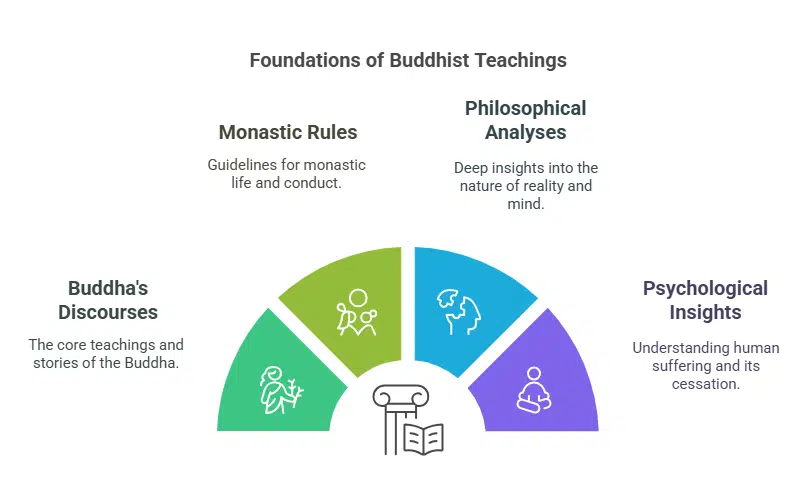
The Pali Canon represents the earliest complete collection of Buddhist teachings, preserved in the Pali language. Divided into three “baskets” (Tipitaka), it contains the Buddha’s discourses, monastic rules, and philosophical analyses. Unlike some religious texts that focus on divine revelation, the Pali Canon emphasizes psychological insights and practical guidance for ending suffering.
What makes these texts particularly valuable for contemporary readers is their psychological sophistication and their focus on the nature of mind and consciousness. The Buddha’s analysis of human suffering and the path to its cessation offers profound insights relevant to anyone interested in understanding the human condition, regardless of religious background.
The King James Version Bible: A Literary and Cultural Monument
For those interested in exploring Christianity’s sacred texts, the King James Version (KJV) Bible stands as both a religious and cultural landmark. Commissioned by King James I and completed in 1611, this translation transformed English literature and language. KJV Bibles from PPH offer readers access to this influential text in various editions suitable for study and reflection.
What makes the KJV unique is its literary quality and historical significance. Its poetic cadences and memorable phrases have permeated Western culture, literature, and common expressions. Even for those approaching it from a cultural rather than religious perspective, the KJV Bible offers insights into Western art, literature, and thinking that continue to resonate today.
The Zohar: Mystical Heart of Kabbalah
The Zohar represents the foundational work of Jewish mystical thought known as Kabbalah. Written primarily in Aramaic and emerging in 13th-century Spain, this collection of commentaries on the Torah explores the nature of God, the universe, the human soul, and the path to spiritual development.
What makes the Zohar particularly fascinating is its symbolic language and mystical interpretations of seemingly straightforward biblical passages. It presents a conception of reality as multi-layered, where sacred texts contain hidden meanings accessible through contemplation and spiritual practice. Even a casual exploration of the Zohar can provide insights into mystical dimensions of religious experience that transcend particular traditions.
The Guru Granth Sahib: Sacred Scripture of Sikhism
The Guru Granth Sahib serves as the central religious text of Sikhism and is regarded as the final and eternal guru following the line of ten human Sikh gurus. This extensive work comprises approximately 1,430 pages of hymns and writings that emphasize equality, service, devotion, and the unity of God.
What makes this text particularly noteworthy is its inclusive nature—it contains not only the writings of Sikh gurus but also works by Hindu and Muslim saints. This ecumenical approach reflects Sikhism’s emphasis on the universal accessibility of spiritual truth beyond religious boundaries, making it a powerful example of interfaith appreciation.
Exploring religious texts beyond one’s familiar tradition opens doorways to understanding the aspirations, values, and insights of diverse cultures. Whether you’re drawn to the poetic wisdom of the Tao Te Ching, the philosophical dialogues of the Bhagavad Gita, or the literary richness of the KJV Bible from PPH, each text offers unique perspectives on enduring human questions.
The true value of these works lies not just in their historical or theological significance, but in their continued relevance to contemporary life. They invite readers to engage with fundamental questions about meaning, ethics, consciousness, and our relationship with whatever we consider sacred. In a world where religious literacy is increasingly important, taking time to engage directly with these primary sources can foster greater understanding, empathy, and appreciation for the rich diversity of human spiritual expression.





















