The digital world is undergoing a massive transformation with two of the most revolutionary technologies—Web3 and the Internet of Things [IoT]. As these technologies converge, they are redefining how devices interact, data is processed, and security is maintained.
How Web3 and IoT Are Coming Together to Build a Smarter Future is a question that many industry experts are exploring. This integration promises a decentralized, secure, and efficient ecosystem that benefits various industries, including healthcare, smart cities, supply chain management, and more.
In this article, we will explore how Web3 and IoT complement each other, their real-world applications, and the challenges that need to be addressed for large-scale adoption.
Understanding Web3 and IoT
Web3, also known as the decentralized web, is the next evolution of the internet that emphasizes user control, transparency, and decentralization. Unlike Web2, which is dominated by centralized entities like Google, Facebook, and Amazon, Web3 leverages blockchain technology to create a trustless and permissionless environment.
Key Features of Web3:
- Decentralization: Eliminates the need for intermediaries by using blockchain networks.
- Smart Contracts: Self-executing contracts that run on blockchain protocols.
- Tokenization: Enables digital assets and ownership representation.
- Interoperability: Seamless communication between decentralized applications [dApps].
What is IoT?
The Internet of Things [IoT] refers to a network of interconnected devices that collect and exchange data over the internet. From smart home appliances to industrial sensors, IoT is transforming the way we interact with technology.
Key Features of IoT:
- Connectivity: Devices communicate via Wi-Fi, Bluetooth, or cellular networks.
- Data Collection: Sensors gather real-time data for analytics and automation.
- Automation: Enables smart decision-making without human intervention.
- Security Challenges: Centralized control raises risks of cyberattacks and data breaches.
The Need for Web3 in IoT
Traditional IoT systems rely on centralized cloud services, making them vulnerable to security threats, single points of failure, and privacy concerns. By integrating Web3, IoT devices can operate on decentralized networks, improving security, autonomy, and efficiency.
How Web3 and IoT Are Coming Together
Web3 introduces decentralized networks powered by blockchain, eliminating the reliance on a single entity to manage IoT systems. These decentralized IoT networks distribute data across multiple nodes, ensuring enhanced security and resilience.
Examples:
- Helium Network: Uses blockchain to create a decentralized wireless network for IoT devices.
- IOTA: A distributed ledger tailored for IoT transactions, enabling feeless microtransactions.
Smart Contracts and Automated IoT Transactions

Smart contracts automate IoT transactions by executing predefined conditions without intermediaries. This reduces latency, increases efficiency, and ensures secure peer-to-peer interactions.
Use Cases:
- Smart Homes: Devices autonomously adjust temperature and lighting based on blockchain-based smart contracts.
- Healthcare: Remote patient monitoring devices trigger automated alerts if vital signs fluctuate.
- Supply Chain: Sensors track goods, and smart contracts release payments upon delivery verification.
Tokenization and Data Monetization in IoT
Web3 enables tokenization, allowing IoT device owners to monetize their data. Instead of large corporations monopolizing user data, individuals can earn cryptocurrency by sharing their device-generated insights.
Examples:
- Ocean Protocol: Enables data owners to sell IoT-generated data securely.
- Streamr: Allows IoT devices to stream real-time data to buyers via decentralized networks.
Key Benefits of Integrating Web3 and IoT
| Benefit | Description |
| Enhanced Security and Privacy | Decentralization removes single points of failure and enhances data privacy. |
| Improved Interoperability | Web3 protocols allow different IoT ecosystems to communicate seamlessly. |
| Lower Operational Costs | Eliminates intermediaries, reducing transaction costs in IoT automation. |
| User Empowerment | IoT users control their data and can monetize it securely. |
| Resilience | Decentralized IoT networks are less prone to hacking and data breaches. |
Real-World Use Cases of Web3 and IoT Integration
Web3-enabled IoT systems optimize traffic flow, manage waste efficiently, and enhance energy distribution in smart cities.
Examples:
- Blockchain-powered smart grids distribute electricity efficiently.
- Decentralized traffic systems optimize signals based on real-time data.
Healthcare and Remote Patient Monitoring
Blockchain-powered IoT medical devices secure patient data and enhance remote healthcare.
Examples:
- Wearable health monitors store medical records securely on a blockchain.
- Automated insurance claims using smart contracts for medical procedures.
Supply Chain and Logistics
Web3-IoT solutions enhance transparency, traceability, and efficiency in supply chains.
Examples:
- Blockchain-based shipment tracking improves product authenticity.
- IoT sensors verify storage conditions for perishable goods.
Industrial Automation and Smart Manufacturing
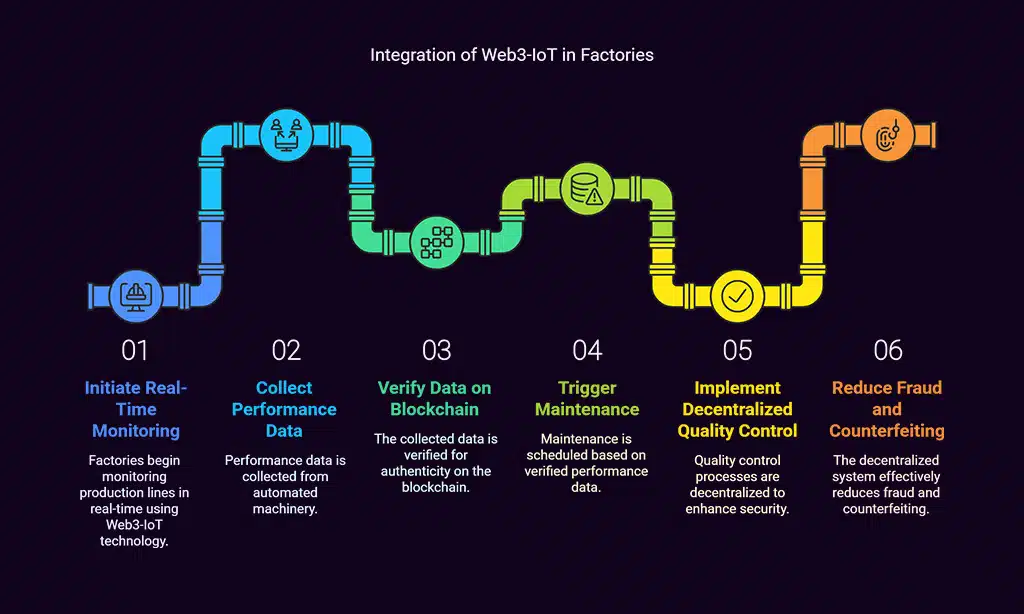
Factories integrate Web3-IoT to enable real-time monitoring and decentralized control of production lines.
Examples:
- Automated machinery maintenance based on blockchain-verified performance data.
- Decentralized quality control reduces fraud and counterfeiting.
Challenges and Limitations
Scalability and Network Congestion
Blockchain networks must scale to handle the massive data influx from IoT devices.
Regulatory and Compliance Concerns
Decentralized IoT raises legal and regulatory challenges regarding data privacy and security.
Adoption Barriers and Technical Complexity
Integrating Web3 with IoT requires significant investment, infrastructure, and expertise.
The Future of Web3 and IoT
- AI-powered IoT devices interacting autonomously on blockchain networks.
- Decentralized cloud storage replacing traditional cloud services.
Potential Innovations and Market Growth
- More businesses adopting blockchain-based IoT ecosystems.
- Increased interoperability between different Web3 and IoT networks.
How Businesses and Developers Can Prepare
- Invest in decentralized applications [dApps] for IoT.
- Develop blockchain-based IoT security solutions.
- Encourage government regulations that support Web3-IoT innovation.
Takeaways
How Web3 and IoT Are Coming Together to Build a Smarter Future is shaping the next phase of technological evolution. By decentralizing IoT networks, enhancing security, and enabling data monetization, Web3 is revolutionizing IoT applications across industries.
However, challenges like scalability and regulatory issues need to be addressed for widespread adoption.
The fusion of Web3 and IoT holds immense potential for transforming smart cities, healthcare, supply chains, and industrial automation. As businesses and developers embrace this synergy, we move closer to a truly decentralized and intelligent future.
Are you ready for the Web3-IoT revolution? The future is decentralized, secure, and smarter than ever!