The internet has long been dominated by centralized web hosting services, where corporations control vast amounts of online data. However, a new era is emerging with the rise of decentralized web hosting (IPFS & Web3).
This innovative approach leverages blockchain technology and peer-to-peer networks to create a more secure, censorship-resistant, and user-controlled internet.
As concerns over data privacy, government restrictions, and high hosting costs grow, decentralized web hosting offers an alternative that empowers users and enhances web security.
This shift is not just theoretical; real-world applications are already in play. Major companies and independent developers are actively experimenting with Web3 hosting solutions to reduce reliance on traditional web hosting services.
As decentralized technology continues to mature, it is expected to redefine the way we build and interact with the internet, promoting a free and open digital ecosystem.
What Is Decentralized Web Hosting?
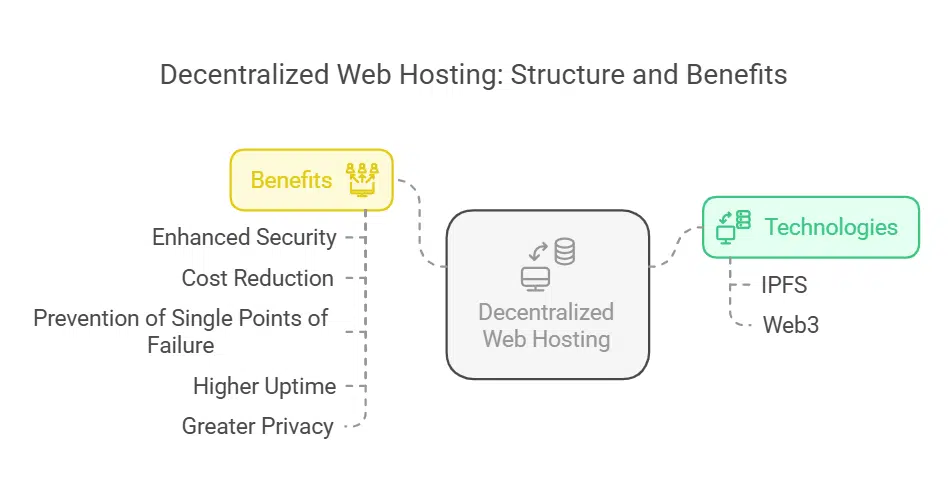
Decentralized web hosting is a method of storing and distributing website content across multiple nodes instead of relying on a single centralized server.
It uses technologies like the InterPlanetary File System (IPFS) and Web3 to enhance security, reduce costs, and prevent single points of failure.
Unlike conventional hosting, where website data is stored in a specific data center controlled by a hosting provider, decentralized hosting spreads the information across a global network, ensuring higher uptime, greater privacy, and improved security.
Key Features of Decentralized Web Hosting:
- Distributed Storage – Websites are hosted on multiple nodes instead of a single server.
- Censorship Resistance – Data cannot be easily altered or removed by authorities.
- Enhanced Security – Blockchain and cryptographic verification prevent unauthorized modifications.
- Cost-Effective – Eliminates the need for expensive hosting plans.
- Fault Tolerance – Websites remain accessible even if individual nodes go offline.
Why Is Traditional Web Hosting Problematic?
Traditional web hosting services have long been the foundation of the internet, but they come with inherent drawbacks. Some of the key issues with centralized hosting include:
| Problem | Explanation |
| Centralized Control & Censorship | Websites hosted on centralized servers are vulnerable to government takedowns and corporate control, making them susceptible to political and commercial influence. |
| Single Points of Failure | If a hosting provider’s server goes down, websites become inaccessible, severely impacting businesses and online services. |
| High Hosting Costs | Hosting services charge fees that increase as websites scale, making it expensive for individuals and small businesses, particularly those requiring high bandwidth or data storage. |
| Data Breaches & Privacy Risks | Centralized hosts store user data, making them attractive targets for hackers who can exploit security vulnerabilities. |
How Web3 and IPFS Are Changing the Hosting Landscape
Web3 and IPFS introduce a decentralized, peer-to-peer infrastructure for hosting websites. Instead of depending on a single provider, data is distributed across multiple nodes, reducing dependency on centralized authorities and enhancing security.
This approach also empowers users with more control over their data, preventing unauthorized modifications or takedowns by centralized entities.
What Is IPFS (InterPlanetary File System)?
IPFS is a peer-to-peer protocol that enables decentralized file storage and sharing. Unlike traditional URLs, which fetch data from a specific location, IPFS retrieves content based on its cryptographic hash, ensuring data integrity and redundancy.
This method ensures that content remains available even if the original host node goes offline.
| Feature | Benefit |
| Content Addressing | Ensures files are identified by their unique hash, eliminating broken links. |
| Decentralized Storage | Data is stored across multiple nodes, reducing reliance on a single entity. |
| Improved Security | Cryptographic verification ensures data authenticity and prevents tampering. |
| Efficient Bandwidth Use | Data retrieval is optimized through peer-to-peer sharing, reducing latency. |
Role of Web3 in Decentralized Hosting
Web3 represents the next phase of the internet, powered by blockchain and smart contracts.
It facilitates decentralized hosting by providing domain names through Ethereum Name Service (ENS) and Handshake, enabling users to store and retrieve website data without intermediaries.
Web3 hosting solutions also allow developers to integrate smart contracts, automating processes like payments, content licensing, and data verification.
IPFS vs. Traditional Hosting – Key Differences
| Feature | IPFS (Decentralized) | Traditional Hosting (Centralized) |
| Data Storage | Distributed P2P Network | Single Server or Cloud Provider |
| Security | Highly Secure, Immutable | Prone to Hacks & Data Loss |
| Censorship Resistance | High | Low, Subject to Restrictions |
| Cost | Low | High Monthly Fees |
| Scalability | Easily Scalable | Limited by Server Capacity |
Benefits of Decentralized Web Hosting

Decentralized web hosting offers numerous advantages over traditional hosting methods, making it a compelling choice for individuals and businesses seeking greater control, security, and cost-effectiveness.
By leveraging blockchain technology and peer-to-peer networks, decentralized hosting eliminates many of the vulnerabilities associated with centralized servers, creating a more resilient and efficient digital infrastructure.
Increased Security & Data Integrity
Decentralized web hosting ensures that once data is uploaded, it cannot be altered or erased by a single entity, making it highly secure against cyber threats.
Even if one node goes offline, copies of the data exist across the network, preventing data loss.
Decentralized hosting also eliminates vulnerabilities associated with DDoS attacks, as there is no single point of failure for hackers to target.
Censorship Resistance & Freedom of Speech
Decentralized hosting allows users to bypass government-imposed restrictions, ensuring information remains accessible.
This is particularly useful for independent journalists, activists, and organizations operating in restrictive environments.
Lower Hosting Costs & Scalability
Hosting on IPFS is cost-effective since it eliminates the need for centralized data centers. Users only pay for storage when needed, avoiding the recurring costs associated with traditional hosting providers.
Greater Control for Content Creators
Content creators own their data, preventing third-party platforms from monetizing or restricting access to their content.
With blockchain integration, creators can implement direct monetization models without intermediaries, allowing peer-to-peer transactions with cryptocurrency.
Challenges & Limitations of Decentralized Hosting
| Challenge | Explanation |
| Adoption Barriers | Many users find it difficult to transition from traditional hosting due to the technical expertise required. |
| Speed & Performance | Fetching data from multiple nodes may cause higher latency compared to centralized servers. However, improvements in content delivery mechanisms are addressing these issues. |
| Storage Costs | Storing large files on blockchain-based networks can be expensive and inefficient, requiring additional solutions like Arweave and Filecoin. |
| Regulatory Uncertainty | Governments may impose restrictions or create legal ambiguities surrounding decentralized hosting. |
Future of Decentralized Web Hosting
As Web3 technology evolves, decentralized hosting will become more mainstream, shifting control away from corporations to individual users.
Platforms like Ethereum, Filecoin, and Arweave are already developing scalable hosting solutions that provide efficient alternatives to centralized hosting providers.
The Role of AI, Blockchain & Smart Contracts in Web Hosting
Artificial intelligence and blockchain integration will enhance the efficiency, security, and automation of decentralized hosting solutions. AI-powered caching mechanisms and blockchain-based storage verification will improve performance while maintaining data integrity.
Takeaways
Decentralized web hosting (IPFS & Web3) is poised to revolutionize the internet by providing a censorship-resistant, cost-effective, and secure alternative to traditional hosting.
While challenges remain, continuous innovation in blockchain technology and peer-to-peer networks is paving the way for a future where users have greater control over their online presence.
As adoption grows, decentralized hosting could become the standard for a truly open and resilient web