

Are you staring at a mystery board and thinking, “How am I supposed to find the fok959s-m model when the label looks like it survived a flood?” You might be dealing with a dead HVAC controller, a puzzling control module, or a part with faded alphanumericals that all look the same after a long service life.
This complete guide walks you through the fastest ways to find the model number, confirm the exact variant, and start safe, practical troubleshooting without guessing.
Key Takeaways
- Start with the product label and the user manual, then match the model number and serial number to confirm the exact FOK959S-M variant.
- Use the manufacturer’s documentation (manual PDF, datasheet, wiring diagram, and bill of materials) to confirm the part number, spec, and where the module sits in the assembly.
- Use image search and text-from-photo tools to pull the alphanumeric code from a clear photo, even when the printing is faint.
- When you contact an OEM or supplier, send high-resolution photos plus the full identifier (including suffixes) and ask about lifecycle status, replacements, and firmware compatibility.
How to Find FOK959S-M Model
If you need to find the FOK959S-M model number fast, don’t start with guesses or “close enough” matches. Start with the identifier trail, which usually means the label, the manual PDF, and any barcode or QR label tied to the serial number.
| Where to look | What you’re trying to capture | Why it matters |
|---|---|---|
| Outer label or nameplate | The outer label or nameplate includes the model number, serial number, suffix, and manufacturing date. | One extra character can mean a different voltage, firmware line, or connector layout. |
| Inside the enclosure | The sticker is located on the control module, bracket, or inside the cover. | Some manufacturers hide the identifier to protect it from heat, UV, and cleaning chemicals. |
| Circuit board surface | The circuit board surface may have a barcode label and printed markings indicating “S/N” or “SN.” | This helps you match the exact model and authenticity when the housing label is missing. |
| User guide and service documents | Part number references in diagrams and the bill of materials | Documentation often confirms which model belongs in a specific machine or assembly slot. |
Check the User Manual
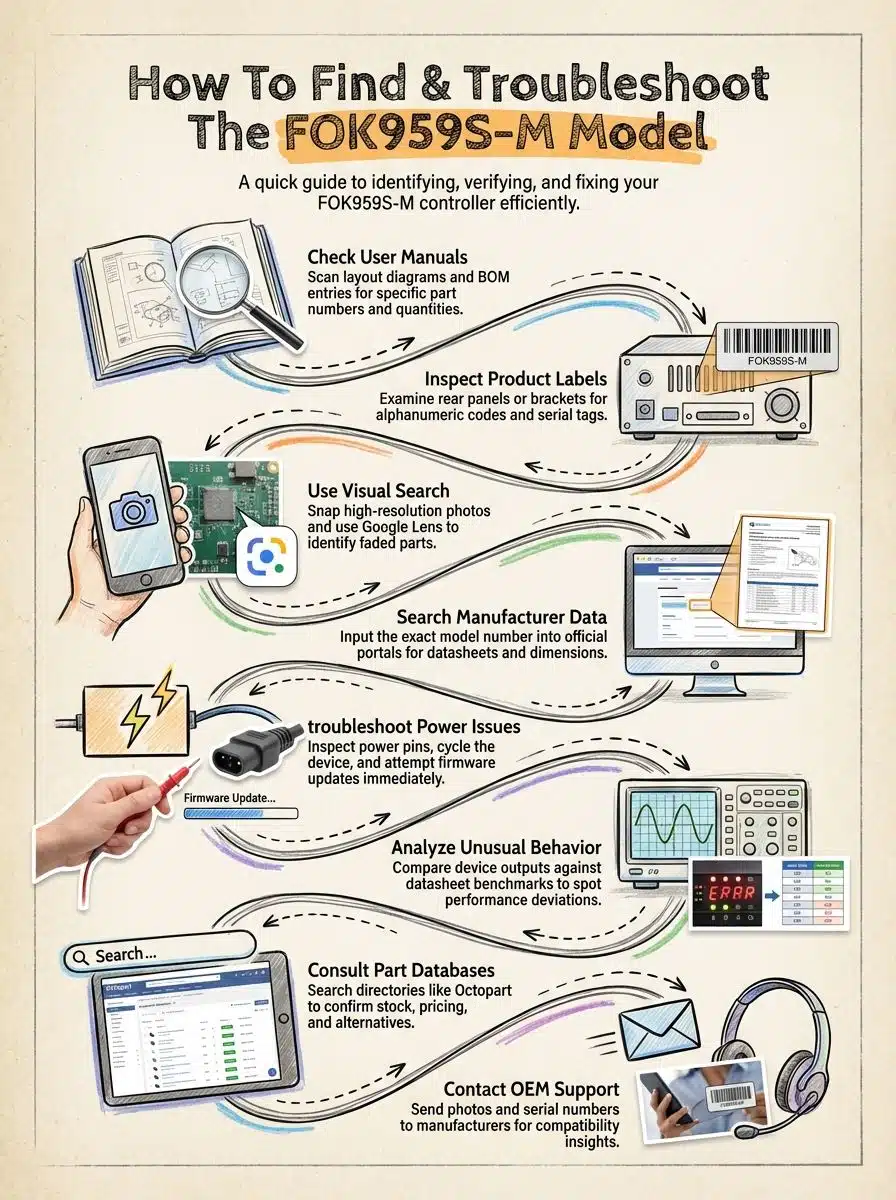
Open the OEM user manual or manual PDF and go straight to the parts diagram, component layout, and exploded view. Those sections usually list the part number, and the bill of materials (BOM) often shows the exact FOK959S-M quantity used in each assembly.
If your PDF is searchable, use the find function to search for FOK959S-M (including the hyphen). If it’s a scanned PDF, run OCR in a tool like Adobe Acrobat so the text becomes searchable, then repeat the search.
Also check maintenance logs and service sheets. A lot of teams write down the model number during prior repairs, and that record can be faster than pulling a unit apart.
Inspect the Product Label
Look for a sticker label or data tag on the bottom, rear panel, sidewall, mounting bracket, or inside the enclosure. If you’re checking an embedded module, inspect the cable side too, since the sticker sometimes sits near the connector for quick servicing.
Before you scrub anything, take photos. Use bright light, turn on your phone’s macro mode if you have it, and try “raking light” (flashlight angled from the side) to make stamped or worn characters pop.
If the identifier is still hard to read, use a text-from-photo feature to copy the alphanumeric code into your notes, then search it exactly as copied. In a March 2025 support update, Apple describes using Live Text to copy text from photos, which can save you from mistyping similar characters like 0 and O.
Some equipment uses machine-readable labels. For example, Koppel explains that many air conditioner units place the model and serial sticker inside the indoor unit’s front panel area and on a specific side of the outdoor unit, and Schneider Electric notes that certain products use a QR code for customer-facing serial details while a different code type may be reserved for internal traceability, so it pays to scan carefully and confirm what the code resolves to.
Once you have the label data, write it exactly as printed, including suffixes. A suffix is often the difference between a compatible replacement and a part that fits physically but fails electrically.
- Photograph the whole label (context), then a tight close-up (readability).
- Capture any barcode or QR label plus the printed text beside it.
- Record the full identifier, including hyphens, suffixes, and revision marks.
- Compare the model number to the serial number; they are not interchangeable.
Search Manufacturer Documentation Online
Once you have identified your best guess, search the manufacturer’s website for product pages, technical resources, and spare parts catalogs. Type the model exactly, including the hyphen and capitalization, since many search tools treat those as part of the part number.
What you’re hunting for is a clean match across multiple documents, like a datasheet plus a manual PDF plus a wiring diagram. When those line up, you can trust you’ve found the exact model, not a close cousin.
While you’re there, please take a moment to review the lifecycle notes and replacement guidance. A discontinued module might have an official substitute part number, and that’s usually the safest path for compatibility.
Troubleshooting Common Issues
Once you’ve confirmed the FOK959S-M model number, troubleshooting gets easier because you can stop treating the unit like a mystery box. Your next goal is to do a quick, safe physical inspection and rule out the most common “it’s dead” causes before you order parts.

If you’re not trained to work around energized equipment, stop at visual checks and documentation. For live testing, involve a qualified technician and follow your site’s safety rules.
- Cut power before opening panels, then confirm the unit is actually de-energized.
- Inspect connectors for bent pins, looseness, or corrosion.
- Look for an onboard fuse, burned spots, or cracked solder joints.
- Confirm the model number and suffix again before you try firmware or replacement parts.
Device Fails to Respond
If the FOK959S-M does not respond at all, start with the “small stuff” that takes minutes. Many control boards and controllers use a small onboard fuse, and a blown fuse can make the whole device look dead even when the rest of the system is fine.
Next, check for simple causes that block startup, like a door or panel interlock switch that isn’t engaged, loose low-voltage wiring, or a connector that backed out during vibration. If the fuse blew again after replacement, treat that as a symptom, then look for shorts, damaged wiring, or a failing external component pulling too much current.
Only consider firmware updates after you confirm the exact model and variant. Loading the wrong firmware package can create new problems, so match the model number, revision, and any documented firmware requirements first.
Unusual Operation Behavior
Strange behavior, like delayed actions, wrong outputs, or intermittent resets, often points to something you can validate with a checklist. Compare readings and behavior to the specification (technical standard) limits in the datasheet, then work through wiring and grounding one item at a time.
In humid environments, oxidation and grime can creep into connectors and terminals. A careful reseat of connectors, plus cleaning with electronics-safe contact cleaner (with the power off), can fix issues that look like “random glitches.”
Capture evidence as you go. Record error codes, blink patterns, the operating context (startup, load change, heat), and the serial number. That package gives OEM support better context and helps you avoid common pitfalls like mixing up similar-looking variants.
Tips for Ensuring Accurate Model Identification
When you’re trying to locate an exact model in a hurry, the best strategy is to build a small trail of proof. One clear identifier from a label is good, but two or three independent matches (label plus manual plus database listing) are where you get confidence.

| Method | Best for | Common pitfalls |
|---|---|---|
| Label or nameplate | Fastest model number capture | Faded print, missing suffixes, confusing model vs serial |
| User manual and BOM | Confirming the correct part number inside a machine | Using a generic manual for a different revision or region |
| Photo + visual recognition | Reading worn alphanumericals and matching housings | Blurry photos, glare, and partial identifiers |
| Parts database and supplier listings | Cross-checking lifecycle status and substitutes | Unauthorized sellers, mislabeled listings, counterfeit risk |
| OEM or certified distributor support | Final confirmation and compatibility checks | Sending incomplete photos or leaving out the suffix and serial |
Use Online Tools and Databases
Use parts databases to cross-check the model number, lifecycle status, and replacement suggestions. Tools like Octopart, Mouser Electronics, RS Components, element14, and Digi-Key can be helpful because they often show manufacturer part numbers, packaging details, and distributor notes in one place.
Photo-based tools can speed up locating the model when you only have a worn sticker. Try Google Lens, Bing Visual Search, or Yandex Image Search on a close-up photo, then validate the result against a datasheet or manual PDF before you order.
If you’re ordering parts into the Philippines, factor in customs and landed cost early so procurement doesn’t stall after you identify the exact model. The Bureau of Customs has published guidance around de minimis shipments valued at PHP 10,000 and below, including a PHP 430 regulatory charge per waybill under Customs Administrative Order 02-2024, and the Tariff Commission describes the ASEAN Harmonized Tariff Nomenclature (AHTN) as an eight-digit HS-based system used for classification, which can help you and your broker avoid clearance delays.
Contact Customer Support
If your photos and searches still leave doubt, go straight to the OEM or a certified distributor. The goal is to get a clear “yes, that’s the exact model” before you spend money on the wrong part.
Send a tight, complete info bundle so you get real opinions and insights instead of back-and-forth questions.
- Write the full model number exactly, including suffixes and revision marks.
- Include the serial number, any barcode text, and clear photos of all sides.
- Add one photo showing the module installed in the machine, including connectors and mounting.
- Describe the symptoms, when they started, and what changed (power event, overload, water exposure).
- Ask directly about end-of-life status, approved replacements, and firmware compatibility.
Takeaways
If you need to find the fok959s-m model, start with the label, then confirm it with the user manual and manufacturer documentation.
When the printing is worn, a clear smartphone photo plus visual recognition tools can help you copy the identifier accurately, and then you can validate it against the spec and diagrams.
Bring high-resolution photos, serial number details, and basic troubleshooting notes when you reach out to an OEM, supplier, or forum; it speeds up the answer and helps you land on the exact model faster.
FAQs on Fok959s-m Model
1. What is the Fok959s-m model?
The Fok959s-m is a specific product, from a brand, that uses modular technology and has innovative features.
2. Where do I find the model number?
The model number is often on the back, on a sticker, or inside the manual. If you can not find it, check the box or the system settings; it may list the name.
3. What are common pitfalls in troubleshooting this device?
Common pitfalls include skipping usability notes and ignoring small error lights. If the product is highly specialized, a tiny step can break the fix, so read the guide.
4. How do I get parts or help fast?
Call Brand support; they know the modular parts and the technology. If the model is well labeled, parts and guides match, and you save time. When in doubt, ask a forum or a pro; it can cut your work in half, no joke.





















