

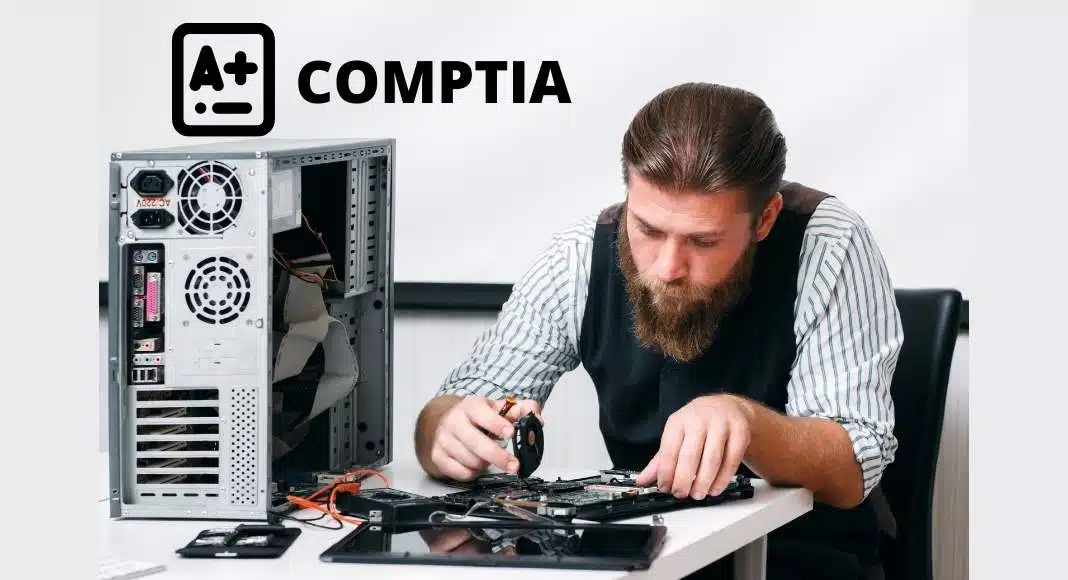
The A+ certification track is the world leading entry level certification for jobs in information systems (IT) support and help desk. It is the only certification track that has reached over one million certifications and as such it has launched a large number of IT careers.
Here we are looking at how to prepare for that exam. Let’s first define what “practicing for an exam” includes and excludes. Test prep is not properly speaking what we mean by “studying”, it is what comes after you have studied the content that the exam sponsor (in this case CompTIA) has published. It involves taking the knowledge of the content you have studied and getting you “formatted” for the exam. This means learning how to answer very pointed questions about the content you have learned and also mastering the specifics of the exam i.e., time available and the types of questions (multiple-choice question, drag and drop, performance-based questions, etc.). The first and most obvious way to do that is to use an A+ practice test.
How to distinguish a good A+ practice test from a lesser one
There are five characteristics any relevant A+ practice test must possess:
- Clearly formulated questions
- Credible detractors (wrong answer choices)
- A unique choice for the correct answer
- An explanation for the correct answer
- Listing the precise A+ exam sub-objective the question belongs to
These characteristics are what make thorough and thoughtful test preparation possible. Going through the Microsoft AZ-305 Practice Test Dumps, you need to carefully evaluate how you approach each question. If you select the correct answer, ensure you fully understand the reasoning behind it. When reviewing the incorrect options, analyze not only why they are wrong but also why they might appear to be correct within the context of the question. Additionally, if you experience any uncertainty while answering, revisit the relevant AZ-305 exam sub-objective to strengthen your understanding. This approach ensures that on exam day, you can confidently answer similar questions, even if they are slightly modified. This method fosters deep, knowledge-based preparation rather than ineffective rote memorization. So far, we have focused solely on the multiple-choice question (MCQ) format. There are other types of questions on this exam.
Ace your next IT certification test with Exam Labs all-in-one study guides. We offer exam-mimicking practice tests, in-depth syllabus reviews and discount vouchers codes for top certs including CompTIA, AWS, Cisco and Microsoft.
Question Types of the CompTIA A+ Exam
On the A+ exam you will face, in addition to MCQ: drag and drop, scenario-based questions, and performance-based questions. Of these the Performance Based Questions (PBQ) are to most advanced. CompTIA can offer these question types because they have outsourced the proctoring of the exam to Pearson VUE which has a solid software-based test engine (you will take your exam on a computer). Now, for you to prepare for those types of questions will require you to go to the he next step up and use an exam simulator. Although there are a fair amount of free A+ practice tests online, exam simulators will be a premium product that you would have to buy. If you decide to go that route, then make sure it includes the performance-based question type. The best way to make sure of that, is to just google “A+ performance-based question” and find out who includes these and who doesn’t.
An additional online resource is the free A+ study guide: https://www.certblaster.com/aplus-examnotes-for-a-exams-220-1001-and-220-1002/
























