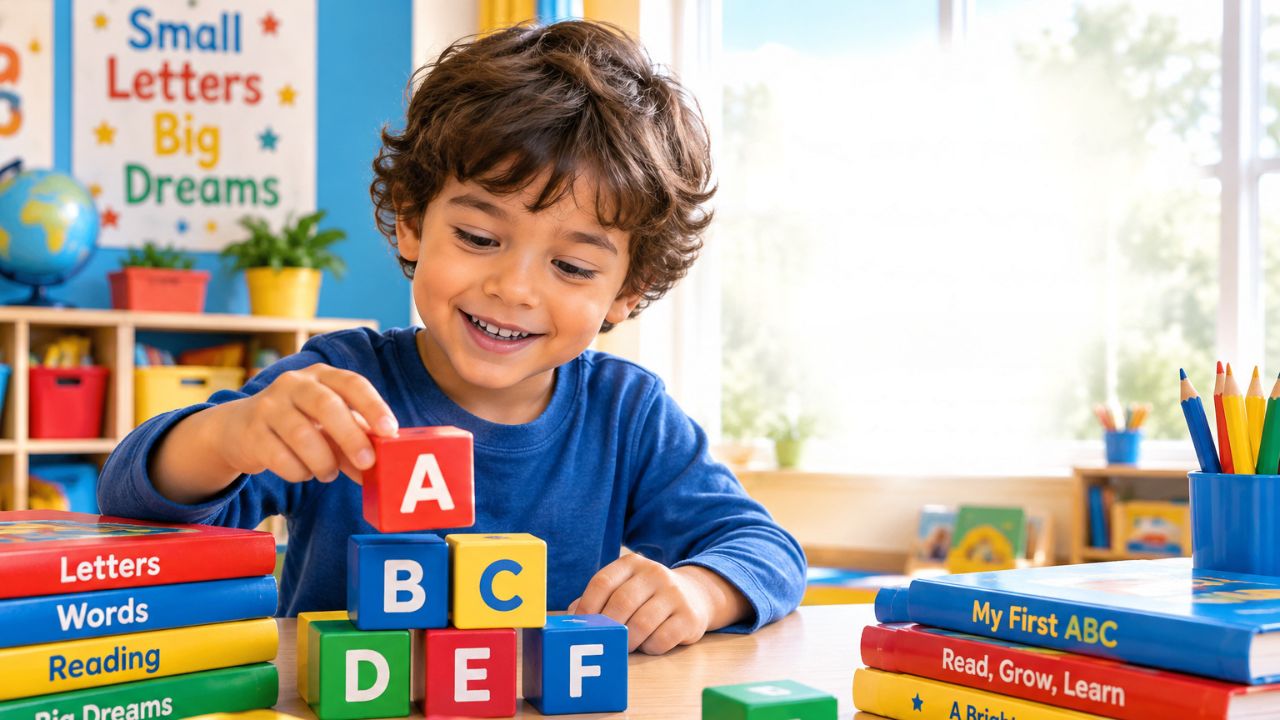
My nephew Zayan is five. One evening, he named every letter on the alphabet chart on his bedroom wall. Later, I opened a picture book and pointed to one of those same letters, and he had no idea what it was. That moment taught me more about how alphabet knowledge predicts reading success than any report I’d read. Knowing letters in order isn’t the same as knowing letters. And the kind of knowing matters for reading.
In this article, I’ll explain what the research says, where it falls short, and how you can check your own child’s letter knowledge at home in a few minutes.
What Counts as Alphabet Knowledge in How Alphabet Knowledge Predicts Reading Success
Alphabet knowledge isn’t one skill. It has three parts:
- Letter shape: Telling one letter apart from another, even in a different font or handwriting.
- Letter name: Saying what the letter is called.
- Letter sound: Linking the letter to its most common sound. This is the first step toward understanding that written letters stand for spoken sounds.
A child can be strong in one part and weak in another. Zayan knew the names, but only in one familiar place.
The Research Behind How Alphabet Knowledge Predicts Reading Success
The key study is the National Early Literacy Panel report from 2008. The panel named 11 early skills that predict later reading, and alphabet knowledge was one of the strongest. Children who know few letters in preschool and kindergarten face a higher risk of reading problems later.
How strong is the link? Two large research reviews found that letter knowledge in kindergarten had a correlation of about .50 with later reading. In research on child development, that’s a strong link for a single skill.
Newer data points the same way. A study published in 2026 followed more than 810,000 first graders in France and tested their reading fluency a year later. The strongest predictor was the alphabetic principle: knowing that letters stand for sounds. The study also found something interesting. Phonemic awareness, the ability to hear the small sounds inside words, predicted reading only when the child’s letter knowledge was already strong.
In short, sound skills help most when a child already knows the letters.
Why Letter Names Matter in How Alphabet Knowledge Predicts Reading Success
Letter names do more work than they seem to. Most letter names contain the letter’s sound. “Bee” starts with the sound B makes, and “tee” starts with the sound T makes. So a child who knows the names already has clues to the sounds.
A name is also stable. A letter’s shape changes with fonts, and its sound can change from word to word, but its name stays the same. Think of the name as a folder where a child stores everything else they learn about that letter.
Why Recognition Beats Recitation in How Alphabet Knowledge Predicts Reading Success
This is the part Zayan made clear to me. Singing the alphabet song is not the same as recognizing letters.
The research backs this up. One study measured how stable children’s early skills stayed over six months. Letter naming held up well, with a stability of .67. Alphabet recitation, meaning saying the letters in order, was much weaker at .37.
So when a child sings A to Z perfectly, it’s good, but it tells you less than you think. What predicts reading is naming a letter when it’s out of order, out of context, and in a new place.
The Limits of How Alphabet Knowledge Predicts Reading Success
Letter knowledge predicts reading, but that doesn’t make it a shortcut. A 2010 meta-analysis by Piasta and Wagner looked at studies on teaching the alphabet. It found little evidence that alphabet teaching alone improved phonological, reading, or spelling skills.
There are two reasons this makes sense.
First, letter knowledge is partly a signal. Children who know many letters often have more books at home, more talk, and more practice with print. Those things help reading too.
Second, the benefit comes from connecting skills, not isolating them. Teaching letters and sound skills together usually works better than teaching each one alone. So the goal isn’t to drill 26 names. It’s to connect each shape to a name and a sound and then use that connection with real words.
What Zayan Showed Me About How Alphabet Knowledge Predicts Reading Success
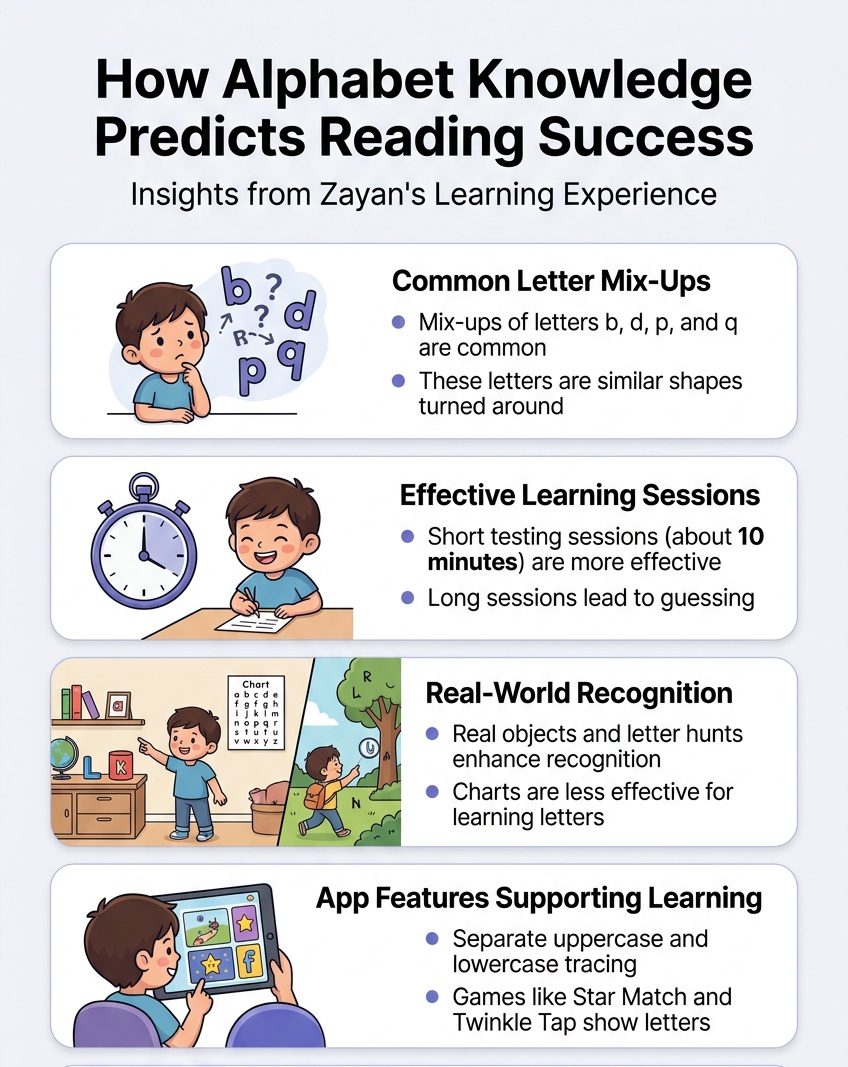
After the wall chart moment, I stopped testing Zayan in order. Three things stood out.
1. His hard letters were b, d, p, and q. These four letters are the same shape turned around. For a five-year-old, a chair is still a chair whichever way it faces, so it’s no surprise that flipped letters look the same to him. Mix-ups like this are common at his age. They don’t mean something is wrong. They’re simply the letters that need extra practice.
2. He gave me about ten minutes. After that, his answers turned into guesses. Short sessions worked better than long ones every time.
3. Real objects and letter hunts worked best. Letters on a chart didn’t stick for him. Finding a letter on a cereal box, a street sign, or a toy did. It forced him to recognize the letter out of order and in a new place, which is exactly the skill the research says predicts reading.
How the app fits in. As chief technical advisor for Alphabet Magic: Trace & Phonics, I’m close to this product, so please keep that in mind. (It’s also on the App Store.) Here’s what it includes and why each part matters:
- Separate uppercase and lowercase tracing. This matters because lowercase is where the b, d, p, and q mix-ups happen.
- Letter games like Star Match and Twinkle Tap. These show letters out of order, so children have to recognize them rather than recite them.
- Star Connect. This is a phonics game that links letters to sounds.
I’ve written more about which alphabet app features actually help children learn.
Still, an app is for practice. It doesn’t replace an adult sitting next to the child. Even one parent’s Play Store review of our app says kids still need a grown-up to guide them. I agree. If you’re comparing options, see these apps for kids learning English and these preschool learning games on Google Play.
A Home Check Based on How Alphabet Knowledge Predicts Reading Success
This takes about five minutes, well within a young child’s attention span:
- Write letters in random order. Use lowercase, since it’s harder than uppercase.
- Point to each letter and ask its name. Count only quick, confident answers.
- Ask for the sound of each letter. A letter counts as learned only when the child knows both the name and the sound.
- Test it somewhere new. Find a known letter in a book or on a package. If the child can’t name it there, it isn’t learned yet.
- Watch the lookalike letters. Check b, d, p, and q, plus other common pairs like m and w, or n and u.
Write down the letters your child misses. Those are next week’s practice letters. By the end of kindergarten, children are usually expected to recognize and name all uppercase and lowercase letters.
Final Thoughts on How Alphabet Knowledge Predicts Reading Success
How alphabet knowledge predicts reading success comes down to a simple idea. Knowing letters out of order, with their sounds, and in new places is one of the clearest early signs that a child is ready to read. Singing the song doesn’t show that, and neither does naming letters on a familiar chart. Check what your child really knows, practice in short sessions, and connect letters to sounds and real objects. That’s the part that matters.