
Search visibility is no longer limited to a list of ranked pages.
A potential customer can ask ChatGPT to compare software, read a Google AI Overview before opening a result, or use Perplexity to research a service. The response may cite a company, summarize one of its articles, mention a competitor instead, or answer the question without producing an immediate website visit.
That creates a more complicated problem for businesses.
A page can rank well in conventional search but remain absent from an AI-generated comparison. Another page can be cited prominently and still receive little traffic. A brand may even influence an answer without receiving a visible link.
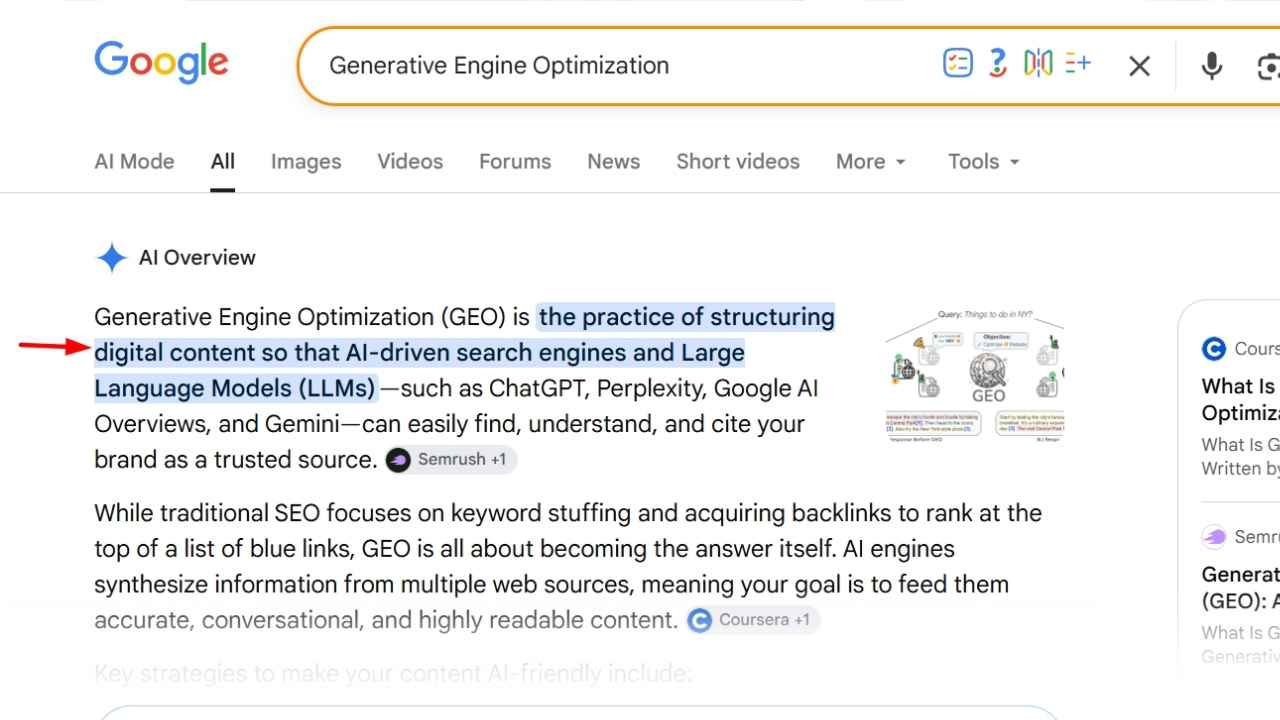
Generative Engine Optimization, or GEO, addresses that changing path between a question and a business outcome. It focuses on helping AI-driven search systems find, understand, retrieve, cite, and accurately represent a website’s information.
GEO deserves serious attention, but it also needs a sober explanation. It is not a replacement for SEO, and it is not a shortcut built around one file, one schema type, or one writing format. The practical work is less dramatic: improve technical access, remove ambiguity, publish information worth using, and measure more than rankings.
What Generative Engine Optimization Changes
Traditional SEO often revolves around two outcomes: ranking for a query and earning a click.
Generative search introduces several stages between those two events. A page must first be available to the relevant system. Its content must then match the question closely enough to be retrieved. The system may use it, cite it, mention the brand, or leave it out of the final response.
These are separate outcomes:
- Discovery: The system can crawl, index, or retrieve the page.
- Citation: The page appears as a visible source.
- Answer influence: Its facts or explanations shape the generated response.
- Business impact: The visibility contributes to traffic, branded demand, leads, sales, or another useful action.
Treating all four as “AI visibility” hides important differences.
For example, a research report may earn citations because it contains original data, yet send few visitors to the publisher. A product page may receive referral traffic while the AI system describes the product inaccurately. A company may appear in several comparison answers but only for broad informational questions with little commercial value.
A useful GEO strategy asks where the website is losing visibility in that sequence.
If the page is not retrieved, the problem may be technical access, weak relevance, or poor internal discovery. If it is retrieved but not cited, the information may lack clarity or supporting evidence. If citations appear without business results, the selected questions may have low intent or the landing page may not help visitors take the next step.
Google now describes GEO and answer engine optimization as work that remains part of SEO. That is the most sensible way to approach it. The established disciplines of crawling, indexing, helpful content, site quality, internal linking, and reputation still matter. GEO adds new ways to evaluate whether those foundations are producing visibility inside generated answers.
What Most People Get Wrong About Generative Engine Optimization
Much of the current GEO advice begins with the assumption that AI search systems need a special kind of article.
This has produced familiar recommendations: split every paragraph into tiny chunks, create a page for every possible question, add an llms.txt file, use a particular schema type, or rewrite every article in a simplified “AI-readable” style.
The advice sounds precise, which makes it attractive. It is also incomplete.
Google does not require special AI schema, mandatory content chunking, or a separate AI version of a page for visibility in AI Overviews and AI Mode. It also states that llms.txt is not used for Google Search.
Clear structure still helps. A direct answer beneath a descriptive heading is easier for both readers and retrieval systems to locate than a vague introduction followed by several hundred words of background. Comparison tables, definitions, limitations, dates, and specifications can provide useful source material.
Mechanical writing does not automatically improve retrieval. An article made entirely of short answer blocks can become repetitive and shallow. Publishing dozens of near-duplicate pages for slight variations of the same question creates a different problem: the site now has several weak pages competing to explain one subject.
The strongest page is usually the one that resolves the full information need without wandering.
Another mistake is treating a citation as a stable ranking position. Generated answers can change when the prompt is rephrased, when a different platform is used, when fresher sources become available, or when the same test is repeated.
The foundational GEO study reported visibility improvements of up to 40% in its benchmark. That finding helped establish GEO as a serious research topic, but it is frequently quoted without enough context. The experiment showed that changes to content already available within a controlled retrieval setting could affect its visibility. It did not prove that applying the same edits would consistently improve live-platform discovery, organic traffic, or revenue.
More recent research describes GEO as a partly observable pipeline rather than a single ranking system. A source can be discovered, retrieved, cited, paraphrased, misrepresented, or ignored at different stages. That helps explain why universal GEO formulas tend to disappoint.
A better working assumption is that GEO improves probability, not control. It can make a source more useful and easier to retrieve, but no publisher can guarantee placement in a generated answer.
What Makes a Page Useful to AI Search Systems
An AI answer engine cannot use information it cannot access. This sounds obvious, yet technical access is easy to overlook when a team becomes focused on content formatting.
Start With Crawlability
For Google’s generative search features, important pages need to be indexed and eligible to appear in Search. The usual technical problems still apply: accidental noindex directives, weak internal links, broken canonicals, rendering failures, blocked resources, redirect errors, and important text hidden inside images or interactive elements.
ChatGPT Search has a separate crawler called OAI-SearchBot. OpenAI states that allowing this crawler, along with traffic from its published IP addresses, is important for inclusion in ChatGPT Search.
OAI-SearchBot is distinct from GPTBot. A publisher can allow search access while separately controlling whether GPTBot may crawl content that could be used to improve foundation models.
Perplexity makes a similar distinction. PerplexityBot is designed to surface and link websites in Perplexity search results and is not described as a crawler for foundation-model training. Perplexity recommends permitting the crawler and its published IP ranges.
This creates a practical technical checklist:
- Review robots.txt rather than assuming every AI crawler is blocked or allowed.
- Check CDN and web application firewall rules.
- Verify official user agents and IP ranges.
- Inspect server logs for failed crawler requests.
- Confirm that important information exists in readable HTML text.
- Check indexing, canonicals, redirects, and internal links.
- Revisit crawler rules after infrastructure or security changes.
Content work should not begin with a rewrite when the real problem is a firewall rule.
Remove Brand and Product Ambiguity
Search systems must work out what an organization is, what it sells, where it operates, and whether similarly named entities are related.
Contradictions make that harder.
A company may describe itself as an enterprise platform on its homepage, target freelancers on its pricing page, and appear as a marketing agency on an old business directory. The website may use two versions of the company name while software marketplaces list a third. Product limits may differ between a help article and a sales page.
These inconsistencies are more damaging than they appear. They can lead to inaccurate summaries, missing comparison attributes, or uncertainty about whether several sources describe the same business.
Review the facts readers and search systems are likely to compare:
- Official company and product names
- Primary services and use cases
- Countries or markets served
- Pricing and plan limitations
- Integrations and compatibility
- Author names and relevant expertise
- Support and contact details
- Refund, cancellation, privacy, and eligibility policies
- Product restrictions and known limitations
Structured data can reinforce these details, but it should match visible page content. Markup is not a safe place to insert claims that the page itself does not support.
Publish Evidence, Not Advertising Language
Promotional claims are rarely the strongest material for an answer.
Phrases such as “industry-leading platform,” “powerful solution,” and “best service” do not give a search system much to verify. Specific facts are more useful:
- A pricing table with clear limits
- A product specification
- A documented integration
- A methodology explaining how a study was conducted
- Original data with a stated sample
- A comparison that includes disadvantages
- A current screenshot
- An update or correction history
- A named author with relevant expertise
- A clear explanation of what the product cannot do
Many sites have plenty of articles but weak source pages.
Consider a hypothetical payroll platform. It may publish broad content about remote work while leaving basic buyer questions unanswered: Which countries are supported? Can contractors download tax documents? How long does implementation normally take? Which data formats can users export? What happens when an employee moves to another country?
Those details are more likely to help a comparison answer than another general article about improving team productivity.
Documentation, policy pages, research pages, and technical explainers are often underrated GEO assets because they do not resemble conventional traffic-focused blog posts. They may contain the most citable information on the site.
External Evidence Matters, but Quantity Is a Poor Target
A business cannot validate every statement through its own domain.
Reputable publications, review platforms, partner directories, trade organizations, marketplaces, academic references, and public business profiles can help clarify how the wider web understands a company.
This does not mean every third-party mention improves AI visibility. Repeated press-release copies, fabricated reviews, low-quality guest posts, and inconsistent directory listings may add noise rather than authority.
A smaller number of accurate references is more useful than a large collection of vague ones.
Useful external evidence often comes from work with independent value:
- Original research journalists can examine
- Expert commentary with clear qualifications
- Public tools or datasets
- Well-documented integrations
- Transparent product comparisons
- Case studies based on real, permitted information
- Accurate marketplace and directory profiles
The first task is usually correcting contradictions, not chasing more mentions.
A Practical GEO Workflow for an Existing Website
A business does not need to rebuild its entire SEO operation. A focused audit can reveal where the largest gaps are.
Build a Question Map
Begin with the decisions people are trying to make, not only the keywords they type.
A keyword list for project-management software may contain “best project management tool.” A useful question map goes further:
- Which tools suit a remote team of 20?
- Which platforms allow guest access?
- What are the limitations of the free plans?
- Which products integrate with a particular CRM?
- What should a nonprofit compare before subscribing?
- What data can be exported during a migration?
- Which option is suitable for regulated industries?
Include informational, comparison, troubleshooting, cost, compatibility, risk, and audience-fit questions.
These are often the follow-up questions hidden inside a broader request. They also expose missing information quickly.
Audit the Pages That Should Answer Them
Do not begin by counting words. Check whether the page contains the necessary facts.
For each commercially or editorially important question, identify the best page on the site and review whether it provides:
- A direct answer
- Supporting evidence
- Important exceptions
- A relevant date or version
- Clear ownership or authorship
- A useful next step
A common failure is forcing one page to rank while the actual answer is scattered across a blog post, product page, support document, and PDF.
Consolidate where it improves clarity. Link supporting pages where separate documentation is necessary.
Improve the Answer Without Flattening the Writing
The clearest section structure is often simple:
Direct answer → supporting detail → limitation → practical implication
It does not need to appear identically under every heading.
Some questions need a one-paragraph answer. A technical comparison may need a table. A safety-related topic may require a longer explanation of conditions and risk. Product documentation may work better as bullets.
The page should sound like it was written to resolve the reader’s problem, not assembled to provide extractable sentences.
Avoid removing qualifications just to make a claim shorter. A neat but misleading answer is a poor GEO asset, particularly for finance, health, law, cybersecurity, and other high-stakes subjects.
Maintain Information That Changes
Prices, policies, screenshots, product names, compatibility details, and feature limits can become outdated quickly.
Assign clear ownership to pages containing time-sensitive information. Use meaningful update dates rather than refreshing every timestamp automatically. Add version notes when changes affect how instructions work.
When a fact changes, update the source page before trying to correct every generated answer. Then review important third-party profiles or listings that may continue to repeat the old information.
Factual maintenance is less visible than publishing a new article, but it protects both search visibility and reader trust.
How to Measure GEO Without Creating Misleading Reports
GEO measurement is still less stable than conventional rank tracking. That makes test design more important, not less.
Create a fixed set of questions connected to real business priorities. Include several natural phrasings for the most important questions, since wording can change which sources are retrieved.
Record the conditions of each test:
- Platform
- Exact prompt
- Date
- Country or market
- Account or device context
- Whether web search was used
- Brand mentions
- Visible citations
- Linked pages
- Description accuracy
- Competitors included
- Referral traffic
- Conversions or assisted actions
Repeat the test. One appearance is an observation, not a trend.
Keep the main outcomes separate in reporting:
- Was the site or brand found?
- Was it cited?
- Did its information shape the answer?
- Was the description accurate?
- Did any useful user action follow?
Google introduced dedicated generative AI performance reports in Search Console on June 3, 2026. The initial rollout covers a subset of websites and includes impressions, appearing pages, countries, devices for Search, and performance over time.
That provides stronger first-party visibility data for eligible Google Search Console properties. It still does not answer every business question. An impression does not show how much of the generated response came from the page or whether the user considered the citation persuasive.
For ChatGPT Search and Perplexity, referral analytics and server logs can reveal some activity. Prompt monitoring can add context, but it needs repeated tests and consistent conditions.
Citation count should not become the headline metric on its own. A broad informational citation may have less value than one accurate appearance in a high-intent comparison. A mention that misstates the product may be worse than no mention at all.
The most useful GEO report connects visibility with accuracy, intent, and business value.
The Practical Takeaway
Generative Engine Optimization is best treated as an extension of serious SEO work.
It rewards the same qualities that make a website useful outside AI search: accessible pages, clear explanations, accurate product facts, original evidence, credible authorship, consistent brand information, and regular maintenance.
The difficult part is accepting that visibility now has several layers. Ranking, retrieval, citation, answer influence, traffic, and conversion are related, but they are not the same result.
A practical starting point is to choose 20 questions that could influence a customer’s decision. Test how Google’s AI features, ChatGPT Search, and Perplexity handle them. Then compare the answers with the strongest pages on the website.
The gaps are usually concrete:
- A crawler is blocked.
- A product limitation is missing.
- Two pages contradict each other.
- The best evidence is buried in a PDF.
- The company description is inconsistent across the web.
- A comparison page avoids discussing disadvantages.
- An important policy has not been updated.
- The site answers a keyword but not the decision behind it.
Fix those problems before investing in elaborate GEO tactics. The most useful question is not, “How do we make an AI system quote this page?” It is, “Do we have the clearest and most defensible information available when someone asks a question that matters to our business?”
That is where Generative Engine Optimization becomes practical rather than promotional.