

Bluesky, a decentralized social network, is emerging as a potential game-changer in the social media landscape, offering itself as a viable alternative to Elon Musk’s X (formerly Twitter). With an impressive user base of around 27 million, Bluesky’s growth trajectory reflects a significant shift in the way users engage with online platforms. Recent reports suggest the platform’s parent company, a public benefit corporation, could soon reach an impressive valuation of $700 million, bolstered by a new funding round.
Despite its growing popularity, Bluesky’s future raises important questions. Many users are wary of the platform’s venture-capital backing and the potential for it to fall under the influence of powerful entities. Concerns stem from observing how billionaires such as Elon Musk and Meta’s Mark Zuckerberg have reshaped their platforms in ways that sometimes disregard user interests. To address these fears, a coalition of prominent individuals and organizations has come together with a mission to protect the underlying technology of Bluesky and ensure users retain control over their data and connections.
Protecting the Future of Bluesky’s Technology
The initiative, called the “Free Our Feeds” campaign, represents a diverse coalition of advocates, including Hollywood actors like Mark Ruffalo and Alex Winter, Wikipedia founder Jimmy Wales, Mozilla Foundation’s executive director Nabiha Syed, and tech investor Roger McNamee. This campaign’s primary goal is to safeguard Bluesky’s foundational technology from being monopolized or manipulated, ensuring users have the freedom to migrate their data and connections to other networks if needed.
Bluesky operates on a decentralized framework powered by the AT Protocol (Authenticated Transfer Protocol). This protocol was designed to enable a network of interconnected platforms where users can interact seamlessly, regardless of the platform they choose. While Bluesky is the most prominent platform utilizing the AT Protocol, there are smaller implementations, such as niche recipe-sharing and blogging platforms, that also leverage its capabilities.
Ambitious Goals for Free Our Feeds
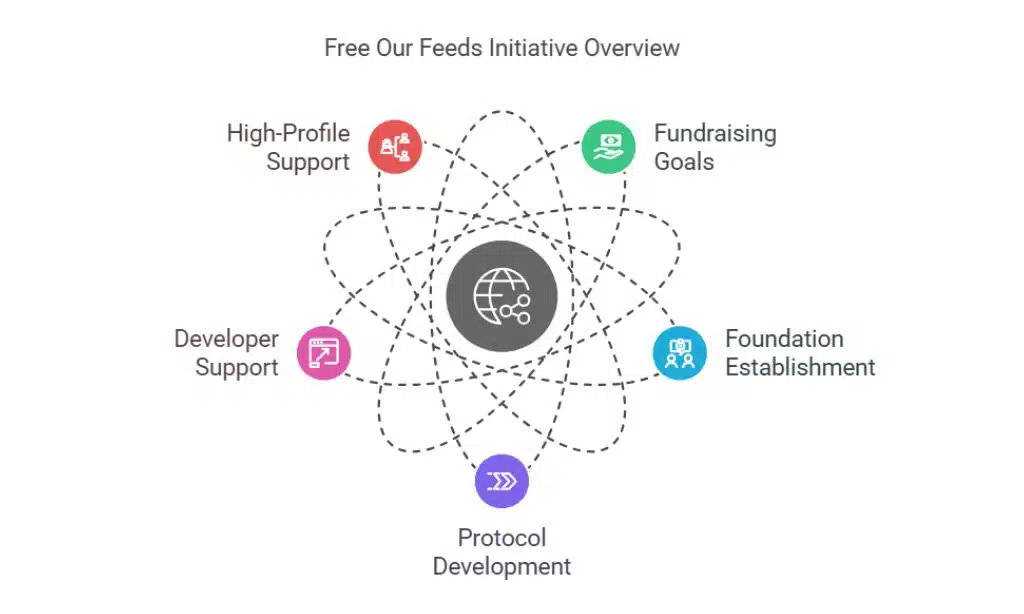
Free Our Feeds has set a lofty fundraising target of $30 million over the next three years, with an immediate goal of securing $4 million. These funds will be allocated to establish a public-interest foundation tasked with overseeing the AT Protocol’s development. This foundation will also provide financial and technical support to developers aiming to build new platforms using the protocol, effectively expanding the ecosystem of decentralized social networks.
Robin Berjon, a technologist and one of the initiative’s custodians, highlighted the importance of this effort. “Infrastructure, especially technical infrastructure, is notoriously challenging to fund,” Berjon said. “However, this initiative has captured the attention and support of high-profile figures, creating a unique opportunity to drive meaningful and lasting change.”
Bluesky’s Standpoint
Bluesky’s leadership has voiced support for the Free Our Feeds initiative. Jay Graber, CEO of Bluesky, emphasized the importance of building an open and collaborative network. “With Bluesky, we’re building an open network, and collaborating with organizations like Free Our Feeds ensures users have more choices and an improved experience,” Graber stated.
This perspective aligns with Bluesky’s core philosophy of decentralization. The company acknowledges the potential for future leadership or external pressures to compromise its values. To counter this, Bluesky’s technology is designed to empower users with the ability to leave the platform while retaining their data and social connections.
Key Priorities for the AT Protocol
One of the immediate objectives of Free Our Feeds is to develop a second relay for the AT Protocol. Relays are essential components that notify the network when users post updates, enabling features such as personalized feeds and view counts. Currently, Bluesky operates the only relay for the protocol, which represents a single point of control and power. Expanding the number of relays is a crucial step toward ensuring a truly decentralized ecosystem.
With sufficient funding, the initiative also plans to address other aspects of the AT Protocol infrastructure, such as the development and operation of personal data servers. These servers serve as repositories for user data within the AT Protocol, allowing users to maintain greater control over their information.
Combating Power Concentration
The new foundation aims to democratize the governance of the AT Protocol by introducing transparent and inclusive decision-making processes. “We’re not taking over,” Berjon emphasized, “but we’re working to ensure that the network operates smoothly across multiple infrastructure providers without any single entity dominating the ecosystem.”
Additionally, Berjon suggested the potential for collaboration between the AT Protocol and ActivityPub, the decentralized protocol used by Mastodon and Meta’s Threads. While a full merger of the two protocols may not be feasible, interoperability between them could further strengthen the decentralized social media landscape.
Revolutionizing Social Media Development
The broader goal of Free Our Feeds is to lower the barriers to entry for developers interested in creating new social networks. By providing a robust and accessible infrastructure, the initiative aims to empower developers to launch alternative platforms in a matter of days. This capability opens the door to innovative social media concepts that challenge the status quo and offer users more diverse and meaningful experiences.
“Once the infrastructure is operational, developers can reuse building blocks rather than starting from scratch,” Berjon explained. “This paves the way for endless possibilities in social networking, allowing for a variety of platforms that cater to different user needs and preferences.”
A Vision for Decentralized Social Media
Free Our Feeds envisions a future where social media is no longer dominated by a few centralized entities. By fostering the growth of decentralized networks built on the AT Protocol, the initiative aims to create an ecosystem where users have greater autonomy, privacy, and choice. This vision challenges the traditional model of social media, emphasizing collaboration, innovation, and user empowerment.
The success of this campaign could mark a turning point in the evolution of social networking, offering a viable path toward a more open and equitable digital future. For now, all eyes are on Free Our Feeds and its mission to safeguard the principles of decentralization in the rapidly changing landscape of social media.





















