


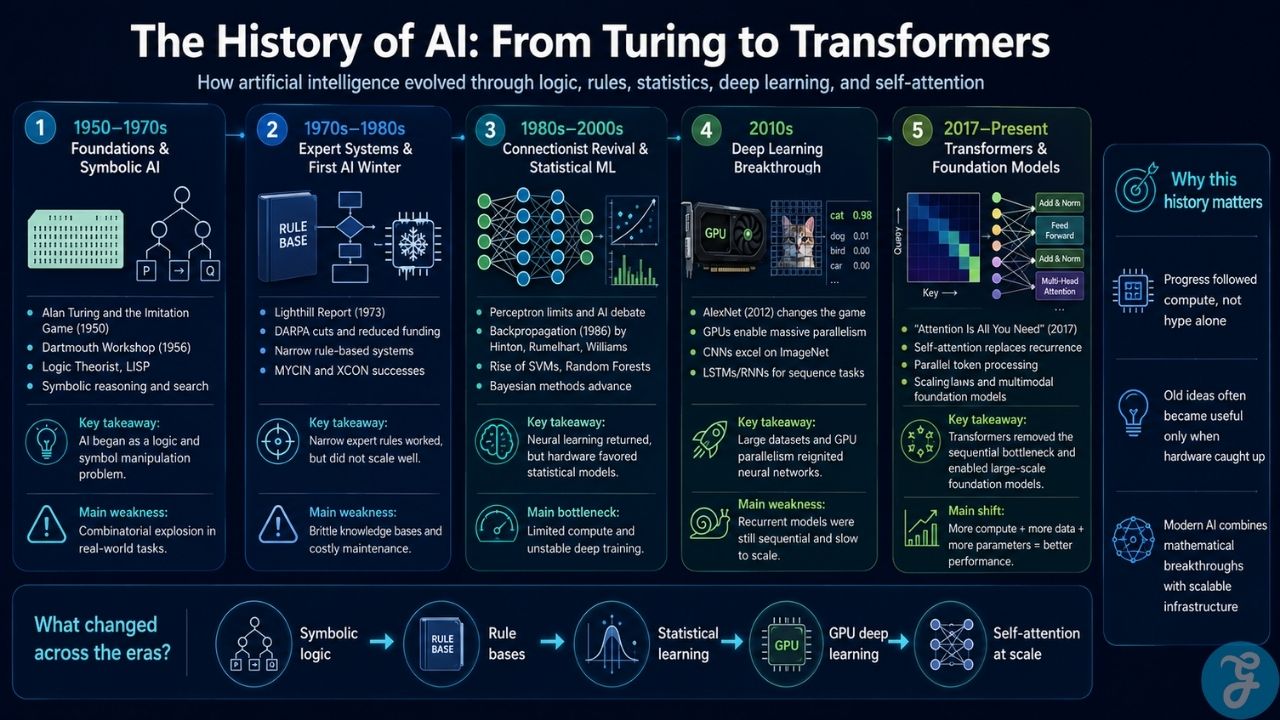
Artificial intelligence advances in cycles driven by hardware limits and overextended hype. The core mathematical ideas powering modern foundation models (neural networks, backpropagation, self-attention) existed long before compute capacity could run them at scale. The historical progression of the discipline reflects shifts in dominant compute paradigms: symbolic logic, expert rule bases, statistical learning, and deep matrix acceleration.
The Foundations and Symbolic Era (1950 to 1970s)
Modern AI originated as a formal mathematical problem. In his 1950 paper Computing Machinery and Intelligence, Alan Turing proposed an operational metric for machine intelligence: the Imitation Game. Turing replaced philosophical debates about machine consciousness with an empirical test based on conversational performance.
The Dartmouth Workshop of 1956
John McCarthy, Marvin Minsky, Nathaniel Rochester, and Claude Shannon organized the Dartmouth Summer Research Project on AI in 1956. The workshop established the field as an independent research discipline. Early work operated on the physical symbol system hypothesis, which asserted that high-level intelligence consists of manipulating explicit tokens according to formal logical rules.
Symbolic AI and Logic Systems
Early programs relied on hardcoded heuristics and logical inference. Allen Newell and Herbert Simon built the Logic Theorist in 1956, proving 38 mathematical theorems from Principia Mathematica. John McCarthy created LISP in 1958, establishing list processing as the primary language for early software development. These early symbolic programs quickly failed in real-world applications due to combinatorial explosion; search trees expanded exponentially as input variables grew.
The First AI Winter and Expert Systems (1970s to 1980s)
By 1970, academic research had failed to produce functional machine translation or autonomous natural language systems. Funding bodies withdrew financial support as early benchmarks proved unscalable.
The Lighthill Report and DARPA Cuts
Sir James Lighthill published a critical review for the UK Science Research Council in 1973. The report stated that AI algorithms performed adequately in restricted laboratory domains but degraded completely when applied to real-world industrial tasks. Concurrently, the US Defense Advanced Research Projects Agency (DARPA) cut funding for unconstrained exploratory research, demanding immediate military applications.
The Rise of Expert Systems
Industry pivoted in the late 1970s toward specialized knowledge bases. Expert systems replaced general problem-solving goals with narrow domain rules. Systems like MYCIN for medical diagnoses and XCON for hardware configuration relied on thousands of explicit conditional statements written by knowledge engineers. Vendors built specialized LISP hardware to execute these rule engines, creating a commercial market by 1985.
The Second AI Winter and Connectionist Revival (1980s to 2000s)
The commercial expert system market collapsed in the late 1980s. Rule bases proved brittle, expensive to maintain, and incapable of updating automatically from raw data. At the same time, general-purpose microprocessors outpaced specialized LISP workstation hardware, causing widespread vendor bankruptcies.
The Connectionist Counter-Revolution
Frank Rosenblatt introduced the Perceptron in 1958, but Marvin Minsky and Seymour Papert proved in 1969 that single-layer perceptrons could not solve non-linear functions such as XOR. This mathematical bottleneck stalled neural network research for over a decade.
David Rumelhart, Geoffrey Hinton, and Ronald Williams popularized the backpropagation algorithm in 1986. Backpropagation resolved the single-layer bottleneck by using gradient descent to calculate error derivatives across hidden layers, establishing the mathematical baseline for modern connectionism.
Statistical Machine Learning Takeover
Hardware limits in the 1990s prevented deep neural networks from scaling. Training deep layers caused gradients to vanish or explode. Research shifted toward statistical machine learning models with tractable convex optimization guarantees: Support Vector Machines (SVMs), Random Forests, and Bayesian inference engines. These statistical methods dominated quantitative finance, spam filtering, and information retrieval throughout the 2000s.
The Deep Learning Wave (2010s)
The shift back to neural architectures occurred when large web-scale datasets met parallel graphics processing hardware.
AlexNet and GPU Parallelization
Alex Krizhevsky, Ilya Sutskever, and Geoffrey Hinton entered AlexNet into the 2012 ImageNet Large Scale Visual Recognition Challenge. AlexNet deployed a deep Convolutional Neural Network (CNN) trained across two NVIDIA GPUs using CUDA. Its top-5 error rate of 15.3% beat traditional computer vision baselines by over 10 percentage points, demonstrating that deep architectures could automatically extract hierarchical features from raw inputs without manual feature engineering.
Sequential Models and Recurrent Limits
Natural language processing adopted Recurrent Neural Networks (RNNs) and Long Short-Term Memory (LSTM) units to process sequential data. While LSTMs reduced gradient decay across longer input sequences, the architecture retained a fundamental hardware bottleneck: step-by-step sequential processing. Calculating state $t$ required the completion of state $t-1$, blocking full GPU parallelization across large text corpora.
The Transformer Architecture and Self-Attention (2017 to Present)
Google researchers published Attention Is All You Need in 2017, introducing the Transformer architecture to replace recurrent networks in sequence processing.
Transformers eliminated temporal recurrence entirely. By using positional encodings alongside multi-head self-attention layers, the architecture processes every token in an input sequence concurrently.
Self-Attention Mechanics
The self-attention module computes pairwise matrix inner products across all input tokens simultaneously, calculating relative connection weights regardless of sequence distance. This layout unlocked total parallelization during training, enabling researchers to distribute workload across vast GPU clusters without sequential dependencies.

The Commercial Frontier: ChatGPT, Gemini, and Claude
The commercialization of Transformer models shifted AI from specialized academic benchmarks to infrastructure-scale software. OpenAI launched ChatGPT in late 2022 using GPT-3.5, applying Reinforcement Learning from Human Feedback (RLHF) to align raw next-token prediction probabilities with human intent and conversational dynamics. This demonstrated that auto-regressive pre-training paired with post-training alignment could produce zero-shot generalization across writing, translation, and code generation.
Architectural Specialization Among Tech Giants
As parameter counts grew beyond hundreds of billions, major labs diverged in architectural focus:
-
OpenAI (GPT Series): Focused on aggressive compute scaling and hybrid architectures. Development expanded toward test-time reasoning models (such as the o-series), which allocate test-time compute to run internal validation loops before returning an answer, trading latency for mathematical and logical precision.
-
Google (Gemini Series): Built natively multimodal architectures from inception rather than stitching separate vision and audio encoders onto a text backbone. The Gemini models integrated long-context attention mechanisms capable of processing millions of tokens in a single context window, targeting deep integration across enterprise systems and developer tools.
-
Anthropic (Claude Series): Prioritized alignment techniques, pioneering Constitutional AI to replace manual human reward modeling with self-critique based on formal principle sets. Claude models established strong benchmarks in long-document synthesis, complex system coding, and multi-step reasoning while maintaining strict behavioral guardrails.
Inference Optimization and Agentic Execution
Massive model sizes exposed a new economic bottleneck: inference cost. Hardware clusters running FLOP-intensive models faced memory bandwidth limitations during auto-regressive generation. This forced a transition toward Mixture-of-Experts (MoE) architectures, which route individual tokens through sparse subnetworks rather than activating the entire parameter space for every word.
By mid-decade, frontier development shifted from passive chat interfaces to agentic systems. These systems equip models with external tool calls, code execution environments, and autonomous planning loops to perform multi-step execution across live software pipelines.
Final Operational Outlook: Compute Walls and the Next Paradigm
Seventy-five years of AI history demonstrates a recurring pattern: algorithmic theories repeatedly outpace the physical hardware built to run them. The transition from symbolic logic to multi-head self-attention was not driven by sudden breakthroughs in cognitive theory, but by the availability of parallel GPU clusters capable of accelerating dense matrix math.
Today, the transformer paradigm faces its own hardware wall. Scaling laws are hitting physical limits imposed by data center power consumption, memory bandwidth constraints, and the exhaustion of human-generated training text. As token generation shifts from passive context prediction to active, test-time compute loops and agentic execution, the bottleneck has moved from raw training FLOPs to real-time inference economics.
If history is any guide, breaking past current platform limitations will not happen through incremental parameter expansion alone. The next shift in AI will require fundamental architectural evolutions (such as sparse Mixture-of-Experts routing, alternative attention mechanisms, or novel hardware paradigms) to bypass the thermal and financial boundaries of modern data centers.
Frequently Asked Questions (FAQs) About the History of AI Intelligence
What caused the historical AI winters?
AI winters occurred when commercial promises exceeded hardware and algorithmic capabilities. Funding dropped sharply after brittle symbolic engines failed to transition from controlled benchmarks to messy real-world environments.
How does symbolic AI differ from modern deep learning?
Symbolic AI manipulates human-written rules and explicit logical statements. Deep learning uses multi-layered artificial neural networks to learn statistical patterns directly from raw unstructured data without manual instruction sets.
Why were GPUs critical to the deep learning revival?
Graphics processing units feature thousands of parallel execution cores designed for matrix math. Because neural network training consists primarily of dense matrix multiplications, GPUs accelerate training runs by orders of magnitude compared to traditional CPUs.
What primary limitation did the Transformer solve?
Transformers eliminated the sequential bottleneck inherent to Recurrent Neural Networks and LSTMs. By replacing recurrent state updates with self-attention mechanisms, Transformers allow every token in a text sequence to be processed in parallel across large hardware clusters.
How did RLHF transform models into systems like ChatGPT and Claude?
Reinforcement Learning from Human Feedback (RLHF) aligns raw statistical token predictors with human expectations. While pre-training teaches a model language structure and factual distribution, post-training alignment uses reward models to penalize toxic output, optimize safety guidelines, and improve instruction-following compliance.





















