

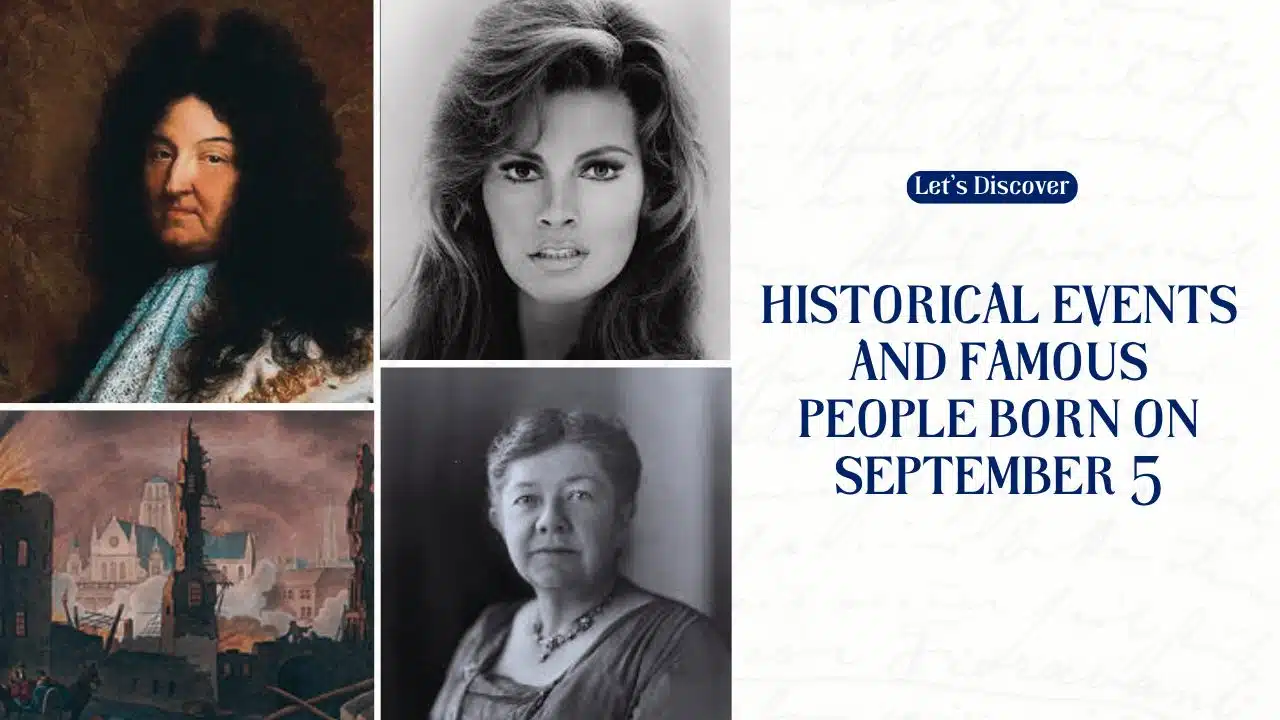
September 5 stands as a date of significant historical importance, marking pivotal moments that have shaped the course of nations and the lives of individuals who have left indelible marks on our world. This article delves into the remarkable events that unfolded on this day throughout history and celebrates the lives of notable figures born on September 5. From naval encounters that altered the balance of power to cultural milestones that continue to resonate, we explore the diverse tapestry of human experience encapsulated in this single calendar date.
Historical Events on September 5
1596: Cornelis de Houtman Taken Hostage in Java
On September 5, 1596, Dutch fleet commander Cornelis de Houtman found himself in a precarious situation when he was taken hostage in Java. This event occurred during the early days of Dutch exploration and trade in the East Indies, a venture that would eventually lead to the formation of the Dutch East India Company (VOC) in 1602.
De Houtman’s expedition, which began in 1595, was the first Dutch voyage to the East Indies. The mission aimed to establish direct trade routes with the Spice Islands, bypassing Portuguese intermediaries. However, the journey was fraught with challenges, including conflicts with local rulers and traders.
The hostage situation in Java resulted from escalating tensions between de Houtman’s crew and local authorities. While the exact circumstances remain somewhat unclear, it’s believed that disputes over trade agreements and cultural misunderstandings contributed to the incident. De Houtman was eventually ransomed and released, allowing him to return to the Netherlands.
This event, while a setback, did not deter Dutch ambitions in the region. Instead, it highlighted the need for more organized and better-prepared expeditions, ultimately contributing to the establishment of the VOC. The company would go on to dominate trade in the East Indies for nearly two centuries, profoundly impacting the economic and political landscape of Southeast Asia.
1666: End of the Great Fire of London
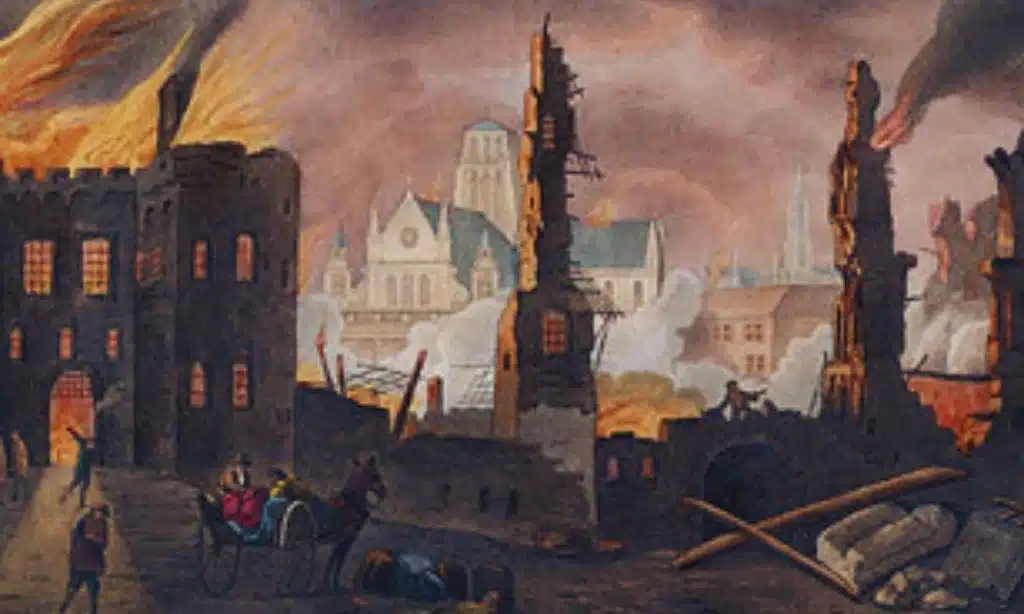
The Great Fire of London, which had raged for four days, finally came to an end on September 5, 1666. This catastrophic event reshaped the physical and social landscape of England’s capital city, leaving an enduring mark on its history and architecture.
The fire began in the early hours of September 2 in a bakery on Pudding Lane. Fueled by strong winds and the predominantly wooden structures of medieval London, the blaze quickly spread through the city. Despite efforts to create firebreaks by demolishing buildings, the conflagration continued to expand, consuming everything in its path.
By the time the fire was extinguished, it had destroyed 13,200 houses, 87 parish churches, and numerous public buildings, including the Royal Exchange and Guildhall. Remarkably, only eight deaths were officially recorded, though the actual toll was likely higher.
The aftermath of the Great Fire led to significant changes in London’s urban planning and architecture. New building regulations were introduced, requiring the use of brick and stone instead of wood. Sir Christopher Wren was commissioned to redesign many of the city’s prominent buildings, including St. Paul’s Cathedral, which stands as a lasting testament to London’s rebirth from the ashes.
The Great Fire also had far-reaching social and economic consequences. It exacerbated existing housing shortages and led to the displacement of a large portion of London’s population. However, it also provided an opportunity for modernization and improvement of the city’s infrastructure, including wider streets and better sanitation systems.
1781: Battle of the Chesapeake
On September 5, 1781, a pivotal naval engagement of the American Revolutionary War took place off the coast of Virginia. Known as the Battle of the Chesapeake or the Battle of the Virginia Capes, this conflict saw a French fleet under Comte de Grasse defeat British forces led by Admiral Thomas Graves and Samuel Hood.
The battle’s strategic importance cannot be overstated. By preventing the British fleet from reaching Yorktown, where General Lord Charles Cornwallis was stationed with his army, the French victory effectively trapped the British forces on land. This naval blockade, combined with the approaching Franco-American army led by George Washington and the Comte de Rochambeau, set the stage for the decisive Siege of Yorktown.
The engagement lasted for several hours, with both sides exchanging fire. Although neither fleet suffered catastrophic losses, the French managed to inflict more damage on the British ships. More crucially, they maintained their position at the mouth of the Chesapeake Bay, denying the British access to Yorktown.
The outcome of this battle had far-reaching consequences. It allowed Washington and Rochambeau to lay siege to Cornwallis’s army, ultimately leading to the British surrender at Yorktown on October 19, 1781. This capitulation effectively ended major military operations in the American Revolutionary War, paving the way for American independence.
The Battle of the Chesapeake underscores the crucial role of naval power in the conflict and highlights the significance of French assistance to the American cause. It stands as a turning point in world history, contributing directly to the birth of the United States as an independent nation.
1907: King Edward VII Meets Russian Foreign Minister
On September 5, 1907, a significant diplomatic meeting took place between King Edward VII of Great Britain and Russia’s Foreign Minister Alexander Izvolski. This encounter was part of broader efforts to strengthen Anglo-Russian relations in the early 20th century.
The meeting occurred against the backdrop of shifting alliances and growing tensions in Europe. Britain, long wary of Russian expansionism, was reassessing its diplomatic position in light of the rising power of Germany. Russia, having recently suffered a humiliating defeat in the Russo-Japanese War, was also looking to realign its foreign policy.
The discussions between Edward VII and Izvolski focused on finding common ground and resolving long-standing differences between their nations. Key topics likely included the situation in Persia (modern-day Iran), Afghanistan, and Tibet – areas where British and Russian interests had often clashed.
This diplomatic engagement contributed to the signing of the Anglo-Russian Convention later that year, which delineated spheres of influence in Asia and helped to resolve several points of contention between the two empires. More broadly, it was a crucial step in the formation of the Triple Entente – the alliance between Britain, France, and Russia that would play a pivotal role in World War I.
1950: First Performance of Gerald Finzi’s “Intimations of Immortality”
On September 5, 1950, the musical world witnessed the premiere of Gerald Finzi’s setting of William Wordsworth’s “Intimations of Immortality” at the Three Choirs Festival in Gloucester Cathedral, England. This performance, featuring Eric Greene as the solo tenor and Herbert Sumsion conducting the orchestra and choir, marked a significant moment in British classical music.
Gerald Finzi, known for his deeply expressive and lyrical compositions, had long been inspired by Wordsworth’s poetry. “Intimations of Immortality,” one of Wordsworth’s most famous works, explores themes of childhood, memory, and the human connection to nature – themes that resonated strongly with Finzi’s own artistic sensibilities.
The composition, which took Finzi several years to complete, is a large-scale work for tenor, chorus, and orchestra. It captures the nuanced emotions and philosophical depth of Wordsworth’s ode, translating the poet’s reflections on the loss of childhood wonder into a rich musical tapestry.
The premiere was well-received, with critics praising Finzi’s sensitive treatment of the text and his ability to evoke the poem’s nostalgic and contemplative mood through music. This work has since become one of Finzi’s most celebrated compositions, cementing his reputation as a significant figure in 20th-century English music.
Famous Birthdays on September 5
Louis XIV (1638-1715)
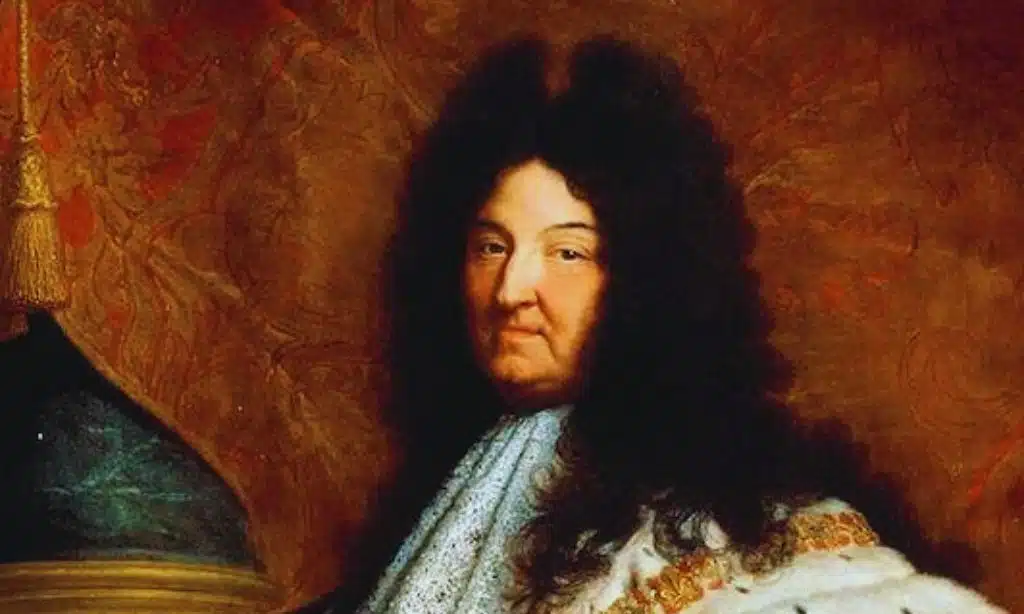
Louis XIV, known as the “Sun King,” ascended to the French throne at the age of four following his father’s death. His reign, lasting over 72 years, is the longest recorded of any monarch of a sovereign country in European history. Louis XIV’s rule was characterized by the centralization of power in the monarchy, epitomized by his famous declaration “L’État, c’est moi” (“I am the State”).
Under Louis XIV’s rule, France became the dominant European power. He engaged in numerous wars, expanding France’s borders and influence. Domestically, he suppressed the power of the nobility, bringing them under his direct control at the lavish Palace of Versailles, which he constructed as a symbol of his absolute power and grandeur.
Louis XIV was also a great patron of the arts, fostering a golden age of French culture. He supported renowned artists, writers, and composers, including Molière, Racine, and Lully. His reign saw advancements in various fields, from architecture and garden design to ballet and cuisine, leaving an indelible mark on French and European culture.
Archduke Charles (1771-1847)
Archduke Charles of Austria, Duke of Teschen, was a prominent military commander and theorist during the Napoleonic Wars. Born into the Habsburg dynasty, he dedicated his life to military service and the defense of the Austrian Empire.
As a field marshal, Charles achieved notable victories against French forces, including the Battle of Stockach in 1799 and the Battle of Aspern-Essling in 1809, where he inflicted Napoleon’s first major defeat on the battlefield. Despite these successes, he also faced setbacks, such as the Battle of Wagram in 1809.
Charles’s contributions extended beyond the battlefield. He worked tirelessly to modernize and reform the Austrian army, introducing the Corps system and emphasizing the importance of staff work. His writings on military strategy and tactics, including “Grundsätze der Kriegskunst für die Generale” (Principles of War for Generals), influenced military thinking well into the 19th century.
Amy Beach (1867-1944)
Amy Beach was a pioneering American composer and pianist who significantly contributed to the development of classical music in the United States. A child prodigy, Beach began composing at an early age and gave her first public piano recital at age sixteen.
Beach’s most famous work, the “Gaelic” Symphony in E minor, premiered in 1896, making her the first American woman to compose and publish a symphony. This work, along with her Piano Concerto in C-sharp minor, showcased her ability to write large-scale orchestral pieces, a realm previously dominated by male composers.
Throughout her career, Beach composed in various genres, including chamber music, choral works, and art songs. Her style blended European Romantic traditions with American folk melodies, particularly drawing inspiration from Irish-Gaelic tunes.
Despite facing societal constraints as a woman in a male-dominated field, Beach achieved significant recognition during her lifetime. Her success paved the way for future generations of women in classical music, and her works continue to be performed and studied today.
John Cage (1912-1992)
John Cage was an avant-garde composer, music theorist, and artist who revolutionized 20th-century music and art. His innovative approach to composition and performance challenged traditional notions of music, inspiring generations of artists across various disciplines.
Cage is perhaps best known for his composition 4’33”, a piece performed in the absence of deliberate sound, emphasizing the ambient sounds of the environment. This work epitomizes Cage’s philosophy that all sounds can be music, blurring the lines between art and everyday life.
Throughout his career, Cage experimented with unconventional instruments and compositional techniques. He pioneered the “prepared piano,” in which objects are placed on or between piano strings to alter their sound. Cage also incorporated chance operations into his compositional process, often using the I Ching to make musical decisions.
Cage’s influence extends beyond music into visual arts, dance, and philosophy. His collaborations with choreographer Merce Cunningham and his involvement with the Fluxus movement demonstrate the interdisciplinary nature of his work. Cage’s ideas continue to challenge and inspire artists, encouraging them to reconsider the boundaries of art and music.
Raquel Welch (1940-2023)
Raquel Welch rose to fame as an actress and international sex symbol in the 1960s. Her breakthrough role came in the 1966 science fiction film “Fantastic Voyage,” followed by her iconic appearance in “One Million Years B.C.” the same year, which cemented her status as a leading sex symbol of the era.
Throughout her career, Welch strived to break free from the limitations of her sex symbol image. She took on diverse roles in films such as “The Three Musketeers” (1973), for which she won a Golden Globe Award. Welch also ventured into television, starring in numerous made-for-TV movies and series.
Beyond acting, Welch authored several books on health and fitness and launched a successful line of wigs. Her business acumen, combined with her enduring popularity, allowed her to maintain a presence in the public eye long after her peak years in Hollywood.
Welch’s career spanned over five decades, during which she challenged stereotypes and paved the way for strong female roles in action and adventure films. Her impact on popular culture extends beyond her film work, influencing fashion and beauty standards of her time.
Takeaways
September 5 stands as a date of remarkable historical and cultural significance. From the naval battles that shaped nations to the artistic achievements that continue to resonate, this day has witnessed events that have left an indelible mark on human history. The diverse array of individuals born on this date – from absolute monarchs to avant-garde composers – further underscores the day’s importance.
Louis XIV’s reign defined an era of French dominance and cultural flourishing. Archduke Charles’s military innovations influenced warfare for generations. Amy Beach broke barriers for women in classical music, while John Cage revolutionized our very conception of music. Raquel Welch challenged stereotypes in Hollywood, becoming an enduring cultural icon.
These events and personalities, though separated by time and circumstance, collectively illustrate the multifaceted nature of human achievement and the ongoing process of social and cultural evolution. As we reflect on the significance of September 5, we are reminded of the complex tapestry of human history and the individual contributions that shape our shared narrative.
References:
- Hutton, R. (2017). The Great Fire of London: Anniversary Edition of the Great Fire of 1666. Yale University Press.
- Lynn, J. A. (1999). The Wars of Louis XIV 1667-1714. Longman.
- Rothenberg, G. E. (1982). Napoleon’s Great Adversaries: The Archduke Charles and the Austrian Army, 1792-1814. Indiana University Press.
- Block, A. F. (1998). Amy Beach, Passionate Victorian: The Life and Work of an American Composer, 1867-1944. Oxford University Press.
- Pritchett, J. (1993). The Music of John Cage. Cambridge University Press.
- Welch, R. (2010). Raquel: Beyond the Cleavage. Weinstein Books.
- Dull, J. R. (2009). The Age of the Ship of the Line: The British and French Navies, 1650-1815. University of Nebraska Press.
- Larson, K. (2012). Where the Heart Beats: John Cage, Zen Buddhism, and the Inner Life of Artists. Penguin Press.
- Treasure, G. (2001). Louis XIV. Longman.
- Taruskin, R. (2005). The Oxford History of Western Music. Oxford University Press.






















