Think about how many software subscriptions you use right now. A decade ago, businesses bought heavy software on physical disks, installed it on local servers, and paid for expensive annual maintenance. Cloud computing changed all that. We moved to lightweight subscriptions that ran entirely in our web browsers. But if you think the market has settled, you are wrong. The software industry is on the edge of another massive shift.
Looking at the future of SaaS over the next five years, we see a complete rewrite of how developers build tools and how companies buy them. People want smarter assistants, fairer pricing, and tools that fit exactly into their weird, specific workflows.
Let us break down exactly where the market is heading and how you can prepare your tech stack for the coming years.
1. Vertical SaaS Will Dominate Niche Markets
The era of massive, one-size-fits-all software is fading fast. As we move forward, vertical SaaS platforms built for highly specific industries are going to take over. Instead of generic customer databases, we are seeing tools designed exclusively for dental offices, local contractors, or freelance designers. These niche tools solve the exact problems a specific industry faces right out of the box, meaning businesses spend zero time trying to customize a generic platform to fit their unique workflows.
Here is a quick look at how vertical platforms compare to traditional horizontal software.
| Feature | Horizontal SaaS | Vertical SaaS |
| Target Audience | Broad (Anyone doing business) | Niche (Specific industry or trade) |
| Setup Time | Long (Requires heavy customization) | Short (Built for immediate use) |
| Compliance | Basic | Deeply integrated (e.g., HIPAA for healthcare) |
| Market Size | Massive but highly competitive | Smaller but extremely loyal |
Understanding this shift helps explain why so many new startups are ignoring broad markets entirely.
Deep Dive into Industry-Specific Solutions
When you buy software built exactly for your job title, it feels like magic. A general project management tool needs you to build your own templates and set up your own rules. A vertical tool built for construction managers already knows what a daily site report looks like. It already has built-in weather tracking and union labor compliance forms. Over the next five years, investors will pour money into these highly specialized platforms because they boast incredible retention rates. Once a business finds a tool that speaks its exact language, it rarely uninstalls it.
Best for: Businesses in highly regulated fields like healthcare, finance, or specialized retail.
Why We Chose It: Vertical tools require far less onboarding time and immediately integrate with the specific third-party vendors an industry already uses.
Things to consider: Because the customer base is smaller, vertical platforms sometimes charge a premium price compared to their massive, generic competitors.
As software becomes more specialized, the underlying engines powering these tools are getting a massive upgrade.
2. Artificial Intelligence and Automation Take Over
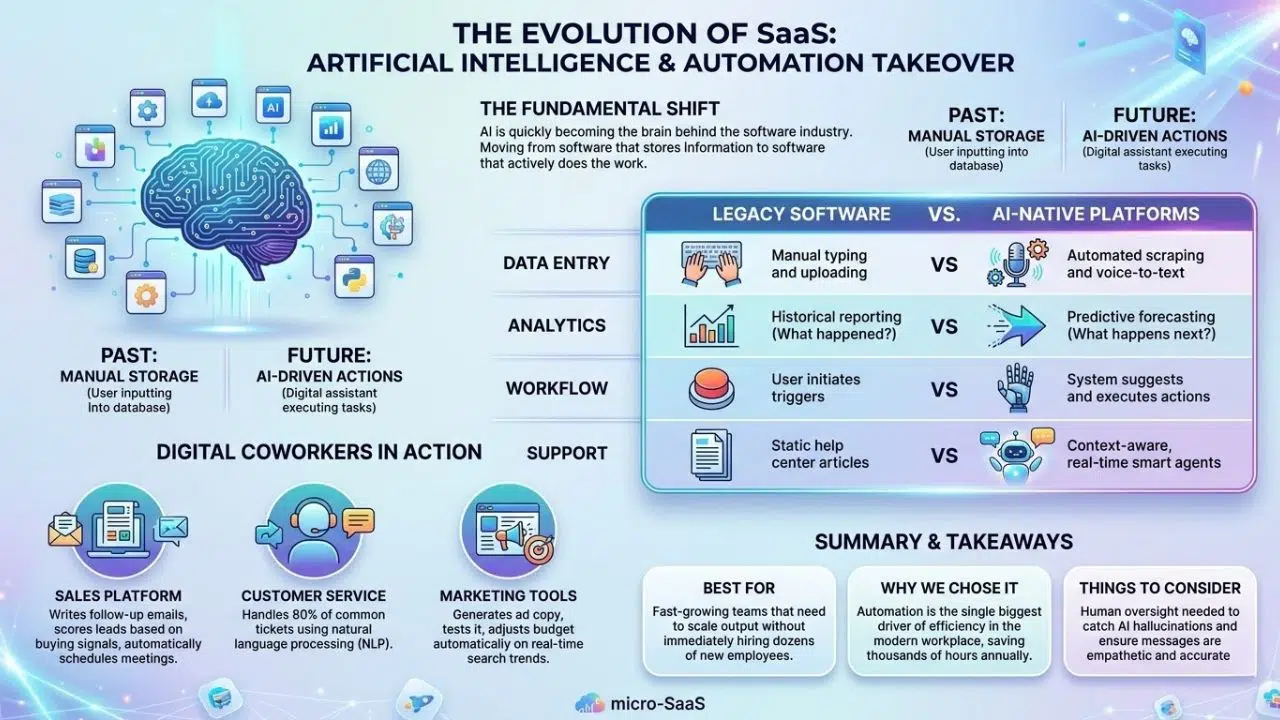
Artificial intelligence is no longer a fun trick you play with on the weekend. It is quickly becoming the brain behind the entire software industry. Over the next five years, the future of SaaS will rely entirely on machine learning algorithms and predictive models. We are moving away from software that simply stores information to software that actively does the work for us. Imagine a sales platform that writes your follow-up emails, scores your leads based on subtle buying signals, and automatically schedules meetings without you touching a keyboard.
The table below highlights the difference between legacy software and AI-native platforms.
| Capability | Legacy Software | AI-Driven SaaS |
| Data Entry | Manual typing and uploading | Automated scraping and voice-to-text |
| Analytics | Historical reporting (What happened?) | Predictive forecasting (What happens next?) |
| Workflow | User initiates triggers | System suggests and executes actions |
| Support | Static help center articles | Context-aware, real-time smart agents |
This leap in capability means the tools we use will start feeling more like digital coworkers.
How Smart Assistants Change Daily Workflows
Right now, human workers waste hours every week doing repetitive tasks that computers should handle. AI integration changes that math. Customer service platforms will soon handle eighty percent of common tickets using natural language processing that actually understands user frustration. Marketing tools will generate ad copy, test it, and adjust the budget automatically based on real-time search trends. The companies that build the most invisible, helpful AI into their SaaS products will win the market, while those that force users to do manual data entry will quickly go out of business.
Best for: Fast-growing teams that need to scale their output without immediately hiring dozens of new employees.
Why We Chose It: Automation is the single biggest driver of efficiency in the modern workplace, saving companies thousands of hours annually.
Things to consider: You still need human oversight to catch AI hallucinations and ensure automated messages sound empathetic and accurate.
While platforms get smarter, the way they are packaged and sold is actually getting much smaller.
3. The Shift Toward Micro-SaaS Platforms
People are getting tired of paying for huge software suites when they only use a fraction of the features. This frustration is driving the rise of micro-SaaS. These are tiny, hyper-focused tools run by solo developers or small teams. They do not try to be everything to everyone. Instead, they pick one tiny problem—like optimizing images for a website or syncing contacts between two specific apps—and they solve it perfectly. These tools usually plug right into your existing tech stack using an API.
Let us compare the traditional massive suite approach to the new micro-platform trend.
| Aspect | Massive Software Suites | Micro-SaaS Tools |
| Feature Set | Hundreds of overlapping tools | One specific, highly polished feature |
| Cost | Expensive monthly minimums | Low cost, often single-digit monthly fees |
| Development Speed | Slow updates, bloated code | Rapid iterations, highly responsive developers |
| Integration | Wants you to stay in their ecosystem | Built entirely to connect with outside tools |
This unbundling trend allows companies to build customized tech stacks that fit them perfectly.
Unbundling the Massive Software Suites
The future of SaaS looks a lot like a digital Lego set. Instead of buying a pre-built house, you buy the exact blocks you need. A modern startup might use one tiny tool just for capturing user feedback, another just for generating invoices, and a third just for tracking employee holidays. Because application programming interfaces make connecting these tools incredibly easy, you never feel disconnected. This gives businesses ultimate flexibility. If one tool stops working well, you just swap it out for a competitor without tearing down your entire system.
Best for: Startups, freelancers, and agile teams that want ultimate control over their daily workflows.
Why We Chose It: Micro tools are incredibly affordable and usually have vastly superior customer support because you are often talking directly to the founder.
Things to consider: Subscribing to thirty different micro tools can lead to annoying administrative overhead and complex billing cycles if you do not track your expenses.
Speaking of billing, how we pay for all this software is about to change dramatically.
4. Flexible, Usage-Based Pricing Becomes Standard
The days of signing a rigid annual contract for software you barely use are ending. Customers are demanding fairer billing, leading to a massive shift toward usage-based pricing. Think about how you pay for your water or electricity. You pay for exactly what you consume. Cloud computing trends show that SaaS companies are adopting this exact model. If your business has a slow month in July, your software bill should drop. If you have a massive spike in sales during December, your bill goes up.
Here is how pricing models are expected to shift over the coming years.
| Pricing Model | How It Works | 5-Year Outlook |
| Flat Monthly Rate | Same price every month, regardless of use. | Declining rapidly as users demand flexibility. |
| Per-Seat License | Pay per employee login. | Stagnant, often leads to password sharing. |
| Usage-Based | Pay per gigabyte, API call, or transaction. | Growing massively, aligns cost with real value. |
| Hybrid Tiered | Base access fee plus variable usage costs. | Becoming the standard for enterprise companies. |
This shift forces software providers to continuously prove their worth every single month.
Paying Only for What You Actually Use
Usage-based pricing completely changes the relationship between the buyer and the seller. When a SaaS company relies on a flat annual fee, their main goal is just getting you to sign the contract. After that, they do not really care if you log in or not. But with consumption billing, the software company only makes money if you are actively finding value in their tool. This forces developers to build incredibly intuitive, fast, and helpful products. They have to design features you actually want to use daily, which ultimately creates better software for everyone.
Best for: Seasonal businesses, e-commerce stores, and startups with unpredictable traffic and revenue.
Why We Chose It: It guarantees that your operational costs scale perfectly alongside your actual business growth.
Things to consider: It makes financial forecasting slightly more difficult for your accounting department since the software bill changes every month.
With so much data moving through these variable systems, protecting that information is the next big hurdle.
5. Enhanced Security and Data Privacy Controls
As businesses push absolutely everything into the cloud, hackers are paying attention. Security is no longer an IT problem; it is a board-level priority. Over the next five years, any SaaS platform that cannot prove airtight data security will simply not survive. We are moving toward zero-trust architectures, where systems constantly verify user identities and restrict data access based on strict permissions. Buyers now demand built-in compliance with global privacy laws right from day one.
The table below outlines the security expectations of tomorrow compared to yesterday.
| Security Layer | Past Standard | Future Expectation |
| Login Verification | Single password | Mandatory multi-factor authentication (MFA) |
| Data Storage | Basic server encryption | End-to-end encryption with customer-held keys |
| Access Control | Broad admin privileges | Strict zero-trust, role-based access |
| Compliance Audits | Reactive, done after a breach | Proactive, automated compliance monitoring |
Trust is the ultimate currency in the software market, and companies will pay a premium to protect it.
Protecting User Information in the Cloud
We are going to see a massive rise in privacy-first engineering. This means developers build software specifically designed to collect as little personal data as possible. Tools will automatically redact sensitive information, automatically delete old files, and give users immediate dashboards to see exactly who accessed their data and when. For businesses buying SaaS, asking for a SOC2 compliance report is no longer a formality; it is the very first question asked on a sales call.
Best for: Enterprise companies, financial institutions, and organizations handling sensitive consumer data.
Why We Chose It: A single data breach can destroy a brand’s reputation permanently, making proactive security the smartest investment a company can make.
Things to consider: Extremely tight security controls can sometimes slow down daily workflows, creating friction for employees trying to share files quickly.
If security is handled well, it allows even non-technical workers to start building their own tools safely.
6. Low-Code and No-Code Democratize Development
You do not need an engineering degree to build software anymore. The rise of low-code and no-code platforms is fundamentally changing who gets to create digital tools. Visual, drag-and-drop interfaces allow marketing managers, human resources directors, and sales reps to build their own internal apps. If a team needs a custom dashboard to track applicant interviews, they do not have to wait six months for the IT department to build it. They can just assemble it themselves over the weekend using a no-code SaaS platform.
Here is a comparison showing why this trend is accelerating so quickly.
| Development Metric | Traditional Coding | No-Code/Low-Code SaaS |
| Builder Skillset | Professional software engineer | Any logical, tech-savvy employee |
| Speed to Market | Months or years | Days or weeks |
| Maintenance | Requires ongoing code updates | Managed completely by the platform |
| Initial Cost | Extremely high (Salaries, servers) | Low (Standard SaaS subscription) |
Empowering everyday workers to solve their own technical problems unlocks massive productivity.
Empowering the Citizen Developer
This movement creates a new class of worker known as the citizen developer. When the people who actually do the daily work are given the power to build their own software solutions, the results are incredibly efficient. We will see the future of SaaS platforms leaning heavily into this. Even complex enterprise tools will start offering visual builders so clients can customize the software without writing a single line of script. It bridges the gap between the rigid software of the past and the fluid, custom needs of a modern workforce.
Best for: Operations teams, marketing departments, and small businesses that lack a dedicated engineering team.
Why We Chose It: It drastically reduces the backlog for IT departments and empowers frontline workers to innovate immediately.
Things to consider: If not monitored, citizen developers can create a mess of disconnected, undocumented internal apps that break when that employee leaves the company.
Finally, we have to consider where these citizen developers are actually doing their work.
7. The Rise of Mobile-First SaaS Applications
The desktop computer is no longer the center of the working world. Millions of people do their jobs on their feet—in retail stores, on construction sites, in hospitals, and out in the field. Historically, SaaS companies ignored these deskless workers, building complex platforms that only worked on large desktop monitors. That is changing. The next five years will see a surge in mobile-first cloud software. These are powerful tools designed specifically for the smartphone screen, utilizing offline syncing, native cameras, and location data.
The chart below shows the distinct requirements of mobile platforms.
| App Characteristic | Desktop-First SaaS | Mobile-First SaaS |
| Interface Design | Complex menus, dense data tables | Large buttons, swipe gestures, voice input |
| Connectivity | Assumes perfect Wi-Fi | Built for offline use and background syncing |
| Hardware Use | Keyboard and mouse | Camera, GPS, microphone, touch screen |
| User Environment | Sitting at a quiet desk | Moving, loud environments, wearing gloves |
Building for the phone requires a completely different mindset from developers.
Managing Work From Anywhere
A delivery driver does not have time to navigate a complex drop-down menu on a tiny screen. They need an app with massive buttons, voice-to-text dictation, and automatic photo uploads. The SaaS industry is finally realizing that deskless workers represent a massive, untapped market. Expect to see heavy investment in mobile applications that connect field workers directly to the main office in real-time. This eliminates the need for end-of-day data entry and ensures that the entire company is operating on the exact same information, regardless of their physical location.
Best for: Field service teams, logistics companies, healthcare workers, and retail staff.
Why We Chose It: It brings the power of enterprise cloud computing out into the real world, eliminating paper trails and manual reporting.
Things to consider: Developing great mobile apps requires constant updates for different phone operating systems and dealing with app store compliance.
Final Thoughts
The future of SaaS is undeniably exciting. We are moving away from clunky, expensive, and difficult software toward tools that are intuitive, specialized, and remarkably smart. By embracing artificial intelligence, pivoting toward micro-platforms, and adopting fair usage-based pricing, the software industry is aligning itself perfectly with what modern businesses actually want.
If you want your company to thrive over the next five years, audit your current tech stack. Drop the bloated legacy systems and start experimenting with agile, smart, and flexible cloud tools. The businesses that adapt fastest to these new trends will move quicker, spend less, and ultimately outpace their competition.
Frequently Asked Questions (FAQs)
What does vertical SaaS mean?
Vertical SaaS refers to cloud software created specifically for one niche industry or trade. Instead of building a tool for any business in the world, developers build features strictly for a specific audience, like real estate agents or restaurant owners.
How is AI changing the software industry?
AI shifts software from a passive database to an active assistant. It handles repetitive data entry, predicts customer trends, generates content, and automates complex workflows, allowing human workers to focus entirely on creative and strategic decisions.
Why are companies moving to usage-based pricing?
Buyers are tired of paying flat monthly fees for features they do not use. Usage-based pricing charges companies only for the exact bandwidth, storage, or transactions they consume, ensuring they only pay for the actual value they get out of the software.
What is a micro-SaaS platform?
A micro-SaaS is a small, highly focused software tool usually built by a solo developer or tiny team. It focuses on solving one very specific problem exceptionally well, rather than trying to offer a massive suite of features.