


Artificial Intelligence (AI) is revolutionizing many industries, including contract review. AI is causing a stir in legal and business operations by increasing efficiency, reducing errors, and optimizing processes. In a world quickly becoming more dependent on technology, it is worth considering what role AI plays in the contract review process.
Enhancing Efficiency
Typically, contract review has been a labor-intensive process. Attorneys and corporate executives have routinely spent hundreds of hours reviewing documents to identify key provisions. However, AI has now introduced automation to help scan documents within seconds. AI software for contract review has considerably fastened this process, identifying the key elements using these systems.
With automation, higher volumes of contracts can be managed without loss of accuracy. Teams can spend their time on high-value work rather than being relegated to tedious, repetitive tasks. These distraction-free days translate into higher productivity and prudent resource allocation.
Reducing Human Error
Mistakes in a contract review can become costly errors. Overlooking a clause may lead to misinterpretations that bring court cases or result in financial losses. AI helps solve this issue, drastically reducing these errors because AI can process vast amounts of data without breaks.
Machine learning can be trained to compare large amounts of prescription data to find discrepancies and flag possible errors for a closer look. AI serves as a second line of defense against errors, creating further reliability in contract management. This trust, in turn, enhances a company’s image by promoting reliability with clients and stakeholders.
Streamlining Processes
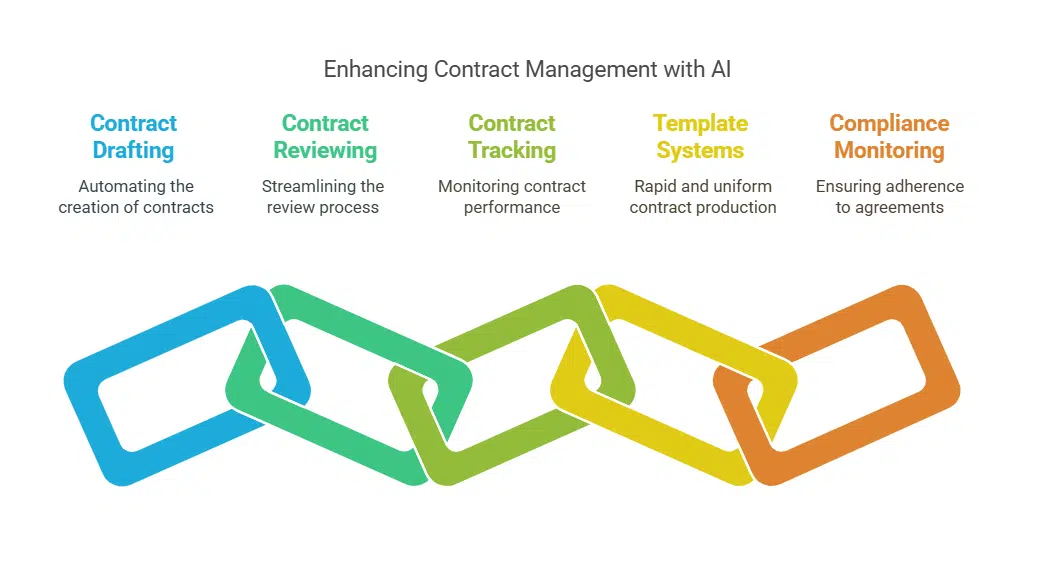
There are multiple stages to contract management, from when you draft the contract to when you execute it. This is a meticulous process, and as a result, it can slow operations down. AI simplifies these processes by providing tools to automate contract reviewing, drafting, and tracking.
Systems based on templates enable users to produce contracts rapidly and create uniformity in documents. AI-based platforms can monitor contract performance and compliance, allowing for immediate visibility into potential points of friction or disagreement. This optimized method improves overall contract management efficiency.
Improving Accessibility
These AI-driven tools also democratize contract review by offering scalable options that smaller enterprises can afford. Dedicated legal teams were a privilege that only larger firms could afford. However, AI services provide state-of-the-art review functionality to a larger audience.
Technology that was once the exclusive province only for big names is now readily and cost‑effectively available to everyone, enabling smaller enterprises to compete confidently. The result is a more level playing field for business, driving innovation and competition in all sectors.
Driving Innovation
Instead, AI’s role is not merely to enhance existing processes; it plays a much more significant part in impacting innovations in contract management. Ongoing research and improved algorithms create innovative systems that learn from previous prompts and responses. They can anticipate trends and propose the most effective negotiation tactics.
AI also permits using smart contracts or self-executing contracts in which the terms embedded in the contract are written into code. This process minimizes the power of intermediaries, speeds up transactions, and increases safety. With the progress of AI, we can also expect a massive breakthrough in contract management.
Addressing Concerns
While it is valuable in its own right, AI in contract review raises issues surrounding data privacy and job loss. Contracts often involve sensitive information, and it is important to keep the data secure. Organizations should take decisive, proactive steps to secure the service design and ensure data integrity.
The threat to jobs is also an issue; in other words, there is a fear that automation might take over human roles. However, AI should be seen as a tool to assist human expertise, not replace it. By handling mundane tasks, AI enables professionals to handle strategy development and client relations. This collaboration between humans and machines can result in higher job satisfaction and new job opportunities.
Conclusion
The impact of AI on contract review is transforming the legal and business landscapes. AI’s benefits are too significant to be disregarded, as it unlocks new levels of efficiency, minimizes mistakes, and accelerates innovation. Despite the challenges, the future is looking bright for AI-enabled contract management. Adopting these technologies will enable more efficient, fair, and innovative solutions in legal and business industries. When AI develops further, its depth of influence will also expand since it is an integral part of the modern world.





















