

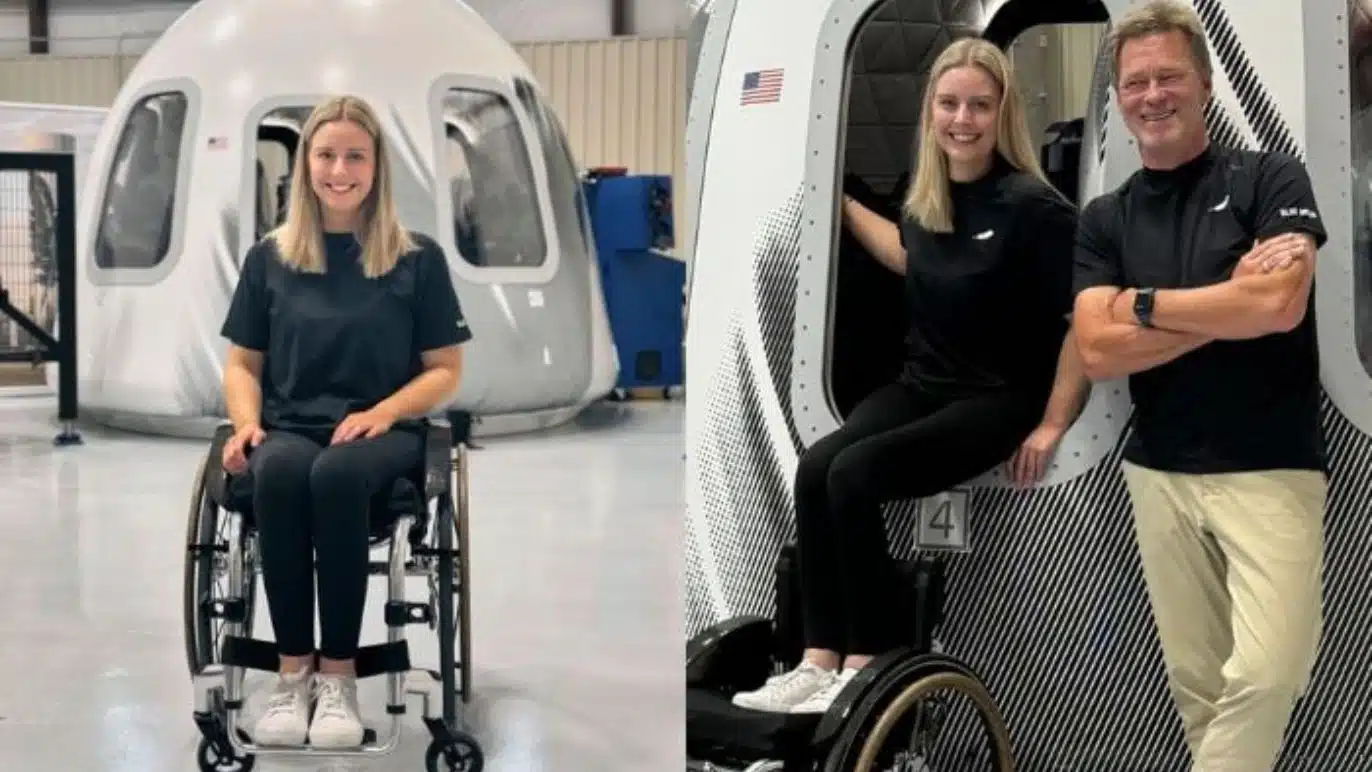
Michaela “Michi” Benthaus, a German aerospace engineer, made history on December 19, 2025, becoming the first wheelchair user to cross the Kármán line into space aboard Blue Origin’s New Shepard rocket. The 33-year-old, who has been paraplegic since a 2018 mountain biking accident, floated weightlessly alongside five crewmates during a 10-minute suborbital joyride from West Texas. Her achievement shatters long-held assumptions about space travel accessibility, proving that physical disabilities need not bar anyone from the final frontier.
The Mission: NS-37 Lifts Off After Tense Delays
Blue Origin’s NS-37 mission, the 37th flight of the reusable New Shepard system, blasted off from Launch Site One in Van Horn, Texas, following a scrub on December 18 due to preflight checks. The crew, self-dubbed “Out of the Blue,” included Benthaus; Hans Koenigsmann, a former SpaceX VP of mission assurance; investors Joey Hyde and Adonis Pouroulis; entrepreneur Neal Milch; and space enthusiast Jason Stansell. Liftoff occurred under clear skies, with the rocket’s BE-3 engine igniting to propel the capsule past 65 miles (105 km) altitude, surpassing the 62-mile (100 km) Kármán line recognized as space’s boundary.
The flight profile unfolded rapidly: ascent took about three minutes, followed by three to four minutes of microgravity where passengers unstrapped to somersault and gaze at Earth’s curvature against the black void. Descent relied on parachutes and a retro-thrust rocket for a gentle desert landing. Blue Origin’s live webcast, starting 40 minutes pre-launch, drew global viewers, capturing the booster’s precise vertical landing nearby—a testament to the system’s 37 successful outings, having flown 86 people (80 unique) to space prior. Koenigsmann, who sponsored Benthaus’s seat alongside Blue Origin, played a key role in preparations, ensuring seamless execution.
Michaela Benthaus: From Accident to Aerospace Pioneer
Born in 1992 in Kiel, Germany, Michaela Benthaus built a career in aerospace and mechatronics engineering before tragedy struck. She joined the European Space Agency (ESA) as a graduate trainee in the Netherlands, working on cutting-edge projects after stints at various research centers since 2016. In 2018, a mountain biking mishap severed her spinal cord, leaving her paraplegic and reliant on a wheelchair—yet she refused to abandon her space ambitions.
Benthaus’s resilience shone through prior experiences: a 2022 parabolic zero-gravity flight from Houston, ambassadorship with AstroAccess (a disability inclusion initiative sponsored by SciAccess), and commanding a 2024 analog mission at Poland’s wheelchair-accessible Lunares Research Station. “I never really thought that going on a spaceflight would be a real option for me,” she told the Associated Press, noting the competitive field even for the able-bodied. Her mission patch featured a hippo plush toy—a hospital recovery companion—symbolizing personal triumphs amid crew symbols of exploration and innovation.
Post-flight, Benthaus beamed: “It was the coolest experience… I laughed all the way up and tried to turn upside down in space.” She highlighted the flight’s feasibility, crediting Blue Origin’s inclusive design and her own advocacy for proving “wheelchair users can go on a suborbital flight.”
Accessibility Innovations: Minor Tweaks, Major Impact
Blue Origin emphasized that New Shepard required only “minor adjustments” for Benthaus, underscoring its baseline accessibility. The launch tower’s existing elevator whisked her seven stories to the capsule atop the rocket. Inside, a patient transfer board enabled scooting from hatch to seat; during microgravity, a strap secured her legs to prevent drifting. Post-landing, recovery teams unrolled a desert carpet for immediate wheelchair access, with Koenigsmann aiding rehearsals.
This builds on precedents: prior flights carried passengers with mobility limits, visual/hearing impairments, and even 90-year-olds. Engineer Jake Mills, who trained the crew, noted the capsule’s design accommodates “a wider range of people than traditional spaceflight.” Partnerships like AstroAccess further disability inclusion, testing protocols for future astronauts. Benthaus’s flight validates these efforts, showing suborbital tourism’s tight 10-12 minute window—from boarding to egress—can flex for diverse needs without overhauls.
Meet the Crew: A Diverse Band of Explorers
The “Out of the Blue” team embodied Blue Origin’s ethos of broadening space access across professions and nations.
-
Hans Koenigsmann: German-born ex-SpaceX executive (2002-2022), now aerospace consultant; organized Benthaus’s flight, leveraging rocket expertise.
-
Joey Hyde: U.S. investor, founder of Dynamo Ventures; space passion drives his suborbital debut.
-
Adonis Pouroulis: South African investor; brings global finance perspective to the stars.
-
Neal Milch: Entrepreneur; represents innovative business minds eyeing commercial space.
-
Jason Stansell: Self-proclaimed “space nerd”; embodies public enthusiasm for Bezos’s vision.
Their mosaic—from ESA engineers to investors—highlights how NS-37 flew 86th-91st humans past the Kármán line, with tickets’ costs undisclosed but auctions previously topping millions.
| Crew Member | Background | Notable Contribution |
|---|---|---|
| Michaela Benthaus | ESA Engineer, Germany | First wheelchair user in space |
| Hans Koenigsmann | Ex-SpaceX Exec, Germany | Mission sponsor, training aid |
| Joey Hyde | Investor, USA | Dynamo Ventures founder |
| Adonis Pouroulis | Investor, South Africa | Global finance expertise |
| Neal Milch | Entrepreneur, USA | Business innovation |
| Jason Stansell | Space Enthusiast, USA | Public outreach passion |
Blue Origin’s New Shepard: Reusability Redefined
New Shepard, named for Alan Shepard, comprises a single-stage booster and autonomous capsule, both vertically landing for reuse—NS-37 marked its 37th paired flight. The BE-3 hydrogen-oxygen engine delivers 490 kN thrust, reaching Mach 3+ speeds. Capsule interiors feature six largest-in-flight windows for panoramic views, pressurized comfort, and zero-G harnesses.
Since 2021’s first crewed NS-16, 16 tourist missions plus uncrewed research have amassed flawless records, contrasting competitors’ profiles. Jeff Bezos, who flew NS-16, champions “millions living and working in space for humanity’s benefit,” with NS-37 advancing that by inclusivity.
Broader Implications: Space for All Abilities
Benthaus’s milestone ripples beyond tourism. “Space is for everyone,” Blue Origin stated, spotlighting her as proof. It challenges NASA’s able-bodied astronaut norms, where disabilities historically disqualified candidates despite parabolic tests proving viability. AstroAccess’s involvement signals orbital futures, potentially influencing Starliner or Artemis.
Globally, reactions poured in: ESA hailed her as “the second German woman in space,” while disability advocates celebrated barrier-breaking. Economically, suborbital flights like NS-37 fuel a $1B+ tourism market, projected to grow as costs drop via reusability. Critics note expense limits equity, but precedents like 90-year-olds flying counter elitism claims.
For Benthaus, it’s personal vindication: “Our world is still inaccessible… but space doesn’t have to be.” Her flight, with hippo toy aloft, inspires millions, redefining who belongs among the stars.
Reactions and Future Horizons
Crewmates echoed joy: Koenigsmann called it “dream fulfillment,” while Stansell live-tweeted awe. Media from CNN to Indian outlets amplified the story, trending #WheelchairToSpace. Bezos tweeted congratulations, teasing NS-38.
Looking ahead, Blue Origin eyes orbital New Glenn, but suborbital inclusivity sets tone. Benthaus eyes advocacy: “This opens doors for others with disabilities.” As 2025 closes, NS-37 stands as a beacon—proving space, like Earth, evolves toward universal access.





















