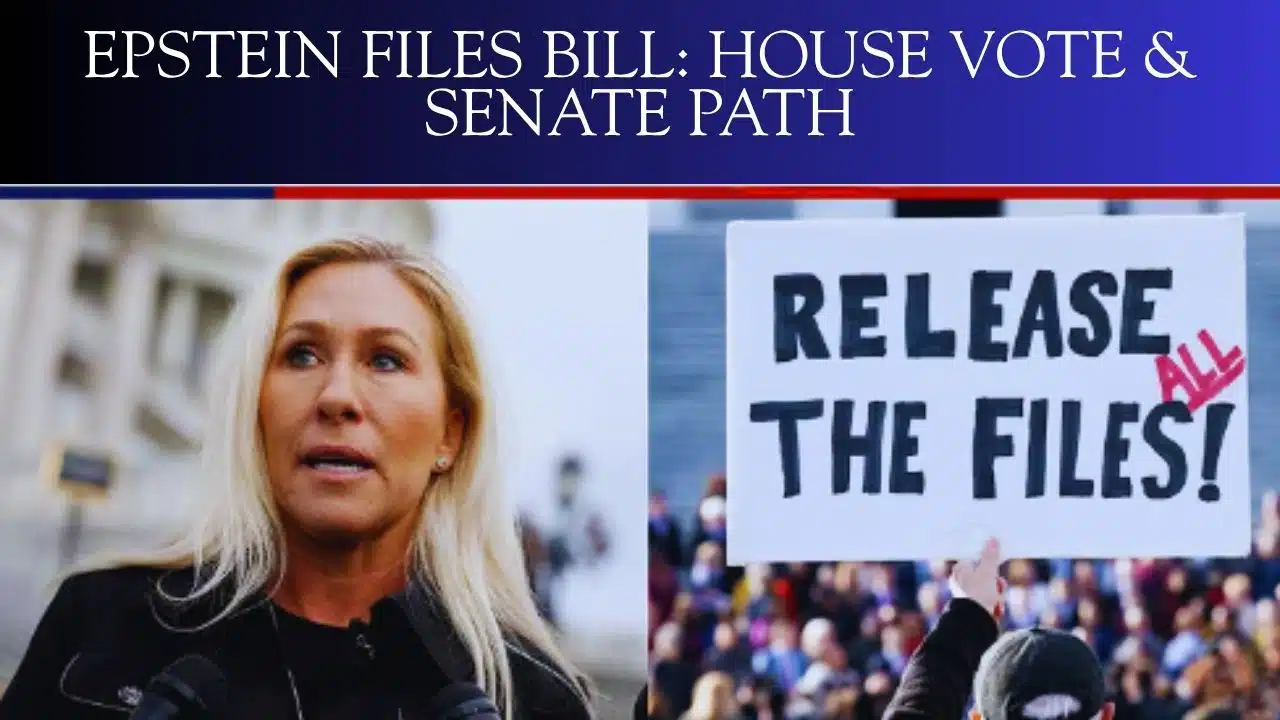
The United States House of Representatives has made a significant move toward greater government transparency by passing the Epstein Files Transparency Act, a bipartisan bill that mandates the Justice Department to publicly release long-sealed documents related to Jeffrey Epstein, the financier convicted of sex trafficking who died in federal custody in 2019. This landmark legislation, which requires the declassification of investigative records, emails, and other materials, passed with a resounding 427-1 vote on Tuesday, November 18, 2025, and has been forwarded to the Senate for consideration. The near-unanimous support underscores a rare moment of unity in Congress, driven by public demands for accountability in one of the most notorious scandals involving elite figures across politics, business, and international royalty. Introduced in July 2025 by Rep.
Ro Khanna (D-CA) alongside Rep. Thomas Massie (R-KY), the bill addresses years of criticism over the handling of Epstein’s case, including allegations of leniency and cover-ups during multiple presidential administrations.The vote’s overwhelming margin highlights the bill’s broad appeal, as it compels federal agencies to disclose unclassified records without the usual exemptions for political embarrassment or reputational harm, potentially unveiling details on Epstein’s vast network of influential associates.
Epstein, who was arrested in 2019 on federal sex trafficking charges involving dozens of underage girls, had previously received a controversial non-prosecution agreement in 2008 that shielded him and potential co-conspirators from further charges, a deal that has long fueled conspiracy theories and calls for reform. This legislation aims to rectify such perceived injustices by ensuring the public gains access to key evidence that could shed light on how Epstein operated with apparent impunity for decades.
The Lone Dissent and Behind-the-Scenes Dynamics
In a striking display of near-total consensus, the House vote saw only one “no” from Rep. Clay Higgins (R-LA), a staunch Trump ally who chairs a key subcommittee on government oversight and had himself initiated a subpoena against the Justice Department earlier in 2025 to obtain these very files. Higgins later explained his opposition, arguing that the bill’s broad scope could inadvertently compromise victim privacy or expose ongoing intelligence operations, potentially undermining the very transparency it seeks to achieve. Despite his reservations, Higgins’ role in pushing the subpoena highlighted internal Republican tensions, as his subcommittee’s work laid the groundwork for the broader legislative effort.
The path to this vote was not smooth, involving intense lobbying and procedural maneuvers to bypass leadership delays. A bipartisan discharge petition, spearheaded by Reps. Massie, Nancy Mace (R-SC), and Lauren Boebert (R-CO), gathered enough signatures to force the bill out of the House Judiciary Committee and onto the floor, overcoming initial resistance from some GOP members concerned about political fallout. House Speaker Mike Johnson (R-LA), who had expressed worries about protecting survivors’ identities, ultimately allowed the vote after pressure from within his party and public advocacy groups, describing it as a “necessary reckoning” while committing to review any Senate amendments for safeguards. This procedural victory came after the bill languished since its introduction on July 15, 2025, when it was first referred to the Judiciary Committee without immediate action.
Senate Advances Bill Toward Trump’s Desk
Following the House’s decisive approval, the Epstein Files Transparency Act (H.R. 4405) has swiftly progressed in the Senate, where it received unanimous support in a procedural vote, paving the way for final passage and transmission to President Donald Trump for his signature. Senate Majority Leader Chuck Schumer (D-NY) praised the measure as a “bipartisan triumph for justice,” noting that it builds on earlier Senate companion legislation introduced by Sen. Jeff Merkley (D-OR) to ensure comprehensive disclosure. With the Senate’s fast-tracked consideration, analysts expect the bill to reach the president’s desk by the end of the week, potentially leading to the mandated release of documents within 30 days of enactment.
The bill’s Senate momentum reflects growing cross-aisle agreement on the need to address Epstein’s legacy, especially after a July 2025 Justice Department memo closed the book on further public disclosures without additional charges, reigniting outrage over unresolved questions about Epstein’s death—officially ruled a suicide—and his enablers. If signed into law, the act would require the Attorney General to publish all relevant unclassified materials in a searchable, downloadable format, covering everything from flight logs to internal memos on prosecutorial decisions. This could include details on Epstein’s private jet, dubbed the “Lolita Express,” which ferried high-profile passengers to his properties, as well as records from his 2019 detention at the Metropolitan Correctional Center in New York.
Trump’s Reversal and Evolving Stance
President Donald Trump’s endorsement has been pivotal in propelling the bill forward, marking a notable shift from his administration’s earlier reluctance to pursue deeper investigations into Epstein’s files. In a series of public statements and social media posts over the weekend, Trump urged Republican lawmakers to back the release, asserting that it would expose connections primarily to Democrats and framing the scandal as a distraction orchestrated by political opponents. On Monday, while addressing reporters at the White House, Trump remarked that Epstein “knew more Democrats than anyone” and expressed hope that the disclosures wouldn’t overshadow his party’s recent electoral successes, yet he affirmed his intent to sign the bill, calling it a chance to “set the record straight once and for all.”
This pivot follows months of White House opposition, including Trump’s July 2025 directive to the Justice Department to halt further releases, a decision that drew bipartisan criticism for appearing to protect allies. Trump, who socialized with Epstein in the 1990s and early 2000s at events in Palm Beach and New York, has repeatedly distanced himself, claiming their relationship soured in the mid-2000s over a disputed property deal at Trump’s Mar-a-Lago resort. Flight logs and photos confirm their interactions, but Trump has pointed to a 2002 quote where he called Epstein a “terrific guy” who liked “beautiful women… on the younger side,” later clarifying it as casual acquaintance without knowledge of crimes. At Trump’s behest, the Justice Department has now launched a targeted review of Epstein’s Democratic ties, including links to former President Bill Clinton, who flew on Epstein’s plane multiple times, as part of broader efforts to contextualize the impending releases.
Unpacking Epstein’s Web of Influence from Recent Disclosures
Recent releases from a House Oversight Committee probe have already provided glimpses into Epstein’s intricate connections, with thousands of pages of emails, estate documents, and financial records revealing his dealings with a who’s who of global elites, from Wall Street titans like JPMorgan Chase executives to political heavyweights and even Trump. One notable 2011 email from Epstein’s files mentioned Trump in passing regarding an alleged victim’s claims, but White House officials have dismissed it as irrelevant, insisting it demonstrates no involvement in Epstein’s illicit activities. These documents also detail Epstein’s financial maneuvers, including offshore accounts and donations to academic institutions like Harvard University, which accepted millions from him despite red flags about his past.
The scandal’s international dimensions are equally stark Epstein’s associate Ghislaine Maxwell, convicted in 2021 for her role in recruiting victims, is explicitly covered under the bill, with mandates for releasing all related investigative materials, including her trial evidence and communications. Entities tied to Epstein’s trafficking and financial networks—ranging from nonprofits to corporations—face scrutiny, as do any immunity deals or sealed settlements that may have protected participants. The legislation specifically prohibits withholding information on grounds of embarrassment, ensuring that names of government officials, politicians, and “politically exposed persons” are fully disclosed without redactions, a provision aimed at piercing the veil of secrecy that has long protected the powerful. Additionally, the bill requires documentation on Epstein’s death, including autopsy reports and witness statements, to address persistent doubts about the official suicide ruling amid reports of jail staff negligence.
In the United Kingdom, the fallout has prompted decisive action King Charles III, under mounting pressure from Parliament and advocacy groups, stripped Prince Andrew of his remaining military titles, patronages, and access to royal residences in early 2025, following revelations of Andrew’s close ties to Epstein, including a settled lawsuit from accuser Virginia Giuffre. Andrew, who denies wrongdoing, had been photographed with Epstein and visited his properties, contributing to the royal family’s ongoing crisis management. These global links illustrate how Epstein leveraged his wealth and connections to evade justice, a pattern the bill seeks to dismantle through mandatory transparency.
Survivors’ Advocacy Fuels Momentum for Accountability
At the heart of this legislative push are Epstein’s survivors, whose tireless advocacy has transformed personal trauma into a national imperative for reform, viewing the bill as a critical step toward justice after decades of institutional failures. On the chilly morning of November 18, dozens of victims rallied outside the U.S. Capitol, bundled in coats and clutching faded photos of themselves as teenagers to underscore the human cost of Epstein’s crimes. Speakers like Sarah Ransome and Maria Farmer shared harrowing accounts of grooming and abuse, criticizing past administrations—from Bill Clinton’s to Trump’s—for overlooking warnings about Epstein’s operation, which spanned his mansions in New York, Florida, New Mexico, and a private island in the U.S. Virgin Islands.
Rep. Marjorie Taylor Greene (R-GA), a vocal supporter, addressed the crowd from the House floor, hailing the vote as a “monumental win for every survivor who’s been silenced by the elite cabal of the rich and powerful.” Advocacy organizations like the National Center for Missing & Exploited Children and anti-trafficking groups have praised the bill’s privacy protections, which allow redactions only for personally identifiable information of victims or child witnesses, child sexual abuse materials, and national security threats—but require detailed justifications published in the Federal Register and reported to Congress. For instance, the act specifies that any classified portions must be declassified to the maximum extent possible, with the Attorney General providing a categorized list of withheld items and summaries of redactions to oversight committees.
Survivors emphasize that full disclosure could prevent future abuses by exposing systemic lapses, such as the 2008 plea deal orchestrated by then-U.S. Attorney Alexander Acosta, who later served as Trump’s Labor Secretary. As the bill inches toward law, these advocates continue their fight, organizing petitions and media campaigns to ensure no stone is left unturned in revealing how Epstein’s network operated with apparent complicity from those in power. This congressional action, born from grassroots pressure, represents not just a policy shift but a broader demand for accountability in addressing sex trafficking and elite impunity.