When I look at a children’s game, I do not begin with its colors, characters, rewards, or sound effects. I start with a simpler question: What does the child need to think about or practise to succeed?
That question reveals the real difference between an educational game and an entertainment-first game.
I use “entertainment-first” because educational games can, and should be fun. Fun is not the dividing line. The educational games vs fun games difference lies in the purpose of the game and how deeply that purpose is built into the experience.
A fun game primarily aims to entertain. An educational game is deliberately designed or used to help the player develop specific knowledge or skills. The strongest ones accomplish both without making learning feel like an interruption.
Educational Games Have a Clear Learning Goal
Every effective educational game starts with an identifiable learning objective.
The goal might be to help children:
- Recognize letters and their sounds
- Form letters or numbers correctly
- Count objects
- Understand number order
- Practise spelling
- Solve arithmetic problems
- Develop logical thinking
- Apply a concept in a new situation
An entertainment game does not need to meet a learning objective. It may still develop useful abilities such as persistence, planning, collaboration, or spatial awareness, but those benefits are usually secondary to the main experience.
In an educational game, the learning goal should influence the rules, challenges, feedback, and progression.
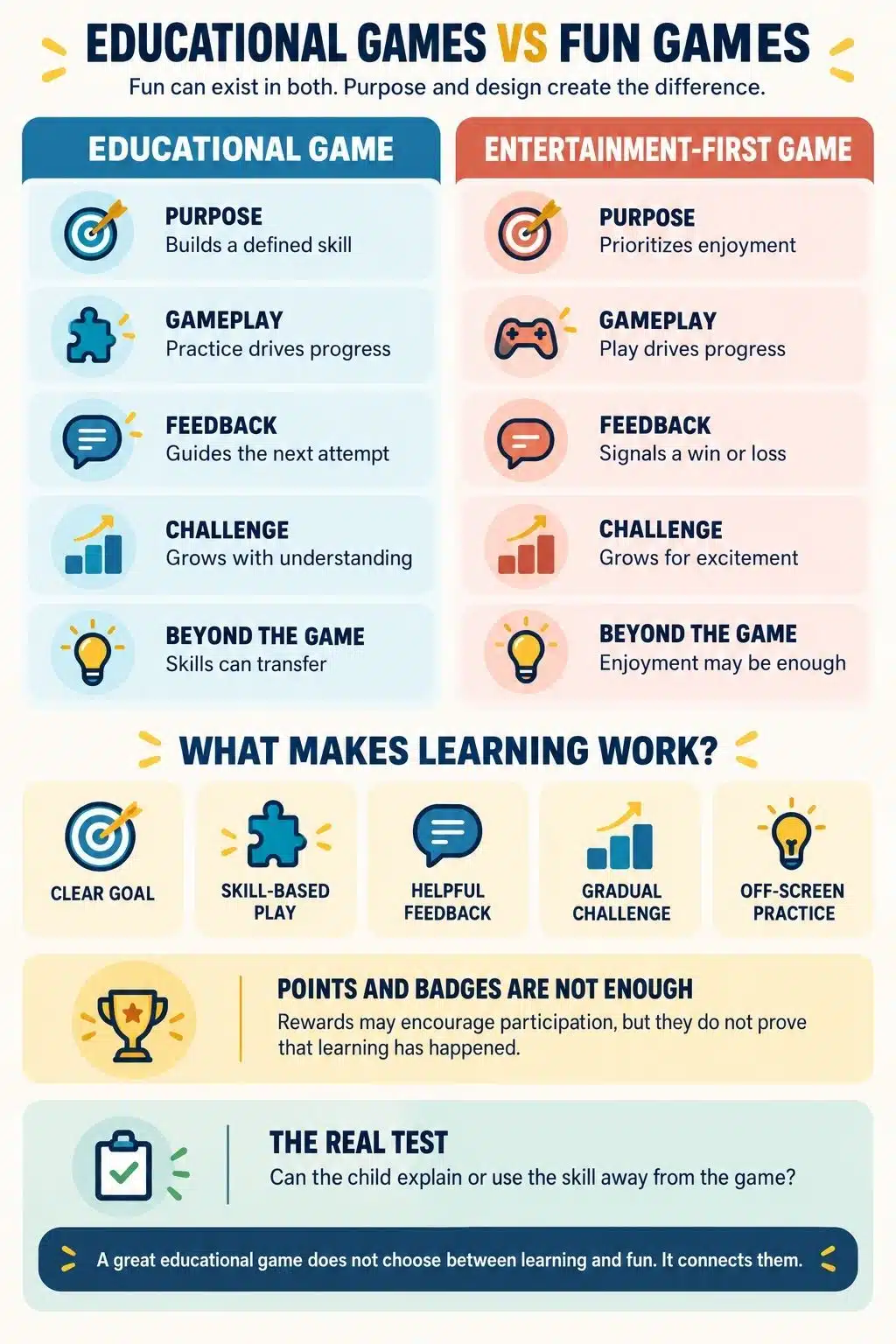
| Area | Educational game | Entertainment-first game |
| Primary purpose | Build defined knowledge or skills | Create enjoyment or excitement |
| Main challenge | Requires meaningful practice | Focuses on winning, exploring, or progressing |
| Feedback | Helps correct mistakes | Mainly reports success or failure |
| Progress | Follows growing understanding | Follows scores, levels, or achievements |
| Success beyond the game | A skill can be recalled or applied elsewhere | Enjoyment may be the complete outcome |
This does not make one type of game inherently better. They simply serve different purposes.
The Learning Must Be Part of the Gameplay
A game does not become educational just because it displays a few questions between levels.
The learning task should be connected to what the player actually does. If the goal is number recognition, recognizing numbers should help the child advance. If the goal is phonics, listening to and working with letter sounds should be central to the challenge.
This is sometimes called intrinsic integration: the educational content and the game mechanics support each other.
Consider two approaches to a spelling game. In one, a child completes an unrelated race and answers a spelling question afterward. In the other, spelling the word correctly moves the character through the world. Both contain spelling, but the second approach makes spelling part of the play itself.
Points, badges, and colorful animations can encourage participation. However, rewards alone do not create meaningful game-based learning. They can make an activity more attractive without improving what the child understands.
Useful Feedback Does More Than Celebrate
Entertainment games often provide simple feedback: you won, lost, earned points, or unlocked a level. Educational feedback needs to do more. It should help the child understand what happened and what to try next.
For a young learner, useful feedback might:
- Show where a letter-tracing movement went off course
- Repeat a letter sound after an incorrect choice
- Demonstrate how to count a group of objects
- Give a hint before revealing an answer
- Allow another attempt without creating unnecessary pressure
A cheerful animation can reward success, but it should not replace instructional feedback. Children need information that helps them adjust their thinking or actions.
Mistakes should also feel recoverable. If every error leads to frustration, a child may start guessing, disengage, or focus only on avoiding failure. Good educational games treat mistakes as part of practice.
Progress Should Follow Understanding
A well-designed learning game usually begins with manageable tasks and becomes more challenging as the child develops confidence.
This gradual support is often called scaffolding. The game may provide demonstrations, visual cues, guided movements, or simpler examples at the beginning. Those supports can then be reduced as the learner becomes more independent.
Difficulty matters. If a game is too easy, it becomes repetitive. If it is too hard, the child may stop trying. The most useful challenge sits between those extremes.
Game progress should also mean more than completing levels. High scores and long playing sessions show activity, not necessarily learning. A child may become skilled at the controls without fully understanding the educational content.
The stronger evidence appears beyond the game. Can the child identify the same letter in a book? Can they count real objects? Can they explain how they reached an answer? That is where digital practice begins to turn into usable knowledge.
Fun Still Matters
A learning objective may separate educational games from entertainment-first games, but enjoyment still plays an important role.
Children are more likely to continue practising when an activity feels welcoming, understandable, and satisfying. Stories, characters, sounds, exploration, and small rewards can help maintain that interest.
However, engagement and learning are not identical. A child can remain absorbed in a game without learning what the game claims to teach.
Research on digital game-based learning generally finds positive but varied results. Games tend to work best when children play them more than once and when the experience is supported by explanation, discussion, or another learning activity. A game should therefore be viewed as a learning tool, not an automatic result.
How We Approach Learning in Our Kids’ Apps
In our own work, we try to connect the action on the screen with the skill being practised.
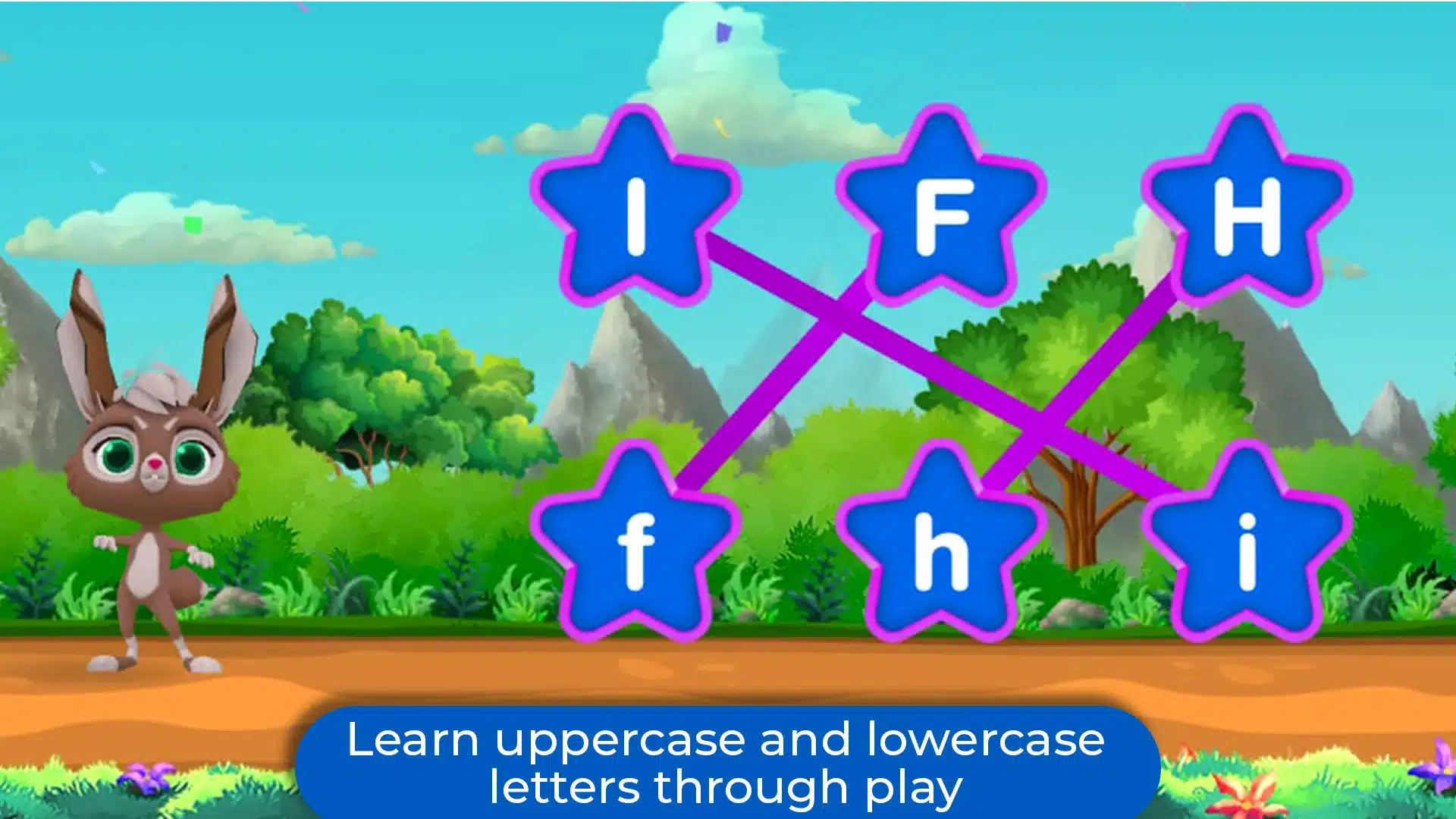
Alphabet Magic trace & phonics focuses on early literacy activities such as uppercase and lowercase letter tracing, letter matching, phonics, and spelling. A child is not simply collecting rewards beside the alphabet content. Letters and sounds are involved in the activities themselves.
Our other app, 123 Magic Number Fun: Math Kid, covers number tracing from 1 to 50, number recognition, counting, sequences, matching, and basic arithmetic puzzles across 12 mini-games. Google Play also lists it as Teacher Approved.
Because these are our apps, I want to be transparent about why I am mentioning them. They are practical examples of how we try to combine play with focused practice. They are not proof that every child will learn in the same way or at the same pace.
Parents and teachers can strengthen either experience with a simple off-screen follow-up. After a letter activity, ask the child to find that letter in a book or write it on paper. After a counting activity, ask them to count toys, buttons, or pieces of fruit.
That small connection helps reveal whether the child can carry the idea beyond the screen.
What Children Carry Beyond the Screen Matters Most
For me, the real difference between educational games and fun games is not how serious they look. It is what children must understand to make progress, and what they can still do after the screen is turned off.
A strong educational game respects both sides of the experience. It gives children a genuine reason to play while making the learning impossible to miss. When purpose, challenge, feedback, and enjoyment work together, play becomes more than a reward for learning. It becomes part of the learning itself.
Frequently Asked Questions on Educational Games vs Fun Games
1. Can educational games really help children learn?
Yes, they can support learning when the activities match a clear objective and provide meaningful practice. They are generally most useful when combined with conversation, guidance, reading, writing, or real-world activities.
2. Can an educational game be as fun as a regular game?
Absolutely. Educational and fun are not opposites. The best learning games use curiosity, challenge, discovery, and feedback to make the educational task enjoyable rather than disguising it behind unrelated rewards.
3. Are all fun games educational in some way?
Many games can develop skills such as problem-solving, coordination, creativity, or teamwork. However, that does not make every game an educational game. A true educational game intentionally connects its design to a defined learning outcome.
4. Can points and badges turn an activity into an educational game?
Not by themselves. Points and badges may motivate a child to continue, but they do not guarantee understanding. The activity still needs meaningful practice, useful feedback, and challenges that support the intended skill.
5. How can I tell whether my child is actually learning?
Look beyond playtime and scores. Ask your child to explain an answer, demonstrate the skill in another setting, or complete a similar task without the game’s prompts. Independent recall and real-world use are stronger signs of learning.