

A significant revelation has emerged regarding U.S. federal agencies’ spending on subscriptions to Politico, a widely recognized political news outlet. Public records indicate that various government departments collectively spent over $8.2 million on subscriptions, particularly for Politico Pro, the outlet’s premium business-to-business (B2B) service that provides in-depth, real-time political intelligence.
This spending has come under intense scrutiny as part of a government-wide review initiated by the Department of Government Efficiency (DOGE), a newly established task force led by billionaire entrepreneur Elon Musk. The DOGE initiative, backed by former President Donald Trump, aims to eliminate what it deems to be wasteful government spending, ensuring taxpayer money is used effectively.
As a result, multiple federal agencies—including the Department of Health and Human Services, the Department of the Interior, and the Department of Energy—are now facing questions regarding their financial allocations to Politico. The government is actively working on canceling these payments, and the revelations have ignited a larger debate about media funding, public expenditure, and the role of news subscriptions in policy-making.
Breakdown of Government Payments to Politico
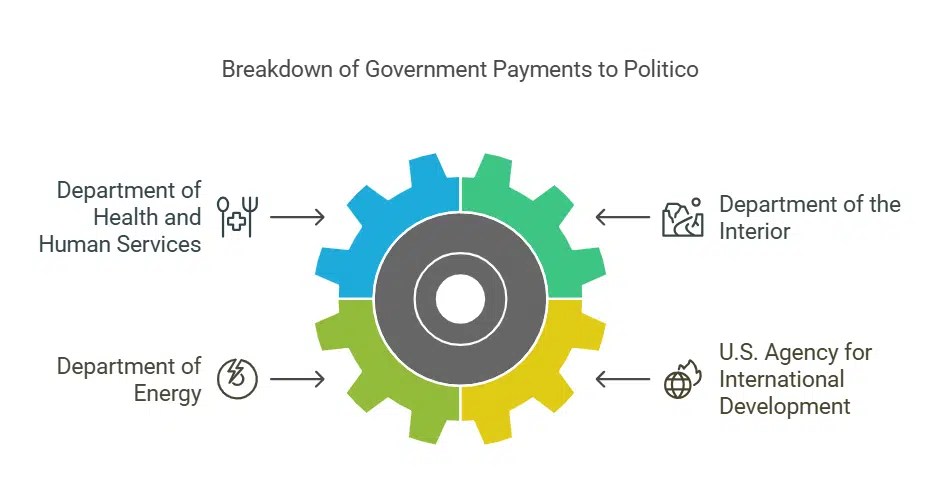
According to public records and official statements, various government agencies made substantial payments to Politico for its premium news services. Some of the key findings include:
- Department of Health and Human Services (HHS): Allocated $1.37 million to Politico Pro subscriptions.
- Department of the Interior: Spent a significant amount, though exact figures remain undisclosed.
- Department of Energy: Another major spender, reportedly in the hundreds of thousands.
- U.S. Agency for International Development (USAID): Contributed $44,000 to Politico subscriptions in the last fiscal year.
These payments were primarily directed toward Politico Pro, a subscription-based service that offers in-depth policy intelligence across multiple sectors. The Politico Pro platform is designed for policymakers, industry leaders, and government officials who require access to real-time legislative updates, detailed policy analysis, and exclusive political insights.
However, the cost of these subscriptions is notably high, with an individual Politico Pro subscription costing around $10,000 per year. Given the total expenditure, this suggests that the government funded over 800 accounts for officials across different agencies.
Government Justification: Why Were These Subscriptions Purchased?
Officials defending the expenses argue that access to Politico Pro was essential for government agencies that rely on up-to-the-minute legislative developments and policy research. The platform provides intelligence tailored to areas such as:
- Healthcare policy and reforms
- Energy regulations and environmental policies
- International development and foreign relations
- Trade agreements and economic policies
- Defense and cybersecurity updates
Federal employees reportedly used these subscriptions to stay updated on legislative changes and policy shifts that could directly impact government programs, funding allocations, and agency operations.
However, the DOGE initiative has questioned whether these expensive subscriptions were truly necessary—especially considering alternative sources of political intelligence, such as free government briefings, nonpartisan research groups, and in-house policy teams.
White House and Government Response to the Spending Controversy
The Biden administration has responded swiftly to the controversy, with White House Press Secretary Karoline Leavitt addressing the matter directly. She stated:
“The DOGE is working on canceling those payments now. This is a government effort to ensure that we are going line by line when it comes to the federal government’s books.”
This response aligns with Musk’s larger spending crackdown, which has already resulted in the abrupt shutdown of the U.S. Agency for International Development (USAID).
Government watchdog groups have also weighed in on the debate, with some officials arguing that Politico Pro was an unnecessary luxury rather than an essential service. Others have countered that journalistic integrity and high-quality news reporting are vital tools for policymakers and that canceling these subscriptions could limit access to valuable policy insights.
Impact on Politico: Financial Struggles and Employee Uncertainty
In an unexpected twist, Politico has faced internal financial struggles since these government payments came under scrutiny. Staffers at the publication reportedly experienced payroll delays, with some employees claiming that their most recent paychecks had not arrived on time.
Politico’s management attributed the issue to a “technical problem,” but speculation quickly arose that the government’s decision to pull funding may have contributed to the financial hiccup. If the government fully cancels its multi-million-dollar contracts, it could pose serious financial risks for the publication, particularly for its Politico Pro division, which relies on high-paying institutional subscribers.
Elon Musk’s Role in Government Spending Reviews
Elon Musk’s involvement in reviewing federal expenditures has marked a dramatic shift in U.S. government oversight. Appointed by Trump to lead the Department of Government Efficiency (DOGE), Musk has focused on reducing bureaucratic waste, eliminating unnecessary spending, and shutting down programs deemed redundant.
His recent decision to shut down USAID has already sent shockwaves through Washington. Employees of the U.S. Agency for International Development were reportedly blindsided when they received emails instructing them not to report to work at their Washington, D.C. headquarters.
Following this move, Musk hinted at future government reforms, including a potential deep audit of the Internal Revenue Service (IRS). He recently polled his followers on X (formerly Twitter), asking whether they believed the IRS should be audited by DOGE. An overwhelming 94.3% of respondents voted in favor of an IRS audit.
Musk’s aggressive cost-cutting measures align with former President Donald Trump’s campaign promises to shrink the federal government and eliminate unnecessary positions. Trump recently pledged to terminate nearly 90,000 IRS employees who were hired under the Inflation Reduction Act of 2022, a statement that drew loud cheers from supporters during a Las Vegas rally.
Public Reaction: Mixed Responses from Officials and Taxpayers
The government’s spending on Politico subscriptions has sparked heated debate among both politicians and the general public.
- Supporters of DOGE’s actions argue that taxpayer money should not be used to subsidize private media subscriptions, especially when cheaper or free alternatives are available. They believe these cuts are part of a necessary government-wide reform to eliminate wasteful spending.
- Critics of the decision warn that restricting access to high-quality journalism and policy research could negatively impact government decision-making. They argue that news services like Politico Pro provide crucial nonpartisan intelligence that helps federal agencies operate efficiently.
Prominent journalism advocacy groups have also raised concerns, stating that cutting off government subscriptions to reputable news outlets could set a dangerous precedent and undermine press freedom.
What Comes Next?
As the Department of Government Efficiency continues its line-by-line review of federal spending, more revelations about government expenses may emerge. If DOGE proceeds with additional subscription cuts, other major media outlets that receive government-funded subscriptions could also come under scrutiny.
For Politico, the potential loss of millions in government-backed subscriptions could force the outlet to reevaluate its business model, especially its Politico Pro service.
For taxpayers, this situation highlights the ongoing debate over government spending priorities, press funding, and the balance between fiscal responsibility and information access.
As this story develops, it remains to be seen how deep the government’s spending review will go—and whether more agencies will see similar budget cuts in the months ahead.





















