Hey there, have you ever tried making a crypto transaction on the Ethereum blockchain, only to get hit with a surprise fee that stings your wallet? Those sneaky costs, known as gas fees, can really add up, especially when you’re just trying to buy or trade some Ether (ETH), and it feels like a punch to the gut.
Let me share a quick fact, gas fees are what you pay to process transactions on the Ethereum network, and they’re measured in tiny units called Gwei. Now, imagine dodging those high gas fees by learning a few simple tricks.
In this post, we’ll break down what crypto gas fees are, why they spike due to network congestion, and how you can cut down on those pesky transaction costs with easy tips. Stick around, let’s save some cash!
Key Takeaways
- Gas fees are payments in Ether (ETH) for transactions on the Ethereum blockchain, measured in tiny units called Gwei (10^-9 ETH).
- High fees happen due to network congestion, especially when blocks are over 50% full after the EIP-1559 upgrade, raising the base fee.
- Minimize costs by timing transactions during off-peak hours, like after midnight or on weekends, using tools like Etherscan Gas Tracker.
- Use Layer 2 solutions like Arbitrum or Optimism to cut fees by batching transactions on the Ethereum mainnet.
- Switch to low-cost networks like Solana, where transactions can cost less than a cent, saving more ETH.
What Are Gas Fees in Crypto?
Gas fees in crypto are payments you make to get things done on the Ethereum blockchain. Think of them as a tip you give to validators, the folks who process and secure your transactions.
Without this fee, your trade or smart contract action on Ethereum just won’t happen. It’s like fuel for a car; no gas, no go.
These transaction fees, often paid in Ether (ETH), keep the Ethereum network running smoothly. Validators work hard to maintain network security, and gas fees reward them for that effort.
So, next time you’re buying Ethereum or using decentralized applications (dApps), know that this cost is what keeps the whole system safe and ticking.
How Do Gas Fees Work?
Think of gas fees as the price you pay to get your transaction rolling on the Ethereum blockchain. They’re like a toll for using the network’s computing power. Every action, from sending Ether (ETH) to running smart contracts, needs this fee to keep things moving.
These costs are paid in ETH, and the tiniest unit is called Wei. Often, though, you’ll see them shown in Gwei, which equals 10^-9 ETH. Pretty small, right?
Here’s the deal with calculating them. Gas fees come from multiplying the gas limit by the gas price. The gas limit sets how much work your transaction needs on the Ethereum Virtual Machine (EVM).
Meanwhile, the gas price is what you’re willing to shell out for each unit of that work. Validators, who secure the network under the Proof-of-Work system, get these fees as their reward.
Tools like Etherscan Gas Tracker help you check current rates, so you can plan smart and save some crypto coins!
Why Are Gas Fees High?
Hey, did you ever wonder why gas fees in crypto can skyrocket, almost like gas prices at the pump during a holiday rush? Stick around to find out the surprising reasons behind these high costs!
Network congestion
Holy cow, network congestion can really mess with your crypto transactions on the Ethereum blockchain! Picture a busy highway during rush hour, jam-packed with cars. That’s how the network looks when tons of users are sending transactions or using dapps, all fighting for space.
During these peak times, gas fees skyrocket because of the huge demand for block space. It’s pure supply and demand at play, and trust me, it can sting your wallet.
Now, let’s chat about why this happens. After the EIP-1559 upgrade, if a block gets over 50% full, the base fee climbs higher. This means you pay more to get your transaction prioritized on the Ethereum mainnet.
It’s like tipping extra at a crowded diner to get served faster. So, when network demand surges, brace yourself for those high gas fees!
Complex transactions
Hey there, let’s chat about complex transactions in the crypto world. These deals, often tied to smart contracts or DeFi platforms, demand a lot of computing power on networks like the Ethereum blockchain.
More effort means higher gas fees, plain and simple.
Think of it like cooking a fancy meal versus a quick snack, where the big recipe takes more time and tools. Complex transactions need extra steps on the Ethereum Virtual Machine, or EVM, spiking those transaction costs.
So, when you’re using decentralized applications or swapping on a decentralized exchange, expect a heftier price tag due to the heavy lifting involved.
Strategies to Minimize Gas Fees
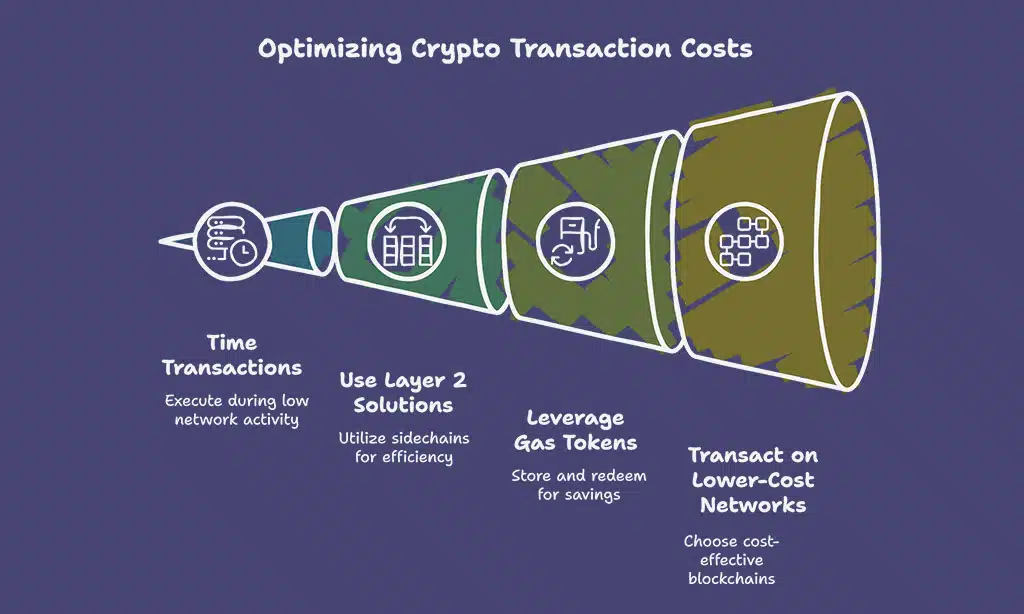
Hey, want to save some cash on those pesky gas fees in crypto? Keep reading for clever tips to cut down your costs on the Ethereum network!
Time your transactions during low activity
Think about the Ethereum network as a busy highway, folks. During rush hours, like U.S. and European business times, traffic jams up, and gas fees soar. But, if you pick the right moment, you can dodge the chaos.
Aim for off-peak hours, say after midnight or on weekends, when gas prices drop a lot. It’s like sneaking out for a drive when the roads are clear.
Smart timing can save you a bundle on crypto gas fees. Check tools like Etherscan Gas Tracker to spot those quiet periods on the Ethereum mainnet. By waiting for low network demand, your transaction costs shrink fast.
So, play it cool, watch the clock, and keep more ether (ETH) in your pocket with this simple trick.
Use Layer 2 solutions
Hey there, let’s chat about slashing those pesky gas fees with a cool trick, Layer 2 solutions. These are like side roads next to the busy Ethereum mainnet highway, handling tons of transactions at once to cut down costs.
Think of names like Arbitrum, Optimism, and zkSync, which batch up cryptocurrency transactions and settle them on the Ethereum blockchain for way less ether (ETH).
Now, imagine not stressing over high gas fees every time you use decentralized applications or DeFi platforms. By picking these Layer 2 networks, you’re dodging network congestion and saving big on transaction costs.
It’s like finding a shortcut that gets you there faster and cheaper, so why not give it a spin?
Leverage gas tokens
Gas tokens are a neat trick to cut down on crypto gas fees. They work by letting you store and later redeem variable coins as Ether (ETH). This can save you some cash on miner fees on the Ethereum blockchain.
Think of it as stashing away a discount for a rainy day, pretty handy, right?
Got a transaction coming up? Use gas tokens to lower those pesky costs. Just remove the coins from storage when you need them, and voilà, you’ve got ETH to spend. It’s like finding a coupon in your wallet, and it works wonders on the Ethereum network.
Transact on lower-cost networks
Hey there, let’s chat about saving some cash on crypto gas fees. One sweet trick is to use lower-cost networks like Solana, Avalanche, or Sui instead of pricier ones like the Ethereum mainnet.
These options can slash your transaction costs big time, with Solana transactions often costing just a tiny fraction of a cent. Wow, right?
Switching to these blockchain networks means you keep more of your hard-earned ether (ETH) in your crypto wallets. It’s like finding a shortcut on a busy road, less stress and more savings.
So, next time you’re sending cryptocurrency transactions or using decentralized applications (dapps), pick a network with low transaction fees and watch the difference.
How to Check and Estimate Gas Fees
Let’s talk about gas fees, folks. Checking and estimating them can save you a bundle on the Ethereum blockchain.
- First off, explore tools like Gas Now for real-time updates on gas fees. This handy service displays the current gas price on the Ethereum network. It helps you choose the optimal moment to send your cryptocurrency transactions. No guesswork, just reliable data at your fingertips.
- Next up, check out Etherscan’s Gas Tracker for a clear overview of network costs. This tool details the gas fees on the Ethereum mainnet. You can see if the network demand is rising or falling. It’s like having a forecast for transaction costs!
- Don’t overlook your wallet’s built-in features, like those in MetaMask. This popular wallet provides gas fee estimations right before you confirm a transaction. You’ll see the gas limit and gas price clearly presented. It’s a fast way to avoid overpaying on ether (ETH).
- Keep in mind the EIP-1559 upgrade and its effect on fees. Since this change, a base fee adjusts based on network congestion. Include a priority fee for quicker transaction speed, and you’ve got the complete view. Understanding this helps you plan more effectively.
- Lastly, use gas fee calculators for an estimate of costs. Many websites offer these for free, showing how much a transaction might cost you. They account for the Ethereum Virtual Machine (EVM) workload and transaction details. It’s like getting an early insight before you spend.
Takeaways
Hey there, crypto fans! Gas fees don’t have to drain your wallet. With smart moves like timing trades during quiet hours or using Layer 2 networks, you can save big on costs. Keep an eye on tools like Etherscan Gas Tracker for real-time fee updates.
Stick with these tricks, and watch your Ethereum deals get cheaper!
FAQs on Crypto Gas Fees
1. What exactly are gas fees in crypto?
Hey, think of gas fees as the toll you pay on the digital highway of the Ethereum blockchain. These transaction fees cover the cost of running smart contracts or moving ether (ETH) on the Ethereum network. They keep the Ethereum Virtual Machine (EVM) humming, securing network security while you use decentralized applications (dapps).
2. Why do Ethereum gas fees get so high sometimes?
Man, it’s like rush hour on the Ethereum mainnet, with network congestion driving up costs. High gas fees hit when network demand spikes, especially during hot DeFi (decentralized finance) platform activity. Transaction complexity also plays a part, jacking up the base fee and priority fee for faster transaction speed.
3. How can I cut down on crypto gas fees?
Try timing your cryptocurrency transactions for off-peak hours, when the Ethereum network isn’t swamped. Layer 2 solutions or layer 2 networks can slash transaction costs too. Also, tools like Etherscan gas tracker or other gas fee calculators help you spot a lower gas price.
4. What’s the deal with gas limit and gas tokens?
Gas limit is your cap on how much you’re willing to shell out for a transaction on the Ethereum blockchain. Gas tokens, though, are a neat trick some folks use to store cheaper gas for later.
5. Can transaction batching save me from high gas fees?
You bet, bundling multiple moves into one go with transaction batching can trim down costs on DeFi platforms. It’s like carpooling, less trips mean less tolls on the Ethereum network.