

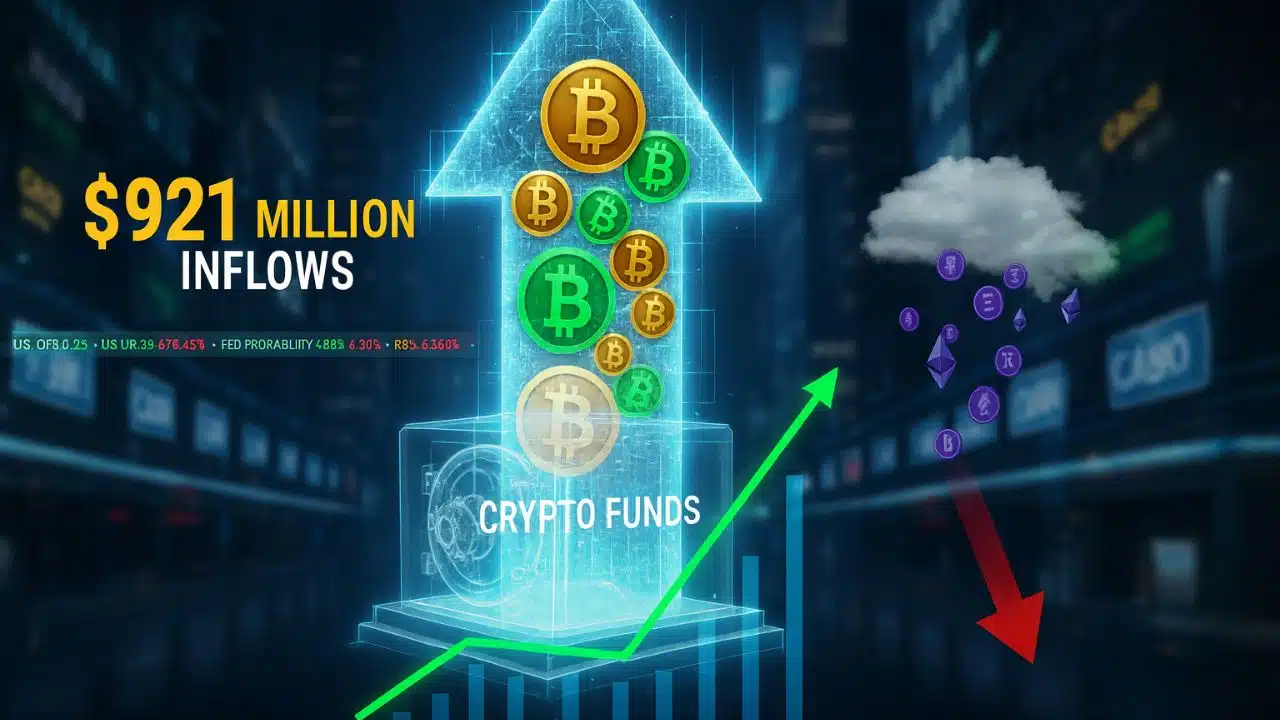
Institutional investors poured $921 million into digital asset investment products last week, reversing a trend of outflows as softer-than-expected U.S. inflation data fueled overwhelming market conviction that the Federal Reserve will cut interest rates again this week.
- Total Net Inflows: Digital asset ETPs (Exchange Traded Products) attracted $921 million for the week ending October 24, 2025, reversing the prior week’s $513 million outflow.
- Primary Driver: Bitcoin-focused Crypto Funds were the near-exclusive beneficiaries, pulling in $931 million.
- Major Divergence: Ethereum products experienced their first outflow in five weeks, bleeding $169 million, signaling a stark divergence in institutional sentiment.
- Macro Catalyst: The U.S. Consumer Price Index (CPI) for September came in at 3.0% (below the 3.1% forecast), reinforcing market hopes for a dovish monetary policy.
- Fed Rate Cut Odds: Market probability of a 25-basis-point rate cut at the Fed’s October 29 meeting has surged to over 95%, according to CME FedWatch Tool data.
Institutional capital is flooding back into Crypto Funds, but this time, it’s almost exclusively a one-asset trade.
In a powerful demonstration of how macroeconomic data is dictating digital asset flows, investment products tracking cryptocurrencies saw net inflows of $921 million last week, according to the latest weekly report from digital asset manager CoinShares.
This nine-figure sum marks a decisive reversal from the $513 million in outflows seen the week prior, highlighting a volatile but increasingly responsive institutional market. The surge was almost entirely driven by investors piling into Bitcoin, which they view as a prime hedge against the monetary easing now widely expected from the U.S. Federal Reserve.
The buying frenzy was ignited by last Friday’s U.S. inflation report. The Bureau of Labor Statistics revealed that the headline Consumer Price Index (CPI) rose 3.0% year-over-year in September, coming in just below analysts’ consensus forecast of 3.1%.
In a “bad news is good news” market, this sign of cooling inflation was interpreted as a green light for the Fed to continue its pivot away from tightening.
The Macro Catalyst: All Eyes on the Fed
The market’s reaction was immediate and unambiguous. The probability of the Federal Open Market Committee (FOMC) announcing another 25-basis-point rate cut at its meeting this Wednesday, October 29, soared to over 95%. This would follow a similar cut just last month, marking a significant dovish shift.
The Federal Open Market Committee (FOMC) is widely expected to lower the federal funds rate by 25 basis points at its October meeting, mirroring September’s move,” said Sam Williamson, senior economist for First American. This cut would bring the target range to 3.75–4%, marking another step toward a more neutral policy stance.
This sentiment was echoed by James Butterfill, Head of Research at CoinShares, who directly linked the crypto inflows to the changing macro environment.
“The lower-than-expected [CPI] data released on Friday helped restore some confidence that further rate cuts are likely this year,” Butterfill noted in his report.
This renewed optimism sent shockwaves through all “risk-on” assets, including equities. The S&P 500 and FTSE 100 both touched record highs on Friday, and crypto-related stocks surged. Coinbase (COIN), for example, jumped 9.8% on Monday following a JPMorgan upgrade and broad market optimism.
A Stark Divergence: Bitcoin Soars, Ethereum Sinks
The $921 million total inflow figure, however, masks a critical underlying trend: a dramatic “flight to quality” within the crypto sector itself.
Bitcoin’s Gravity-Defying Inflow
Bitcoin-based investment products were the undisputed winners, attracting a staggering $931 million in inflows. This figure, being larger than the total net flow, indicates that inflows into Bitcoin were so strong they offset significant outflows from other assets.
The demand was heavily concentrated in the popular U.S. Spot Bitcoin ETFs. These regulated products, which only launched in 2024, accounted for $446.3 million of the total inflows. BlackRock’s iShares Bitcoin Trust (IBIT) led the pack, pulling in $324.3 million on its own.
This trend solidifies Bitcoin’s narrative as “digital gold”—an institutional-grade asset used as a hedge against inflation and, in this case, the currency devaluation that can result from interest rate cuts.
Ethereum’s Sudden Reversal
In sharp contrast, Ethereum-based funds suffered their worst week in over a month. Investors pulled $169 million out of Ethereum products, marking the first week of outflows after five consecutive weeks of gains.
This divergence suggests that while institutions are comfortable betting on Bitcoin as a macro play, they are growing more cautious about Ethereum and the broader altcoin market. Ethereum’s status as a “tech” or “growth” asset makes it more sensitive to underlying economic weakness, a fear that persists despite the market’s hope for Fed cuts.
Other altcoins saw mixed, though modest, activity. Products tracking Solana (SOL) saw $29.4 million in inflows, while those for XRP attracted $84.3 million, as investors await potential U.S. ETF approvals for those assets.
The Broader Context: A Jittery Market
While the inflows are bullish, they do not erase underlying economic uncertainty. The recent, and now resolved, U.S. government shutdown has left investors with “little guidance on the direction of U.S. monetary policy,” according to CoinShares’ Butterfill.
Furthermore, broader economic sentiment remains fragile. Chris Williamson, Chief Business Economist at S&P Global Market Intelligence, noted that while U.S. business activity accelerated in October, “business confidence in the outlook for the coming year has deteriorated further… as companies worry about the impact of policies.
The crypto market is reflecting this conviction, but also its fragility. Trading volumes for digital asset ETPs were high at $39 billion for the week, well above the 2024 year-to-date average, showing strong participation.
However, the year-to-date (YTD) inflow total for Crypto Funds stands at $30.2 billion. While substantial, this is still significantly lower than the $41.6 billion recorded by this time last year, indicating that 2025 has been a more challenging and selective market for institutional crypto investment.
The market’s immediate future hinges on two critical events this week:
- The FOMC Decision (Oct 29): The market has already priced in a 25-basis-point cut. Any deviation from this—either no cut or a more aggressive 50-point cut—would introduce extreme volatility. The language used by Fed Chair Jerome Powell in his press conference will be scrutinized for clues about a potential third cut in December.
- Big Tech Earnings: Earnings reports from mega-cap companies including Alphabet, Microsoft, Meta, Apple, and Amazon are all due. As the drivers of the traditional “risk-on” equity market, their performance will heavily influence sentiment and could either support or undermine the current crypto rally.
For now, the crypto market is riding a wave of macroeconomic optimism. Bitcoin, having reclaimed ground above $115,000 in recent trading, has clearly re-established itself as the institutional asset of choice. The coming days will determine if this renewed confidence is the start of a sustainable fourth-quarter rally or merely a temporary sugar rush from the hope of cheaper money.
The Information is Collected from Binance and Yahoo Finance.






















