

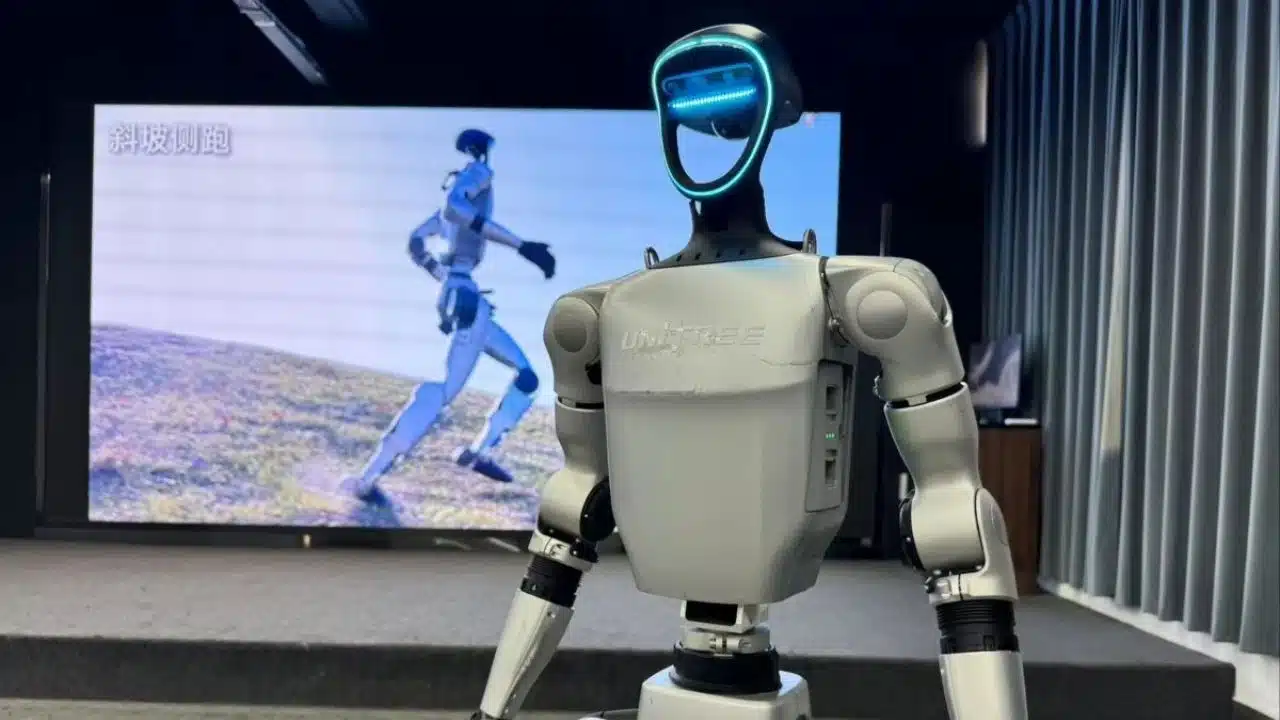
Six Chinese humanoid robots joined singer Wang Leehom onstage in Chengdu on Dec. 18, performing synchronized dance moves and a coordinated flip sequence—footage that Elon Musk reposted on X with the caption “Impressive,” amplifying global attention on China’s fast-advancing humanoid robotics.
What happened in Chengdu
The performance took place during a Wang Leehom concert in Chengdu, where six humanoid robots danced in formation with human performers and executed synchronized acrobatic flips as part of the routine.
Video of the moment spread quickly online, helped by Musk’s repost, and reignited debate about how quickly humanoid robots are moving from lab demos to public, real-world venues.
Key event details
The robots shown in the viral clip were identified as Unitree Robotics’ G1 humanoids, appearing in matching stage outfits and moving in tight synchronization with the dancers.
The clip circulated widely because it showed multiple robots landing their flips cleanly on a live stage—an environment with timing constraints, lighting shifts, and limited room for error.
| Item | What’s known |
| Date | Dec. 18, 2025 |
| Location | Chengdu, China |
| Performer | Wang Leehom |
| Robots | Six Unitree G1 humanoids |
| Viral trigger | Musk reposted the video with “Impressive” on X |
Musk’s repost and why it mattered
Musk reposted the concert clip on X and added a one-word reaction—“Impressive”—turning a regional entertainment moment into a global tech talking point.
Because Musk leads Tesla, which is developing its own humanoid robot program, his reaction was widely interpreted as acknowledgment that Chinese humanoids are improving quickly in public-facing demonstrations.
The repost also shifted the story beyond entertainment, making it part of a broader narrative about competition in “embodied AI”—systems that combine software intelligence with physical bodies that can move, balance, and manipulate objects.
Even so, a flashy routine does not automatically prove readiness for factory or home work, where endurance, safety, reliability, and hands-on dexterity matter as much as athletic motion.
Who built the robots: Unitree G1 in context
Unitree’s G1 is marketed as a humanoid platform with a flexible joint design and a configuration that can range from 23 to 43 joints (depending on options), according to the company’s product materials.
Unitree positions the G1 around motion capability and research/development use cases, emphasizing learning-driven control and precise force-position control concepts in its product descriptions.
Specs and pricing signals
A widely cited industry report tied the G1’s base configuration to a $16,000 list price when it was introduced around ICRA 2024, framing it as a lower-cost humanoid aimed at labs and developers rather than a mass consumer device.
The same report contrasted it with Unitree’s earlier H1 humanoid, describing a base price near $90,000 and positioning H1 as higher-performance while G1 focuses on compactness and affordability.
Unitree’s own store listings emphasize the product line’s configuration flexibility (including joint-count variations) and direct buyers to contact the company for pricing, suggesting pricing can vary by version and region.
This matters because humanoid adoption at scale typically depends on whether robots can be manufactured and supported cheaply enough for businesses to justify them against wages, safety requirements, and downtime costs.
Why flips are a milestone (and what they don’t prove)
Synchronized flipping is a demanding balance-and-control demonstration because small timing errors compound when multiple robots move together, especially on a stage where choreography must match music cues.
However, a short routine still leaves open key operational questions—battery life under load, recovery from slips, durability after repeated falls, and the ability to safely work near crowds for long periods.
Why China is pushing humanoids now
China’s Ministry of Industry and Information Technology (MIIT) has publicly described humanoid robots as a potentially disruptive technology and set national goals that include establishing a preliminary innovation system by 2025.
MIIT’s published direction also sets longer-range ambition for broader industrial strength by 2027, aligning humanoids with economic growth and strategic technology development.
This policy backdrop helps explain why high-visibility demos—whether at conferences, factories, or public performances—are happening more often: they showcase progress, attract partners, and build confidence that domestic suppliers can produce core components and full systems.
Separate from industrial policy, some local governance work has also emerged, including guidance efforts in Shanghai that emphasize risk management and coordination for humanoid deployment.
The global market race behind the viral moment
Major financial research has projected extremely large long-term market potential for humanoids, including Morgan Stanley Research estimating a possible $5 trillion market by 2050 (including related supply chains and services).
That projection also anticipates adoption to be gradual at first, with faster acceleration later—suggesting today’s viral demos may be early signals rather than proof of immediate mass rollout.
The concert video landed amid an international wave of humanoid “capability clips,” including Boston Dynamics showcasing Atlas backflips in past demonstrations—highlighting that acrobatics have long been used to prove balance and control in robotics.
What stands out in the Chengdu clip is the combination of entertainment choreography, multiple robots moving together, and a mainstream live-event setting that exposes robots to a different kind of scrutiny than a controlled lab floor.
what comes next
The “Chinese robots backflips at concert” moment is less about entertainment novelty and more about how quickly humanoid robots are entering public spaces as credible performers of complex motion.
Musk’s repost mattered because it boosted the clip to a global audience and connected the event to the broader competitive landscape in humanoids and embodied AI.
Next signals to watch are practical ones: purchase orders, developer ecosystems, safety governance, and repeatable deployments in factories, logistics sites, hospitals, and eldercare—areas MIIT has explicitly highlighted as future application domains.
If China meets its policy goalposts and companies can deliver reliable fleets at falling costs, public demos like the Chengdu concert could be remembered as an early marker of humanoids moving from spectacle to everyday infrastructure.





















