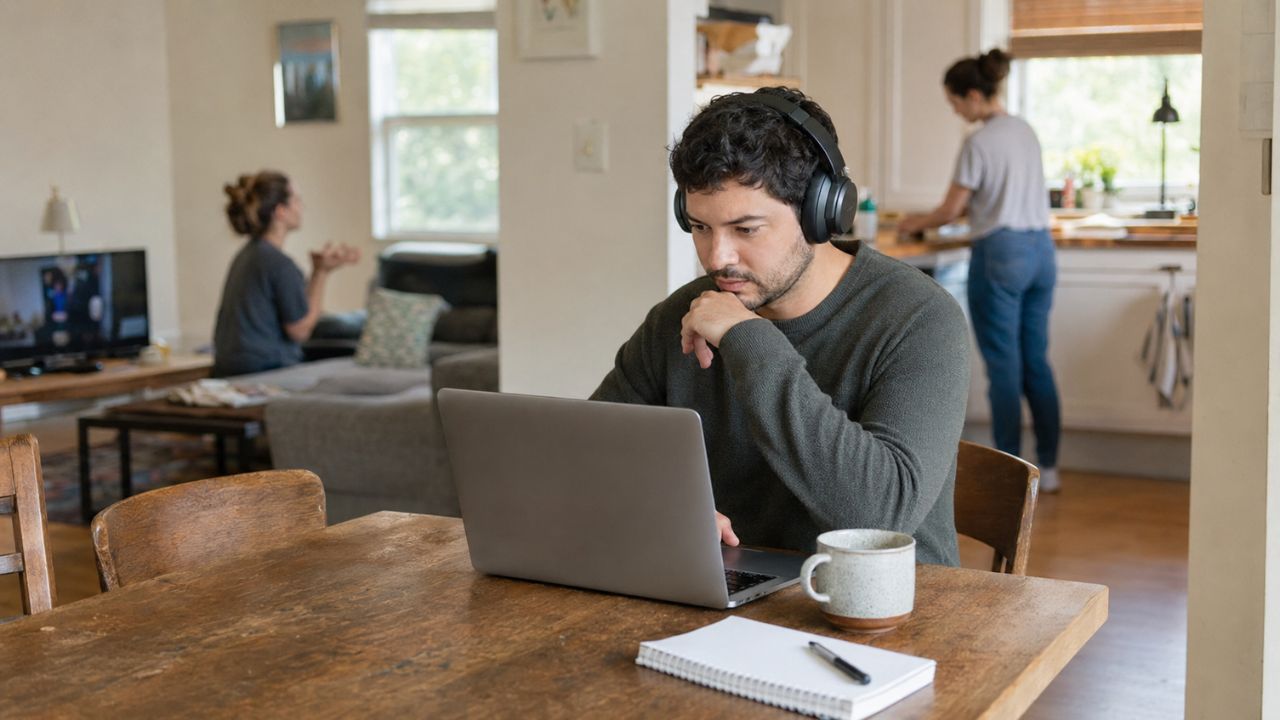
A noisy household rarely stays noisy in one predictable way. A television starts in the next room, someone takes a call, children need attention, kitchen appliances come on, and a quiet afternoon suddenly turns into a difficult place to think.
The usual advice is to put on headphones and try harder to concentrate. That may help in some situations, but it does not solve every type of noise. It can also be impractical if you need to hear a child, an alarm, a visitor, or another important sound.
To stay focused in a noisy household, you need more than one defence. Start by understanding what is disrupting you. Then reduce what you can, schedule around what remains, and make interruptions easier to recover from.
The aim is not to turn a shared home into a silent office. It is to create conditions in which focused work is possible without expecting everyone else to stop living.
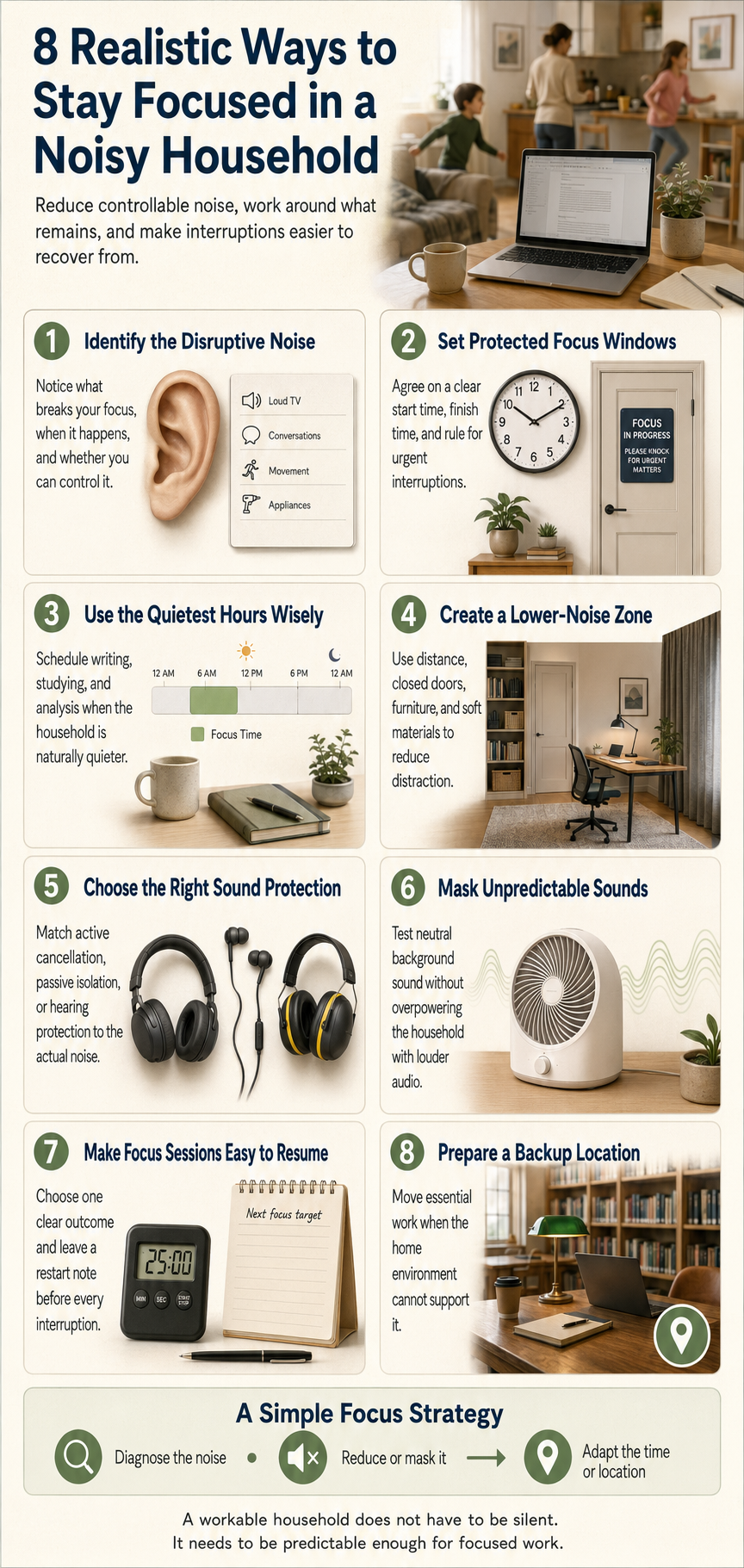
8 Ways to Stay Focused in a Noisy Household
These methods are designed to work together. You may only need two or three of them on an ordinary day, while an important deadline could justify changing your schedule or leaving the house altogether.
1. Identify What Is Actually Breaking Your Concentration
I would not begin by buying anything. I would spend one normal day noticing when concentration fails and what was happening at the time.
Household noise usually falls into a few broad categories:
- Speech: conversations, phone calls, television dialogue, online meetings
- Steady sound: fans, air conditioners, distant traffic, appliance hum
- Sudden sound: doors closing, dishes, barking, alarms, nearby construction
- Social interruption: someone asking a question or expecting a response
- Visual distraction: movement around the room, even when it is relatively quiet
These problems do not have the same solution. Active noise cancellation may soften a low mechanical hum but do much less against sudden voices nearby. A sound machine may mask minor background changes, but it cannot prevent someone from interrupting you directly.
For a simple noise audit, note the source, time, task, and severity of each disruption for a day or two. You may discover that the household is not equally distracting all day. Perhaps conversations peak in the evening, the kitchen is busiest at lunchtime, or traffic becomes noticeable only when the windows are open.
Once the pattern is visible, you can make a targeted change instead of trying to eliminate every sound.
2. Agree on Specific Focus Windows
“Please be quiet while I work” is difficult for anyone else in the household to follow. It has no clear start, finish, or definition of what quiet means.
A protected focus window is more practical. It could be 30 minutes before an online class, 45 minutes for writing, or an hour before an important deadline. Tell the people around you:
- When the focus period begins and ends
- Which activities would be most disruptive
- What counts as an urgent interruption
- How they can signal you without entering the room
- When you will be available again
A useful request might be: “I need to concentrate from 10:00 to 10:45. Could we keep the television low and save non-urgent questions until then?”
This is easier to respect than an open-ended demand for silence. A closed door, desk card, or agreed headphone signal can also help, provided everyone knows what it means. In homes with children, caregivers, roommates, or several people working remotely, the agreement needs to be reciprocal. Other household members should be able to request their own quiet periods too. The goal is coordination, not control.
3. Match Demanding Tasks to the Quietest Hours
Not every task needs the same level of concentration. One of the most effective adjustments is to stop treating every hour as equally suitable for every kind of work.
Use the quietest predictable period for tasks such as:
- Writing or editing
- Studying unfamiliar material
- Preparing a presentation
- Analyzing information
- Solving complex problems
- Conducting an interview or examination
Save louder periods for routine messages, scheduling, simple research, file management, household chores, or other work that is easier to pause and resume.
This may require moving one difficult task earlier or later rather than restructuring the entire day. If the household is calm before breakfast, that could be the right time for concentrated writing. If evenings are quieter, protect part of that period rather than wasting it on administrative work.
People with limited control over their schedules may not find a perfectly quiet hour. Even then, identifying the least disruptive 20 or 30 minutes can be more useful than repeatedly attempting deep work during the busiest part of the day.
4. Build a Lower-Noise Zone With What You Already Have
A private home office is helpful, but it is not the only way to create a usable workspace.
Begin with location. Increase the distance between your desk and the television, kitchen, entrance, shared wall, or other frequent noise source. Facing away from a doorway or busy room can reduce visual interruptions as well.
Then look at the path the sound takes:
- Close a door or window when practical
- Address obvious gaps around doors
- Move the desk away from a thin shared wall
- Place substantial furniture or a filled bookcase against that wall
- Add rugs, curtains, or other soft materials to reduce harsh echoes
- Avoid working directly beside hard, reflective surfaces when another option exists
These changes can make a room feel calmer, but they should not be oversold as soundproofing. The UK Health and Safety Executive explains that absorbent materials mainly reduce reflected and reverberant sound. They do not automatically block the direct path of sound through walls, doors, ceilings, or open gaps.
In many homes, moving the desk farther from the noise source will have a greater effect than buying decorative acoustic panels.
5. Choose Headphones or Ear Protection for the Right Reason
“Noise-cancelling” is often treated as one solution, although different products manage sound in different ways.
Active noise cancellation is generally most useful for steady, lower-frequency sounds such as engine noise, ventilation, or a persistent hum. It may be less effective against nearby speech, clattering dishes, or other sudden changes.
Passive isolation relies on the physical fit and materials of the headphones or earphones. A good seal can reduce a broader range of ordinary background sound, although results vary by product and fit.
Earplugs and protective earmuffs are designed for situations in which the sound may threaten hearing. Ordinary consumer headphones should not be assumed to provide that protection. OSHA specifically advises against replacing tested hearing-protection devices with consumer active noise-cancelling headphones that were not designed and rated for hazardous noise.
Complete isolation may also be the wrong choice when you must remain aware of children, alarms, deliveries, or household emergencies. In those situations, a transparency mode, lower level of isolation, or non-headphone strategy may be safer.
Buy according to the problem you identified, not simply because a product promises better focus.
6. Mask Unpredictable Sound Without Adding Another Distraction
Sound masking does not remove noise. It introduces a steady, neutral background that makes changes in the surrounding environment less noticeable.
A fan, gentle rainfall recording, or low-volume neutral noise may soften the contrast between quiet periods and sudden household sounds. Keep the volume comfortable. Trying to overpower the house with louder audio replaces one problem with another.
I would be cautious with music during language-heavy work. Research on background audio has found that music with lyrics can reduce concentration and attention performance. Familiar instrumental music may be less intrusive for some people, but silence or simple neutral sound remains a sensible starting point for reading, writing, and memorization.
Claims about white, pink, and brown noise also need restraint. A 2024 systematic review and meta-analysis found a small improvement in laboratory attention tasks among children and college-age participants with ADHD or elevated ADHD symptoms. For participants without ADHD, white or pink noise slightly reduced performance. The review found no qualifying brown-noise studies.
That does not mean people without ADHD must avoid sound masking. It means these sounds should be tested as personal environmental tools, not promoted as universal concentration hacks.
Try the same task with and without masking for several sessions. Keep it only if the work becomes easier or more accurate.
7. Work in Sessions That Are Easy to Resume
Interruptions are frustrating partly because returning to a vague task takes time. “Finish the report” does not tell you where to restart. “Draft the paragraph comparing the two results” gives you a clear entry point.
Choose one defined outcome for each focus session. The session could last 20 minutes in a busy household or longer when the environment is predictable. The useful duration is the one you can realistically protect.
Before stopping, whether for a planned break or a household interruption, leave a short restart note:
- Next: check the figures in the second table
- Continue from the paragraph about delivery costs
- Compare sources three and four
- Email the revised section after proofreading
This small habit reduces the need to reconstruct the task from memory.
It also addresses a real feature of task switching. Researcher Sophie Leroy uses the term attention residue to describe what happens when part of our attention remains with an unfinished task after we switch. Her research indicates that interruptions and incomplete tasks can leave fewer cognitive resources available for the next demanding activity.
A restart note will not prevent every distraction, but it can make an unavoidable interruption less costly.
8. Keep a Backup Location for Work That Cannot Tolerate Noise
Some conditions cannot be improved enough. The neighbours may be renovating, several family members may need the same room, or an important examination may require more quiet than the home can provide.
For those occasions, identify a realistic backup location in advance:
- A public or university library
- A campus study room
- A quiet office
- A community workspace
- A quieter room borrowed at an agreed time
- A trusted friend’s or relative’s home
- An affordable coworking option, if available
A backup plan is particularly useful for interviews, presentations, examinations, major deadlines, and tasks involving confidential conversations.
Leaving the house is not always accessible, affordable, or practical, especially for caregivers. It does not need to become a daily solution. Even one planned session in a quieter location can protect the most demanding part of a project.
Changing location is not an admission that you lack discipline. Sometimes the environment is unsuitable for the task, and spending hours fighting it is a poor use of attention.
What If You Cannot Wear Headphones?
Headphones can be uncomfortable, inaccessible, or unsafe when you need to remain aware of the household. If they are not an option, rely more heavily on timing, distance, communication, and task selection.
Move away from speech where possible, even if that means using a less attractive corner of the room. Face a wall instead of a busy doorway. Close visual distractions. Use a visible focus signal and give other household members a clear time when you will be available.
You can also prepare a “noisy-hour list” of tasks that tolerate interruption. When the home becomes unexpectedly busy, switch to something from that list instead of forcing difficult work under unsuitable conditions.
This is different from jumping randomly between tasks. The decision is made in advance, so you are not spending additional energy deciding what to do each time the noise changes.
Make the Household More Predictable, Not Perfectly Quiet
A shared home will always contain some movement, conversation, and interruption. Trying to eliminate all of it can create more tension than focus.
A better system controls the parts of the problem that are manageable. Identify the most disruptive sounds, negotiate short focus periods, place demanding work in quieter hours, and make the workspace less exposed. Use headphones or sound masking selectively, not automatically. For work that cannot survive the available conditions, change the time or location.
Most importantly, make interrupted work easy to resume. Noise becomes far less damaging when you know exactly where to return.
You do not need a silent home to stay focused in a noisy household. You need a realistic arrangement that protects your most demanding work while respecting the other people and responsibilities sharing the space.
Frequently Asked Questions on How to Stay Focused in a Noisy Household
1. Why is talking more distracting than other household sounds?
Speech carries meaning, so the brain may continue processing it even when you are trying not to listen. This makes conversations, phone calls, and television dialogue especially disruptive during reading, writing, or memorization. Increasing your distance from the voices or masking them with a steady neutral sound may help.
2. Do noise-cancelling headphones block household conversations?
Active noise cancellation works best against steady sounds such as fans, traffic, and appliance hum. It may reduce nearby voices, but it rarely removes them completely. Headphones with good passive isolation may help further. Avoid complete isolation when you need to hear children, alarms, visitors, or other safety signals.
3. Is white, pink, or brown noise better for concentration?
There is no universally best option. White noise sounds brighter, pink noise is softer, and brown noise has a deeper tone. Try each at a low volume while completing the same kind of task, then compare your focus and accuracy. Research does not support treating any noise color as a guaranteed concentration aid for everyone.
4. How can I stay focused in a noisy household without headphones?
Move farther from conversations, face away from visible activity, close doors when practical, and use rugs or curtains to reduce harsh echoes. You can also schedule difficult work during quieter periods and prepare a list of interruption-friendly tasks for noisy hours. If an important task requires silence, consider using a library or another suitable location.