

Geneva, May 21, 2025 — In a landmark financial and diplomatic gesture, China has announced a commitment of $500 million in financial support to the World Health Organization (WHO) over the next five years. This pledge, officially released by the Chinese Permanent Mission to the United Nations Office in Geneva and shared with Anadolu Agency, underscores Beijing’s growing role in international public health diplomacy and global governance.
A Detailed Look at the Funding Components
The substantial five-year funding plan is multi-pronged, designed to support the WHO through various channels:
1. Increase in Assessed Contributions
China will increase its assessed contributions, which are mandatory payments required from each UN member based on economic capacity and population. These are the most stable and predictable form of funding for the WHO and ensure that all countries contribute equitably to the organization’s operations.
2. Voluntary Contributions
In addition to the mandatory payments, China will also provide voluntary contributions, which are earmarked or flexible funds used for specific health programs or emergency responses. These contributions have historically been used to address outbreaks, maternal and child health, vaccine rollouts, and non-communicable diseases in vulnerable countries.
3. Project Support via South-South Fund
The third component involves project support through the Global Development and South-South Cooperation Fund, a mechanism created by China to promote shared growth and mutual learning among developing nations. Through this channel, China intends to back capacity-building efforts, infrastructure development in health systems, and disease surveillance in low-income regions.
China’s Statement: Reinforcing WHO’s Global Role
In its official communication, China reiterated its long-standing support for the WHO and emphasized the agency’s pivotal position in coordinating international health responses.
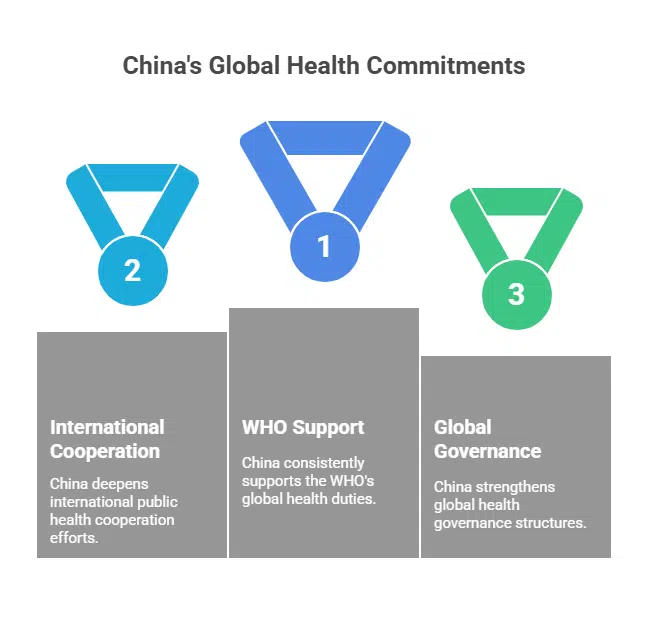
“China always supports the WHO in fulfilling its duties, deepens international public health cooperation, and strengthens global health governance,” the mission said.
The statement also recognized the WHO’s “leading and coordinating role” in managing transnational health threats and guiding health policy for member states. It further noted that China is committed to working closely with the WHO to improve the efficiency and impact of the pledged financial support.
Flexibility and Accountability: How the Funds Will Be Used
According to China’s UN mission, the exact use of the funds will be decided through mutual consultation between Chinese authorities and the WHO leadership.
“The exact use of the pledged funds will be agreed upon by both sides,” the statement noted, adding that Beijing is “looking forward to working with the WHO to further explore cooperation mechanisms to improve the efficiency of the use of the financial support.”
This arrangement allows for flexibility in adapting funding to urgent needs, while also raising questions about transparency and accountability, which are recurring concerns in the governance of international aid.
A Timely Move Amid WHO’s Financial Challenges
The announcement comes at a particularly sensitive time for the WHO, which has faced significant funding challenges in recent years. One of the most impactful setbacks was the temporary withdrawal of support from the United States during the Trump administration, a decision that rattled the organization and forced a recalibration of its funding strategy.
Although the U.S. has since resumed its financial contributions under the Biden administration, the WHO remains heavily dependent on voluntary donations, which account for more than 80% of its annual budget, according to WHO financial reports. This makes the organization vulnerable to political shifts and donor priorities.
China’s decision to step in with a significant, multi-year commitment is likely to redefine power dynamics within the WHO, raising Beijing’s influence in shaping global health priorities.
China’s Expanding Role in Global Health Diplomacy
China’s financial commitment aligns with its larger foreign policy strategy of enhancing its global soft power through health and development cooperation. Over the past decade, China has increased its presence in Africa, Southeast Asia, Latin America, and other parts of the Global South through infrastructure investment, medical aid, vaccine diplomacy, and training initiatives.
The Global Development and South-South Cooperation Fund, through which a portion of this WHO funding will be channeled, serves as a vehicle for deepening partnerships with developing countries. It has previously supported projects in public health, sanitation, epidemic response, and telemedicine infrastructure.
This pledge also reflects China’s desire to counterbalance Western dominance in international institutions, including the WHO, where the United States and European countries have traditionally wielded substantial influence over agenda-setting and governance.
Global Reactions and Strategic Implications
Health experts and policy analysts see China’s pledge as both a pragmatic step and a symbolic gesture. It signals the country’s readiness to take on a more active role in steering international health policy, particularly at a time when multilateralism is under pressure and institutions like the WHO need consistent support to combat ongoing and emerging threats such as:
-
Pandemic preparedness (post-COVID-19 recovery)
-
Antimicrobial resistance
-
Climate-induced health crises
-
Mental health and non-communicable diseases
-
Equitable access to vaccines and treatments
However, some critics warn that financial commitments from powerful nations must come with clear safeguards to avoid politicization of health aid or undue influence over independent international bodies.
Strengthening WHO’s Resilience
As the WHO continues to recover from past financial instability, China’s pledge may offer a lifeline to stabilize core programs, bolster health system resilience in vulnerable regions, and expand global surveillance networks for disease control. However, the success of this support will depend on:
-
Transparent allocation of funds
-
Coordinated program execution
-
Inclusive governance involving all member states
-
Accountability in results measurement
With major global health threats on the rise and multilateral cooperation becoming more critical than ever, the next phase of collaboration between China and the WHO could serve as a test case for how geopolitics and health diplomacy intersect in the 21st century.





















