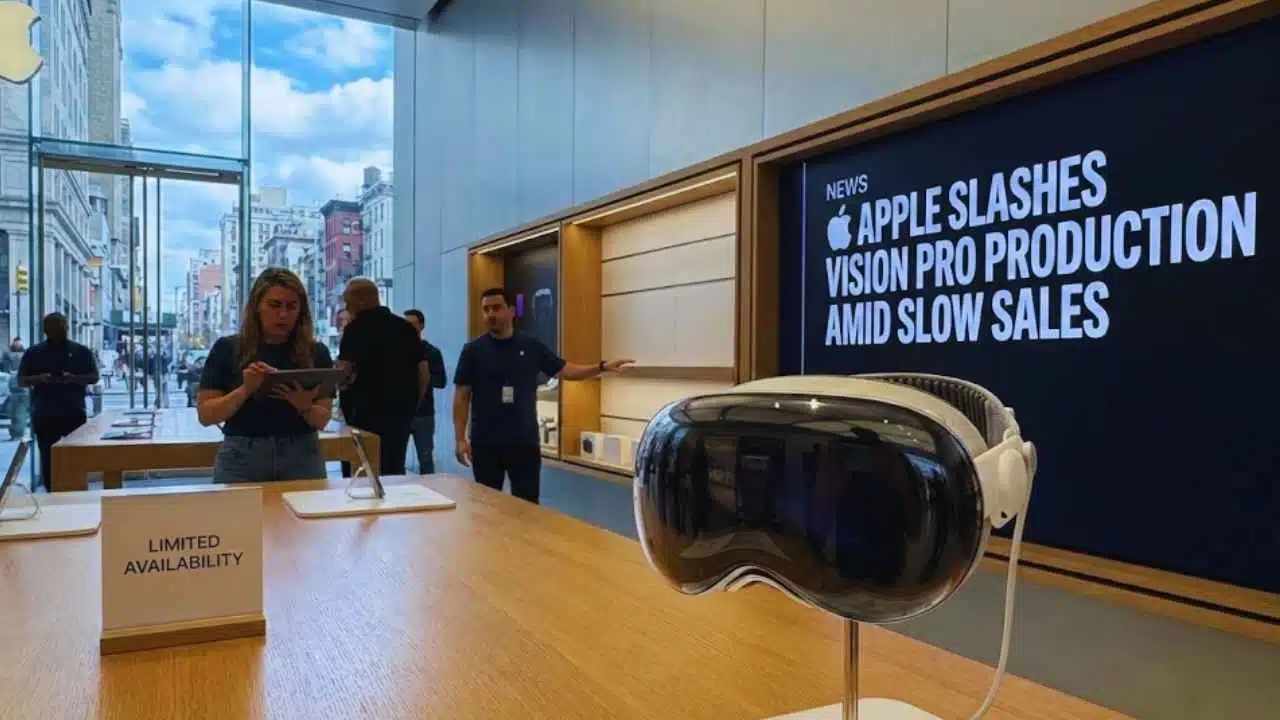
Apple has sharply scaled back Vision Pro production and marketing after weaker-than-expected demand for its $3,499 headset, signaling a slowdown in its push to make “spatial computing” a mainstream consumer category.
What Changed: Production And Marketing Pulled Back
Apple’s manufacturing partner Luxshare is reported to have halted production of the original Vision Pro model at the start of 2025 after Apple shipped an estimated 390,000 units in 2024. Apple also cut digital advertising spend by more than 95% in 2025 across major markets such as the U.S. and U.K., based on marketing-intelligence tracking cited in recent reporting.
Market trackers now estimate Apple shipped only about 45,000 Vision Pro units in Q4 2025, a key quarter for consumer electronics. That figure is tiny compared with Apple’s core hardware lines, where quarterly iPhone, iPad, and Mac volumes are typically measured in the millions.
Apple did not publicly detail production targets or shipment goals for Vision Pro. The company has also not publicly commented on the reported production slowdown.
Why Vision Pro Struggled: Price, Comfort, And The App Gap
The Vision Pro launched with premium positioning and premium pricing. Apple set the starting price at $3,499 and began U.S. sales on February 2, 2024, framing the product as a new “spatial computer.”
But several obstacles limited consumer adoption:
- High cost: $3,499 places Vision Pro far above mass-market VR headsets.
- Comfort and endurance: reviewers and users have repeatedly raised concerns about weight and long-session comfort, along with battery limitations for extended use.
- Limited native app library: Apple has pointed to thousands of experiences, but the dedicated ecosystem remains small compared with earlier platform launches. In mid-2024, Apple said Vision Pro had about 2,500 apps, and outside analyses suggested the active catalog may be smaller over time as interest fluctuated.
This created a familiar platform dilemma: many consumers wait for more compelling apps, while many developers wait for a larger installed base.
Apple Tried A Refresh: M5 Upgrade And Comfort Changes
Apple did update the hardware in October 2025, announcing an upgraded Vision Pro featuring the M5 chip and a redesigned Dual Knit Band aimed at improving comfort. Apple said the update improves performance and battery life and pairs with new features in visionOS 26.
Apple’s support documentation for the M5 model also references internal battery testing conducted in August–September 2025, reinforcing that Apple prioritized efficiency and runtime improvements in the refresh.
Still, the refresh did not appear to trigger a major demand rebound through late 2025, based on shipment estimates and reported marketing pullbacks.
The Broader Market Isn’t Helping
Apple is dealing with weak traction at the same time the broader VR category faces choppy demand. Recent reporting citing market research describes a double-digit decline in overall VR headset sales, while Meta’s Quest line continues to dominate the mainstream segment thanks to much lower pricing.
In parallel, industry researchers have pointed to a shift in momentum toward smart glasses and AI-enabled wearables rather than bulky headsets. IDC, for example, has highlighted rapid growth in display-less smart glasses and noted Meta’s large share in the combined AR/VR + smart-glasses category during 2025.
Where Vision Pro Is Working: Enterprise And Specialized Use Cases
Even with soft consumer demand, Vision Pro has shown traction in specialized environments where price matters less than capability.
One example is aviation training. CAE, a major pilot-training company, published materials describing immersive familiarization and procedures training that uses Apple Vision Pro to help pilots build cockpit knowledge and confidence.
Healthcare has also been an area of experimentation, including surgical training simulations and visualization concepts—use cases that fit Vision Pro’s strengths: high-resolution displays, hands-free interaction, and the ability to overlay information in a controlled setting.
These wins, however, are unlikely to generate iPhone-scale volumes. They do offer Apple a “proof of value” lane while it rethinks how to bring spatial computing to broader audiences.
Key Numbers And Timeline
| Milestone / Metric | What Happened | Why It Matters |
| Feb. 2, 2024 | Vision Pro went on sale in the U.S. at $3,499 | Premium pricing shaped a niche market from day one |
| 2024 shipments (est.) | Around 390,000 units shipped globally | Early demand did not sustain mass-market momentum |
| Start of 2025 (reported) | Luxshare halted production of the original model | Suggests inventory buildup and/or demand reset |
| 2025 marketing (reported) | Digital ad spend cut >95% | Sign of reduced push to scale consumer adoption |
| Q4 2025 shipments (est.) | About 45,000 units | Indicates weak holiday-quarter traction |
| Oct. 15, 2025 | Apple announced Vision Pro refresh with M5 and new band | Apple attempted to address performance and comfort hurdles |
What Comes Next: A Cheaper Vision Headset?
Industry expectations increasingly point to Apple expanding the lineup with a more affordable Vision device—likely lower-spec than Vision Pro—to broaden the audience. Recent reporting also indicates Apple did not substantially expand Vision Pro’s country availability through 2025, leaving the product concentrated in a limited set of markets.
A lower-priced model could address the biggest adoption barrier (cost), but it won’t automatically solve the second-biggest issue: the need for must-have apps and repeatable everyday use cases that justify wearing a headset.
Apple’s Vision Pro appears to be settling into a slower phase—less consumer marketing, more selective production, and a heavier emphasis on developers and enterprise pilots. The October 2025 M5 refresh shows Apple is still investing, but the reported production and ad-spend cuts suggest the company is no longer treating Vision Pro as an immediate mass-market breakout.
The next chapter likely depends on two things: whether Apple can make the hardware lighter and cheaper without compromising the experience, and whether developers (and Apple itself) can deliver a wave of software that makes spatial computing feel essential rather than optional.