

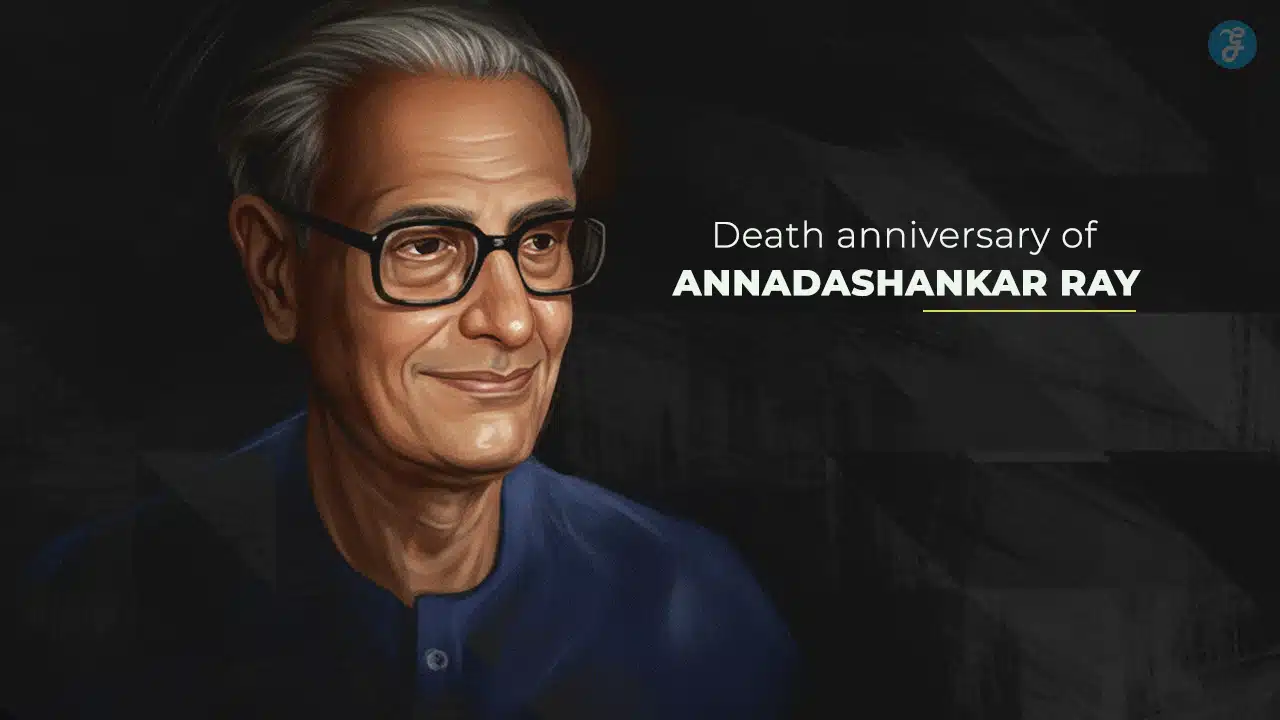
When Rabindranath Tagore passed away in 1941, a young civil servant named Annada Shankar Ray penned a quiet elegy titled “Tumi Rabe Nirobe”—“You shall remain, in silence, within our hearts.” It wasn’t just a poem; it was the passing of a torch.
Tagore, the 19th-century poet-philosopher who gave Bengal its moral vocabulary, had kindled a generation that would carry his ideals into an uncertain modern age. Annada Shankar Ray, born in 1904, stood at that crossroads—between colonial subjugation and post-independence disillusionment.
Separated by four decades yet united by vision, both men sought to defend the dignity of the human being—Tagore through the soul’s liberation, Ray through the mind’s integrity. One found freedom in poetry; the other in principle. But their mission was the same: to remind Bengal that civilization means little without compassion. Let’s discuss the vision of Annada Shankar Ray and Tagore.
Tagore’s Vision: The Spiritual Foundation of Human Dignity
For Rabindranath Tagore, dignity was not a social construct—it was the very essence of existence. Every human, he believed, is a fragment of the universal spirit. This conviction ran through his seminal works—Gitanjali, Sadhana, Nationalism, and Ghare-Baire—where he envisioned a world beyond boundaries of race, religion, or nation.
At a time when colonial India was consumed by nationalism, Tagore dared to ask a deeper question: What is freedom without humanity?
In Nationalism (1917), he warned that blind patriotism can deform the moral soul: “Patriotism cannot be our final spiritual shelter; my refuge is humanity.”
His project at Shantiniketan embodied this idea—an education system that freed the mind from rote learning and nurtured self-realization. Art, for Tagore, was not decoration but a spiritual act—a means to awaken empathy and elevate consciousness.
For him, human dignity lay in recognizing the divine potential in every being. He wrote, “The highest education is that which does not merely give us information but makes our life in harmony with all existence.”
This was Tagore’s creed—freedom as harmony, not conflict.
Annada Shankar Ray’s Response: Rational Humanism and Civic Integrity
If Tagore was the saint-poet, Annada Shankar Ray was the philosopher-administrator—calm, precise, and deeply moral.
He joined the Indian Civil Service (ICS) in 1927, a symbol of excellence in colonial India. But beneath the uniform beat the heart of a writer who believed that ethics was a higher calling than authority. When he resigned from service in 1951, disillusioned by post-colonial corruption, it wasn’t merely a professional decision—it was a moral statement.
Through works such as Banglar Mukh, Chitra o Chintan, Khanjana, and Naba Bharat, Ray developed a rational humanism rooted in integrity, justice, and reason.
He did not reject spirituality but grounded it in social ethics: the belief that truth must be lived, not only felt.
His essays dissected hypocrisy and self-deception with surgical precision. He wrote, “The test of civilization is not its prosperity but its humanity.”
Where Tagore sang of universal love, Ray demanded ethical accountability. Both, however, fought the same enemy—moral decay disguised as progress.
Bridging Two Philosophies: Annada Shankar Ray and Tagore
Despite differences in temperament, Tagore and Ray were not opposites—they were successive notes in the same moral symphony.
| Aspect | Rabindranath Tagore | Annada Shankar Ray |
|---|---|---|
| Core Belief | Spiritual Humanism | Rational Humanism |
| Medium | Poetry, Song, Education | Essay, Satire, Prose |
| Tone | Idealistic and Lyrical | Analytical and Moral |
| Vision | Harmony of Soul and Nature | Integrity in Civic Life |
Tagore sought the dignity of the soul; Ray sought the dignity of conduct. Both distrusted fanaticism, materialism, and political arrogance.
Tagore’s Visva-Bharati and Ray’s Banglar Mukh were mirror institutions—one educating hearts, the other disciplining minds. Each believed that the true purpose of culture is not prestige but purification—a cleansing of collective conscience.
In bridging their philosophies, one sees Bengal’s evolution: from the spiritual awakening of the 19th century to the ethical realism of the 20th.
Human Dignity in a Divided Bengal
The tragedy of Bengal—Partition—tested the ideals of both thinkers. Tagore, in 1905, had already opposed the first division of Bengal, warning that political manipulation of religion would scar the land. His song “Banglar Mati Banglar Jol” became an anthem of unity.
Annada Shankar Ray lived through the second Partition of 1947—the one that turned ideals into ashes. His essays from this period resonate with grief and moral outrage. He saw a nation born, but humanity wounded.
He wrote of a Bengal that had lost its moral compass, where violence had replaced vision and slogans had drowned truth.
To him, the true freedom struggle was not against foreign rulers but against internal decay.
In their own ways, both men turned their pens into weapons of moral resistance—Tagore’s verse to awaken love, Ray’s prose to awaken reason.
The Ethical Aesthetic: Beauty as Moral Truth
What united these two minds most profoundly was their shared conviction that art and ethics are inseparable.
For Tagore, beauty was the path to truth. In Gitanjali, his aesthetic vision transcended religion—beauty itself became divine. For Ray, beauty was found in clarity, honesty, and restraint. His prose was a moral art form—simple, yet radiant with integrity.
Their aesthetics were not indulgent but ethical—a rebellion against ugliness, vulgarity, and deceit.
Ray’s poem Tumi Rabe Nirobe captures this unity perfectly. Though written for Tagore, it also reveals Ray’s own faith: that silence—the silence of the moral self—is where truth endures.
“Tumi rabe nirobe, hridoye mamo…” — “You will remain, in silence, within my heart.”
It was less an elegy and more a philosophical testament: even when the voice of truth falls silent, its echo shapes generations.
Relevance in the Age of Disruption
Eighty years after Tagore’s passing and over two decades after Ray’s, their mission feels startlingly urgent. The modern world—noisy, divided, and algorithm-driven—has forgotten the grammar of dignity. Technology amplifies voices but not wisdom; power multiplies, but empathy erodes.
Tagore foresaw this moral entropy. He warned that civilization might progress materially but regress spiritually. Ray diagnosed the same malaise in secular terms—the corrosion of truth in politics, media, and public life.
In an era of AI-generated art and truthless discourse, their teachings converge:
-
Tagore: “Faith is the bird that feels the light when the dawn is still dark.”
-
Ray: “Human dignity is that light itself—not what we wait for, but what we must keep alive.”
Together they offer an antidote—a humanism of balance: intellect without arrogance, freedom without hatred, and art without ego.
The Dialogue That Never Ends
Annada Shankar Ray once said that every generation must rediscover Tagore for itself—not as an idol, but as a mirror. In truth, Ray spent his life in silent dialogue with the poet he revered: refining, questioning, and extending.
If Tagore was the sunrise of Bengal’s modern consciousness, Annada Shankar Ray was the late-afternoon light that revealed its shadows.
Their differences were temporal, not spiritual; their goal was one—to preserve the dignity of being human in a world quick to forget it.
And perhaps that’s why Tumi Rabe Nirobe still resonates today. It is not only about Rabindranath Tagore. It is about the enduring echo of truth—the voice that refuses to die when conscience is alive.
Takeaways
The moral imagination of Bengal—from Tagore’s universalism to Ray’s rationalism—forms a continuum that still defines South Asian humanism.
Both men remind us that progress without ethics is self-defeat; creativity without conscience is chaos.
Their combined vision, distilled, would read thus:
“To honor humanity is to honor the divine within reason and the reason within the divine.”
As the world debates technology, nationalism, and identity, their message remains timeless — To be human is not merely to exist, but to live with dignity, clarity, and grace.






















