A backlink profile can appear healthy until one commercial phrase starts showing up across dozens of unrelated websites. The total link count may look encouraging, but the repeated wording suggests that someone—not independent publishers—was choosing the anchors.
This is why SEO teams monitor anchor text ratio. It shows how the links pointing to a site or page are divided among brand names, URLs, exact keywords, partial keyword variations, page titles, and other forms of link text.
There is no Google-approved percentage that defines a natural profile. Google’s published guidance focuses on whether anchor text is concise, descriptive, relevant, and useful to readers. Its spam policies focus on why links were created and whether they were intended to manipulate rankings.
An anchor text ratio can expose a pattern that deserves attention. It cannot, by itself, tell you whether a backlink profile is safe.
What Is Anchor Text?
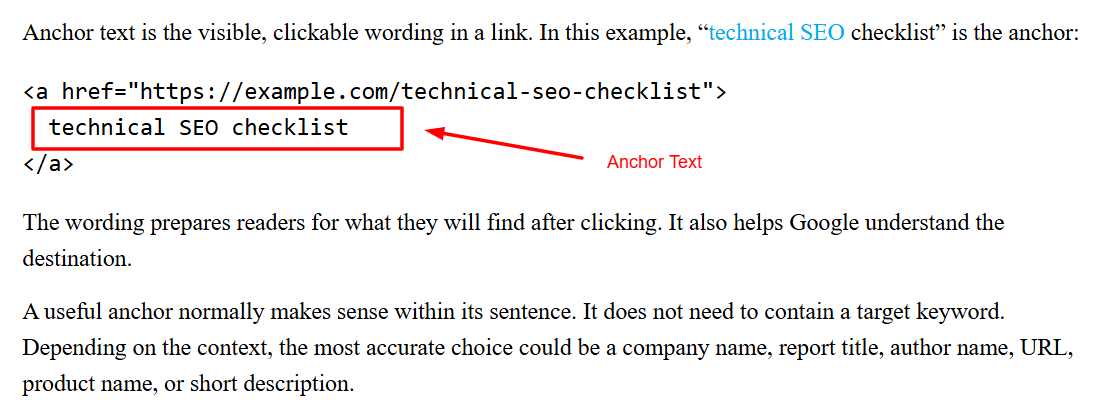
Anchor text is the visible, clickable wording in a link. In this example, “technical SEO checklist” is the anchor:
<a href="https://example.com/technical-seo-checklist">
  technical SEO checklist
</a>
The wording prepares readers for what they will find after clicking. It also helps Google understand the destination.
A useful anchor normally makes sense within its sentence. It does not need to contain a target keyword. Depending on the context, the most accurate choice could be a company name, report title, author name, URL, product name, or short description.
The surrounding copy matters too. Consider these two examples:
- Northstar Analytics published a new customer retention report.
- A new report from Northstar Analytics examines customer retention trends.
The first uses a topical anchor; the second uses the brand. Both can clearly describe the destination because the full sentences provide context.
When an image is used as a link, Google can use the image’s alt attribute as anchor text. Alt text should describe the image or its function. Filling it with search phrases weakens accessibility and turns a useful field into another keyword container.
What Does Anchor Text Ratio Measure?
An anchor text ratio expresses the share of a backlink profile assigned to each anchor category.
If five out of 100 backlinks use the exact target keyword, the exact-match ratio is 5% when calculated by backlink count:
Exact-match ratio = exact-match backlinks ÷ total backlinks reviewed × 100
The calculation is simple. The result is easy to misuse.
A homepage may naturally receive company names and URLs. A research report may collect its title, author names, abbreviated citations, and descriptions of its findings. A local business might earn links using its business name, domain, address, service, or location.
Those pages should not be pushed toward the same distribution.
This is also why published “ideal ratio” charts are not reliable planning tools. A chart recommending fixed percentages for branded, partial-match, and exact-match anchors ignores the page type, market, brand recognition, and sources behind the links.
The Anchor Categories Worth Separating
Backlink platforms do not classify every anchor correctly. A short manual review can prevent a report from turning harmless citations into apparent warning signs.
Branded anchors
These use a company, website, publication, or product name:
- Northstar Analytics
- Northstar
- Northstar Retention Platform
Misspellings and abbreviations may belong here if they clearly identify the same organization. Brand-plus-keyword anchors need more care. “Northstar Analytics software,” for example, contains a brand but also describes a commercial topic. Depending on the audit, it may deserve its own category.
Naked URLs
A naked anchor displays the address:
- northstaranalytics.com
- https://northstaranalytics.com/research/retention-report
These often appear in reference lists, profiles, directories, citations, and copied resource pages.
Before analyzing them, combine obvious technical variations such as HTTP and HTTPS, www and non-www, or URLs with and without a trailing slash. Those variations do not represent meaningful anchor diversity.
Exact-match anchors
An exact-match anchor reproduces the keyword being targeted:
- anchor text ratio
- project management software
- immigration lawyer in London
An exact match is not automatically manipulative. It may simply be the clearest description of a page.
The more revealing question is how often the wording repeats and where it appears. One exact-match citation in a relevant article is very different from the same phrase appearing in paid posts, forum signatures, unrelated directories, or articles built around nearly identical copy.
Partial-match and topical anchors
Partial-match anchors contain a target phrase or close variation:
- reviewing your anchor text ratio
- safer backlink anchor practices
- project management tools for agencies
Topical anchors describe the subject without closely repeating the keyword:
- how linking sites describe a page
- research into employee retention
- software for coordinating remote projects
Do not place every vaguely related phrase into one large “partial match” group. That can hide a concentration of commercial keyword variations.
Page-title anchors
Articles, research reports, and tools are often linked using their official titles. If the title includes the target keyword, automated software may classify the link as exact-match.
That label misses the editorial context. A publisher citing a report by name is not necessarily optimizing the anchor. For research-heavy sites, separating title citations from commercial exact matches produces a more useful analysis.
Generic, empty, and miscellaneous anchors
Generic wording includes phrases such as “read the report,” “learn more,” “source,” and “visit the website.” These anchors provide limited information alone, although the surrounding sentence may explain the link perfectly well.
Empty anchors can come from linked images, icons, or implementation errors. In Google Search Console, image links without text may appear as empty. Inspect the source page before classifying them.
What Anchor Text Ratio Looks Natural?
A natural profile reflects how different people independently describe the brand, page, or resource. That usually produces variation, but variation alone is not evidence of quality.
A believable profile often contains brand names, URLs, titles, and descriptive phrases chosen for different editorial reasons. The mix changes between the homepage and deeper pages. Commercial wording does not repeat across a collection of obviously coordinated placements.
The origin of the links matters more than the neatness of the chart.
A profile with only 2% exact-match anchors can still be poor if most links came from automated directories or paid articles on unrelated sites. A page with a higher exact-match share may be unremarkable if its official title is also the phrase publishers naturally use when citing it.
The practical rule is straightforward: investigate combinations of repetition, commercial intent, and questionable placement. Do not treat one percentage as a verdict.
Count Links and Referring Domains Separately
One website can generate hundreds of backlinks through a footer, sidebar, widget, or syndicated template. Counting every occurrence may make one anchor look dominant even though a single domain produced the entire pattern.
Review the profile in two ways:
- Backlink-level analysis reveals repetition, sitewide links, templates, widgets, and syndicated pages.
- Referring-domain analysis shows how widely an anchor pattern is distributed across separate websites.
For strategic decisions, referring domains usually provide the clearer starting point. Backlink totals remain valuable when an unusual number needs explaining.
There is a reporting complication. One domain may use several anchor types. If it is counted in every relevant category, the percentages can overlap and add up to more than 100%.
A report that must total 100% can assign each domain to its dominant anchor type, but that removes detail. Whichever method is used, record it. Changing the method between audits can create an apparent trend that does not exist.
How to Audit an Anchor Text Profile
Start with Google Search Console and, if available, a third-party backlink index.
Search Console can show top linking sites, top linked pages, and common linking text. Its Links report is not a complete backlink database. Google describes the data as a sample, some tables may be truncated, and the report does not show whether a backlink uses nofollow.
Third-party platforms maintain their own indexes, so their totals will differ from Google’s and from one another. Do not waste time trying to make the numbers match exactly. Use the same data source and classification method when comparing changes over time.
Separate the homepage from important pages
A sitewide chart can hide aggressive optimization on one URL. Review the domain first, then examine the homepage, major service or product pages, location pages, promoted resources, research, and high-performing articles separately.
The homepage will often lean toward branded and URL anchors. A statistics page or named report may receive more title and topical anchors. Combining them can blur both patterns.
Clean the data before judging it
Normalize capitalization and obvious URL variations. Merge clear brand spellings carefully. Keep product names, report titles, and commercial keyword phrases separate when they serve different purposes.
Watch for redirects as well. Links to an old URL may now resolve to a different page, making the destination’s current anchor profile look stranger than the original placement intended.
Investigate unusual groups, not isolated links
Open a representative sample of pages behind a dominant or rapidly growing anchor category. Look at the entire placement.
Warning signs include:
- Identical anchors and surrounding sentences across multiple domains
- Links placed in articles unrelated to the destination
- Thin pages that appear to exist mainly to hold outbound links
- Optimized anchors in comments or forum signatures
- Keyword-heavy links distributed through widgets or badges
- Sitewide footer links using commercial phrases
- Undisclosed paid or sponsored placements
- Groups of sites with nearly identical layouts and publishing patterns
One ugly backlink is rarely worth an emergency. Repeated behavior deserves more attention.
Check what changed
A sudden jump in one anchor category is not proof of manipulation. It may come from a publicity campaign, a report being cited by title, content syndication, scraper activity, a sitewide placement, redirected URLs, or a backlink platform discovering older pages.
Document the likely cause before asking publishers to change links or remove them.
Exact-Match Quotas Create the Wrong Incentive
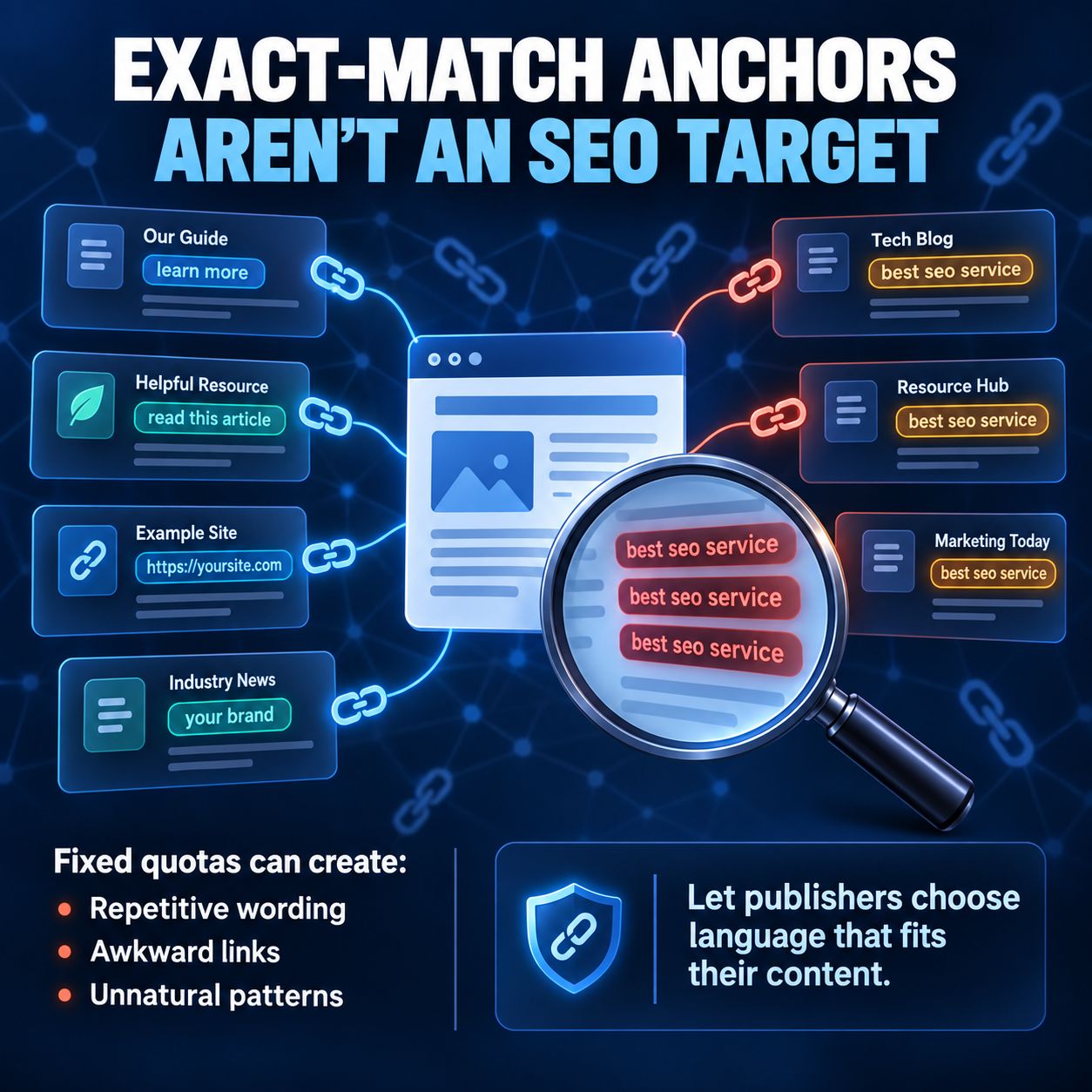
A link-building target such as “secure five exact-match anchors this month” turns anchor text into something the campaign must control. That pressure often produces awkward wording and repetitive placements.
Google includes optimized anchor text in paid advertorials, guest posts, and distributed press releases among its link-spam examples when the links pass ranking credit. Its policies also cover links bought for ranking purposes, excessive exchanges, automated link creation, low-quality directories, distributed keyword-rich widgets, and optimized forum links.
Paid advertising and sponsorship are allowed, but the relationship should be qualified. Google prefers rel="sponsored" for advertisements and paid placements, although nofollow remains acceptable. Links added by users in comments or forums can use rel="ugc".
For legitimate editorial outreach, provide the correct destination and explain why the resource supports the article. Let the publisher choose the wording. Trying to engineer a “natural” anchor mix is still engineering the profile.
When to Take Action
An unusual ratio is a reason to inspect the links, not proof of a penalty.
Start with the links you control or previously arranged. Correct misleading anchors, remove manipulative templates, and qualify commercial placements properly. If Search Console reports a manual action for unnatural links, follow the instructions in the Manual Actions report and document the cleanup.
Do not upload a disavow file simply because an SEO platform labels several domains “toxic.” Google says most sites do not need the tool and warns that using it incorrectly can harm search performance.
Its guidance limits disavowal to cases where a considerable number of spammy, artificial, or low-quality links have caused a manual action or are likely to cause one. When the links came from campaigns run by the site owner or an SEO working for them, make a good-faith effort to remove or qualify them first.
The disavow tool also works with URL-prefix properties rather than Search Console Domain properties, a detail that can confuse people who try to use it during a rushed cleanup.
Final Thoughts
Do not begin an audit by asking what percentage of exact-match anchors is safe. Begin by identifying which page has an unusual pattern, who created the links, why the same wording keeps appearing, and whether those placements make editorial sense.
Use the anchor text ratio to narrow the investigation. Compare backlinks with referring domains, separate branded citations from commercial phrases, and inspect the source pages behind any suspicious group.
The ratio is not a link-building target and should not become one. A defensible profile grows from different publishers having genuine reasons to cite a brand, tool, report, or article—and choosing language that fits their own content.
Frequently Asked Questions
1. What Is Anchor Text in SEO?
Anchor text is the clickable text used in a hyperlink that points to another webpage. It helps users and search engines understand the topic or context of the linked page.
2. Why Is Anchor Text Important for SEO?
Anchor text provides context about a linked page and can help search engines understand its relevance. A well-structured anchor text profile can support a website’s overall SEO and internal linking strategy.
3. What Is a Natural Anchor Text Ratio?
A natural anchor text ratio refers to a varied and balanced mix of branded, URL-based, generic, partial-match, and exact-match anchor texts. There is no single ideal percentage that applies to every website.
4. What Are the Different Types of Anchor Text?
Common types include branded anchors, exact-match anchors, partial-match anchors, generic anchors, naked URLs, and image anchors. Using different types naturally can create a more diverse link profile.
5. How Can You Create a Natural Anchor Text Profile?
Use descriptive and relevant anchor text without repeatedly targeting the same keyword. Prioritize natural wording, brand mentions, relevant phrases, and URLs while avoiding excessive exact-match keyword anchors.