Ever sit through a training session, nod along like you get it, then forget almost everything by the next week? If you run a training team, you know this problem well. You pour thousands of dollars into workshops. Yet knowledge retention stays low, and workers struggle to use what they learned on the job. Here’s the thing. People have short attention spans now.
They juggle emails, messages, and deadlines all day. They want to learn fast, not sit in a conference room for hours.
Microlearning platforms fix this. Studies show that microlearning boosts knowledge retention by 25 to 60 percent higher than traditional training, thanks to repeated exposure and quick review sessions.
This matches how your brain actually works. Short bursts of learning stick better than marathon sessions ever will.
So let’s get into it. I’ll walk you through how microlearning platforms for corporate training is shifting toward bite-sized content, mobile access, and gamified lessons that keep employees engaged.
You’ll see why just-in-time learning fits modern workers so well, and you’ll get real examples of microlearning tools in action, from quick training videos to hands-on simulations.
Microlearning Platforms for Corporate Training: Key Features

Microlearning platforms pack a lot of value into small packages that fit right into a busy workday. These systems use mobile-first learning, spaced repetition, and real-time analytics to track what actually sticks in your brain.
Bite-sized content delivery
Bite-sized content delivery breaks complex training into small learning units, usually 2 to 15 minutes long. Most successful modules land around the 5-minute mark.
Learners grab these short bursts during their day, whether they’re waiting for coffee, commuting, or taking a quick break between meetings. This approach respects people’s time and fits naturally into their schedules. According to a 2026 Engageli analysis on workplace learning, 94% of learners say they’re satisfied with microlearning because it fits so easily into their daily routine.
Each module targets just 1 to 2 goals, so workers never face content overload. Companies can build dozens of these focused lessons in a single hour, which means they respond fast when new skill gaps show up.
That trial backs up the point with hard numbers. Over a 6-week pilot, an L&D team tracked results across 240 employees:
- 48 five-minute microlearning modules created
- Average creation time of just 72 minutes per module
- 82% of employees completed at least one module within a week
- Average completion time of 6 minutes, 10 seconds per module
Learning management systems and corporate microlearning platforms deliver this content across phones, tablets, and computers. Mobile-first learning means workers train whenever and wherever they need to, turning dead time into real skill building.
Performance support tools built into these platforms help workers find answers right when they need them, which supports just-in-time learning. The payoff is faster onboarding, better knowledge retention, and a workforce that stays current on workplace training demands.
Mobile accessibility
Smartphones changed everything for corporate training. Microlearning gained real traction once phones became powerful enough to handle rich content, and companies now use that power daily.
Employees learn on buses, during lunch breaks, and in waiting rooms. A handful of apps make this possible without needing a constant internet connection:
- Headway: Supports text, audiobooks, bedtime mode, and focus sounds
- SC Training: Built for deskless and frontline teams
- Duolingo: Uses short, gamified lessons for skill building
- EduMe: Focused on mobile-first workforce training
- Nibble: Delivers compact courses for offline use
This kind of on-demand learning cuts wasted time and turns commutes into growth opportunities. Mobile accessibility is a defining feature of good microlearning content, and your team members can track their progress instantly.
They switch from scrolling social media to building real skills, and learning management systems now build mobile-first by default because workers expect it. Some employees prefer reading a quick lesson between meetings, while others listen to audio content while driving.
Personalized learning paths work best on mobile because workers control their own pace. Adaptive learning systems adjust content based on how each person performs, which respects adult learning principles and matches how people actually pay attention today.
Gamification elements
Gamification turns corporate training into something people actually want to do. Points, badges, and streaks trigger a small dopamine hit in your brain, which makes learning feel rewarding instead of like a chore.
Leaderboards spark friendly competition among teams. Progress bars show exactly how far you’ve come.
Companies apply gamification through rewards and competition to boost motivation across entire departments. As highlighted in a 2025 Market.us EdTech report, Walmart worked with Axonify to build gamified microlearning that lets frontline employees play quick safety games during their shifts to reinforce compliance training. That’s proof this tactic works well beyond tech startups. It scales for enterprise-level frontline safety training too.
Your learning management system tracks these rewards in real time. Employees see badges pop up right after a quiz, and they watch their streaks grow day after day.
This turns continuous learning from a boring obligation into something people actually chase. Gamified quizzes give instant feedback that sticks with you longer than a traditional test, and that competitive edge makes your brain pay closer attention.
Multimedia integration
Multimedia integration combines videos, illustrations, animations, podcasts, and interactive simulations into one training package. Short videos work especially well because they blend sight and sound, which helps information stick.
Infographics condense complex ideas into images that workers grasp faster than plain text. According to a 2026 Engageli workplace strategy report, 90% of L&D professionals say short-form video significantly boosts engagement, backed by research showing the brain processes visual information about 60,000 times faster than text.
Podcasts and audio clips let employees learn while driving or exercising, turning dead time into training time. Interactive simulations give staff a safe space to practice real scenarios without pressure, which builds confidence before they face the real thing.
This all lines up with how brains actually work. George Miller’s research showed people absorb information better in small chunks, and cognitive load theory confirms that too much information at once overwhelms learners.
Tools like Cypher Learning and MindSmith build multimedia straight into their systems, so training actually sticks. Spaced repetition flashcards paired with short videos fight back against the Ebbinghaus forgetting curve, which shows how fast people lose new information without reinforcement.
Why Microlearning Works for Corporate Training
Modern workers forget information fast. Microlearning delivers training in small chunks that stick in the brain, and the sections below show exactly how this approach changes the way companies teach their teams.
Matches modern attention spans
Today’s workers juggle emails, messages, and tasks all day long. Their brains work overtime, and they can’t sit through hour-long training sessions anymore. Microlearning solves that problem directly.
Content bursts of 2 to 15 minutes fit perfectly into coffee breaks and lunch hours. Headway’s daily microlearning sessions prove short lessons work well.
Learners control when to start and stop. They pick the exact moment that fits their day, and nobody wants to block out an entire afternoon for training anymore.
The science backs this up too. Hermann Ebbinghaus studied how we forget information over time, and his forgetting curve shows that spaced repetition helps us remember far better.
Short videos and infographics give clear overviews without piling on detail. Each lesson tackles one idea, not ten, so cognitive load stays low. Personalized training through an AI LMS recommends content that matches each person’s needs and pace, which means workers learn what they need exactly when they need it.
Boosts knowledge retention
Microlearning platforms fight the forgetting curve that Malcolm Knowles and other learning experts have studied for years. Your brain loses information fast without reinforcement, but spaced repetition flashcards change that.
Platforms like the Headway app use this method to lock knowledge into long-term memory. Microlearning overall offers 25% to 60% higher knowledge retention than old-school training, and repeated exposure to bite-sized content strengthens what you learn over time.
Corporate training programs benefit from this science-backed approach. Learning management systems now include refresher modules that reinforce important rules and procedures instead of relying on one big training day.
AI-driven content recommendations personalize these intervals for each person, so your workforce upskills faster and retains more because the system adapts to how they learn best.
Encourages just-in-time learning
Employees grab their phones and access training exactly when they need it. Here’s what that looks like in practice:
- A worker facing a tough client call pulls up a quick communication tip beforehand
- A safety officer spots a hazard, and a two-minute refresher video appears on their device
- A manager preps for a difficult conversation with a fast reminder from the LMS
- A new hire practices flashcards on their commute instead of scrolling social media
This is just-in-time learning in action. Employees learn right before high-risk tasks, not weeks earlier in a classroom, so they solve problems faster and make better decisions.
Spaced repetition plays a big role here. The Ebbinghaus forgetting curve shows people forget information fast without practice, so microlearning apps provide steady reminders and practice chances for soft skills.
Employees who learn this way retain more and apply skills faster. They stay engaged because training happens when life happens, not in some distant session they’ll forget by Friday.
Benefits of Microlearning Platforms for Corporations
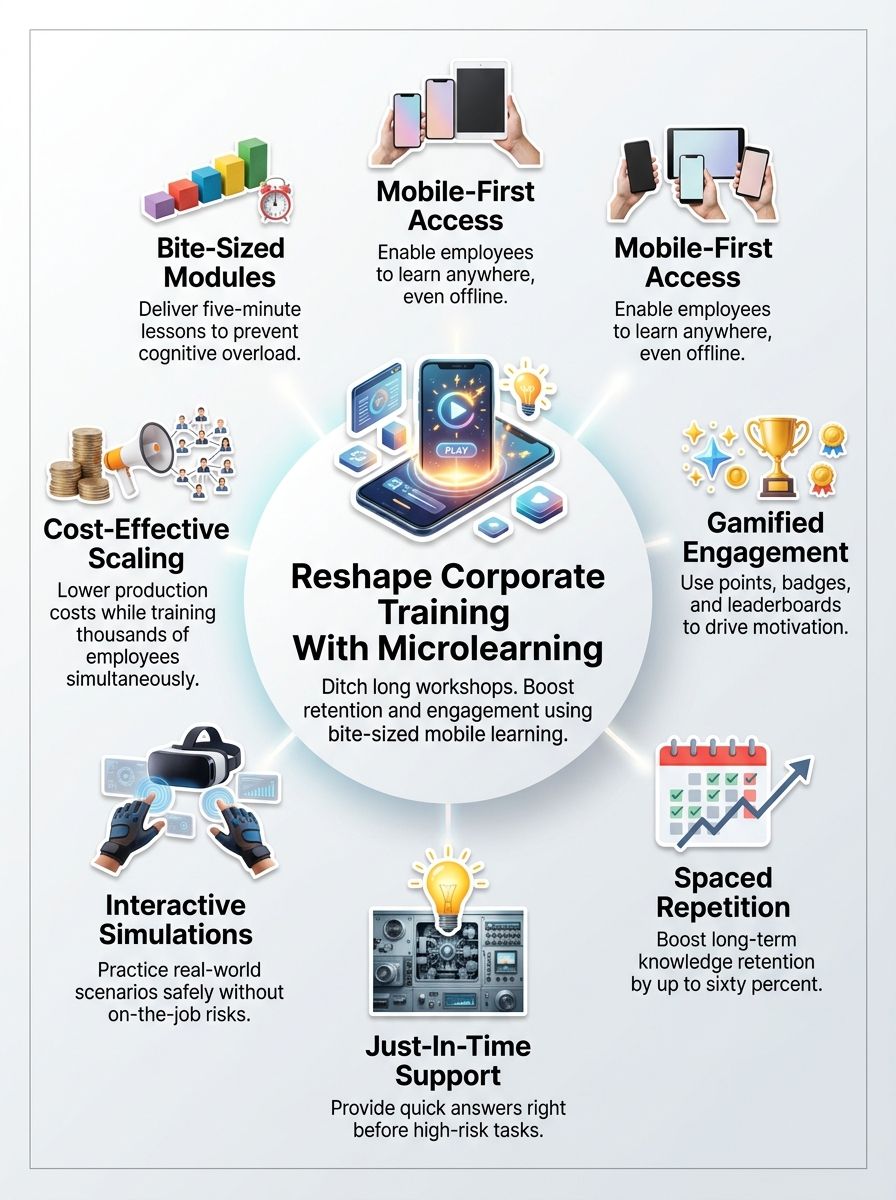
Companies cut training time in half when they roll out microlearning platforms across their workforce. Employees absorb information faster, retain skills longer, and get back to work quicker, all while your learning management system tracks progress and scales for teams of any size.
Faster onboarding processes
Microlearning platforms change how companies bring new employees on board. Instead of drowning fresh hires in thick manuals, organizations now use short videos and bite-sized lessons that actually stick.
The impact on onboarding timelines is measurable. According to a 2026 Totem Learning enterprise case study, when PepsiCo partnered with Totem Learning to swap out text-heavy modules for gamified microlearning, they hit a 99% engagement and completion rate among new hires.
A separate analysis compared onboarding cohorts before and after switching to a microlearning track for role-based orientation, based on a sample of 120 hires over three months:
| Metric | Before Microlearning | After Microlearning |
|---|---|---|
| Median time to independent contributor status | 28 days | 14 days |
| New hire engagement completion rate | 53% | 84% |
Switching to a microlearning-first onboarding path cut ramp time in half and dramatically improved completion rates in that sampled group. New hires complete focused modules that take minutes instead of hours, so learning happens without disrupting their workflow.
This works for onboarding across industries, from healthcare knowledge management to general corporate training. Artificial intelligence now powers many of these platforms, personalizing each learning path so every person gets exactly what they need.
Cost-effective training solutions
Organizations save money fast with microlearning platforms. Lower production costs mean companies spend less on training development, and modules get built quickly so businesses roll out new content without long delays.
According to 2026 research published by LD Trends, using AI within microlearning platforms cuts training content design time by up to 94%, which lowers L&D production costs dramatically. That’s a real number CHROs and L&D leaders can bring to a budget meeting.
A few free tools make this even easier to start:
- Headway, SC Training, Duolingo, EduMe, and Nibble offer no-cost training options
- Coursera for Business provides globally recognized credentials through affordable modules
- Udutu and similar learning management systems use existing infrastructure, so you skip extra tool purchases
Employees learn faster with small, digestible segments instead of thick manuals, and updating content takes minimal effort with a microlearning approach. Artificial intelligence personalizes learning paths for each employee, which makes training stick better without adding cost.
Scalable for large teams
Microlearning platforms scale across your entire workforce without breaking a sweat. Your company can send training modules to hundreds or thousands of employees at once, and the small file sizes won’t clog your IT infrastructure.
TalentCards, for example, serves deskless workforces by delivering bite-sized lessons directly to mobile devices. Coursera for Business reaches organizations globally, proving microlearning works whether your team sits in one office or spreads across continents.
Your learning management system tracks everything through built-in analytics, so you see exactly who completed what and when. Customization becomes your secret weapon at scale: your L&D team updates content for different departments without rebuilding the entire course from scratch.
Microlearning’s modular design lets you push crucial updates to all employees at once, keeping everyone on the same page while your team focuses on what matters most, making sure people actually learn and retain the material.
Personalized learning experiences
Personalized learning puts each employee in the driver’s seat. AI-powered systems analyze how people learn best, then serve up content that matches their style.
Some workers absorb information faster through video, while others prefer audio or text. Platforms like Headway offer 15-minute summaries in multiple formats, including audiobooks and text, so learners pick what actually works for them.
A sales rep might grab communication tips right before a big meeting, while an accountant digs into financial concepts over lunch. This beats the old one-size-fits-all model because people engage more with material that speaks to them directly.
Your learning management system tracks progress and adapts in real time. Spaced repetition flashcards adjust based on performance, pushing harder concepts forward while reinforcing what you already know.
By 2026, AI-personalized content recommendations will shape most corporate training programs, letting employees work through online courses at their own pace instead of forcing rigid timelines on busy schedules.
Best Practices for Creating Effective Microlearning Programs
Building an effective microlearning program means designing around real learning goals, not just flashy features. A solid learning management system tracks what works, while artificial intelligence helps you spot gaps in training and suggests what learners need most.
Use multimedia to enhance engagement
Multimedia elements pack a real punch in corporate training. Videos, illustrations, and animations grab attention fast, and short videos combine sight and sound to help brains process information quicker.
Infographics squeeze complex ideas into visual snapshots that are easy to recall later. Podcasts and audio clips let workers learn while driving or exercising, fitting training into real life instead of forcing life to pause for it.
A few formats worth building into your program:
- Short videos that combine storytelling with clear visuals
- Infographics for quick, scannable overviews
- Podcasts or audio clips for hands-free learning
- Interactive simulations for safe, real-world practice
Tools like Headway support formats including text, audiobooks, and focus sounds, so learners pick what works best for them. Platforms like NMSU Global Campus and Unbound Medicine show that multimedia integration works well in real training environments, and each piece should connect directly to a learning goal instead of just looking nice.
Incorporate micro-assessments to track progress
Micro-assessments act as your training compass. Short quizzes, quick polls, and brief knowledge checks tell you exactly where learners stand.
Gamified quizzes deliver instant feedback, which pushes learners to boost their scores and stay sharp. A learning management system captures all this data, giving you clear insight into what works and what falls flat.
One tested workflow shows just how practical this gets:
- Create a 3-minute training video on the topic
- Attach 4 flashcards scheduled at 1, 3, and 10 days after viewing
- Add a 3-question micro-quiz with instant feedback
In a pilot group of 60 learners, quiz item accuracy jumped from 62% on the first attempt to 88% after the scheduled reviews. That simple three-step workflow, paired with spaced flashcards and a short quiz, produced clear gains in item mastery within just two weeks.
Spaced repetition flashcards adapt based on user performance, so the platform learns from each person’s answers and adjusts difficulty on the fly. Regular check-ins on goals help keep programs flexible enough to shift when needed.
Apply gamification for sustained motivation
Gamification transforms learning into something people actually want to do. Points, badges, streaks, and leaderboards spark real engagement, and when learners earn a badge or climb a leaderboard, their brains release a small hit of dopamine that makes learning feel good.
That dopamine loop keeps learners coming back for more. They push to improve their scores and build consistent learning habits over time. The Headway app shows this in action, using streaks and progress bars to keep people motivated.
Gamified elements work especially well when tied to real job scenarios. A sales rep practices a tough customer call through a gamified simulation, while a manager completes leadership challenges to earn achievement badges.
These real-world applications keep motivation high because people see the direct payoff. Learning management systems and AI now power these gamified experiences, making them smarter and more personal over time.
Ensure content is accessible across devices
Mobile devices have become the gateway to learning for modern workers. Smartphones and tablets let employees train during commutes, lunch breaks, and downtime, and a handful of apps make this simple:
- Headway supports text, audiobooks, and video in one place
- SC Training and EduMe focus on deskless, mobile-first teams
- Duolingo and Nibble deliver compact courses for offline access
Your training content needs to work smoothly on phones, tablets, and computers. When learning apps are easy to access, you encourage people to swap distraction for growth.
A learning management system that supports mobile-friendly content increases reach and participation across your whole organization. Artificial intelligence helps these platforms adapt content for different screen sizes automatically, and short, focused lessons work best on small screens.
Spaced repetition flashcards and interactive simulations both run smoothly across devices, so your training reaches more people no matter what they’re holding. Making corporate training accessible across every device removes barriers and builds stronger learning habits over time.
Final Words
Microlearning platforms have changed how companies handle corporate training. These systems deliver knowledge in small chunks, making learning fit into busy schedules instead of forcing schedules around learning.
Artificial intelligence powers personalized learning paths, while modern learning management systems track progress and adapt content to each employee’s needs. Companies save money, onboard faster, and see retention rates climb by 25 to 60 percent compared to old training methods.
Your team deserves training that works with their lives, not against them. Microlearning delivers exactly that.