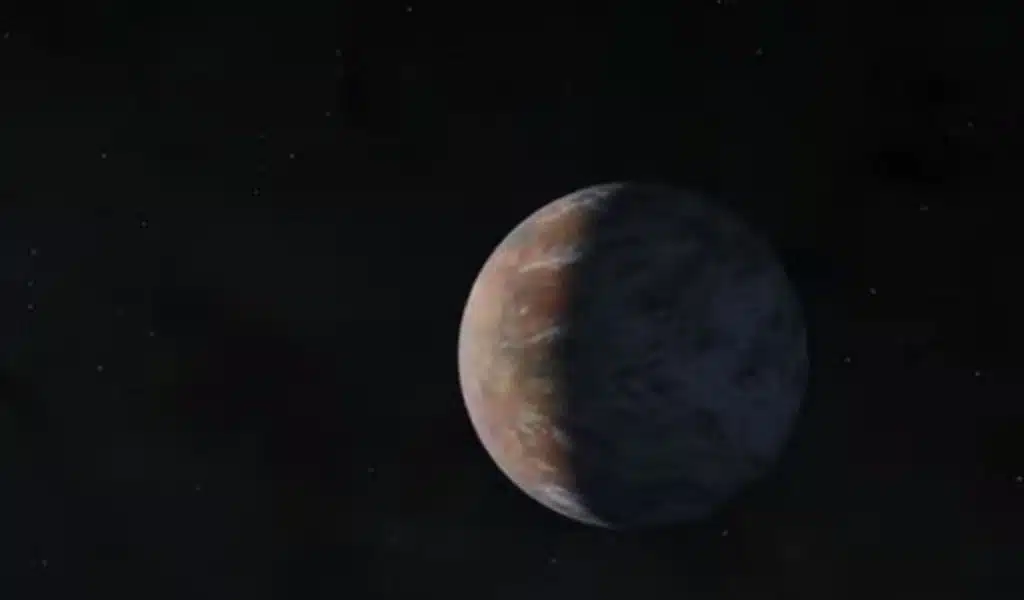
The Transiting Exoplanet Survey Satellite (TESS), a NASA telescope used to look for planets, has found a second Earth-sized planet in the habitable zone of a nearby star.
The planet, which has the name TOI 700 e, is one of four known planets that circle a cool star about 100 light-years away. One planet, called TOI 700 d, was already known to be in the system’s habitable zone.
Read Also: NASA Finds over 5,000 Planets
New research that will be published in the Astrophysical Journal Letters shows that it is joined by another planet inside its orbit. TOI 700 b and TOI 700 c, the other two planets in the system, orbiting closer to the star than TOI 700 a. Because of this, they are likely to have higher temperatures, putting them outside the habitable zone.
One of the researchers, Emily Gilbert of NASA’s Jet Propulsion Laboratory, joked at an American Astronomical Society meeting on Tuesday, January 10th, that the new planet “is nestled in there between planets C and D, so I’m very sorry they’re not in alphabetical order.” Planets are given letters based on when they were found, not where they are in a system. This can lead to situations like this one, where planets closer to the sun are found later than planets farther away.
The planet TOI 700 e, which was just found, is located in an area of the habitable zone known as the optimistic habitable zone, whereas the planet TOI 700 d, which was found earlier, is located in an area of the habitable zone known as the conservative habitable zone. In astronomy, the term “habitable zone” refers to the region of space surrounding a star that has temperatures moderate enough for liquid water to be able to pool on the surface of a planet that orbits that star. Nevertheless, putting this notion into practice is trickier than it might initially appear, which is why the researchers are employing the phrases “optimistic” and “conservative.”
The term “optimistic habitable zone” refers to an area on a planet where there is a possibility that there was liquid water present at some point in the planet’s history. On the other hand, the term “conservative habitable zone” refers to a more limited region within that in which planets would continue to be habitable. The surface temperature of a planet — and, consequently, whether water could exist in the form of a liquid — is what differentiates the two, and this temperature can fluctuate considerably depending on elements such as the thickness and makeup of a planet’s atmosphere throughout the course of time.
Gilbert explained that the traditional habitable zone was expanded “to account for the fact that we believe Mars and Venus once had liquid water on their surfaces.” He was referring to the evidence that there was water on both planets billions of years ago. This evidence suggests that there was water on both planets billions of years ago. By focusing on planets that fall within this hopeful zone, astronomers have access to a greater pool of hypothetically habitable worlds with which to compare and contrast the evolution of our own solar system.
Read Also: Two Earth-Like Planets
The four planets that make up the TOI 700 system can also be evaluated by astronomers in relation to one another. “We are aware that these planets formed under identical initial conditions; more specifically, they formed around the same star and from the same disk.” According to Gilbert, “this gives us the potential to explore how different characteristics of planets may affect the habitability of planets,” including characteristics such as the size of the planet or the boundaries of the habitable zone.
This solar system is one of the very few that we are aware of that contains multiple planets of Earth’s size within its habitable zone. It joins illustrious systems such as the TRAPPIST system in this regard. The announcement of the discovery came the day before the announcement of LHS 475 b, which was the first exoplanet identified by the James Webb Space Telescope, also known as JWST. LHS 475 b is another Earth-size rocky planet. However, because it is so much closer to its star, this planet is outside of the zone where life can exist. The TESS and JWST missions collaborated in order to discover this newly discovered exoplanet. TESS was the first to spot a possible sign of an exoplanet, while JWST was the mission that ultimately verified its existence.
The research team that made this TESS discovery has stated that they intend to continue with follow-up studies of the TOI 700 system in order to learn more about the exoplanets that are contained within it. In the future, we can anticipate additional exoplanet discoveries coming from both telescopes.