Most Fourth of July facts and myths have been repeated so long that even Americans can’t tell which is which, and the biggest one is hiding in plain sight: the United States didn’t actually declare independence on July 4. It happened two days earlier. John Adams was so sure of it that he wrote to his wife Abigail predicting that July 2 would be “celebrated by succeeding generations” with parades, bonfires, and illuminations. He got the party right. He got the date wrong.
That’s the strange thing about America’s biggest holiday. The celebration is real; the history underneath it is half legend. And in 2026, with the country marking its 250th birthday, the Semiquincentennial, those legends are getting repeated louder than ever. So this is a good year to sort out what actually happened in the summer of 1776 and what got invented afterward.
Let’s go through the big ones, one claim at a time.
Myth 1: America Declared Independence on July 4, 1776
This is the founding confusion behind most Fourth of July facts and myths, so it’s worth getting the timeline exactly right.
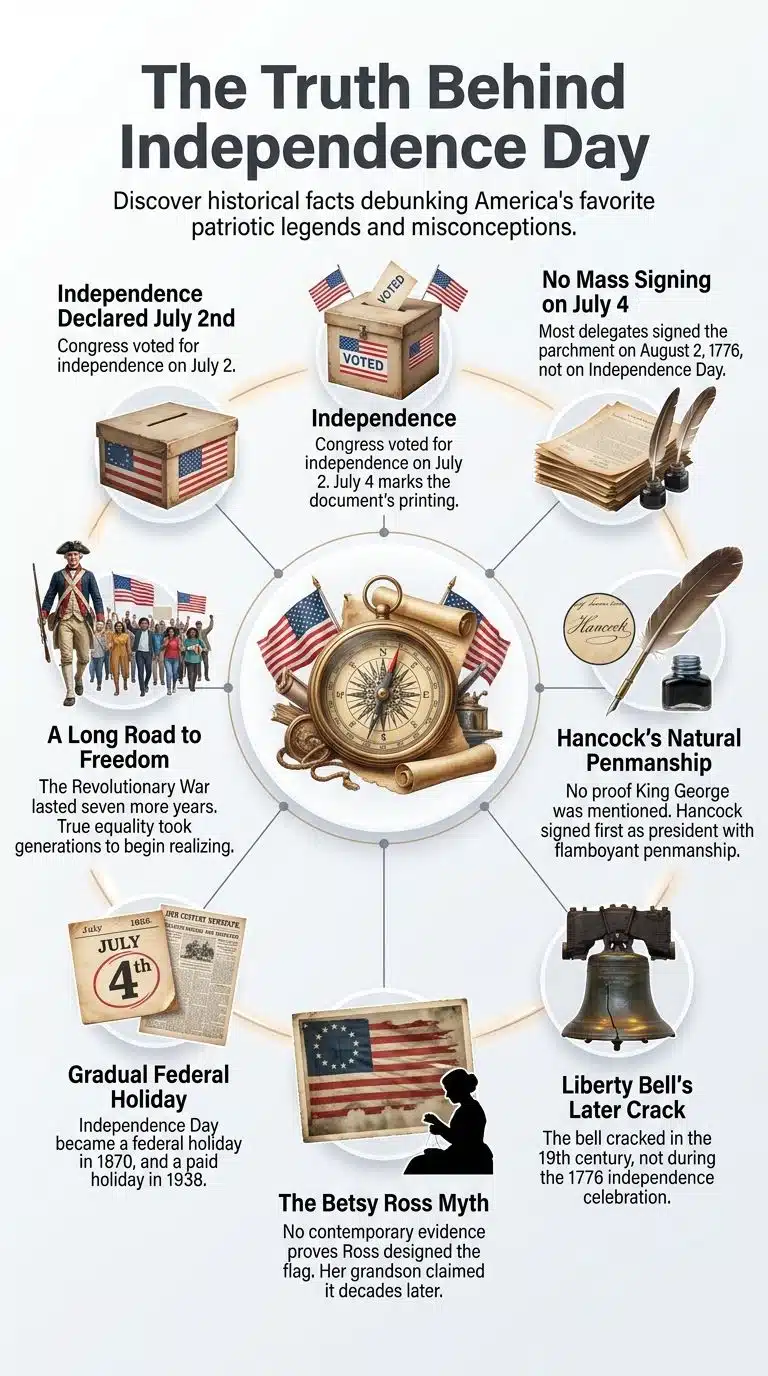
On July 2, 1776, the Second Continental Congress in Philadelphia voted to approve Richard Henry Lee’s resolution declaring the thirteen colonies “free and independent states.” That was the legal act of independence. It was done. Twelve colonies voted in favor (New York abstained, catching up later), and the break with Britain was official.
So what happened on July 4? Congress adopted the text of the Declaration of Independence, the formal document, largely drafted by Thomas Jefferson, explaining and justifying the decision made two days earlier. July 4 is the date printed at the top of the document, which is why it stuck. The announcement outlived the act.
Adams never fully got over it. He reportedly turned down invitations to July 4 events on the grounds that the wrong day was being celebrated. He lost that argument to a printing date.
Myth 2: The Declaration Was Signed on July 4
Every classroom painting suggests it: 56 men gathered in one room, quills out, signing on Independence Day. It didn’t happen that way.
Most delegates signed the engrossed parchment copy on August 2, 1776, nearly a month later. Several signed even after that, and some men who voted for independence never signed at all, while a few signers hadn’t been present for the vote. The famous John Trumbull painting in the Capitol Rotunda (the one on the back of the old $2 bill) actually depicts the drafting committee presenting the document, not a mass signing, and Trumbull himself compressed people into the scene who were never in the room together.
The one signature that probably did land on July 4 belongs to John Hancock, who, as president of Congress, signed the initial printed version along with secretary Charles Thomson. Which brings us to the next legend.
Myth 3: John Hancock Signed Big So King George Could Read It Without Glasses
Great line. No evidence for it. The quote, usually rendered as something about King George III being able to read the signature without his spectacles, doesn’t appear in any contemporary record. It surfaced decades later, well after Hancock’s death, in the era when American Revolution folklore was being manufactured at an industrial scale.
The simpler explanation: Hancock signed first, on a blank parchment, as presiding officer. He had space, he had status, and he had famously flamboyant penmanship in general. His signature is large on plenty of other documents nobody was mailing to a king.
Myth 4: The Liberty Bell Cracked While Ringing for Independence
The story goes that the Liberty Bell rang out on July 4, 1776, to announce independence and cracked from the sheer force of the occasion. Almost none of that survives scrutiny.
First, there was no public announcement on July 4 at all. The first public reading of the Declaration in Philadelphia happened on July 8, 1776, and while bells across the city likely rang that day, there’s no specific record confirming the State House bell was among them (the steeple was reportedly in poor condition at the time).
Second, the famous crack came much later. The bell cracked at some point in the first half of the 19th century, with the defining zigzag fracture traditionally dated to 1846, when it was rung for George Washington’s birthday. And the name “Liberty Bell” wasn’t a Revolution-era title either. Abolitionists popularized it in the 1830s, referencing the bell’s inscription about proclaiming liberty “throughout all the land” in the context of the anti-slavery movement.
The 1776 ringing-and-cracking story traces largely to a fictional tale published by George Lippard in 1847. It was a short story. It won.
Myth 5: Betsy Ross Designed the First American Flag
The Betsy Ross story is one of the most durable pieces of Fourth of July mythology, and it rests almost entirely on family testimony that appeared a century after the fact. Her grandson, William Canby, presented the claim in 1870, saying his grandmother told him the story when he was a child. There’s no contemporary documentation, no letter, no Congressional record, no receipt tying Ross to the design of the first Stars and Stripes.
Ross was a real Philadelphia upholsterer who did make flags; that part is documented for later work. But “made flags” and “designed the American flag at George Washington’s personal request” are very different claims. If anyone has a paper trail for contributing to the flag’s design, it’s Francis Hopkinson, a signer of the Declaration who billed Congress for his design work on the flag (Congress, in true government fashion, declined to pay him, partly on the grounds that he wasn’t the only one involved).
Myth 6: The Fourth of July Was Always a Big National Holiday
The celebration came fast; the holiday came slow. Philadelphia held what’s considered the first organized commemoration on July 4, 1777, complete with fireworks, bonfires, bells, and a thirteen-gun salute, establishing traditions that survive intact 249 years later.
But Independence Day didn’t become a federal holiday until 1870, when Congress finally made it official (unpaid) for federal workers. Paid holiday status took until 1938. For nearly a century, the country’s birthday was celebrated enthusiastically but unofficially, and often politically: in the early republic, Federalists and Democratic-Republicans held rival July 4th events in the same towns, using the holiday to argue about what the Revolution had actually meant. Some things don’t change.
Myth 7: The Declaration Freed the Colonies Then and There
Declaring independence and winning it are different projects. In July 1776, roughly 2.5 million people lived in the colonies, a British fleet was massing off New York, and the war would grind on for seven more years. Britain didn’t formally recognize American independence until the Treaty of Paris in 1783.
There’s also a harder truth inside the founding document itself. The Declaration’s most quoted line, that all men are created equal, coexisted with legal slavery, which persisted for nearly nine more decades. Jefferson’s original draft contained a passage condemning the slave trade; Congress cut it. Frederick Douglass confronted this contradiction directly in his 1852 speech “What to the Slave Is the Fourth of July?”, still one of the most read texts about the holiday. A full accounting of Fourth of July facts and myths has to include the fact that the promise of 1776 was, for millions of Americans, an IOU that took generations to begin collecting.
Fact, Not Myth: The Presidential Death Coincidence Is Real
Here’s one that sounds invented and isn’t. Thomas Jefferson and John Adams both died on July 4, 1826, the 50th anniversary of the Declaration, within hours of each other. Adams’s reported last words, “Thomas Jefferson survives,” were wrong; Jefferson had died at Monticello a few hours earlier.
It gets stranger. James Monroe, the fifth president, died on July 4, 1831. That’s three of the first five presidents dying on Independence Day. And going the other direction, Calvin Coolidge was born on July 4, 1872, the only US president born on the holiday. No conspiracy required, just one of history’s genuinely odd clusters.
Fact, Not Myth: The Fireworks Were John Adams’s Idea (Sort Of)
The tradition of “illuminations” traces straight back to that Adams letter of July 3, 1776. He called for celebrations with “bonfires and illuminations from one end of this continent to the other,” and Philadelphia obliged the very next year. Adams got the format exactly right, down to the pyrotechnics, even if the date drifted two days on him.
A modern scale would have startled him, though. The American Pyrotechnics Association has estimated Americans spend well over $2 billion a year on fireworks, with consumer sales climbing sharply since the pandemic-era boom. A growing counter-trend is worth watching too: cities from Salt Lake City to parts of California have shifted toward drone light shows, driven by wildfire risk, noise complaints, and pet welfare. The 250th anniversary year has featured both, often in the same sky.
Why the Myths Persist
There’s a pattern in how these stories took hold, and it’s not accidental. Most of the enduring legends, Betsy Ross, the Liberty Bell crack, and Hancock’s quip, entered circulation in the mid-1800s, when a young country was actively building a usable past. The generation that lived through the Revolution was gone. Writers, painters, and centennial promoters filled the gap with tidy, emotionally satisfying scenes: one seamstress, one bell, one dramatic signature.
Real history is messier. Independence was a vote on a Tuesday, a document adopted two days later, a signing spread across months, and a war that took seven years. That doesn’t fit on a postcard. The myths do.
And in a search-engine age, the myths get a second life. They’re short, quotable, and endlessly recycled by listicles that copy each other. Which is precisely why checking the primary record, Adams’s actual letters, the Congressional journals, and the National Archives’ own documentation matters more than ever.
Frequently Asked Questions (FAQs) on Fourth of July Facts and Myths
1. Was independence really declared on July 2, not July 4?
Yes. Congress voted for independence on July 2, 1776, and adopted the text of the Declaration on July 4. The document’s printed date is what the holiday commemorates.
2. Did anyone sign the Declaration on July 4, 1776?
Almost certainly only John Hancock and Secretary Charles Thomson, on the initial printed version. The mass signing of the parchment copy happened on August 2, 1776, with some signatures added even later.
3. Why is 2026 a special Fourth of July?
July 4, 2026, marks the Semiquincentennial, the 250th anniversary of the Declaration of Independence, commemorated nationwide under the America250 banner with events ranging from tall ship gatherings to exhibitions at the National Archives.
4. Is the Betsy Ross flag story true?
There’s no contemporary evidence she designed the first flag. The story comes from her grandson’s account presented in 1870, nearly a century later. Francis Hopkinson has the stronger documented claim to early flag design work.
5. Which presidents died on July 4?
Three: John Adams and Thomas Jefferson both died on July 4, 1826, the Declaration’s 50th anniversary, and James Monroe died on July 4, 1831.
The Bottom Line on Fourth of July Facts and Myths
Sorting Fourth of July facts and myths doesn’t shrink the holiday; it makes it more interesting. The real story, a legal break on July 2, a document on July 4, a signing in August, a war until 1783, and a promise of equality that took far longer, is richer than the postcard version. Adams’s bonfires are still burning 250 years on, which would have pleased him enormously, even if he’d grumble about the date until the fireworks started.
So this year, when someone at the barbecue tells you the Liberty Bell cracked announcing independence, you’ve got a better story to tell. The true one usually is.