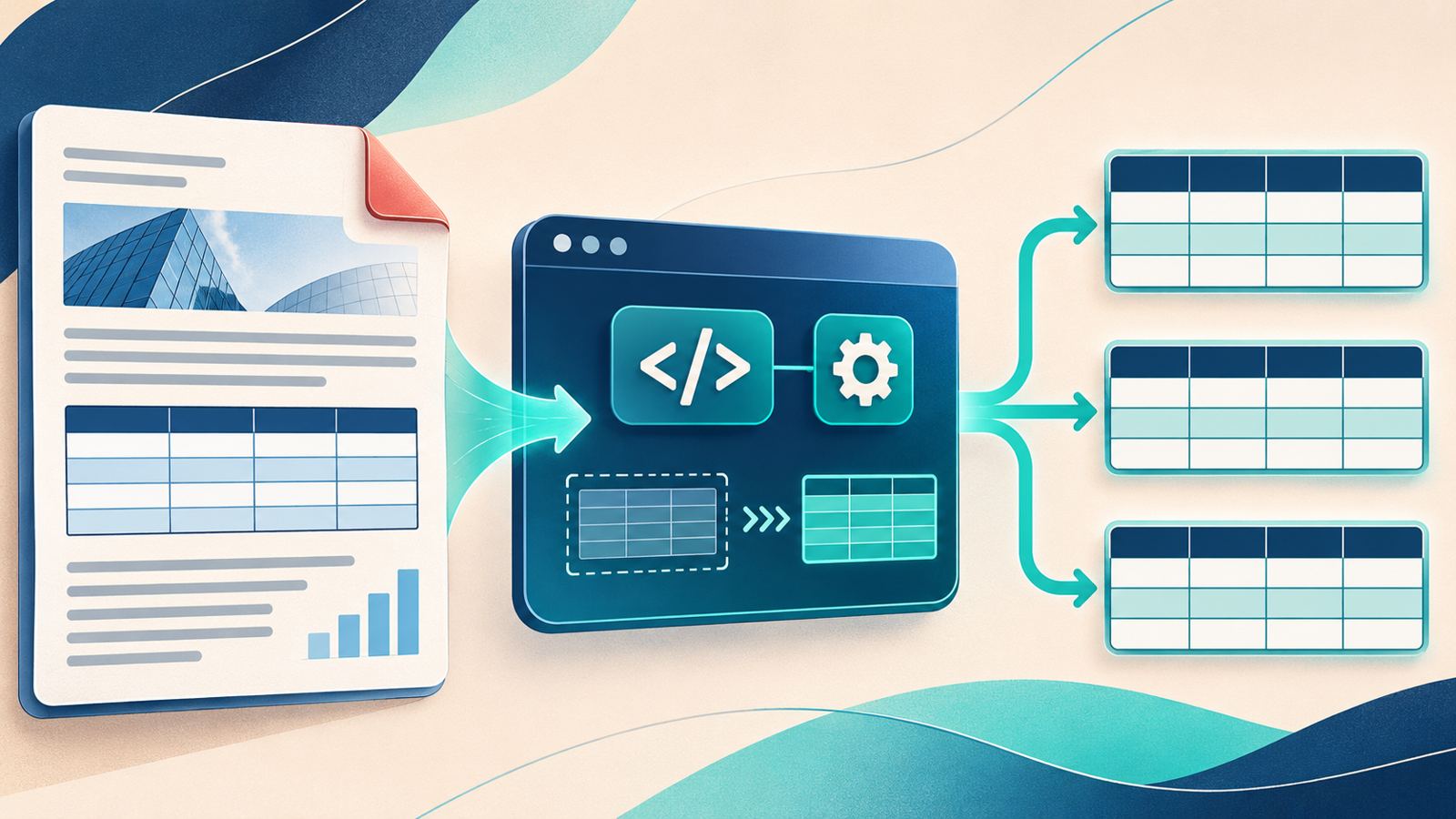
Profound AI is an AI marketing intelligence and automation platform built to help organizations understand how their brands, products, and websites appear in AI-generated answers. Its tools bring together monitored AI responses, consumer prompt research, source-citation analysis, crawler intelligence, content optimization, and marketing workflows. The essential distinction is that it measures visibility inside answer engines, not simply ranking positions on traditional search pages.
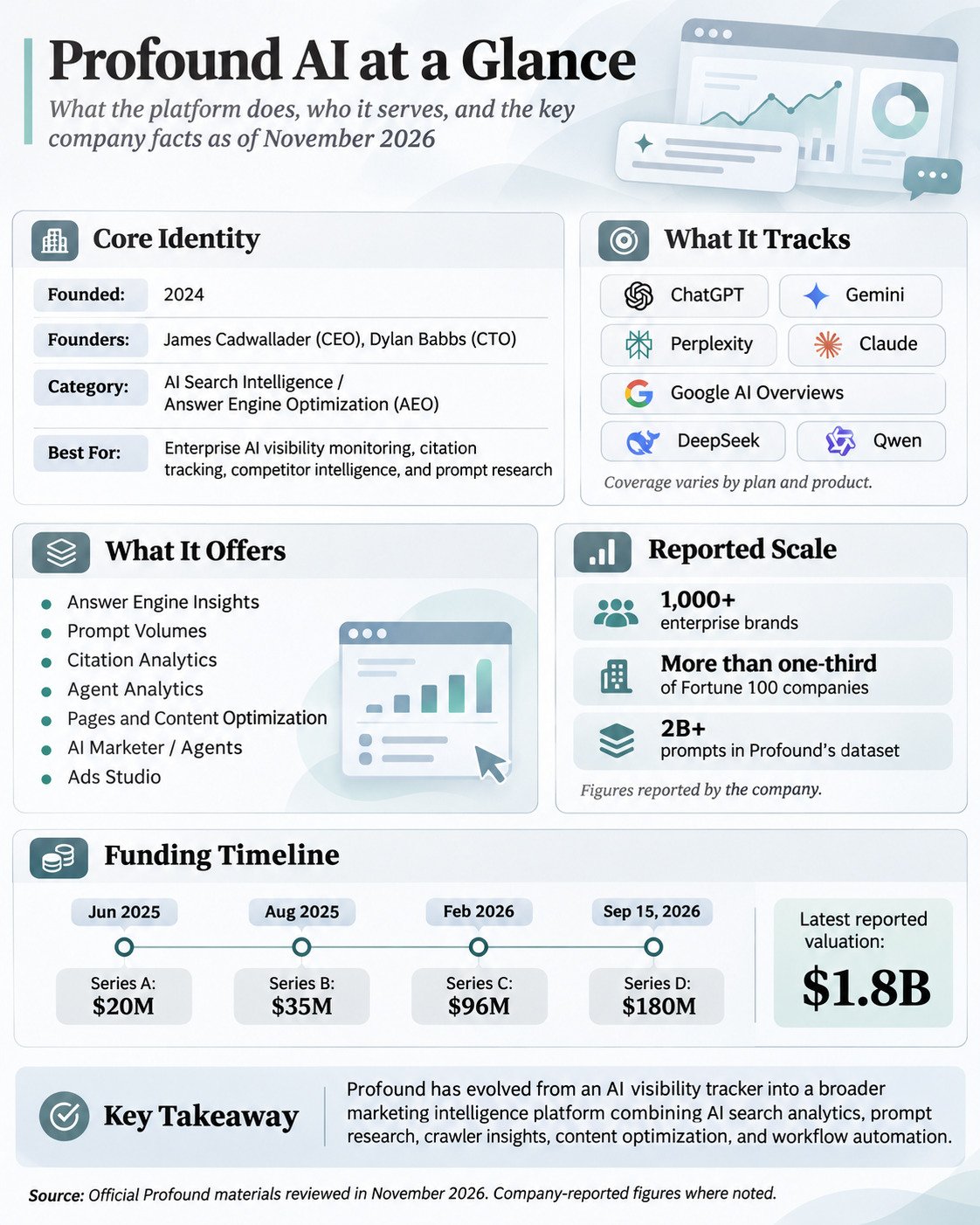
The company was founded in 2024 by James Cadwallader (CEO) and Dylan Babbs (CTO). In September 2026, Profound announced a $180 million Series D at a $1.8 billion valuation. It reported serving more than 1,000 enterprise brands, including over one-third of the Fortune 100. These figures are company statements rather than independent performance audits.
What we checked
This analysis reviews Profound’s public product documentation and company announcements as of November 20, 2026. It is not a logged-in product test or an independently audited benchmark. Funding and adoption figures are attributed to the company. The featured image and three infographics are editorial graphics. Two additional screenshots, manually supplied by Editorialge founder Sukanta Parthib, document his review of Profound’s public guidance and product announcement. His first-person observations below are attributed to him separately from the article’s byline. The screenshots were reviewed on November 20, 2026; their original capture dates are not independently verified. No logged-in performance results are established by these captures.
Why AI search changes the measurement problem
Search-engine optimization typically examines queries, rankings, organic clicks, backlinks, and crawl accessibility. Conversational discovery introduces a different decision environment. A prospective customer can ask an assistant to compare products and receive a synthesized answer naming several vendors, with some links and without others. The answer may influence a purchasing decision without producing a measurable click.
For example, a marketer might ask: “Which AI video generation platform works best for an agency making realistic product ads with consistent characters and limited budget?” A traditional keyword report cannot explain why the assistant recommends one platform, omits another, or cites a specific review. Profound attempts to reveal these patterns through repeated observation.
For a broader comparison, see our guide to ChatGPT visibility trackers for marketing teams.
This does not make SEO obsolete. Clear product documentation, accurate facts, accessible pages, credible supporting sources, and original reporting still matter. But a Google search position and an AI answer mention represent different outcomes, and neither is a guaranteed proxy for revenue.
Profound AI at a glance
How Profound works: a seven-stage workflow
Profound does not publish every detail of its proprietary collection, sampling, classification, or modeling architecture. Its public product descriptions nevertheless support a conceptual workflow: define the market; select relevant prompts; observe AI answers; identify mentions and citations; benchmark results; improve the underlying pages; and measure what changes.
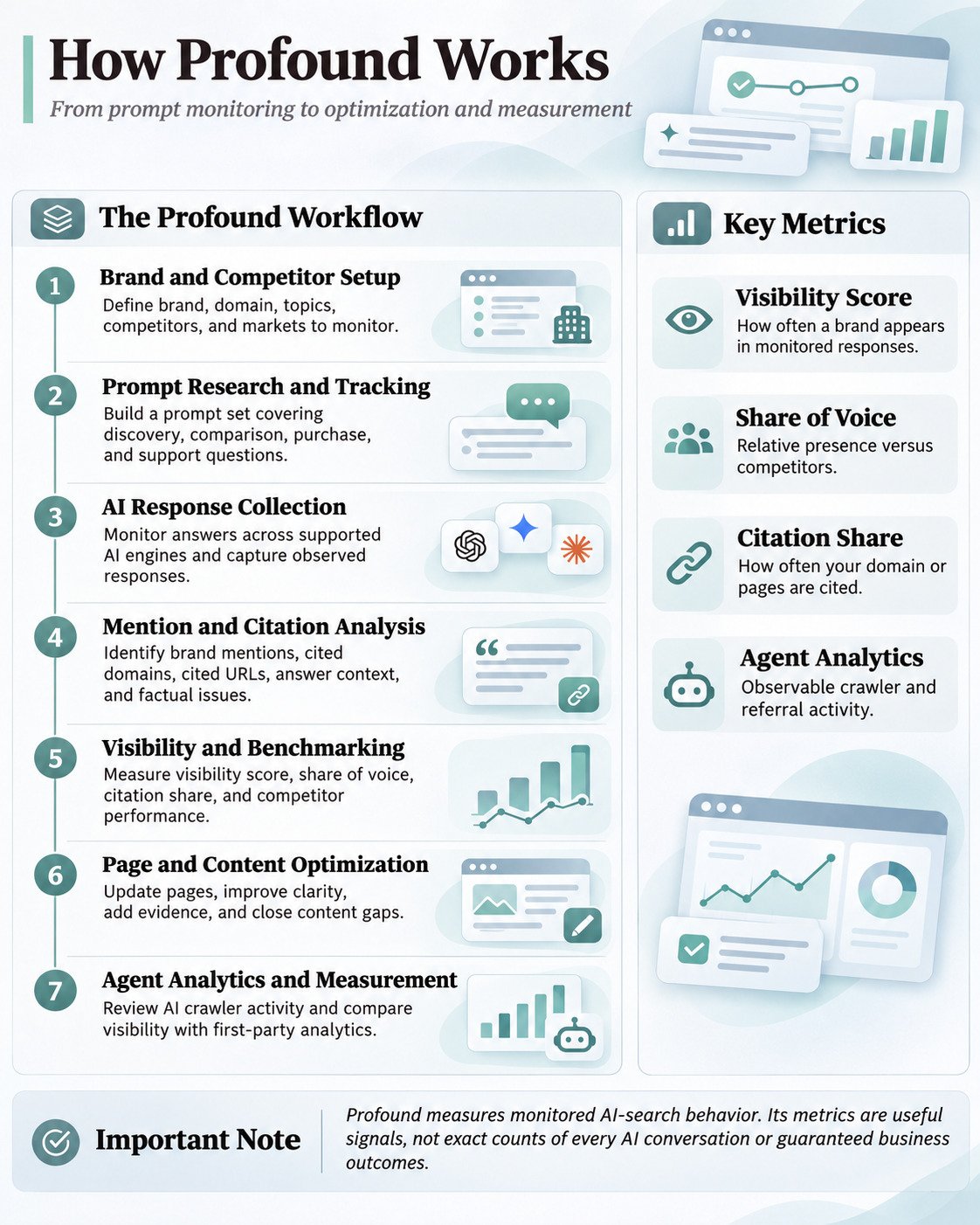
1. Brand, competitor, and market configuration
The account is configured around brands, product categories, competitors, markets, and subject areas. A broad brand-only prompt set would overstate familiarity: asking “What is Brand X?” primarily tests whether an assistant recognizes an explicitly named entity. Unbranded recommendation, comparison, and purchase-intent prompts better test discovery by potential new customers.
2. Prompt selection and discovery
Users may monitor manually selected questions and explore additional patterns using Profound’s Prompt Volumes product. AI prompts often include several constraints and follow-up questions, unlike short search keywords. A useful set should distinguish discovery, consideration, purchase, and support questions. Profound’s Prompt Analysis update announced on November 12, 2026, adds categorization around these stages, brand references, buying questions, and recommendations.
3. AI response observation
The monitoring service tests selected prompts across supported answer engines and captures observed outputs. Different systems, dates, regions, and response conditions may produce different answers. Daily or repeated observations can identify directional patterns, but no tracked sample represents every interaction occurring on the underlying platforms.
4. Mention, citation, and answer-context extraction
The system identifies brand names, competing products, cited domains and URLs, position or order where meaningful, descriptions, and other signals. An answer that recommends a brand is different from one that criticizes it; a link to a publisher is different from a mention of a vendor. Profound offers reporting for visibility, share of voice, average position, citation share, sentiment, and factual accuracy.
5. Competitive benchmarking and source investigation
Marketers compare performance across brands, categories, personas, regions, or supported platforms. Where possible they should examine the underlying prompt and answer execution: percentages without the source response are difficult to audit, particularly when the answer changes between runs.
6. Page and content improvement
Pages and Content Optimization help organize evidence at URL level and identify opportunities involving missing coverage, unclear explanations, dated claims, poor accessibility, and competitive differences. Improvements should primarily benefit readers and accuracy. No content score or format change guarantees that an assistant will cite a page.
7. Follow-up measurement
Teams compare subsequent answer observations with website referrals, sign-ups, revenue events, and first-party analytics. The strongest evaluation distinguishes changes to observed visibility from changes to real business results.
Profound’s primary product capabilities
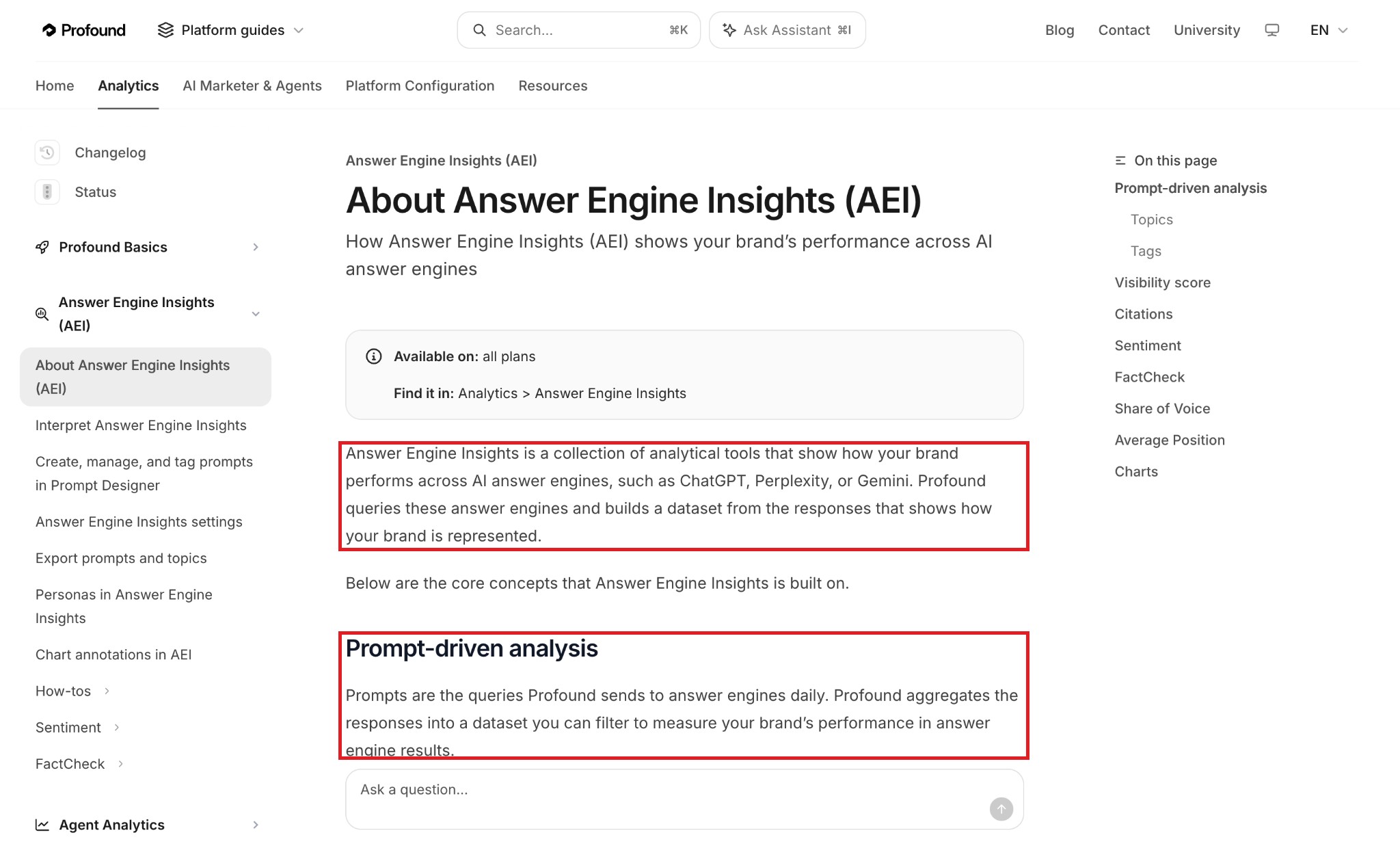
Answer Engine Insights
Our founder and CEO’s observation—Sukanta Parthib, based on his review of the public material shown here: I found the Answer Engine Insights explanation useful for thinking about research and writing. It connects a question with the answers collected from AI engines, rather than treating a visibility score as the whole story. For my editorial workflow, I see value in using that structure to investigate how a brand is described and which sources deserve closer inspection. This is my assessment of the documented approach, not a measured improvement from using a live Profound account.
Best for: brand visibility measurement, competitor comparison, and answer-level audits. The product aggregates response observations to report visibility scores, share of voice, average position, citations, sentiment, and factual accuracy. A simple visibility rate might be 35 mentions in 100 observed responses, or 35%; this is not a statement that 35% of all AI users encountered the brand. Proprietary weighting or filtering may also affect the vendor’s displayed metrics.
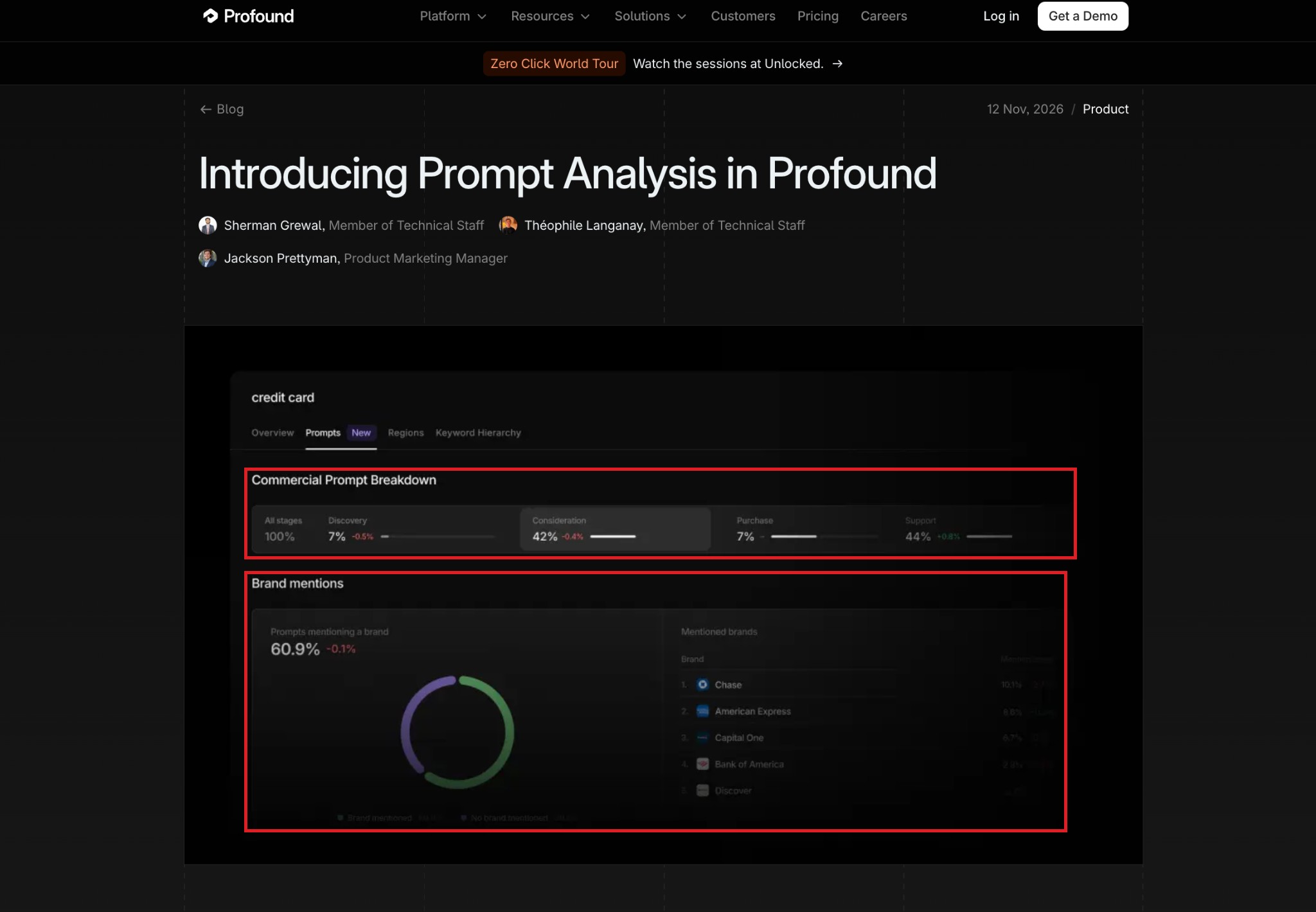
Prompt Volumes and Prompt Analysis
Founder’s observation—Sukanta Parthib, based on his review of the public material shown here: My impression of Prompt Volumes and Prompt Analysis was positive. Separating discovery, consideration, purchase, and support questions could help a writer or researcher decide what an article needs to answer. The brand-mention view also gives me a useful direction for further research. I see practical editorial value in that combination, although the figures in this screenshot belong to Profound’s published example. I have not established their accuracy or measured a productivity gain in my own workflow.
Best for: conversational demand research and understanding customer intent. Profound reports licensing anonymized conversation data from double-opt-in consumer panels, processing that data to limit personal identifiers, and applying statistical or machine-learning adjustments. The company reported more than 1.5 billion prompts in June 2026 and more than 2 billion by its September 2026 funding announcement. These totals describe different company-reported dataset snapshots, not direct feeds from all private AI conversations.
The dataset may help surface emerging questions and market segments, but country, language, population, and platform coverage matter. Modeled prompt demand is an estimate, not an exact provider-reported count. Businesses outside covered regions should confirm available geographic data before purchase.
Citation Analytics and Pages
Best for: publishers, content teams, digital PR, and URL-level optimization. The platform can show which domains or pages are referenced by monitored AI-generated answers. Pages organizes findings around individual URLs and may combine citation trends with content assessments and crawler details where the corresponding integrations exist. A citation does not necessarily mean an endorsement, a reader click, or a business conversion.
Agent Analytics
Best for: technical SEO and AI crawler monitoring. Infrastructure and server-side integrations, including environments such as Cloudflare, AWS, and Vercel, can reveal requests by identifiable AI crawlers and referrals. This supplies information that browser JavaScript analytics may not capture. Bot identity should be verified where practical rather than trusted solely from user-agent strings. A successful crawler request proves contact, not indexing, training, citation, or future AI recommendation.
Content Optimization, Agents, and AI Marketer
Best for: moving from intelligence toward workflow execution. Profound provides content-related assessments, automated research and brief generation, and configurable marketing workflows. Its AI Marketer and agents are designed to combine analytical context with execution-oriented tasks. Organizations should maintain factual review, content approval, permission controls, and documentation of what an agent actually changed. Automation can scale errors as easily as useful work.
Profound Index and Ads Studio
Best for: market benchmarking and broader campaign planning. The Profound Index uses curated prompts to compare brands and industries rather than depending entirely on an individual customer’s selected queries. Ads Studio extends the company’s ambitions toward paid marketing. Its Index and advertising features should not be confused with independent proof of incremental revenue from AI visibility.
Which AI services are covered?
Profound’s enterprise materials list monitoring across services such as ChatGPT, Gemini, Perplexity, Claude, Google AI Overviews, Google AI Mode, DeepSeek, Qwen, Exa Search, and Muse Spark, subject to package and product coverage. Answer monitoring and consumer prompt-data access are distinct capabilities; a platform supported for answer tracking does not necessarily contribute representative panel conversations to Prompt Volumes.
What Profound can measure—and what it cannot prove
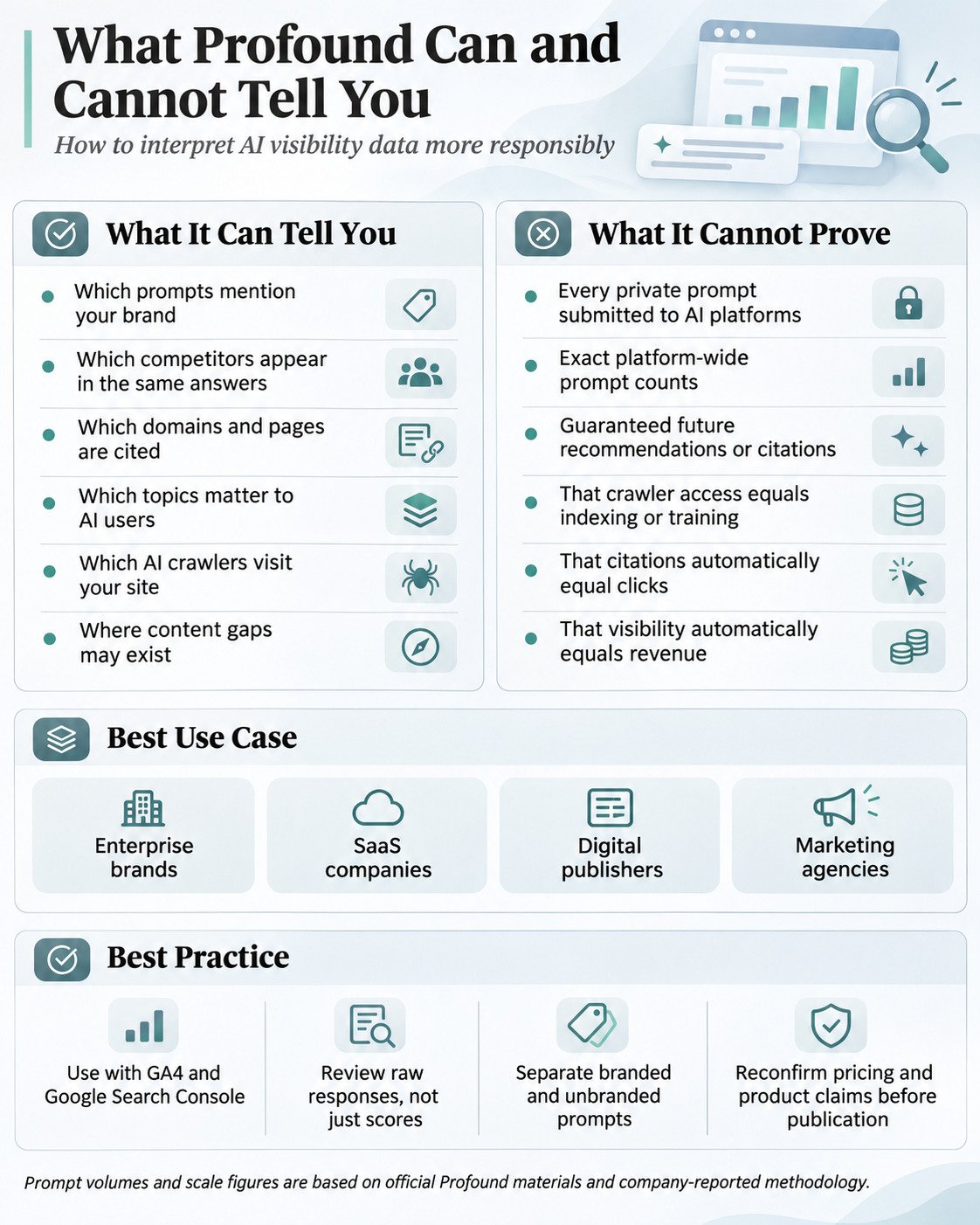
The question of accuracy is fundamental. A selected set of observed prompts establishes how particular systems answered at particular times under particular conditions. It does not directly reveal what every AI user saw. Consumer-panel data can reveal actual sampled conversations, but modeled volume estimates depend on panel coverage and adjustments. Crawler logs show server requests; citations show observed references; analytics show identifiable visits. These data types should remain separate.
Several biases deserve explicit attention. A brand-heavy prompt set can inflate apparent awareness. A United States English-language sample may be unrepresentative of readers in Bangladesh, Spain, or Brazil. Answers are not deterministic: recommendation order and citations may change with model updates, retrieval, context, and time. Finally, an AI answer may influence a later direct or branded-search visit without appearing as an AI referral in analytics.
Pricing and commercial evaluation
Profound’s 2026 public material emphasizes enterprise-oriented plans, custom prompt allocations, daily tracking, agency options, agent credits, integrations, and support. Public trial descriptions differ between pages, so buyers should verify the current trial length and prompt allowance. A fixed historical price quoted by a third-party comparison site should not be presented as universally current.
A procurement assessment should cover prompt quotas and frequency, exact engines, countries and languages, raw-answer exports, URLs and brands monitored, user seats, data retention, API availability, security provisions, support levels, agency workspace limits, and agent-credit overages. The relevant economic question is whether insights produce improvements worth more than licensing and operational costs.
Best for: who should consider Profound?
- Enterprise brands: monitor comparative recommendation presence, misinformation, reputation risk, and geographic differences.
- SaaS and technology companies: analyze how assistants evaluate features, alternatives, price, security, and fit for specific buyers.
- Digital publishers: track cited article URLs, identify rival sources, and prioritize evidence-led content refreshes while separately monitoring referral economics.
- Marketing agencies: compare clients and competitors, but budget for account limits, analyst time, and human review.
- Ecommerce teams: inspect how products are represented in shopping-oriented questions, with careful distinction between organic mentions and paid exposure.
An illustrative workflow for a software brand
Imagine a small AI creative-software provider discovers that it rarely appears in unbranded answers about product-ad video generation. It checks the exact monitored answers and finds competitors repeatedly cited for clear documentation on pricing, model support, character consistency, and usage rights. The company then updates its own product documentation, corrects outdated details, and publishes a well-supported comparison. Subsequent monitoring may reveal a change in mentions or citations; GA4, lead attribution, and subscription data are needed to understand whether the intervention helped the business. This example is hypothetical, not a measured Profound case study.
Limitations, risks, and editorial standards
The central limitations are sampling uncertainty, imperfect attribution, proprietary score definitions, variation between consumer-product responses and API outputs, uneven country or language coverage, the cost of enterprise software, and the need for approval controls around content automation. None of Profound’s visibility metrics constitutes an official ranking factor disclosed by OpenAI, Google, Anthropic, or another AI provider.
Organizations publishing evaluation articles should not claim a hands-on test without genuine logged-in product access and documented testing. The two annotated screenshots show public documentation and a vendor announcement, including a vendor example interface. They establish what was visible in those materials, not the accuracy of the underlying dataset or a test of an Editorialge account. The original supplied captures are retained separately; red outlines identify the relevant passages and example panels.
How to test Profound before committing
A practical pilot uses a predefined mix of branded and unbranded prompts, a realistic competitive set, and relevant market-language combinations. Preserve the raw answers; manually review a sample of citation and sentiment classifications; compare repeated observations; and test exportability. Evaluate whether insights translate into specific editorial, technical, or product-information improvements. Track follow-up sessions and conversions separately rather than calling a visibility change a revenue gain.
Final verdict
Profound offers a broad approach to AI search intelligence by linking prompt demand, answer monitoring, citation analysis, crawler activity, and marketing workflows. Its reported adoption and financing show commercial momentum, but investment and customer counts are not proof of universal efficacy. For organizations significantly affected by AI discovery, the value is its ability to turn opaque answer behavior into evidence that people can inspect and act on. The most responsible use combines those observations with careful editorial work and verified first-party business results.
Frequently asked questions
Is Profound a replacement for Ahrefs or Semrush?
No. It concentrates on AI answers and conversational demand. Traditional SEO tools may offer deeper backlink, ranking, and conventional technical SEO capabilities; many now offer some AI monitoring too.
Can Profound show exactly how many ChatGPT users asked a question?
No. Prompt Volumes combines panel observations with modeled estimates, not a direct universal count of private platform conversations.
Can it guarantee AI citations?
No. Content recommendations and improved accessibility do not guarantee selection in future generated answers.
Does it support ChatGPT, Gemini, and Perplexity?
Yes, with coverage and available functionality depending on the product and subscription.
Does crawler access mean AI training or indexing?
No. A request documents a request. Other outcomes require separate evidence.
Is the current price fixed?
Public enterprise pricing is package-dependent; confirm a current quote and trial terms directly.