Every date on the calendar holds a quiet archive of human ambition, resilience, and transformation. When we look closely at November 21, we find a fascinating intersection of world-altering breakthroughs and deeply personal turning points. It is the day humanity first broke free from the earth in an untethered hot-air balloon, the day Thomas Edison introduced the world to recorded sound, and the day the very first permanent link of the modern internet flickered to life.
In South Asia—particularly across Bangladesh and West Bengal—November 21 carries profound historical and cultural weight. From the decisive military turning points of the 1971 Liberation War to the birth of pioneering Bengali scientists and artists, this single date captures centuries of struggle and triumph.
Whether you are a history enthusiast, a student preparing for competitive exams, or simply curious about what shaped the world on this date, here is a complete, reader-friendly look at November 21 in history.
Quick Glance: Major November 21 Milestones
| Year | Region | Event / Milestone | Why It Matters Today |
| 1783 | France | First untethered manned hot-air balloon flight | Marked humanity’s first free flight, launching the era of aviation. |
| 1789 | United States | North Carolina ratifies the U.S. Constitution | Became the 12th state to join the American Union. |
| 1877 | United States | Thomas Edison announces the phonograph | Revolutionized culture by enabling sound to be recorded and replayed. |
| 1916 | Aegean Sea | Sinking of the hospital ship HMHS Britannic | The largest ship lost in WWI; over 1,000 lives were saved due to improved safety designs. |
| 1962 | India / China | China declares a unilateral ceasefire in the Sino-Indian War | Froze Himalayan border lines along the Line of Actual Control (LAC). |
| 1969 | United States | First permanent ARPANET link established | Connected UCLA and Stanford, laying the groundwork for the modern internet. |
| 1971 | Bangladesh / India | Formation of Mitro Bahini & Battle of Garibpur | A decisive turning point in the 1971 Liberation War, observed as Bangladesh Armed Forces Day. |
| 1995 | Europe / USA | Dayton Peace Agreement initialed | Ended the 3.5-year Bosnian War and established modern Bosnia and Herzegovina. |
| 2013 | Ukraine | Euromaidan protests begin in Kyiv | Reshaped modern European geopolitics and Ukraine’s democratic trajectory. |
The Bangalee Sphere
Across Bangladesh and the Indian state of West Bengal, November 21 is remembered for battlefield courage, scientific innovation, and artistic excellence.
Historical Turning Points
-
1971 – Formation of the Allied Forces (Mitro Bahini) & The Battle of Garibpur: During the final weeks of the Bangladesh Liberation War, November 21 marked a critical strategic shift. The Bangladesh Forces (Mukti Bahini) and the Indian Armed Forces formed a unified joint command known as the Mitro Bahini to launch a coordinated assault against the occupying Pakistan Army. Between November 20 and 21, allied troops fought the fierce Battle of Garibpur in Jessore, decisively defeating Pakistani armored units. Simultaneously, in the skies above, the aerial Battle of Boyra saw Indian Air Force Folland Gnats shoot down two Pakistani F-86 Sabre jets. Today, Bangladesh commemorates this historic day annually as Armed Forces Day.
-
1962 – Unilateral Ceasefire in the Sino-Indian War: Following a bitter month-long border conflict across the Himalayas affecting Arunachal Pradesh (then NEFA) and Aksai Chin, Chinese Premier Zhou Enlai announced a unilateral ceasefire effective midnight on November 21, 1962. Chinese troops withdrew 20 kilometers behind the Line of Actual Control (LAC). This truce reshaped India’s defense policies, border infrastructure, and diplomatic strategy across Eastern India and the broader subcontinent.
Notable Births in Bengal
-
1921 – Dr. Hiralal Chaudhuri (Sylhet, British India – now Bangladesh): Revered globally as the “Father of Induced Breeding” in aquaculture. Working in Cuttack and Barrackpore, Dr. Chaudhuri pioneered the hypophysation technique in 1957, allowing Indian major carps to breed in captivity using pituitary gland extracts. His breakthrough transformed inland fish farming and food security across South and Southeast Asia.
-
1934 – Ruma Guha Thakurta (Kolkata, West Bengal): A towering figure in Bengali cinema and music, she founded the Calcutta Youth Choir in 1958 alongside Salil Chowdhury and Satyajit Ray. As an actress, she delivered unforgettable performances in classics like Satyajit Ray’s Abhijan (1962) and Ganashatru (1989), as well as Tapan Sinha’s Nirjan Saikate.
-
1904 – Haren Ghatak (Barisal, Bengal Presidency): A beloved Bengali children’s poet and rhymester (Chharakar) whose regular contributions to Sandesh and Mouchak enriched 20th-century Bengali juvenile literature.
-
1966 – Kabir Bakul (Chandpur, Bangladesh): One of Bangladesh’s most celebrated contemporary lyricists, having penned over 5,000 songs for films and albums and earned multiple Bangladesh National Film Awards.
Notable Deaths Connected to Bengal
-
1970 – Sir C. V. Raman (Died in Bengaluru): Though Tamil by birth, Sir Chandrasekhara Venkata Raman conducted his Nobel Prize-winning research on light scattering—the Raman Effect (1928)—in Kolkata at the Indian Association for the Cultivation of Science (IACS) while serving as a professor at the University of Calcutta. He became the first Asian to win a Nobel Prize in any branch of science in 1930.
-
1974 – Punyalata Chakrabarti (Died in Kolkata): A gifted Bengali children’s author and the daughter of literary pioneer Upendrakishore Ray Chowdhury (as well as sister to Sukumar Ray). Her memoir, Chhelebelar Dinguli (Days of Childhood), remains a treasured window into the intellectual household of the Bengal Renaissance.
Cultural & Seasonal Observances
-
Armed Forces Day (Bangladesh): Celebrated nationwide with solemn wreath-laying ceremonies at Shikha Anirban in Dhaka Cantonment, public displays of naval vessels in Dhaka, Chittagong, and Khulna, and receptions honoring Liberation War veterans.
-
Nobanno Harvest Season: Falling in early Agrahayan on the Bengali calendar, November 21 sits in the heart of Hemanta (late autumn), when rural communities across Bangladesh and West Bengal celebrate Nobanno—the traditional harvest festival welcoming new rice with pitha (rice cakes) and folk music.
International Observances & Global Days
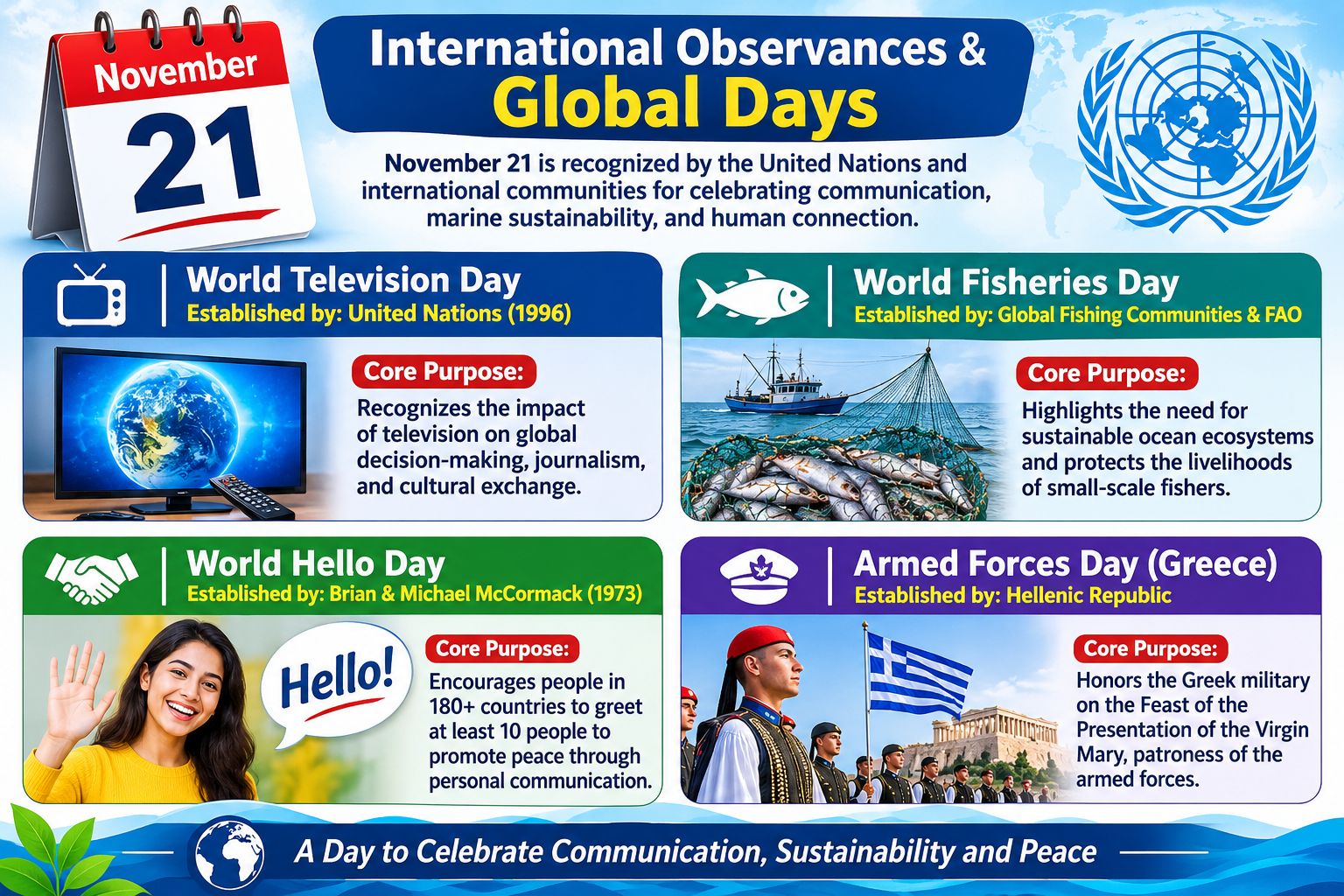
November 21 is recognized by the United Nations and international communities for celebrating communication, marine sustainability, and human connection.
| Observance | Established By | Core Purpose |
| World Television Day | United Nations (1996) | Recognizes the impact of television on global decision-making, journalism, and cultural exchange. |
| World Fisheries Day | Global Fishing Communities & FAO | Highlights the need for sustainable ocean ecosystems and protects the livelihoods of small-scale fishers. |
| World Hello Day | Brian & Michael McCormack (1973) | Encourages people in 180+ countries to greet at least 10 people to promote peace through personal communication. |
| Armed Forces Day (Greece) | Hellenic Republic | Honors the Greek military on the Feast of the Presentation of the Virgin Mary, patroness of the armed forces. |
Global History: Key Events Around the World
United States
-
1789 – North Carolina Joins the Union: Having initially held out until a Bill of Rights was proposed, North Carolina ratified the U.S. Constitution on November 21, 1789, becoming the 12th state of the United States.
-
1864 – Abraham Lincoln’s “Bixby Letter”: Dated November 21, 1864, this famous letter of condolence was sent to Lydia Bixby, a Boston widow believed to have lost five sons in the American Civil War. Praised for its poetic prose, historians still debate whether Lincoln or his private secretary John Hay penned the actual text.
-
1877 – Edison Unveils the Phonograph: Thomas Edison publicly announced his invention of the phonograph—a device using tin-foil cylinders to record and play back sound. It transformed Edison into an international celebrity and birthed the global recording industry.
-
1969 – The Birth of the Internet Backbone: Engineers at UCLA and the Stanford Research Institute established the first permanent host-to-host connection on ARPANET, creating the foundational network architecture that evolved into the modern internet.
-
1976 – Rocky Premieres in New York: Sylvester Stallone’s underdog boxing drama Rocky debuted in New York City, going on to win the Academy Award for Best Picture and becoming a cultural phenomenon.
Europe & Russia
-
1783 – Humanity’s First Untethered Flight: In Paris, French pioneers Jean-François Pilâtre de Rozier and the Marquis d’Arlandes soared roughly 9 kilometers over the city for 25 minutes in a hot-air balloon built by the Montgolfier brothers. It was the first untethered human flight in history.
-
1806 – Napoleon’s Berlin Decree: Seeking to cripple the British economy after defeating Prussia, French Emperor Napoleon Bonaparte issued the Berlin Decree, establishing the Continental System—an embargo prohibiting French allies and neutral nations from trading with Britain.
-
1916 – Sinking of the HMHS Britannic: The younger sister ship of the RMS Titanic, serving as a British hospital ship in World War I, struck a German naval mine in the Aegean Sea and sank in just 55 minutes. Thanks to post-Titanic safety upgrades, 1,036 of the 1,066 people on board survived.
-
1953 – The “Piltdown Man” Hoax Exposed: Scientists at the British Museum officially confirmed that “Piltdown Man”—a set of bone fragments discovered in Sussex in 1912 and hailed for decades as the evolutionary “missing link”—was an elaborate forgery combining a medieval human skull with an orangutan jaw.
-
1995 – The Dayton Peace Accords: Negotiated in Dayton, Ohio, the peace agreement was initialed on November 21, 1995, bringing an end to the devastating Bosnian War and establishing the modern framework of Bosnia and Herzegovina.
-
2013 – Ukraine’s Euromaidan Uprising Begins: When Ukrainian President Viktor Yanukovych abruptly suspended an association agreement with the European Union in favor of closer ties with Russia, thousands of citizens gathered in Kyiv’s Independence Square (Maidan), igniting a revolution that altered European history.
Asia, Middle East, Africa & The Commonwealth
-
1894 – Fall of Port Arthur (China): During the First Sino-Japanese War, Imperial Japanese troops captured the strategic Manchurian naval base of Port Arthur, signaling the waning military power of the Qing Dynasty.
-
1979 – Seizure of the Grand Mosque in Mecca (Saudi Arabia): On the first day of the Islamic year 1400 AH, armed militants led by Juhayman al-Otaybi seized Masjid al-Haram in Mecca, taking tens of thousands of worshippers hostage during a two-week siege that reshaped Saudi domestic policy.
-
1999 – China’s Shenzhou 1 Lands Safely: China successfully recovered its first uncrewed experimental spacecraft, Shenzhou 1, in Inner Mongolia after 14 Earth orbits, paving the way for its human spaceflight program four years later.
-
2017 – Resignation of Robert Mugabe (Zimbabwe): Following a military intervention and mounting parliamentary pressure, 93-year-old Robert Mugabe resigned as President of Zimbabwe, bringing an end to his 37-year rule.
Famous Birthdays on November 21
From Enlightenment philosophers to modern pop icons and pioneering surgeons, November 21 has produced remarkable minds across every field.
| Year | Name | Nationality | Profession & Claim to Fame |
| 1694 | Voltaire (François-Marie Arouet) | French | Enlightenment philosopher and author of Candide; champion of free speech and civil liberties. (Note: Voltaire claimed he was born Feb 20, 1694, though baptismal records state Nov 21). |
| 1787 | Sir Samuel Cunard | Canadian | Shipping magnate who founded the Cunard Line in 1840, pioneering regular transatlantic steamship travel. |
| 1852 | Francisco Tárrega | Spanish | Composer and virtuoso guitarist known as the “Father of Modern Classical Guitar.” |
| 1854 | Pope Benedict XV | Italian | Head of the Catholic Church (1914–1922) who worked tirelessly for peace and humanitarian relief during WWI. |
| 1898 | René Magritte | Belgian | Surrealist painter famous for thought-provoking works like The Son of Man and The Treachery of Images. |
| 1899 | Harekrushna Mahatab | Indian | Freedom fighter, historian, and the first Chief Minister of Odisha. |
| 1904 | Coleman Hawkins | American | Jazz pioneer dubbed the “Father of the Tenor Saxophone,” renowned for his 1939 hit “Body and Soul.” |
| 1924 | Christopher Tolkien | British | Academic and editor who compiled and published his father J.R.R. Tolkien’s posthumous Middle-earth works, including The Silmarillion. |
| 1936 | Dr. Victor Chang | Chinese-Australian | Pioneering cardiac surgeon who led Australia’s heart transplant program and developed an artificial heart valve. |
| 1945 | Goldie Hawn | American | Academy Award-winning actress, producer, and comedy icon (Cactus Flower, Private Benjamin). |
| 1965 | Björk | Icelandic | Avant-garde singer, songwriter, and composer celebrated for blending electronic, classical, and experimental pop. |
| 1967 | Ken Block | American | Professional rally driver, co-founder of DC Shoes, and viral Gymkhana motorsport star. |
| 1985 | Carly Rae Jepsen | Canadian | Grammy-nominated pop singer-songwriter known worldwide for “Call Me Maybe” and critically acclaimed pop albums. |
Famous Death Anniversaries on November 21
History also paused on November 21 to bid farewell to monarchs, Nobel laureates, composers, and literary voices.
| Year | Name | Nationality | Legacy & Cause / Impact |
| 1555 | Georgius Agricola | German | Mineralogist and scholar known as the “Father of Mineralogy” for his foundational mining treatise De Re Metallica. |
| 1695 | Henry Purcell | English | One of England’s greatest Baroque composers, celebrated for the opera Dido and Aeneas. |
| 1811 | Heinrich von Kleist | German | Influential Romantic poet, dramatist, and novelist; the prestigious German Kleist Prize is named in his honor. |
| 1844 | Ivan Krylov | Russian | Russia’s most celebrated fabulist and playwright, whose witty fables remain staples of Russian literature. |
| 1916 | Emperor Franz Joseph I | Austrian | Emperor of Austria and King of Hungary for nearly 68 years; his death mid-WWI accelerated the fall of the Habsburg Empire. |
| 1970 | Sir C. V. Raman | Indian | Nobel Prize-winning physicist (1930) who discovered the Raman Effect in Kolkata. |
| 1993 | Bill Bixby | American | Beloved actor and director famous for starring in The Courtship of Eddie’s Father and The Incredible Hulk. |
| 1996 | Dr. Abdus Salam | Pakistani | Theoretical physicist who won the 1979 Nobel Prize in Physics for the electroweak unification theory—the first Pakistani Nobel laureate. |
| 2011 | Anne McCaffrey | American-Irish | Sci-fi/fantasy author of the Dragonriders of Pern series and the first woman to win both Hugo and Nebula Awards for fiction. |
| 2017 | David Cassidy | American | 1970s teen idol, singer, and actor best known as Keith Partridge on The Partridge Family. |
Fascinating “Did You Know?” Trivia About November 21
-
A Sheep, a Duck, and a Rooster Paved the Way for Human Flight: Before Pilâtre de Rozier and the Marquis d’Arlandes took off over Paris on November 21, 1783, scientists worried that humans wouldn’t survive the upper atmosphere. To test the waters, the Montgolfier brothers sent up a sheep, a duck, and a rooster in a basket weeks earlier. All three landed unharmed, clearing the path for humanity’s historic November 21 flight.
-
One Woman Survived All Three Titanic-Class Disasters: When the HMHS Britannic sank on November 21, 1916, nurse Violet Jessop survived by leaping out of a lifeboat just before it was pulled into the ship’s spinning propellers. Astonishingly, she had already survived the sinking of the RMS Titanic in 1912 and the collision of the RMS Olympic in 1911, earning her the nickname “Miss Unsinkable.”
-
Edison’s First Recorded Words Were a Nursery Rhyme: When Thomas Edison tested the phonograph he unveiled on November 21, 1877, his first recorded words weren’t a grand speech—he simply spoke the lines of “Mary Had a Little Lamb” into the mouthpiece and watched in amazement as the machine played his voice back.
-
A Quote Voltaire Never Actually Said: Voltaire, born on November 21, 1694, is endlessly quoted as saying, “I disapprove of what you say, but I will defend to the death your right to say it.” In reality, those exact words were written in 1906 by English biographer Evelyn Beatrice Hall to summarize Voltaire’s attitude toward free expression.
Final Thoughts
Looking back at November 21, it is remarkable how much human progress can be traced to a single date on the calendar. From the skies over 18th-century Paris to the battlefields of 1971 Bangladesh, and from the laboratories of Kolkata to the early computer terminals linking California universities, November 21 reminds us that history is shaped both by bold leaps into the unknown and by quiet perseverance. Whether we are celebrating World Television Day, honoring the sacrifices of armed forces, or reflecting on the ideas of thinkers like Voltaire and C. V. Raman, this date offers a rich tapestry of stories that continue to resonate in our modern world.