
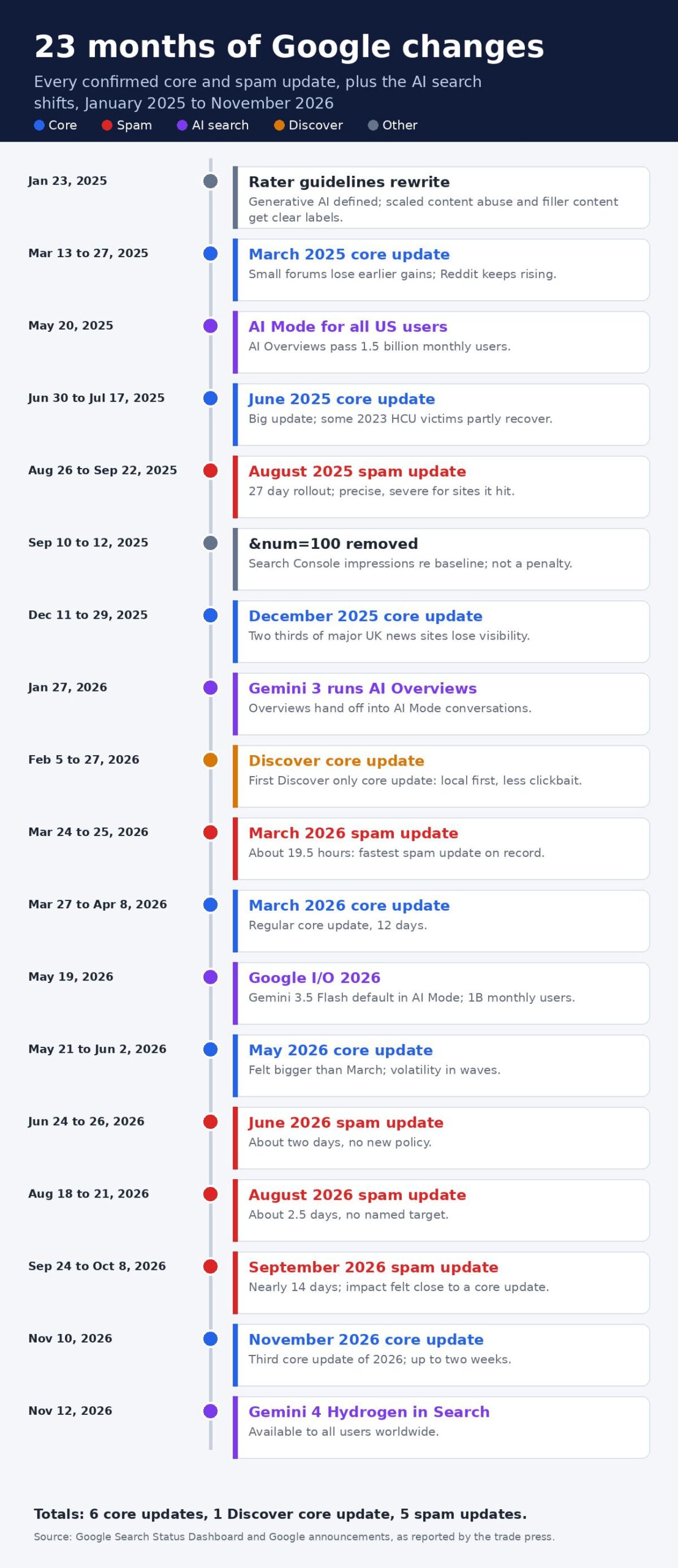
Between January 2025 and November 2026, Google confirmed six broad core updates, one Discover core update and five spam updates. Over the same period it turned search into an answer engine, first with AI Overviews and AI Mode and now with Gemini 4 Hydrogen. If your blog lost most of its Google traffic in that window, you are far from alone. Chartbeat reported a substantial decline in search referrals for small publishers. This analysis walks through all the Google algorithm updates of those 23 months in order: what changed, who got hurt, why, and what still works.
The short version:
- Core updates kept rewarding sites that people already trust and that show real, firsthand knowledge. A ranking decline alone does not establish a spam violation or identify a specific quality problem.
- Spam updates got faster and more frequent. 2026 brought four of them, and one finished in under a day.
- The deeper loss came from the results page itself. When an AI answer sits on top, far fewer people click any link at all.
- Google is not removing AI Overviews. It is folding them into AI Mode and running them on stronger models.
- Sites that rely only on Google for growth are in trouble. Sites with a real audience, a clear topic and visible expertise are still standing.
How This Analysis Was Built
The dates come from Google’s Search Status Dashboard, as reported by the trade press that tracks it every day. The impact figures come from named third-party sources, mainly Pew Research Center, Chartbeat, Similarweb and Sistrix, and each one is credited where it is used. The main case study uses the owner-supplied analysis and Search Console screenshots for an anonymous publisher.
The publishing ZIP does not contain the underlying row-level export, so its detailed calculations have not been independently recomputed during this publishing pass. Google does not publish who won or lost in an update, so any claim about a specific cause is an analysis of patterns, not a statement from Google.
The 23-Month Timeline of Google Algorithm Updates
| Date | Update | Type | Rollout length |
|---|---|---|---|
| Jan 23, 2025 | Search Quality Rater Guidelines rewrite | Guidelines | Not a ranking update |
| Mar 13 to Mar 27, 2025 | March 2025 core update | Core | 14 days |
| May 20, 2025 | AI Mode opens to all US users | AI search | Product launch |
| Jun 30 to Jul 17, 2025 | June 2025 core update | Core | About 17 days |
| Aug 26 to Sep 22, 2025 | August 2025 spam update | Spam | 27 days |
| Around Sep 10 to 12, 2025 | &num=100 parameter removed | Reporting change | Unannounced |
| Dec 11 to Dec 29, 2025 | December 2025 core update | Core | 18 days |
| Jan 27, 2026 | Gemini 3 becomes default in AI Overviews | AI search | Product change |
| Feb 5 to Feb 27, 2026 | February 2026 Discover core update | Discover core | 22 days |
| Mar 24 to Mar 25, 2026 | March 2026 spam update | Spam | About 19.5 hours |
| Mar 27 to Apr 8, 2026 | March 2026 core update | Core | 12 days |
| May 19, 2026 | Google I/O: new search box, Gemini 3.5 Flash in AI Mode | AI search | Product change |
| May 21 to Jun 2, 2026 | May 2026 core update | Core | About 12 days |
| Jun 24 to Jun 26, 2026 | June 2026 spam update | Spam | About 2 days |
| Aug 18 to Aug 21, 2026 | August 2026 spam update | Spam | About 2.5 days |
| Sep 24 to Oct 8, 2026 | September 2026 spam update | Spam | About 14 days |
| Nov 10, 2026 onward | November 2026 core update | Core | Up to 2 weeks |
| Nov 12, 2026 | Gemini 4 Hydrogen comes to Search for all users | AI search | Product change |
Three Things People Get Wrong About These Updates
There was no separate helpful content update in this period. Many site owners still talk about “the HCU” as if it might return. It won’t. Google folded its helpful content system into its core ranking systems in March 2024. Every core update since then carries that judgment inside it. A traffic drop alone does not establish which system was responsible.
E-E-A-T is not an update either. Experience, Expertise, Authoritativeness and Trust is a framework in Google’s guidelines for human quality raters. Those raters do not change your rankings directly. Their scores help Google check whether its systems are moving in the right direction. The guidelines changed twice in this period. The January 23, 2025 revision was the big one: it formally defined generative AI and gave raters clear language for scaled content abuse and filler content. The September 11, 2025, revision was minor. It added examples of how to rate AI overviews and widened “Your Money or Your Life” topics to include elections and civic information. For a deeper look at the signals behind the framework, read our analysis of E-E-A-T signals in 2026.
AI Overviews are not going away. A rumor has circulated that Google plans to drop AI Overviews. We found no Google statement that says so. The record points the other way. In January 2026, Google made Gemini 3 the default model for AI Overviews globally and let people continue from an overview straight into an AI Mode conversation. On November 12, 2026, Gemini 4 Hydrogen became available in Google Search worldwide, and Google calls it “the biggest model upgrade to Search yet.” The AI layer is getting bigger, not smaller. More on Hydrogen below.
2025, Update by Update
January 23, 2025: The Rater Guidelines Get Strict About AI Content
This was the quiet starting gun. The rewrite grew the guidelines from 170 to 181 pages and gave raters explicit instructions for spotting low effort AI content and pages that exist only to fill space. The guidelines revision was not itself a ranking update. It clarified the treatment of content produced at scale with little added value.
What to do: read your own top pages as a rater would. If a page could have been written by anyone with a search engine and no direct knowledge, it is exposed.
March 13 to March 27, 2025: The March 2025 Core Update
The first core update of 2025 ran for two weeks and hit retail, government, forum and publishing sites alike. Its clearest pattern involved forums. Reddit stayed strong while many smaller forums lost the visibility they had gained over the previous year. Two niche hobby forums that had grown more than 1,000 percent in a year saw that growth reversed.
Why it matters: Google had pushed “hidden gems” and forum content hard after 2023. March 2025 showed that the boost was not a permanent gift. Large, active communities kept it. Smaller forums with thin or outdated threads lost it.
What to do: if user-generated content was carrying your traffic, prune dead threads and make sure useful answers are easy to find.
May 20, 2025: AI Mode Opens to Everyone in the United States
This was not a ranking update, but it changed the search more than most of them. At I/O 2025, Google said AI Overviews already had more than 1.5 billion monthly users, and it opened AI Mode, a chat style search experience, to all US users. For publishers, this was the moment the answer engine stopped being an experiment.
June 30 to July 17, 2025: The June 2025 Core Update
This was one of the biggest updates of the two years, and it brought the first good news in a long time for one group of sites. Some sites hit by the September 2023 helpful content update saw their first real improvement in nearly two years. A few came back from almost no visibility at all.
Be careful with that headline, though. Many sites hit in 2023 saw no recovery. The ones that did had usually made deep changes, such as removing weak pages, adding real authorship and rewriting from experience, rather than making small edits. There was also a second lesson. Sites that lost ground in the June update tended to lose visibility in AI Overviews as well. The same quality judgment feeds both.
What to do: treat recovery as a long project measured across core updates, not weeks.
August 26 to September 22, 2025: The August 2025 Spam Update
This was Google’s first spam update in about eight months, and it was long. It started on August 26, 2025, and finished on September 22, a 27-day rollout. Overall volatility looked small in the big tracking tools, which suggests the update was precise rather than broad. For the sites it hit, though, the damage was severe, as the case study below shows.
Google did not name a target. Its spam policies cover scaled content abuse, expired domain abuse, site reputation abuse, cloaking, link spam and other tactics. Sites built on trend-chasing pages outside their real expertise were especially exposed.
September 10 to 12, 2025: The Change That Faked a Crash
In the middle of that spam update, Google stopped honoring the &num=100 parameter, which had let rank tracking tools load 100 results at once. Each of those bot page loads had been counted as an impression in Search Console for every site listed in positions 11 to 100. When the parameter stopped working around September 12, impressions fell sharply for almost everyone, and average position appeared to “improve.”
This matters for any diagnosis. If only your impressions fell in mid-September 2025 while clicks held, you would probably not be hit. If your clicks fell too, something else happened, and the spam update is the first suspect.
September to November 2025: Publishers Fight Back
The fight moved into courts and regulators. On September 12, 2025, Penske Media, owner of Rolling Stone, Billboard and Variety, sued Google. It said about one in five Google searches that link to its sites now show an AI Overview. On November 13, the European Commission opened a formal investigation under the Digital Markets Act into whether Google’s site reputation abuse policy unfairly demotes publishers that host content from commercial partners. Google called the probe “misguided” and defended the policy as essential against pay-for-play tactics.
For anyone selling sponsored posts or hosting partner content, this is the most important policy fight of the two years. Until it is settled, third-party content that has nothing to do with your main topic remains a risk.
December 11 to December 29, 2025: The December 2025 Core Update
The last core update of 2025 ran for 18 days over the holidays and was rough on news. In the UK, more than two thirds of major news websites lost search visibility in Sistrix data, and one regional site dropped by almost half. The Times, Substack and Money Saving Expert were among the few UK winners, according to Press Gazette’s analysis. In the US, the picture was less one sided. About 37 percent of 79 tracked news sites gained visibility.
Outside news, established ecommerce brands did well. In one study of 100,000 keywords, nearly 15 percent of top 10 pages disappeared from the results. Some publishers also saw their Discover traffic collapse within 48 hours of the update starting.
What to do: if December 2025 hurt you, compare your losing pages with the pages that replaced them. Usually the winner is a stronger brand, a more specific answer or a page with clearer firsthand evidence.
2026, Update by Update
January 27, 2026: Gemini 3 Takes Over AI Overviews
Google made Gemini 3 the default model for AI Overviews globally and added follow up questions that move straight into AI Mode. There was no ranking update and no warning to site owners. Yet the change affected every publisher whose page used to be the next click after a search.
February 5 to February 27, 2026: The First Discover Only Core Update
For the first time, Google released a core update just for Discover. It started with English language users in the US, and Google says it will expand to other countries and languages. Its stated goals were more locally relevant content and less sensational, clickbait style material. Publishers outside the US who had been feeding US Discover feeds felt it quickly.
This matters more than it sounds. Discover had become the biggest Google traffic source for many news sites, so a core update just for Discover means one more set of rules to follow. The message was plain: write for a real local audience with real substance, not for a curiosity headline.
March 24 to April 8, 2026: A Record Fast Spam Update, Then a Core Update
The March 2026 spam update finished in about 19.5 hours, the shortest confirmed spam update on record. Rollout duration alone does not reveal when individual sites were assessed or how decisions were made. Three days later, on March 27, the March 2026 core update began. It finished on April 8 after 12 days. Google called it a regular update and gave no specific goals.
Spam update first, core update right after: that pairing became the pattern of 2026. Clear out the obvious violations, then recalibrate everything else.
May 19 to June 2, 2026: Google I/O and the May 2026 Core Update
At I/O 2026 on May 19, Google made Gemini 3.5 Flash the default model inside AI Mode globally, rebuilt the search box around AI and said AI Mode had passed one billion monthly users. Many SEO blogs read that as “AI Mode is now the default search experience.” It was not. The default model changed, not the default page.
Two days later, the May 2026 core update started. It ran from May 21 to June 2 and felt bigger than the March update to most people tracking it. Volatility spiked in several waves rather than all at once.
June 24 to August 21, 2026: Two Fast Spam Updates
The June 2026 spam update ran from June 24 to June 26, and the August 2026 spam update from August 18 to August 21. Neither came with a new policy or a named target. Both were quick, and both lined up with sharp drops on some sites, including the one in our main case study.
One more product change landed in late August. Google confirmed it was opening fuller AI Overviews with the AI Mode follow up box already showing for some queries. That pushed organic links even further down the page.
September 24 to October 8, 2026: The Longest Spam Update of the Year
The fourth spam update of 2026 was different. Google said it might take up to two weeks, and it used nearly all of that time, finishing on October 8. Many observers described the impact as closer to a core update. Google said it was not a link spam update and named no target. That made 2026 the busiest year for spam updates since 2021.
November 10, 2026 Onward: The November 2026 Core Update
The third core update of 2026 began on November 10, almost six months after the May update. Google again called it a regular update and said the rollout may take up to two weeks. Because it falls right before Black Friday, ecommerce and deal sites should read their November data with care. Wait at least a week after Google marks it complete before drawing conclusions.
November 12, 2026: Gemini 4 Hydrogen Arrives in Search
Two days into the core update, Google put Gemini 4 Hydrogen into Search for all users worldwide, with no subscription required. Google says it understands multipart questions better, widens the links Search surfaces through query fan-out, and gives more visual answers such as tables and images. Hydrogen is the fast model in the Gemini 4 family, adapted from the stronger Gemini 4 Carbon. Google has not said how the upgrade affects traffic to the sites that Search links to.
Hydrogen and the AI Overviews Question
So where does that leave the rumor that Google is dropping AI Overviews? Here is what can be verified as of November 19, 2026.
- AI Overviews are still live, and since January they hand off directly into AI Mode.
- Hydrogen now drives AI Mode and the harder AI Overview answers for everyone, not only paying subscribers.
- Google promises that query fan-out will surface a wider range of links. That could mean more sites cited in each answer. Whether more citations lead to more clicks has not been measured publicly.
- AI Mode is still not the default results page. A normal Google search still shows a mixed page with links.
The practical reading is that Google is not removing the AI layer. It is making the AI layer the main way people move through search, and the classic list of links is becoming the fallback. Any plan that assumes the click volume of 2023 will return is a plan built on hope.
What the Numbers Say About the Damage
The claim that “millions of blogs died” is hard to prove, because nobody counts dead blogs. What can be measured is the traffic loss, and it is large.
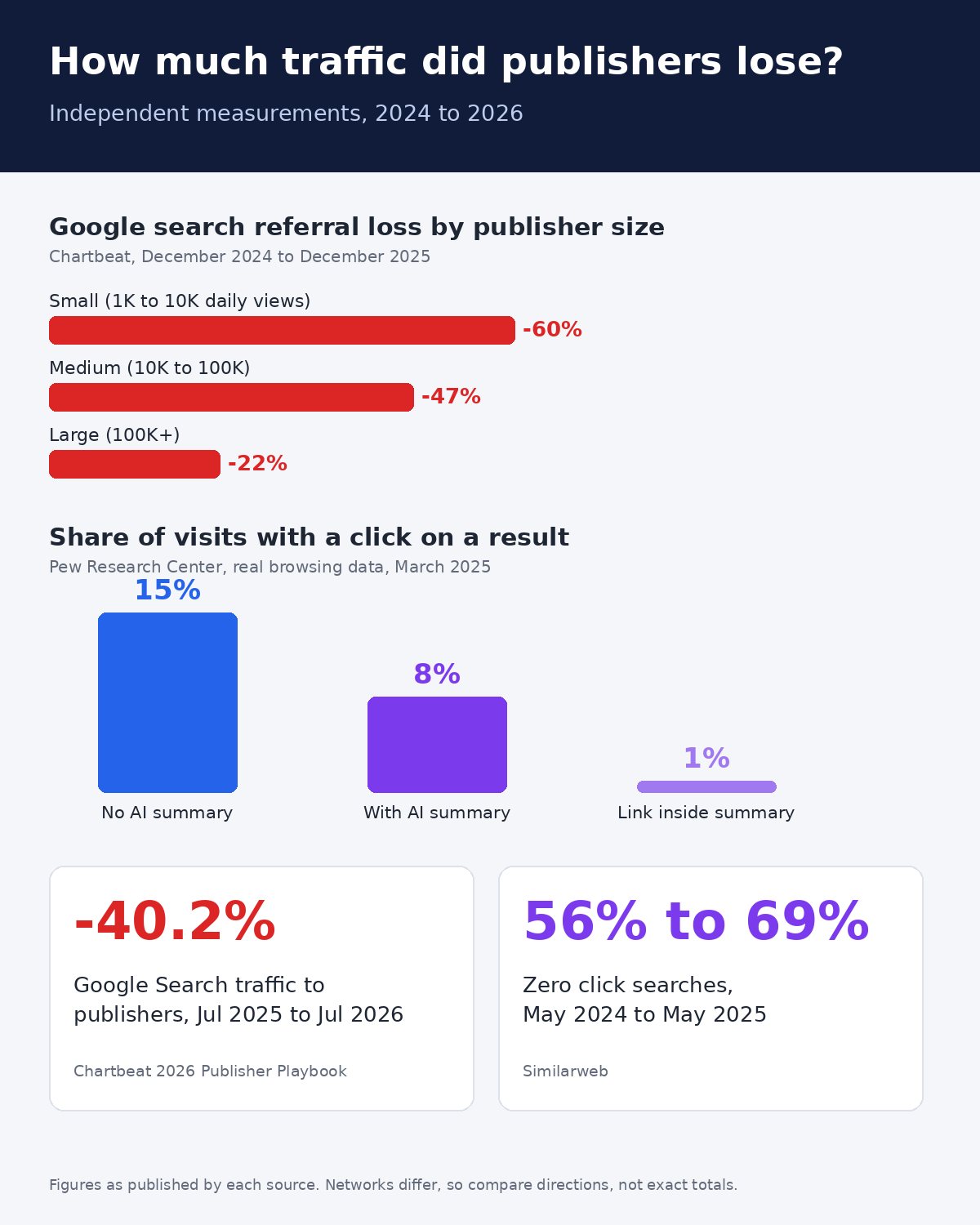
- Visits with AI summaries had lower observed click rates. In Pew Research Center’s study of real browsing data from March 2025, people clicked a traditional result in 8 percent of visits when an AI summary appeared, against 15 percent when none did. Only 1 percent clicked a link inside the summary.
- Small publishers lost the most. Chartbeat measured a 60 percent drop in search referrals for small publishers over two years, 47 percent for medium ones and 22 percent for large ones.
- The decline sped up. Across Chartbeat’s publisher network, Google Search traffic fell 40.2 percent from July 2025 to July 2026, almost double the drop of the year before. Discover’s decline widened from 6.6 percent to 34.3 percent.
- Zero click searches grew. Similarweb data showed zero click searches rising from 56 to 69 percent between May 2024 and May 2025.
Look at those numbers together and a clear pattern appears. The core and spam updates decided who lost rankings. The AI results page decided how much a ranking was still worth. A small blog could hold its position in 2026 and still earn far fewer visits than in 2024. A small blog that also lost rankings was hit twice.
We covered the publisher side of this earlier in why AI Overviews have become a crisis for publishers.
Case Study 1: A Multi Niche Publisher Loses 98 Percent of Its Google Clicks
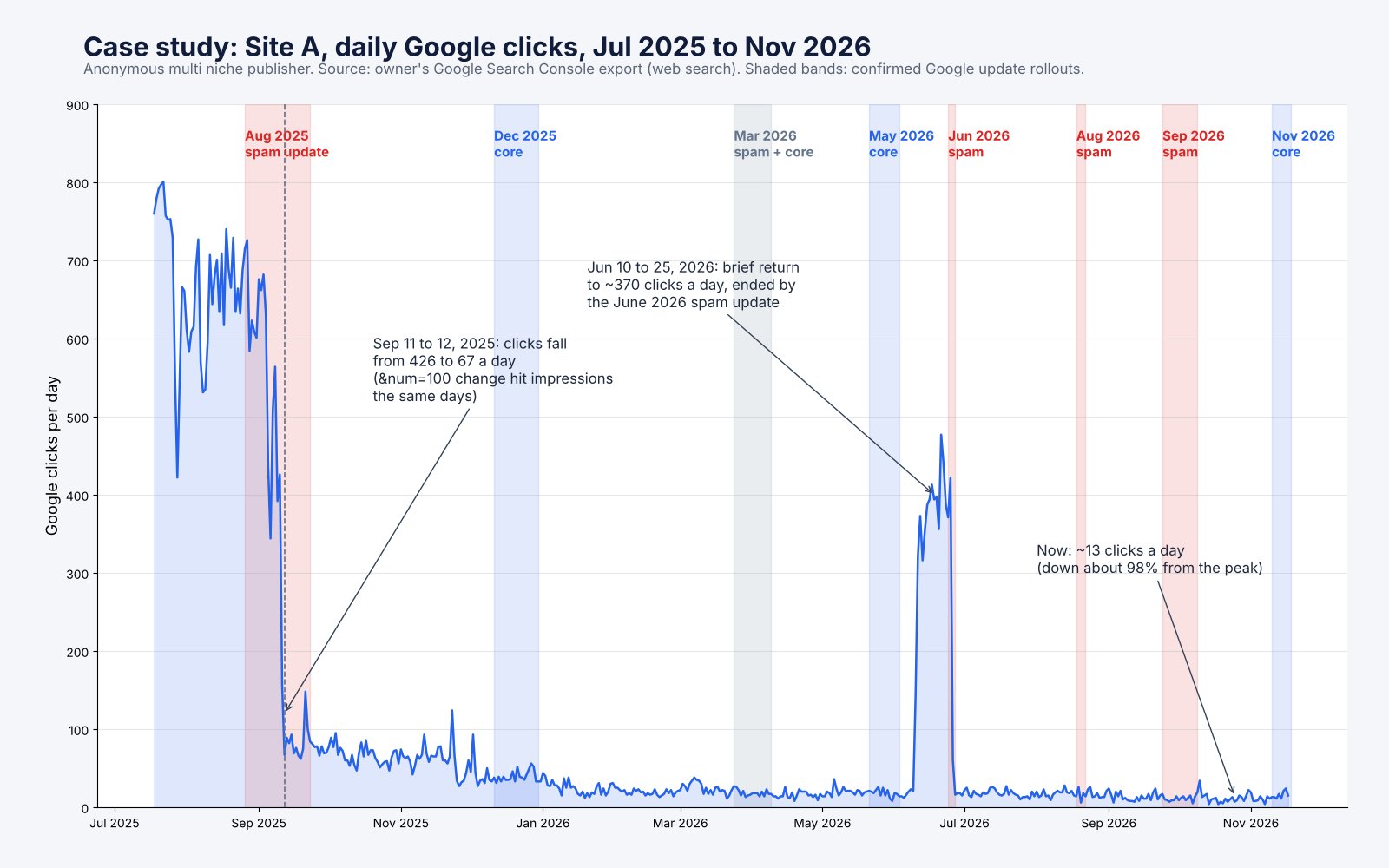
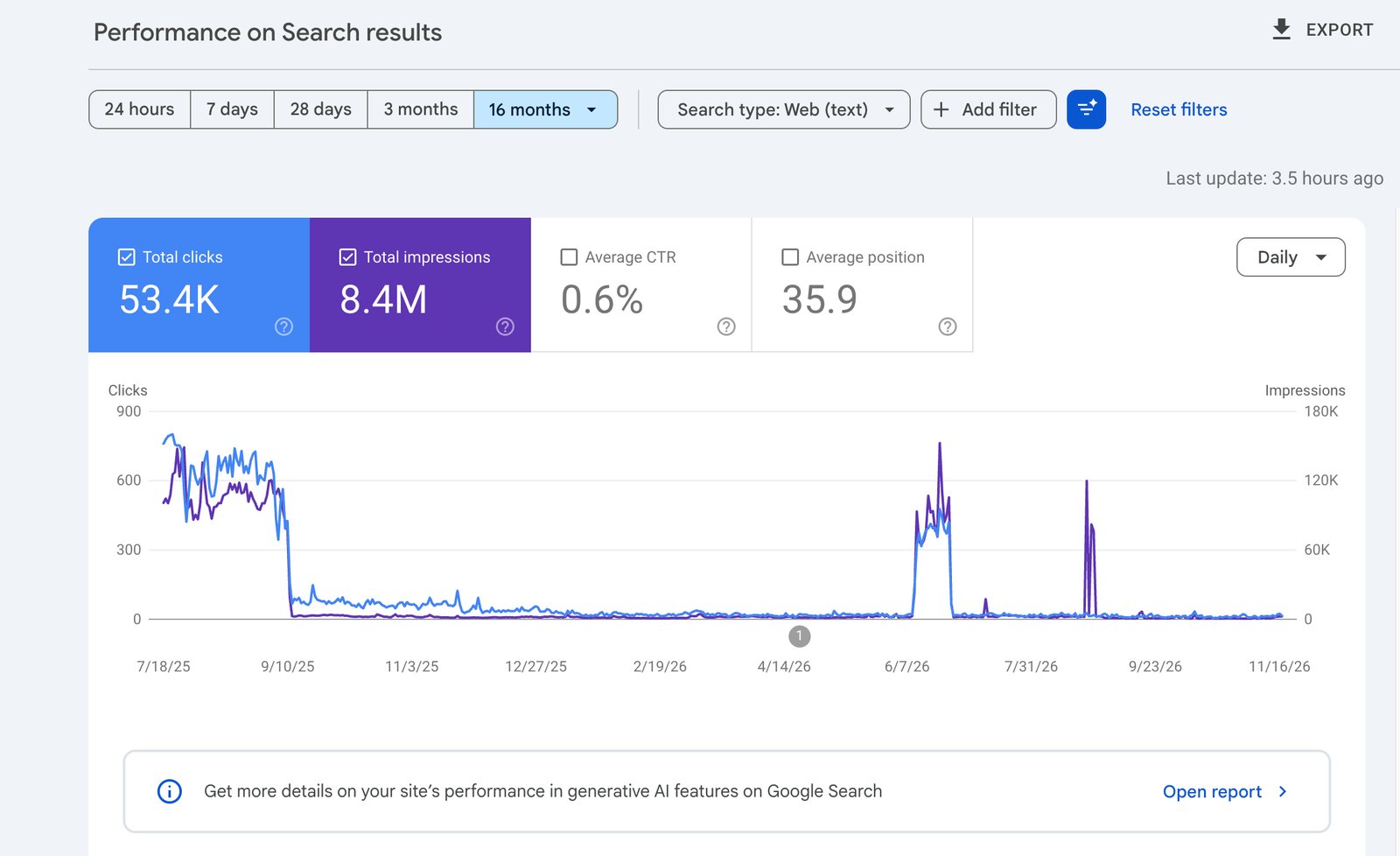
Site A is a multi niche publisher that covers technology, business and lifestyle. Its owner shared 16 months of Search Console data, from July 18, 2025 to November 17, 2026, for this analysis. Over that period it recorded 53,400 clicks and 8.4 million impressions. Most of that came in the first seven weeks.
What happened, phase by phase
| Period | Average clicks per day | Average impressions per day |
|---|---|---|
| Jul 18 to Aug 25, 2025 (before spam update) | 666 | 109,500 |
| Aug 26 to Sep 9, 2025 (spam update rolling) | 584 | 103,800 |
| Sep 10 to Sep 30, 2025 (collapse) | 101 | 7,400 |
| Oct 1 to Dec 10, 2025 | 61 | 2,200 |
| Dec 11, 2025 to Mar 31, 2026 | 26 | 1,700 |
| Apr 1 to May 31, 2026 | 18 | 1,900 |
| Jun 10 to Jun 25, 2026 (brief return) | About 370 | About 85,000 |
| Aug 16 to Nov 17, 2026 | 13 | 4,300 |
The first strike. Clicks began sliding on September 5, 2025, ten days into the August 2025 spam update. Then on September 11 and 12 they fell off a cliff, from 426 to 67 a day. Impressions dropped 98 percent in the same two days. Part of that impression loss was the &num=100 reporting change, which landed on exactly those dates. But clicks are real people, and an 85 percent click drop is not a reporting artifact. The overlap makes the spam update a hypothesis to investigate, not a proven cause of the click loss.
The false dawn. On June 10, 2026, eight days after the May 2026 core update finished, traffic suddenly returned to about 370 clicks a day for two weeks. On June 26, the last day of the June 2026 spam update, traffic fell sharply again. The supplied HTML and handoff disagree on the exact June 26 total, so it is not reproduced here. Timing alone does not establish why the pages lost traffic.
The ghost impressions. On August 24, 26 and 27, 2026, impressions jumped to between 76,000 and 120,000 a day with almost no clicks and an average position near the top. Query, page and search-appearance breakdowns would be needed to identify the source of those impressions. It brought no recovery.
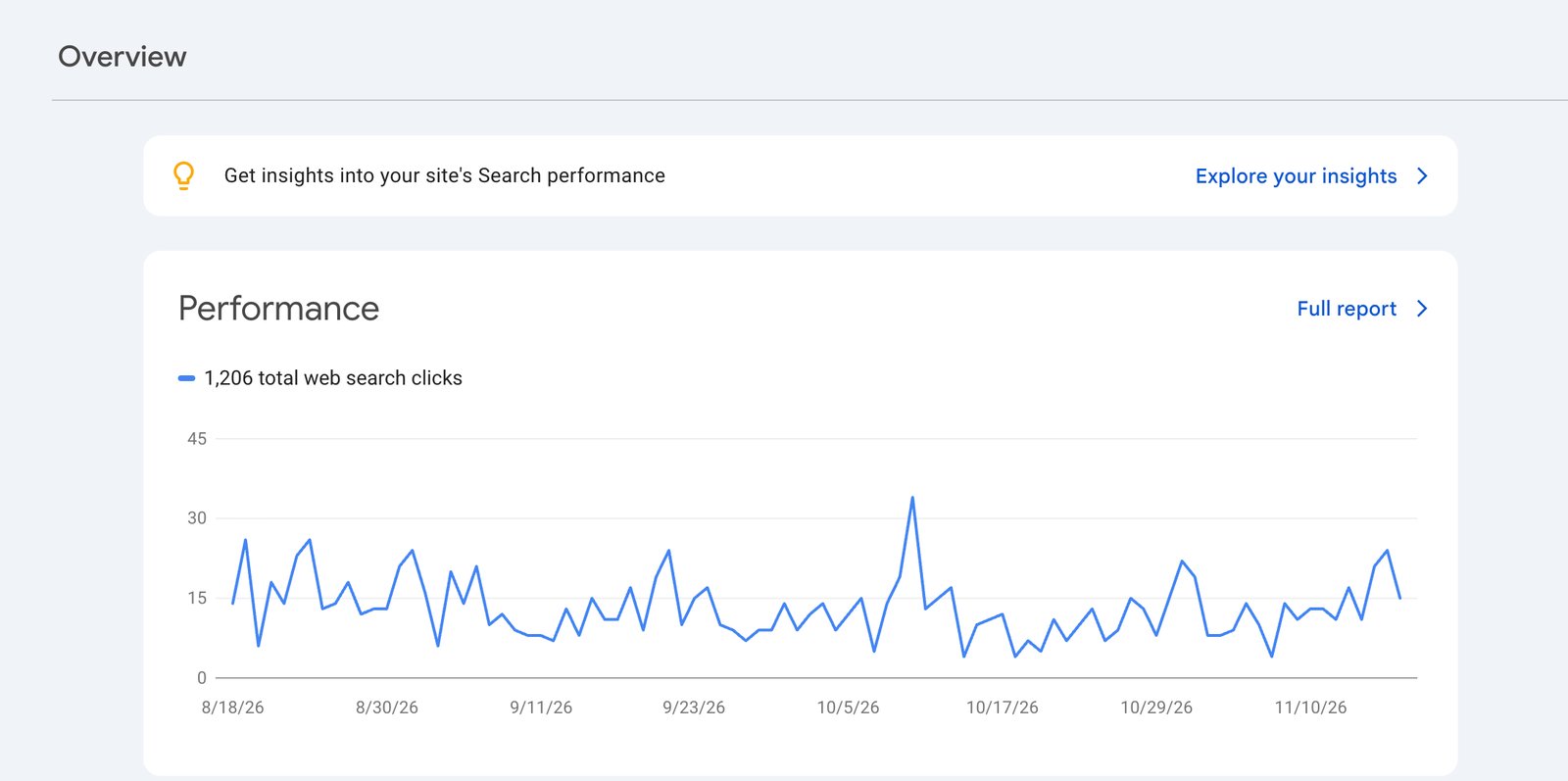
The recent three months show what a site looks like after the damage settles. There are no new crashes, only a flat line between 5 and 30 clicks a day. The November 2026 core update had not changed that by the time of writing.
Why it happened
The page level data explains more than the timeline does. At its peak, Site A depended on a handful of URLs:
- One page earned 29 percent of all clicks in the 16 months.
- The top five pages earned 51 percent, and the top ten earned 63 percent.
- About 48 percent of all clicks went to pages chasing celebrity leak, adult adjacent and gossip queries. Those topics had nothing to do with the site’s core subjects.
The concentration and topic mix justify an editorial review, but they do not prove that Google classified the site as spam or applied a sitewide loss of trust. Search Console totals cannot distinguish a specific algorithmic cause. Review page quality, technical changes, indexing, query demand and competing results alongside the update timeline.
The owner’s recovery plan is a sensible one. It has three parts: a full audit of nearly 1,000 URLs, removal or rework of the off topic pages, and a pause on new publishing until the remaining content forms clear topic clusters. Recovery from a spam related demotion is slow. Google’s own documentation says improvements can take months to register, without guaranteeing recovery or requiring a particular announced core update.
Case Studies 2 to 4: Three Other Ways Sites Went Down
Site A is one pattern. Public data shows at least three others. The sites are not named here, but the figures come from the reporting cited.
Case 2: The forums that grew too fast (March 2025)
Two niche hobby forums had grown more than 1,000 percent in a year on the back of Google’s push for forum content. The March 2025 core update reversed much of that growth while Reddit kept its gains. Lesson: a traffic boost from a change in Google’s preferences can be taken away by the next change. Build the community, not just the indexable threads.
Case 3: The regional news site that lost half its visibility (December 2025)
A UK regional news publisher dropped by almost 50 percent in search visibility during the December 2025 core update. More than two thirds of major UK news sites lost ground at the same time. Lesson: even real journalism is not safe when it competes with larger brands on the same national stories. Local depth and original reporting are the parts no one else can copy.
Case 4: The product review section on a big news brand (site reputation abuse)
Product review and coupon sections hosted on major news domains became the main targets of Google’s site reputation abuse policy. Traffic to one well known news brand’s shopping section fell 25 percent year over year in January 2025, according to The Wall Street Journal. That policy is now under EU investigation. Lesson: a strong domain does not protect content that has nothing to do with what the domain is known for. This is the same lesson as Site A, at a bigger scale.
Where Blogging, Media and Search Stand in November 2026
Independent blogs. The blog that picked keywords from a tool, wrote 1,500 general words and waited for Google is finished as a business model. What survives are blogs with a real person or team behind them, a narrow subject and something only they can say: test results, local knowledge, real cases. Those still rank, and they get cited in AI answers.
Media companies. Large publishers lost less search traffic than small ones, but they are fighting on two fronts at once: the AI answer page and the site reputation abuse policy. Their shift is visible. Direct readers, newsletters, apps and memberships are being built to replace what search no longer sends.
Search itself. Google Search in late 2026 is a hybrid. The ranked list still exists and still decides which sources the AI layer trusts. Ranking well is no longer the goal on its own. It is the ticket into the answer. A page that ranks is likely to be cited, and a page that is cited may or may not be clicked.
Google’s rule enforcement. 2026 showed a faster, more automated spam system. Some announced rollouts have finished in hours; this does not establish when individual ranking decisions were made. Expect spam enforcement to keep arriving with little warning and no named target.
What to Do Now: A Survival Plan for Publishers
Step 1: Diagnose before you touch anything
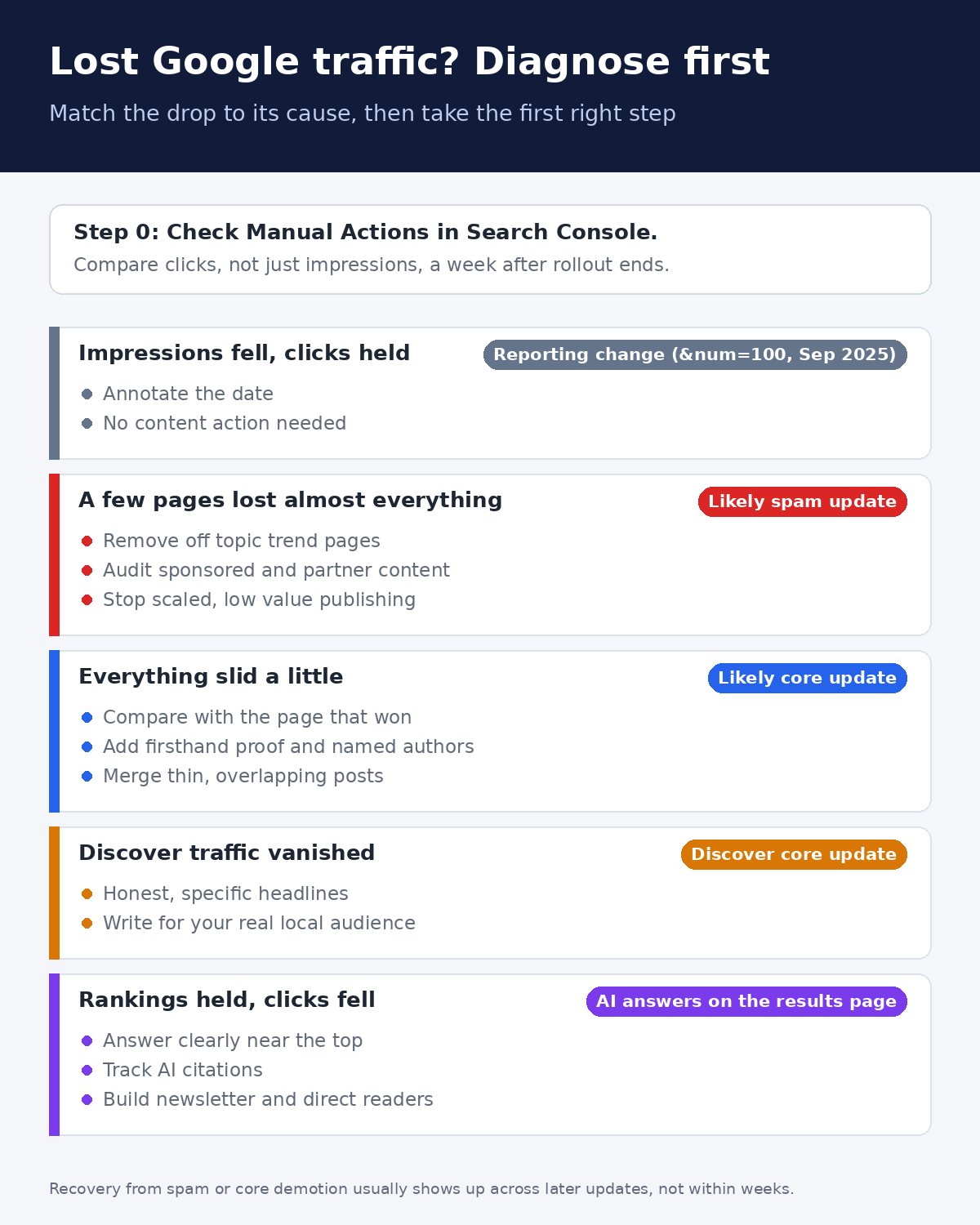
- Check the Manual Actions report in Search Console first. A manual penalty needs a different fix.
- Compare your clicks, not just impressions, with the update dates above. Remember that mid September 2025 impression drops were partly a reporting change.
- Wait about a week after Google marks an update complete, then compare the week after with the week before it started.
- Split your losses by page. Check whether losses are concentrated in a page type or spread across the site. Neither pattern proves a specific algorithmic cause; also check technical failures, demand and competitors.
Step 2: If a spam update hit you
- Remove or rewrite pages that exist only to catch traffic outside your expertise, even if they once earned the most clicks.
- Audit sponsored, guest and partner content. Keep it close to your main topics, label it clearly and use the right link attributes.
- Stop any scaled publishing, with AI help or without, that adds no original value.
- Be patient. Spam demotions often lift only after a later update, and only if the cause is truly gone.
Step 3: If a core update hit you
- Compare your page with the page that replaced it. Write down specifically what the winner offers that yours does not.
- Add what only you can add: your tests, your photos, your data, your local knowledge, named authors with real profiles.
- Merge thin, overlapping posts into fewer, stronger pages. Our technical SEO audit checklist covers the crawl and indexing side of that cleanup.
Step 4: If Discover is your problem
- Drop curiosity bait headlines. Write the headline that tells the reader what they will get.
- Lean into the audience you actually serve. The 2026 Discover update favors local relevance.
Step 5: Build for the answer engine and for people who come back
- Answer the main question clearly near the top of the page, then go deeper. AI systems quote clear answers, and people trust them.
- Track whether you are cited in AI Overviews and AI Mode, not only where you rank.
- Turn search visitors into direct readers through a newsletter, an app, a community or a reason to bookmark you. A reader who returns on their own cannot be taken away by an update.
The Final Word
The Google algorithm updates of 2025 and 2026 did not invent new rules. They enforced old ones faster and harder, while the AI results page shrank the reward for following them. The sites that disappeared mostly had one thing in common: their traffic came from Google, not from readers who cared about them. The sites still standing have a real subject, a real voice and an audience that would look for them even if Google changed again tomorrow. Google will change again. The November 2026 core update is still rolling out as this is written. Build something that can survive the next one.
Frequently Asked Questions
How many Google updates were there from 2025 to November 2026?
Google confirmed six broad core updates (March, June and December 2025; March, May and November 2026), one Discover core update (February 2026) and five spam updates (August 2025; March, June, August and September 2026). That does not count unannounced changes, AI model swaps or the &num=100 removal.
Can a site recover from a Google spam update?
Yes, but slowly, and only after the cause is removed. Recovery usually shows up across later updates, not within weeks.
Is Google removing AI Overviews?
There is no sign of it. Google moved AI Overviews to Gemini 3 in January 2026, links them into AI Mode, and brought Gemini 4 Hydrogen to Search for all users on November 12, 2026.
Why did my impressions crash in September 2025 while clicks did not?
Most likely because Google stopped supporting the &num=100 parameter around September 10 to 12, 2025. That removed bot generated impressions from Search Console.